A marketing funnel — also called a brand funnel or sales funnel — measures how well your brand moves consumers from awareness through to loyalty. From a strategic view, it tells you exactly where you’re losing people and why. The ratios between each stage are where the real insight lives. Get those right, and your brand funnel becomes one of the most powerful diagnostic tools in your marketing toolkit.
Importantly, we use the brand funnel analysis to determine where your brand sits on the brand love curve, which outlines how consumers build a bond with a brand as they move through five stages: unknown, indifferent, like it, love it, and beloved.
Our brand love curve sets up the brand strategy of where to go next. First, indifferent brands have very narrow brand funnels with low awareness, low purchase volume, and negligible repeat purchase and loyalty. Second, brands that are liked but not loved have high awareness and sales. Without an emotional connection, they almost have no loyalty. Then, brands at the loved or beloved stage have the most robust brand funnels, with strong awareness, purchase, repeat, and loyalty scores. Above all, this analysis should be part of our deep-dive business review and can be used to set up your marketing plan decisions.
What Is a Marketing Funnel?
Every brand should understand the details of its brand funnel. It’s one of the best tools for measuring your brand’s underlying health. It explains your consumer’s purchase journey. It is the equivalent of knowing your blood pressure or cholesterol scores.
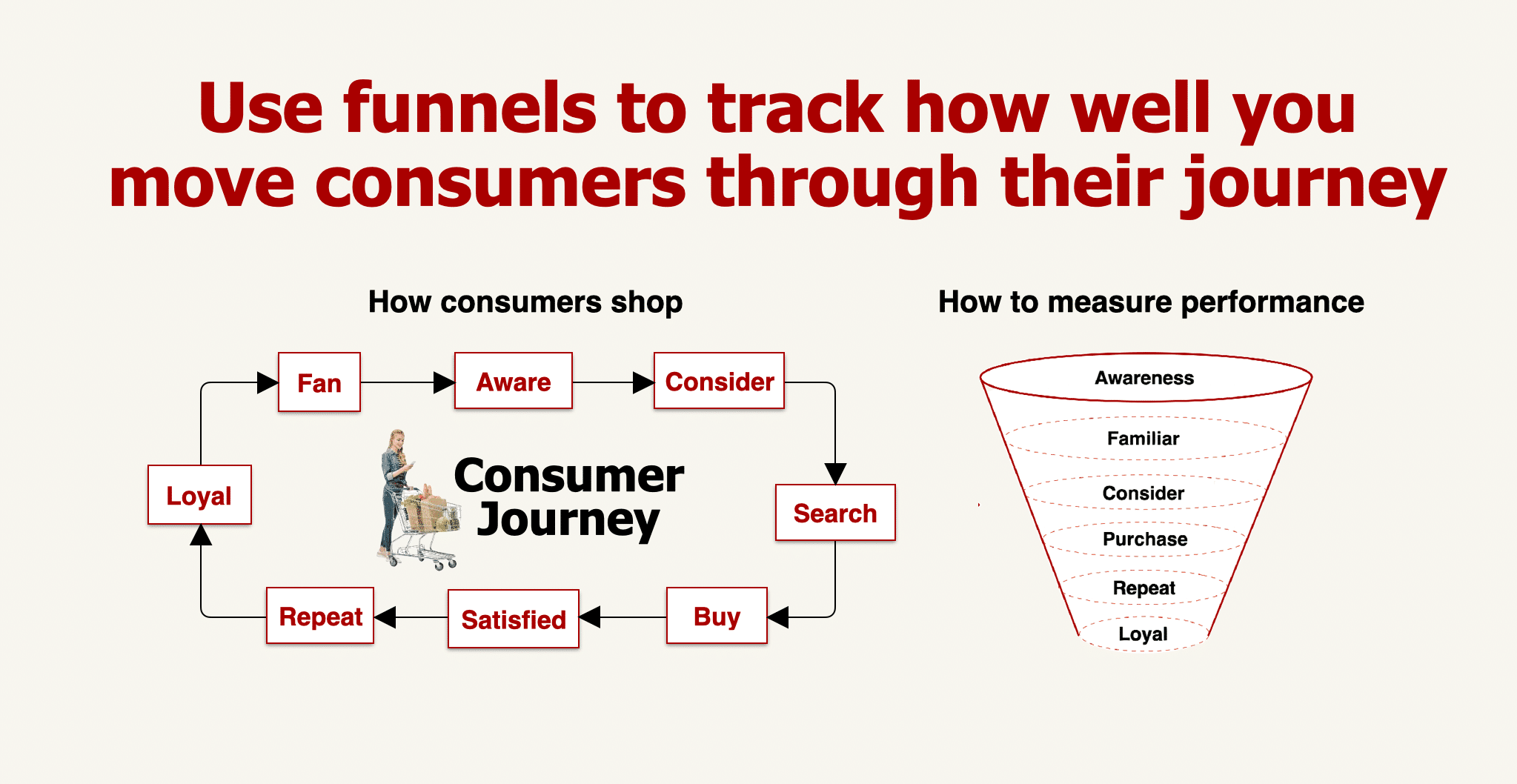
A classic sales funnel replicates the purchase journey and measures awareness, familiarity, consideration, purchase, repeat, and loyalty. At the very least, you should measure awareness, purchase, and repeat. It is not just about understanding the absolute scores on the funnel. You need to understand the ratios that explain how good of a job you do in moving consumers from one stage of the funnel to the next.
I will show you how the robustness of your brand’s sales funnel explains where your brand sits on our brand love curve. As a rule, the broader the sales funnel, the better connected your brand is with consumers.
Marketing Funnel vs. Brand Funnel vs. Sales Funnel
These three terms get used interchangeably, and most of the time that’s fine. But understanding the subtle differences helps you use the right lens for the right problem.
What is a sales funnel?
A sales funnel focuses on conversion. It starts the moment a prospect shows interest and ends when they make a purchase. Sales teams use it to manage pipeline — moving leads from initial contact through qualification, proposal, and close. The sales funnel is transactional by nature. It answers one question: Are we closing?
What is a marketing funnel?
A marketing funnel is broader. It starts before the sale — at the moment a consumer first becomes aware of your brand — and extends beyond it, through repeat purchase and loyalty. Marketing teams use it to understand how their activity is moving consumers at every stage of the journey, not just at the point of purchase. The marketing funnel answers a bigger question: Are we building a business?
What is a brand funnel?
A brand funnel is a marketing funnel viewed through a brand health lens. The stages are the same — awareness, familiarity, consideration, purchase, repeat, loyalty — but the emphasis is on the depth of consumer connection at each stage, not just the volume. A brand funnel tells you whether consumers are moving through the journey because they genuinely prefer your brand, or simply because you were available and priced right. That distinction matters enormously for long-term growth.
Which one should brand managers use?
All three have their place, but the brand funnel is the most strategic tool for brand managers. It connects your marketing performance to brand health, links directly to your brand love curve, and gives you the diagnostic clarity to set strategy — not just measure activity. When you analyze your brand funnel ratios and compare them against a key competitor, you stop guessing about where to focus and start making decisions based on evidence.
The sales funnel tells you if you closed. The marketing funnel tells you how you got there. The brand funnel tells you whether it will keep happening.
Marketing Funnel Analysis — Using Absolute Scores
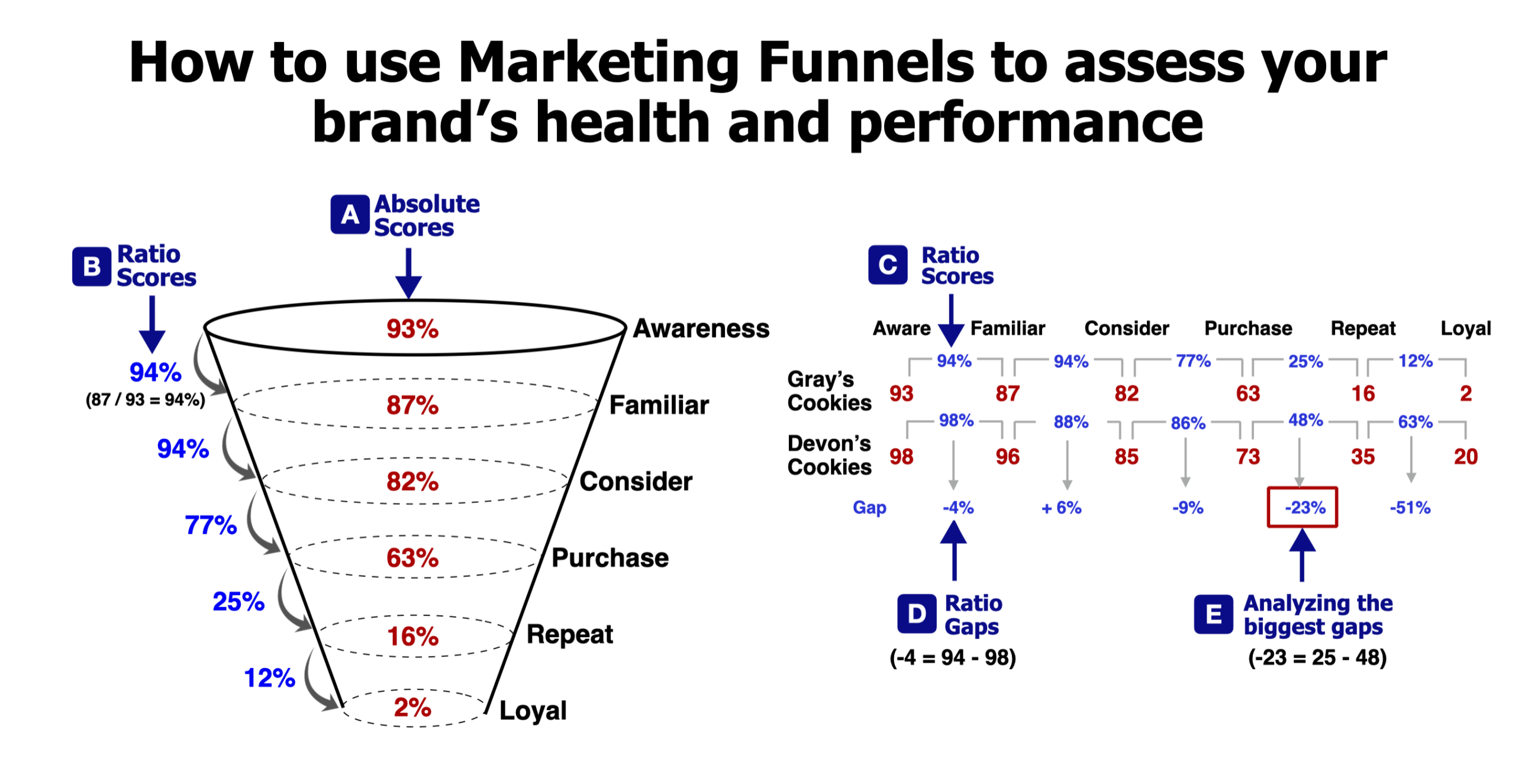
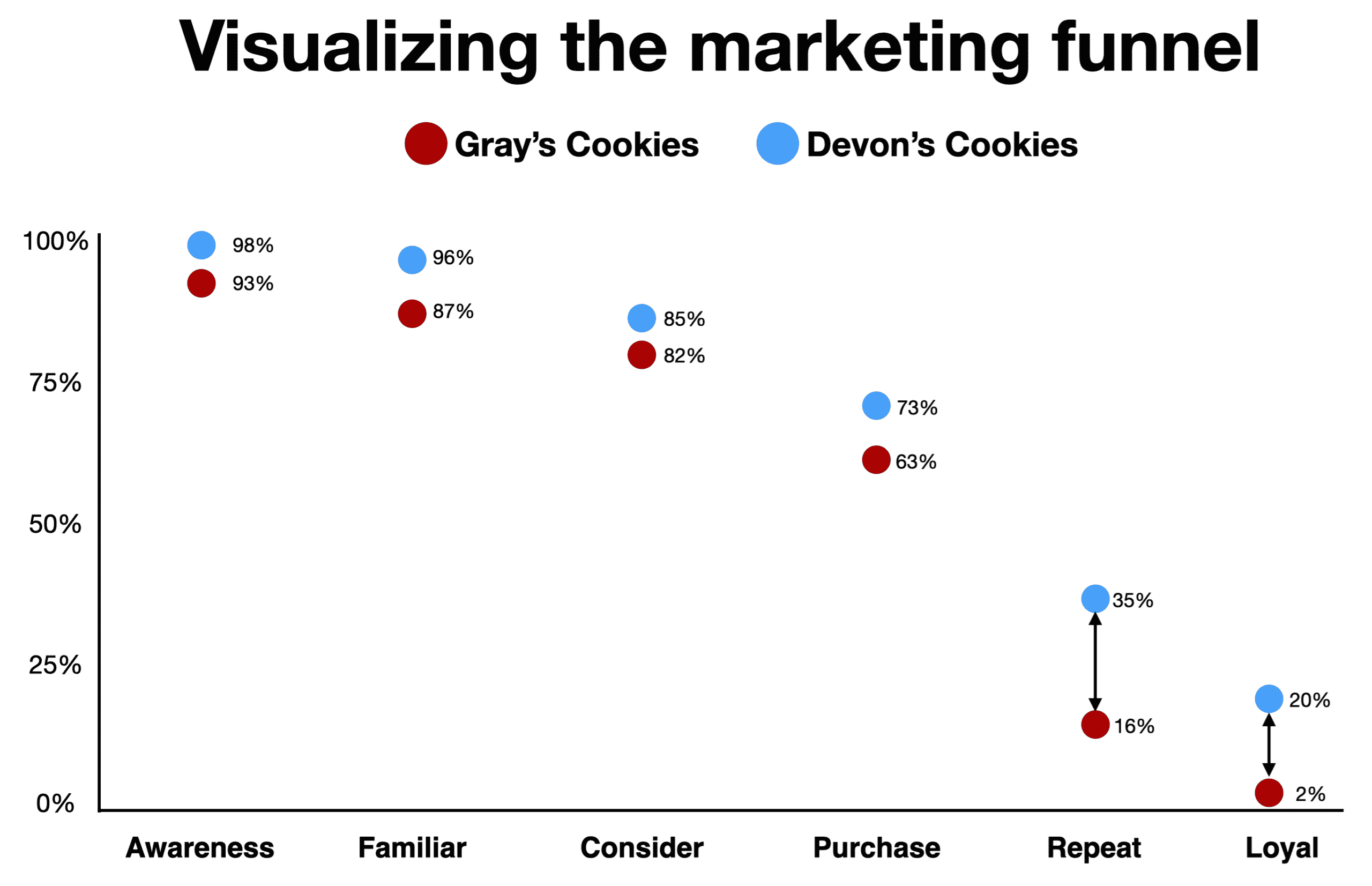
- A: On the sales funnel chart above, the first thing to do is look at the absolute marketing funnel scores. You can do many types of comparisons, whether you compare to last year, competitors, or category norms. Then, look at the sales funnel ratios, which is the percentage score for how well your brand can convert consumers from one stage of their purchase journey to the next. To create ratios, divide the absolute score by the score above it on the funnel. In the example above, divide the familiar score of 87% by the awareness score of 93% to determine a conversion ratio of 94%. This means 94% of aware consumers are familiar
- B: Then, on the next chart, lay out the absolute scores and ratios horizontally to allow a comparison. You will notice these are the same scores as “A” and “B” in the previous chart. The crucial numbers for Gray’s Cookies are the ratios of 94%, 94%, 77%, 25%, and 12% at the top of the chart. Then, bring in a close competitor (Devon’s) with their absolute and ratio scores to allow a direct comparison.
Marketing Funnel Analysis — Why Ratios Matter More
- C: Above, find the ratio gaps by subtracting the competitor’s ratio scores from your brand’s ratio scores. In the example, the first ratio gap is -4% ratio gap (94% – 98%). Clearly, this means Devon’s does a 7% better job in converting consumers from awareness to familiarity than Gray’s Cookies.
- D: Next, as you create ratio gaps along the bottom, you can see where your ratio is either stronger or weaker than the comparison brand. Essentially, these ratios show how well you can move your consumers along their purchase journey.
- E: Finally, start analyzing the significant gaps between the two brands and tell a strategic story to explain each gap. Looking at the example, you can see Gray’s and Devon’s have similar scores at the top part of the funnel, but Gray’s starts to show real weakness (-23% and -51% gap) as consumers move along their purchase journey from repeat to loyalty. You need to address and fix these sales funnel gaps with your brand plan.
How Your Brand Funnel Connects to the Brand Love Curve
It takes a strategic mind to figure out how brand love and the purchase journey move together.
First, for new brands, they are completely “unknown” to consumers. Unless there were genuinely compelling messages, consumers would walk past without even looking. To achieve some success, the priority for these brands is to get noticed within the clutter of the market.
Then, at the “indifferent” stage, consumers feel O.K. about the brand, similar to how they usually feel about commodities, like fruit and vegetables. These brands satisfy the consumer’s basic needs. Consumers will only buy the brand when it is on sale, but switch back to their other brand choice when it is not. Make your brand more than just a commodity. Brands need to be better, different, or cheaper. Otherwise, they will not be around for long, and you waste your investment.
Next, brands that reach the “like it” stage experience the first sign of business success. Their consumers see the brand as a logical, functional, and smart choice. However, the lack of any emotional connection leaves the purchase up to chance. Consumers will still switch brands randomly. Brands at the like it stage stress the product performance so much they forget to trigger any emotions.
As consumers start to love your brand
Importantly, brands at the “love it” stage start to see more emotionally engaged consumers. The rule of love you must follow: Consumers must love the brand before you can tell consumers you love them. Consumers see the brand as a favorite choice, usually connected to a favorite part of their day. They are loyal and build the brand into a routine. These brands must also find a way to demonstrate their love toward consumers and continue to tighten the bond with their most loyal brand lovers.
Finally, brands at the “beloved” stage are where the brand becomes iconic, with a core base of brand lovers who cherish and defend the brand. These consumers see the brand as a personal choice, a badge they proudly hold in their hands or wear on their feet. At the beloved stage, the brands must create magical experiences that inspire brand lovers to share with their friends.
Our brand love curve explains how consumers feel at each stage of their purchase journey
Beloved Brands Marketing Training
To view, use the arrows to see our Beloved Brands Marketing Training program brochure.
It's time to elevate your marketing team's performance with our Beloved Brands Marketing Training program.
Our marketing training makes your marketers smarter with brand analytics, strategic thinking, brand positioning, brand plans, and marketing execution.

Marketing funnel metrics
Matching marketing funnel analysis to the brand love curve
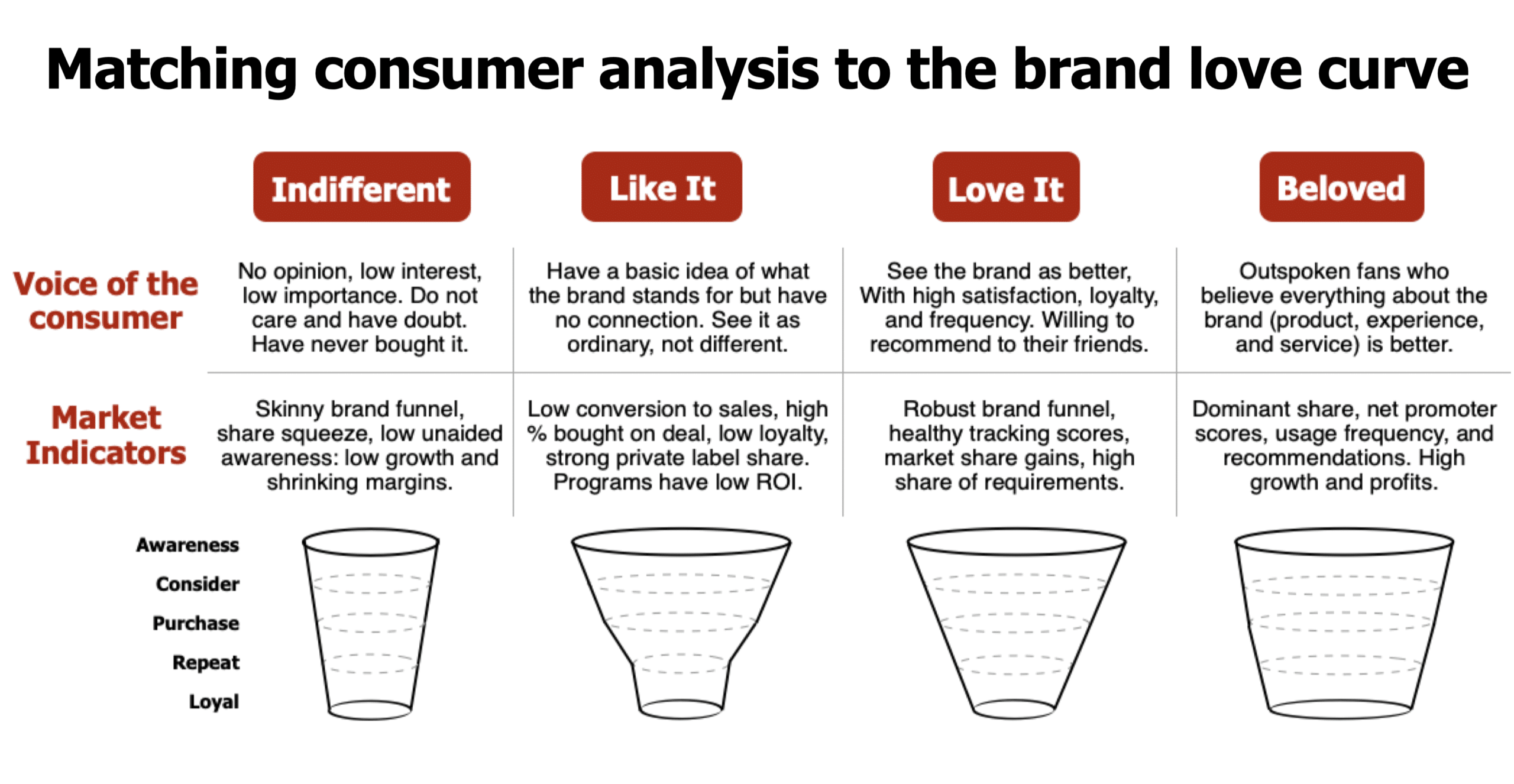
You can begin using your consumer tracking, sales funnel, market share, and the voice of the consumer to help explain where your brand sits on the brand love curve.
First, indifferent brands have skinny sales funnels, starting with inferior awareness scores. Consumers have little to no opinion. Concerning performance, you will see low sales and poor margins. Your brand plan for indifferent brands should increase awareness and consideration to kickstart the consumer’s purchase journey.
Next, the like it brands have sales funnels that are solid at the top but quickly narrow at the purchase stage. Consumers see these brands as ordinary and purchase only on a deal. When they are not advertised or on sale, sales fall off dramatically. These brands need to close potential leaks to build a loyal following behind happy experiences.
Then, the love it brands have a reasonably robust sales funnel but may have a smaller leak at loyal. They have stronger growth and margins. Look for ways to feed the love at various stages of the consumer’s purchase journey turn repeat purchases into a ritual or routine.
Finally, beloved brands have the most robust brand funnels and positive consumer views. These brands should continuously track their funnel and attack any weaknesses before competitors exploit them. Also, it is time to leverage that brand love to influence others.
How to Use Your Brand Funnel to Set Strategy
Five major brand strategies help move your brand from one stage of the brand love curve to the next.
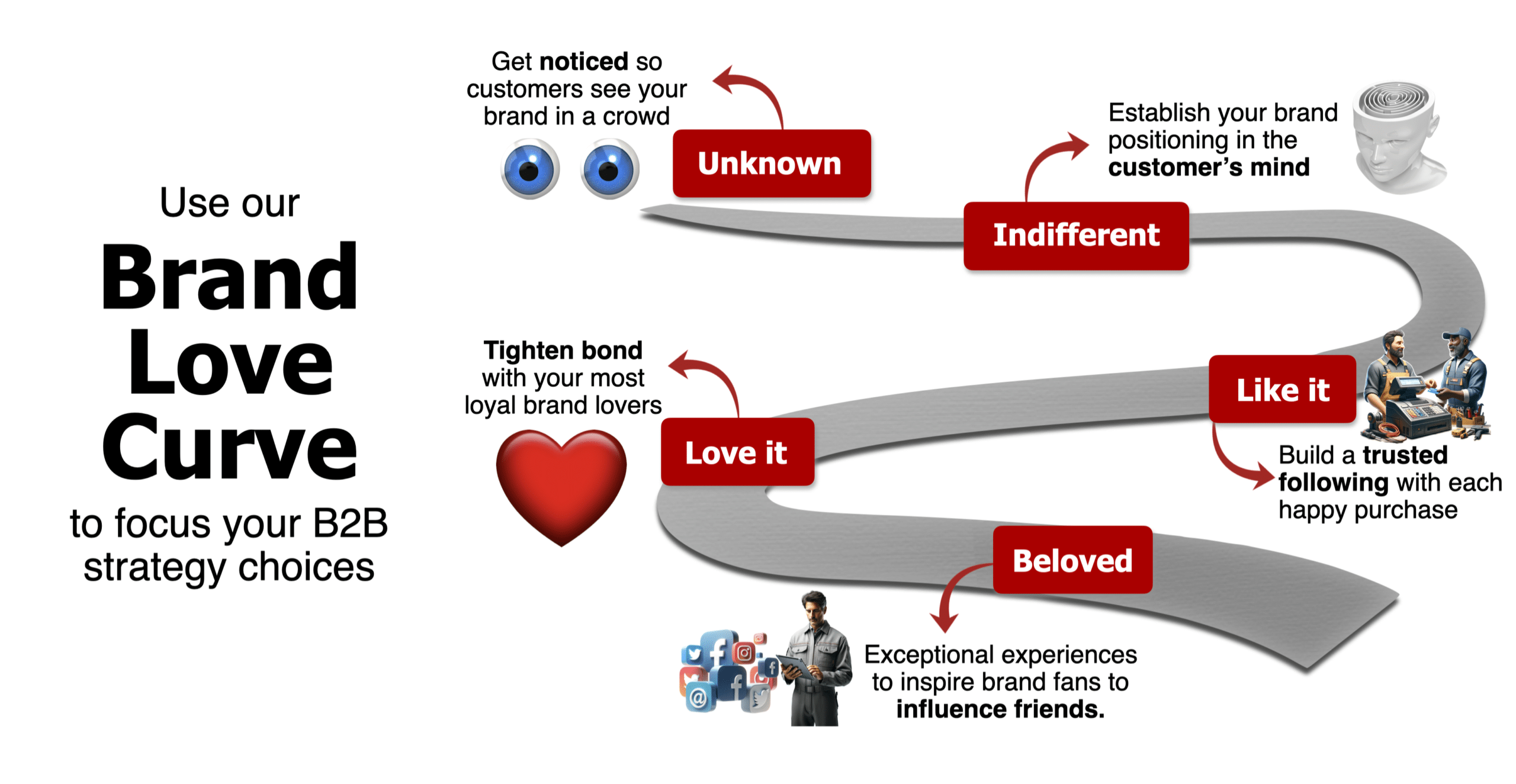
Your consumer strategy should change at each Brand Love Curve stage. For the unknown stage, a brand should focus on getting noticed. At the indifferent stage, focus on establishing the brand in the consumer’s mind. Then, at the like it stage, create reliable experiences. At the love it stage, focus on the connection with consumers. Finally, at the Beloved Stage, try to get your most loyal consumers to speak out or show the brand to others.
Frequently Asked Questions - Marketing Funnel, Brand Funnel, Sales Funnel
What is a marketing funnel?
A marketing funnel is a framework that maps the consumer journey from first awareness of a brand through to repeat purchase and loyalty. It’s called a funnel because the number of consumers narrows at each stage — many people are aware, fewer consider, fewer still purchase, and fewer yet become loyal. The job of a brand manager is to understand where consumers are dropping off and why.
What is the difference between a marketing funnel, a brand funnel, and a sales funnel?
All three describe the same consumer journey but from different perspectives. A sales funnel focuses on converting leads into buyers — it’s typically used by sales teams and measures pipeline stages. A marketing funnel is broader, covering awareness through loyalty, and focuses on how marketing activity moves consumers at each stage. A brand funnel is the same as a marketing funnel but viewed through a brand health lens — it measures how deeply consumers are connected to your brand, not just whether they bought. For brand managers, the brand funnel is the most useful of the three.
What are the stages of a marketing funnel?
The stages of a marketing funnel typically include awareness, familiarity, consideration, purchase, repeat, and loyalty. At a minimum, every brand should track awareness, purchase, and repeat. The absolute scores at each stage matter, but the conversion ratios between stages tell you far more — they show exactly where your brand is losing consumers in their purchase journey.
What is brand funnel analysis?
Brand funnel analysis is the process of examining both the absolute scores and the conversion ratios at each stage of your brand funnel. You compare your ratios against a competitor to find the gaps — where your brand underperforms relative to theirs. Those gaps point directly to your strategic priorities. A brand losing consumers between consideration and purchase has a different problem than one losing them between purchase and repeat.
How do you use a marketing funnel to set a brand strategy?
Start by identifying your biggest ratio gap — the stage where you’re losing the most consumers relative to your competitor. That gap defines your key strategic issue. If your awareness-to-consideration ratio is low, you have a positioning or relevance problem. If your purchase-to-repeat ratio is low, you have a product or experience problem. The marketing funnel doesn’t just measure performance — it tells you where to focus your strategy and your spending.
How often should you update your brand funnel data?
Most brands track their funnel through quarterly consumer tracking studies. The funnel scores themselves don’t shift dramatically month to month — what you’re watching for is directional movement over time and how your ratios compare to key competitors. If you run a major campaign or launch, pull funnel data before and after to measure the impact specifically on awareness and consideration.