The Strategic ThinkBox is a strategic thinking framework for brand strategy that forces you to answer four questions about your brand before you commit to any direction. Most brand strategies fail before they’re written because the team never slowed down long enough to ask the right questions.
I’ve always believed that strategic thinkers see questions before they see solutions. The best strategic thinking conversations I’ve been in over 20 years at Johnson & Johnson, General Mills, and Coca-Cola always started with someone asking an interruptive question that made everyone stop and think before they acted.
The Strategic ThinkBox forces you to answer four questions — core strength, consumer bond, competitive situation, and business situation — before you write a brand strategy. Each answer changes the strategy you should be running. This page covers all four questions, how they connect, and how to use them to uncover the key issues your brand needs to solve.
What is the Strategic ThinkBox and why does brand strategy need it
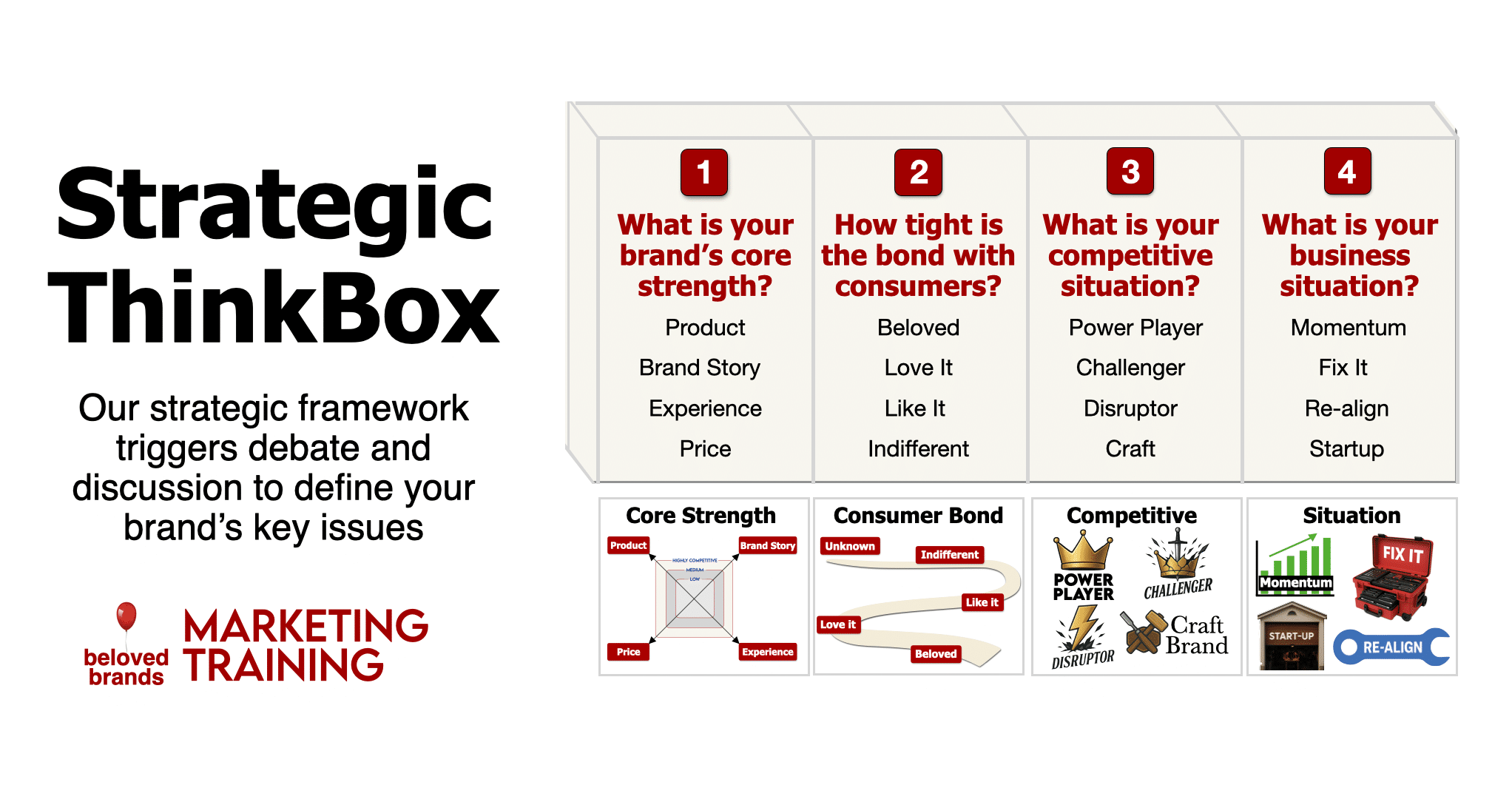
The Strategic ThinkBox is a strategic thinking tool that forces a 360-degree view of your brand situation before you start writing strategy. It asks four questions covering your brand’s core strength, the bond you have with consumers, your competitive position, and your current business situation.
Each question forces a choice between four options.
The discipline of choosing one answer per question — rather than hedging across all four — is what makes the tool useful. A brand that claims four core strengths has none. A brand that can’t clearly name its competitive situation doesn’t have a brand strategy; it has a list of activities.
I borrowed the ThinkBox concept from sports. In golf, a good player uses a ThinkBox before every shot — assessing the lie, the wind, the distance, any hazards in the way — before committing to a shot strategy. Once they step into the PlayBox and address the ball, the strategic thinking is done. The execution takes over. Trying to think strategy during execution is how you hit it into the lake.
Your brand works the same way. Use the Strategic ThinkBox to complete your thinking before you write the plan. Then use the Marketing PlayBox — focusing on target, brand fit, message, and strategy — to execute with clarity and confidence

The four strategic thinking questions in the Strategic ThinkBox
Question 1: What is your brand's core strength?
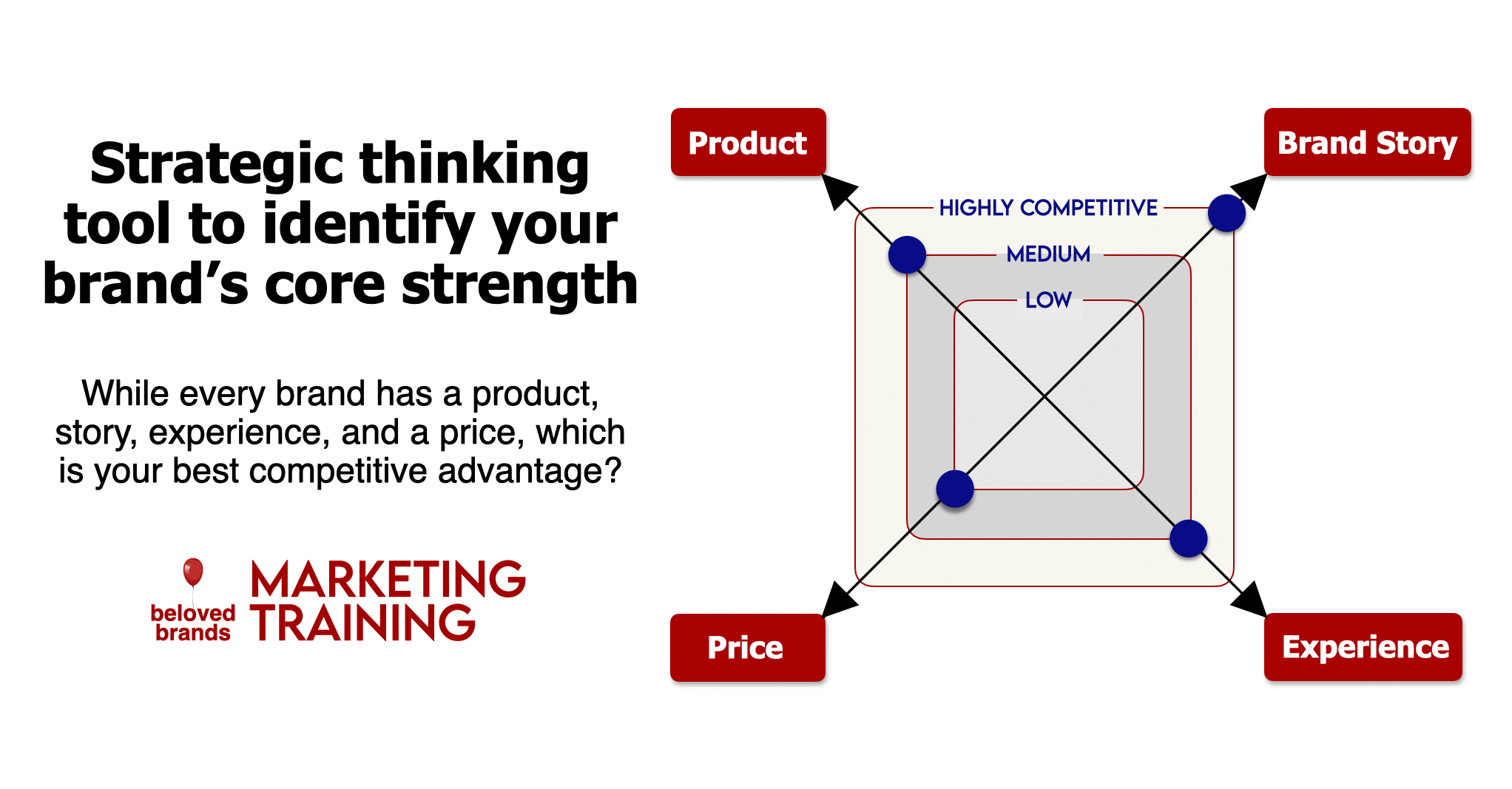
The first question establishes what your brand wins on. There are four options — product, brand story, consumer experience, or price. You choose one as your lead strength, two as supporting strengths, and you accept one as a deliberate weakness.
- Product-led brands win because what they make is genuinely better.
- Story-led brands win because what they stand for connects emotionally with consumers in ways competitors can’t replicate.
- Experience-led brands win because every interaction with the brand delivers something competitors can’t match.
- Price-led brands win because they deliver equivalent quality at a cost competitors can’t sustain.
The choice matters because it determines where you invest, how you communicate, and what you protect when resources get tight. A product-led brand that invests primarily in advertising is misallocating. A story-led brand that cuts advertising to fund product R&D is eroding the thing it actually wins on.
Read the full guide to brand core strength here: beloved-brands.com/core-strength/

Question 2: How tight is the bond with your consumers?
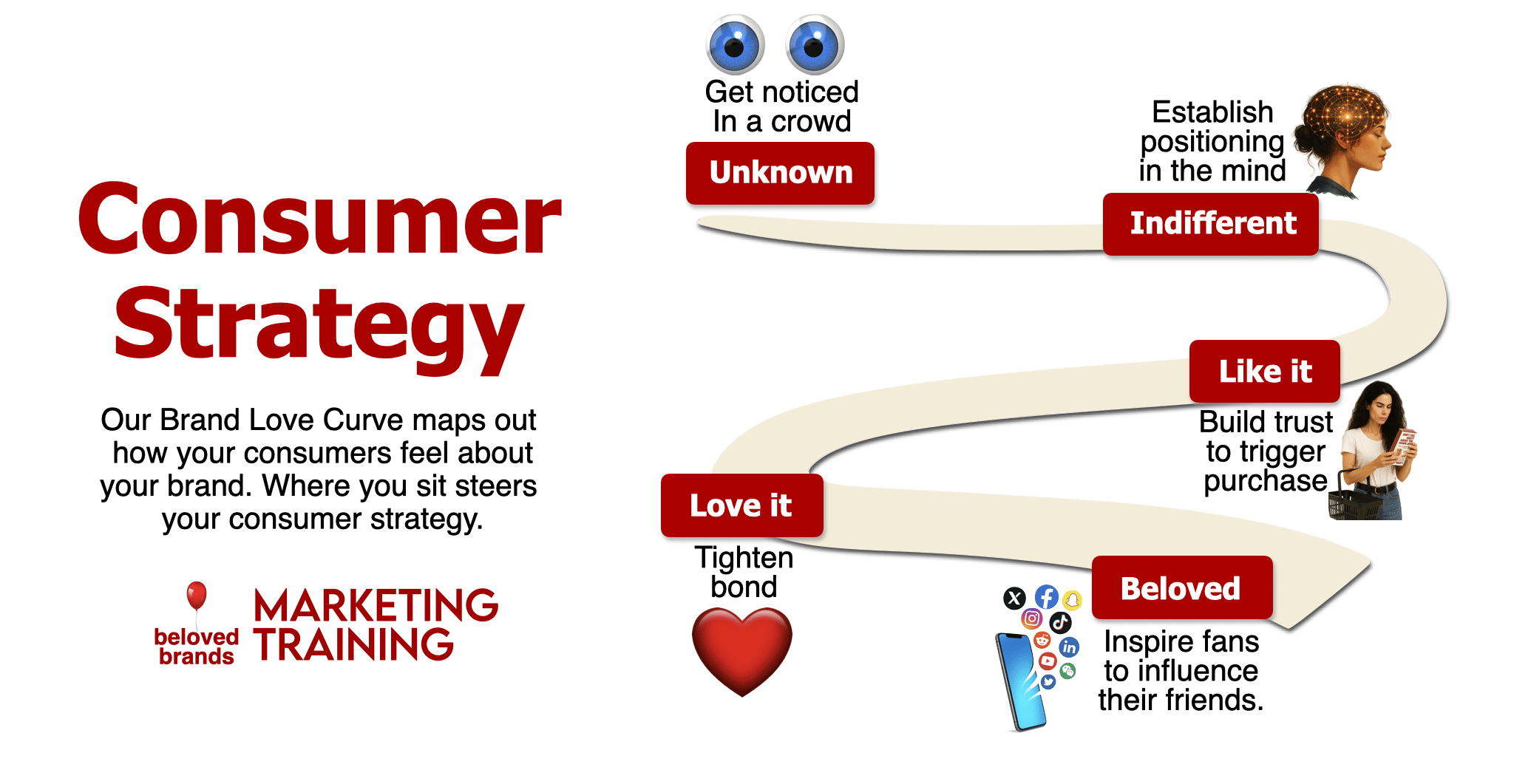
The second question establishes where your brand sits on the Brand Love Curve. The five stages are unknown, indifferent, like it, love it, and beloved. Each stage describes a different consumer relationship and requires a different strategic approach.
- Unknown brands need awareness above everything else.
- Indifferent brands need a clear point of difference.
- Like it brands need to move from rational to emotional connection.
- Love it brands need to deepen the bond with their most loyal consumers and protect the experience that earned their trust.
- Beloved brands need to protect what they’ve built while staying relevant enough to keep earning it.
The Brand Love Curve is also a diagnostic tool for investment. A brand at the indifferent stage has no business running brand building advertising — it needs to establish a reason to exist first. A beloved brand that cuts its marketing investment is spending down brand equity that took years to build.
Read the full guide to consumer strategy here: beloved-brands.com/consumer-strategy/


Question 3: What is your competitive situation?
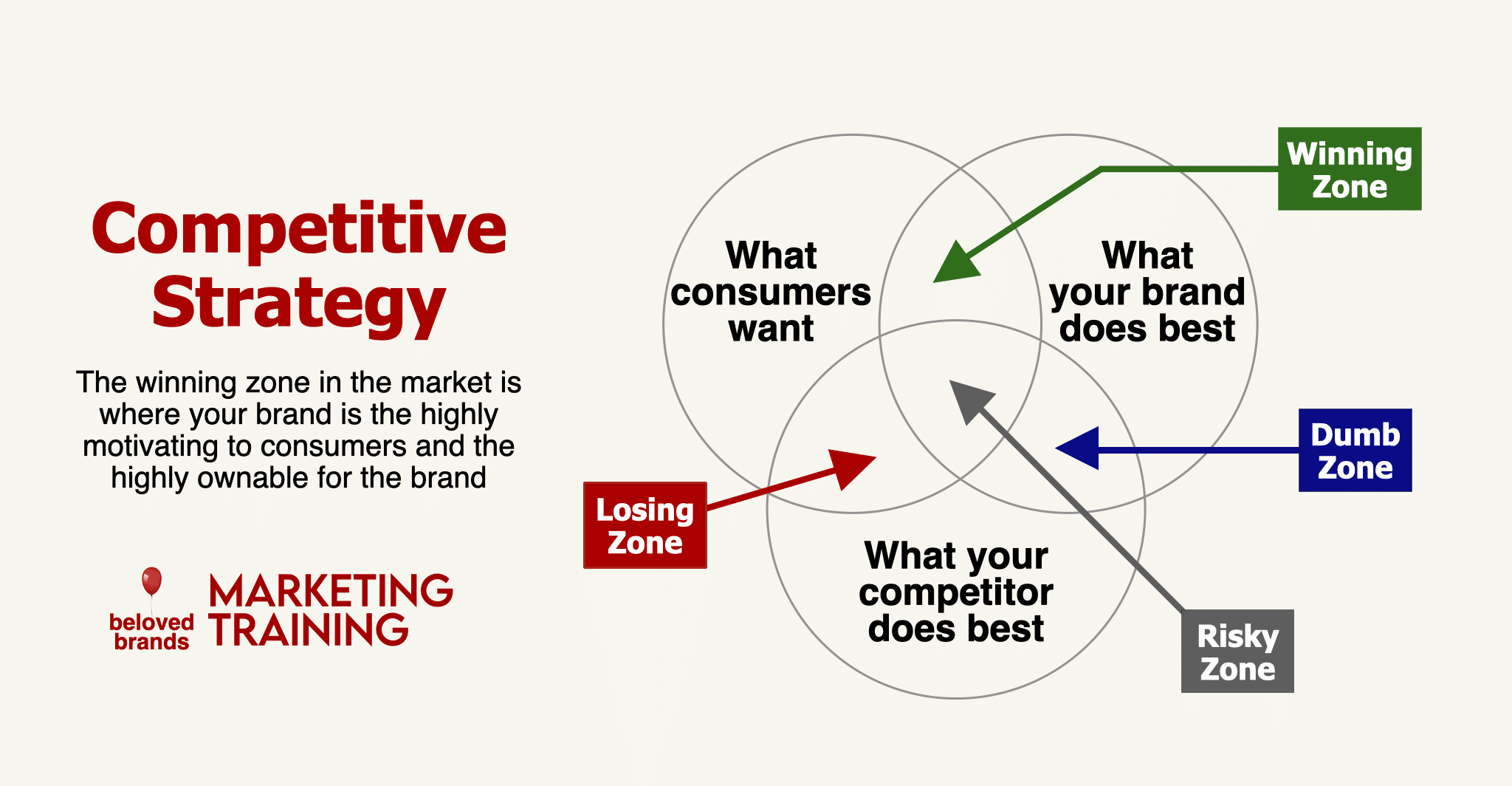
The third question establishes your competitive position. The four options are power player, challenger, disruptor, and craft brand.
- Power players dominate the category through scale, distribution, and consumer familiarity. They compete broadly and defensively.
- Challenger brands have enough presence to compete directly but lack the resources to out-spend the leader — they win by being more relevant to a specific consumer segment.
- Disruptors enter with a fundamentally different proposition and pull consumers away from established brands on new terms.
- Craft brands serve a deliberately small, passionate niche and stay far enough away from the mainstream that power players don’t bother attacking them.
Your competitive situation determines how you allocate investment, which consumers to focus on, and whether your brand strategy should be attacking, defending, disrupting, or deepening. A challenger trying to compete on the power player’s terms almost always loses.
Read the full guide to competitive strategy here: beloved-brands.com/competitive-strategy/
Brand Management Mini MBA
Invest in your future. If you are an ambitious marketer, looking to solidify your marketing skills, our Brand Management Mini MBA will teach you about strategic thinking, brand positioning, brand plans, advertising decisions, and marketing analytics.
Have a look at our brochure on our Mini MBA program
Use > to move through the brochure or x to see the full screen.
You get 36 training videos, key chapters from our Beloved Brands Playbook, and a Brand Management Workbook with exercises to try in real-time. Earn a certificate you can use on your resume or LinkedIn profile.

Question 4: What is your business situation?
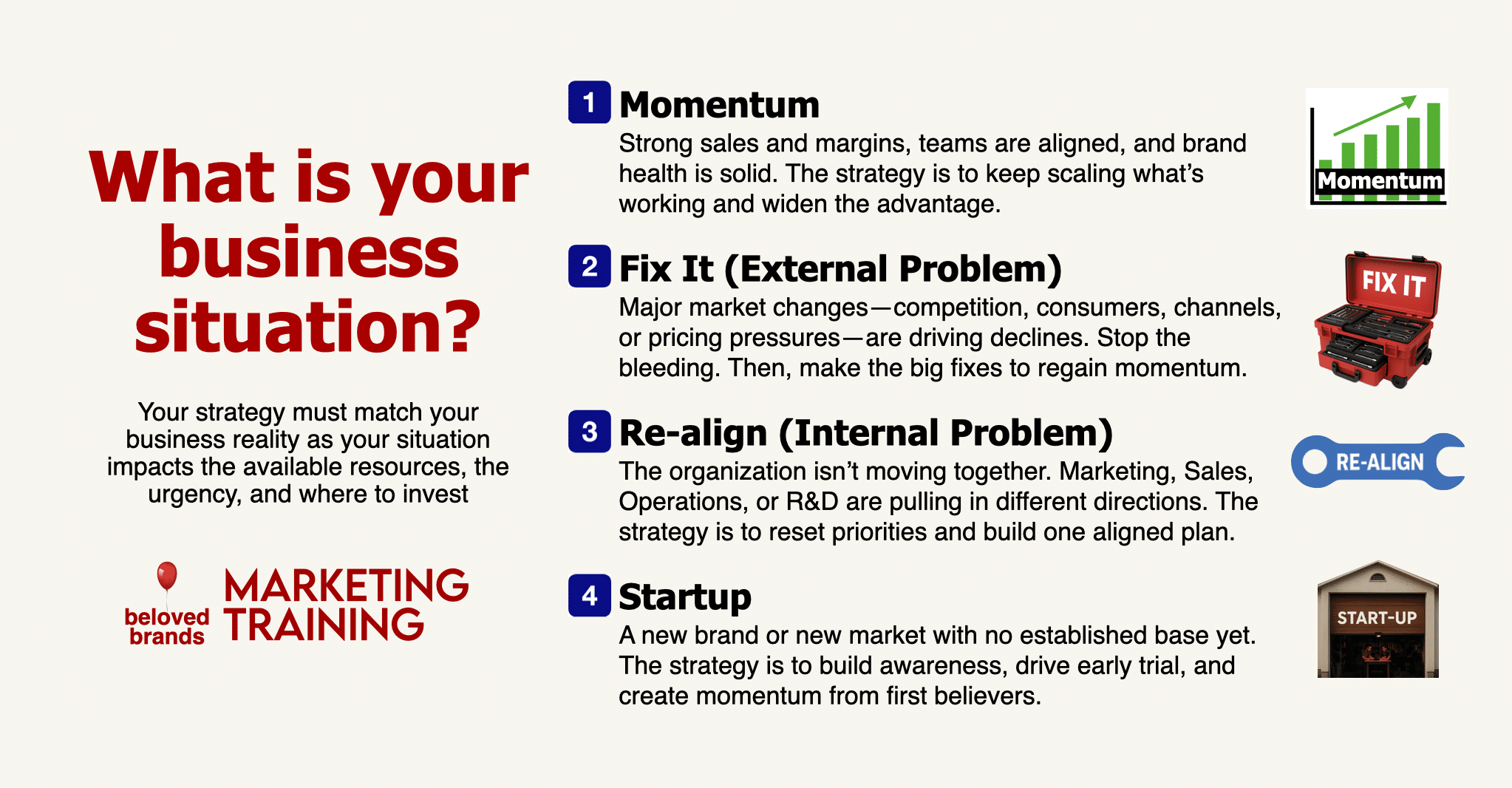
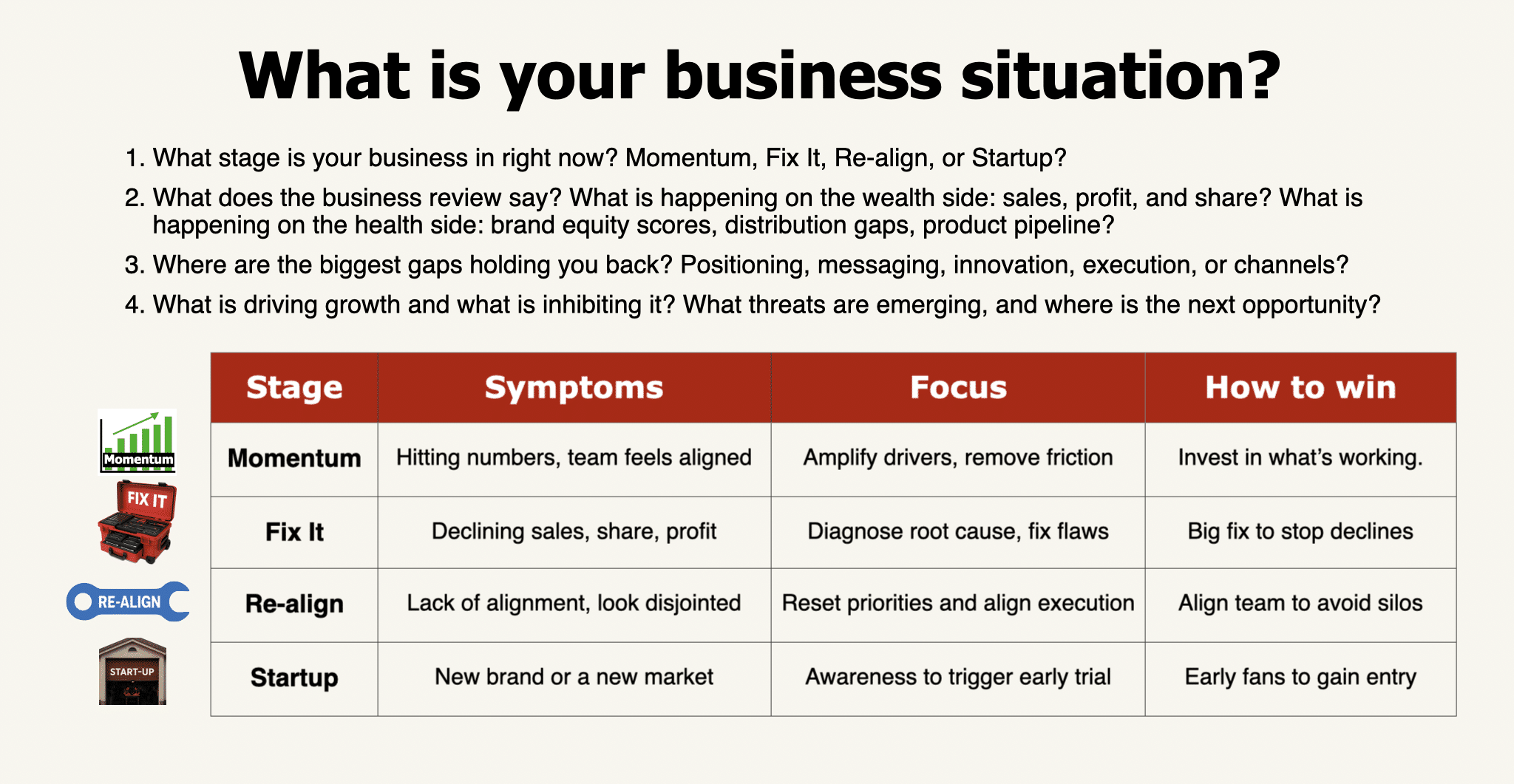
The fourth question grounds everything in the reality of what the business actually demands right now. The four options are momentum, fix it, re-align, and startup.
- Momentum brands are performing well and need to scale what’s working while closing small gaps before they become vulnerabilities.
- Fix it brands are facing external headwinds — competitive attacks, consumer shifts, channel changes — and need to stop the bleeding before rebuilding.
- Re-align brands have an internal problem rather than a market problem — functions are pulling in different directions and the priority is getting everyone moving together before investing in anything new.
- Startup brands have no established base and need to build awareness, drive trial, and earn momentum from first believers.
The business situation determines how much urgency you have, what resources are available, and what kind of leadership the team needs. A momentum strategy applied to a brand in crisis wastes time on growth initiatives when the priority should be stabilization.
Read the full guide to business situation here: beloved-brands.com/business-situation/
How the four strategic thinking questions work together
The real power of the Strategic ThinkBox comes from reading all four answers together, not in isolation.
A story-led brand at the like it stage competing as a challenger in a fix it situation has a very specific brand strategy available to it. The story needs to deepen the emotional connection with the consumer segment most likely to convert to loyalty, while the fix it situation means investment needs to focus on the highest-probability wins rather than broad reach.
A product-led brand at the beloved stage operating as a power player in momentum has a completely different set of priorities — protect the product quality that earned beloved status, invest in category growth, and close any distribution or innovation gaps that could create openings for challengers.
The combinations are almost infinite, but the discipline of working through all four questions before writing a brand strategy ensures you’re building a plan around the actual situation rather than a situation you’d prefer to be in.
How to turn Strategic ThinkBox answers into brand key issues

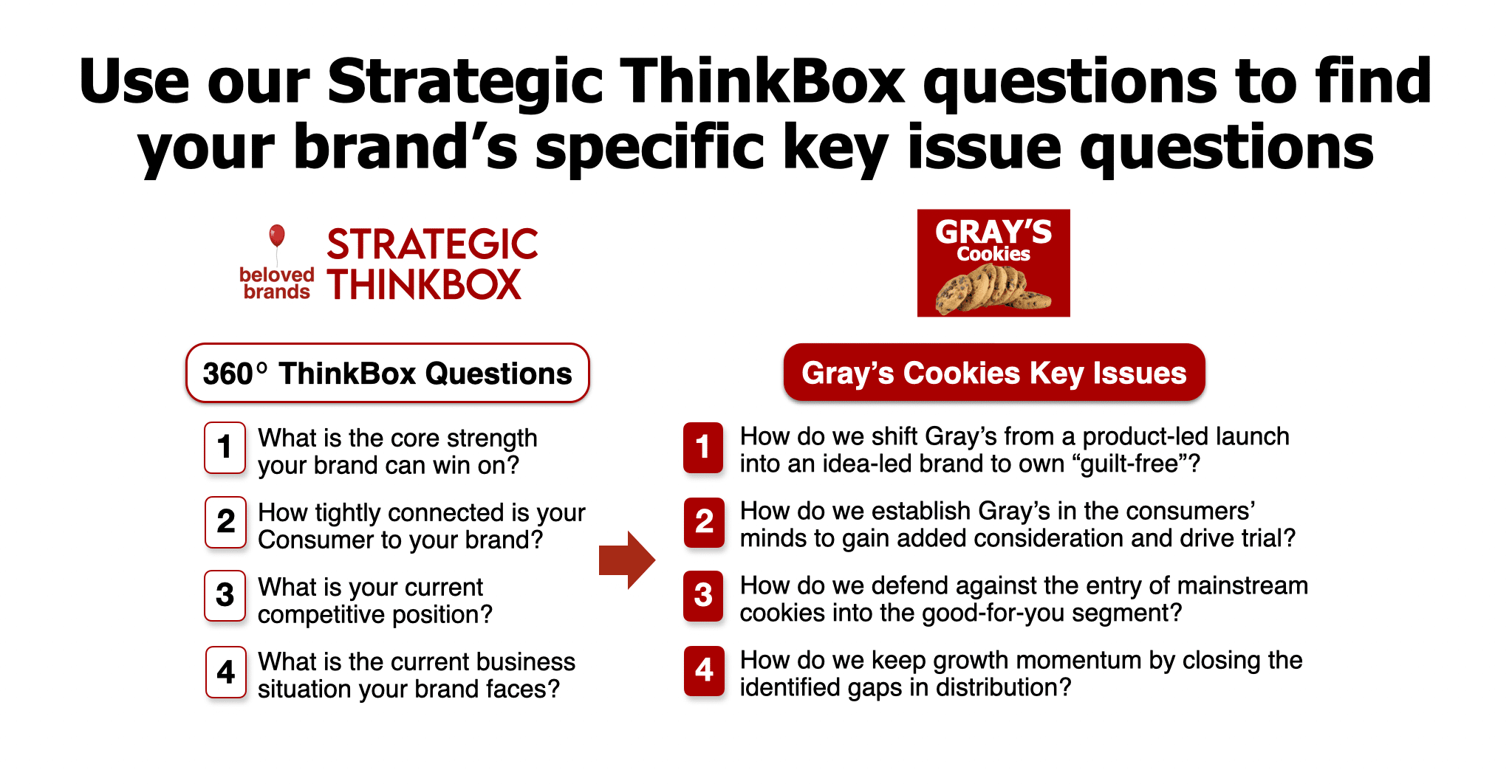
Once you’ve answered all four questions, the next step is translating each answer into a specific key issue question for your brand. Key issues are the strategic questions that stand between where your brand is today and where you want it to be.
The ThinkBox question gives you the category of the problem. The key issue question makes it specific to your brand.
For Gray’s Cookies the Strategic ThinkBox answers pointed to a story-led brand at the like it stage competing as a challenger in a startup-to-momentum situation.
The key issue questions that came out of that:
- How do we shift Gray’s from a product-led launch into an idea-led brand that owns the guilt-free positioning?
- How do we drive consideration and trial to establish the brand in the consumer’s mind before mainstream cookie brands enter the healthy segment?
- How do we defend Gray’s against the competitive launches planned for Q1?
- How do we keep momentum by closing the distribution gaps that are holding back awareness growth?
Each question is specific, answerable, and directly connected to one of the four ThinkBox dimensions. The strategy that answers each key issue becomes the spine of the brand plan.
Brand strategy examples using the Strategic ThinkBox
Coca-Cola
Coke is a story-led brand — the brand story connecting Coke to happiness, refreshment, and shared moments has been built over more than a hundred years and is one of the strongest brand narratives in consumer marketing history.
Coke sits at the beloved stage with its core loyalists, though the bond has weakened in markets where health consciousness is driving category decline. Competitively Coke remains the power player over Pepsi and every challenger in the cola category.
The business situation is the most complex dimension. The cola category is in structural decline as consumers shift to water, energy drinks, and better-for-you alternatives.
Coke faces a fix it situation at the category level even while remaining a beloved brand at the consumer level. The strategic challenge is navigating category decline while protecting brand equity — a genuinely difficult combination that requires both defensive investment in the core and offensive investment in adjacent categories.
Apple
Apple is a product-led brand that has built one of the strongest brand stories in technology. The product is the proof point and the story amplifies what the product delivers.
Apple sits at the beloved stage with a consumer bond so strong that people line up for product launches, defend the brand in public, and feel genuine loyalty to the Apple ecosystem.
Competitively Apple is the power player in premium consumer technology with no serious challenger operating on comparable terms.
The business situation is momentum — consistent revenue growth, expanding services revenue, and a consumer base that upgrades reliably.
The brand strategy priority for Apple is to extend that momentum by deepening the ecosystem, expanding services, and continuing to set the product standard that justifies the premium.
Red Bull
Red Bull is a story-led brand built entirely around extreme energy as a brand idea. The product is an energy drink. The brand is about pushing human limits. That distinction is what allowed Red Bull to build a media company, sponsor extreme sports events, and develop athlete partnerships that no competitor has been able to replicate.
Red Bull sits at the love it stage with its core consumer — passionate, loyal, and willing to pay a significant premium over private label energy drinks. Competitively Red Bull operates as a power player in the premium energy segment while facing challenger brands from below.
The business situation is momentum in premium channels while facing increasing competition in mainstream grocery and convenience.
Frequently Asked Questions - Strategic Thinking
What is the Strategic ThinkBox?
The Strategic ThinkBox is a strategic thinking framework for brand strategy developed by Graham Robertson at Beloved Brands. It asks four questions about a brand’s situation — what is the core strength, how tight is the consumer bond, what is the competitive situation, and what is the business situation — and forces a specific answer to each one. The answers combine to define the key issues the brand needs to solve and the strategic direction to pursue.
How do you use the Strategic ThinkBox?
Work through all four questions in sequence before writing any brand strategy. For each question, choose one answer from the four options rather than hedging across multiple answers. The discipline of committing to one answer per question is what generates strategic clarity. Once you have all four answers, translate each one into a specific key issue question for your brand. Those key issues become the foundation of the brand plan.
What are the four questions in the Strategic ThinkBox?
The four questions are: What is your brand’s core strength — product, brand story, experience, or price? How tight is the bond with your consumers — unknown, indifferent, like it, love it, or beloved? What is your competitive situation — power player, challenger, disruptor, or craft brand? What is your current business situation — momentum, fix it, re-align, or startup?
What is a key issue in brand strategy?
A key issue is a strategic question that defines what stands between your brand’s current situation and where you want it to be. Good key issues are specific, answerable, and directly connected to one of the four ThinkBox dimensions. They frame the strategic challenge clearly enough that the answer becomes the strategy. A key issue that’s too vague generates equally vague strategies. A key issue that’s too tactical generates tactics rather than strategies.
What is the difference between strategic thinking and brand strategy?
Strategic thinking is the process of asking the right questions and making focused choices about where to compete and how to win. Brand strategy is the output — the vision, key issues, strategies, and goals that guide the brand. You need strong strategic thinking to produce a strong brand strategy. The Strategic ThinkBox is the tool that bridges the two — it structures the strategic thinking process so it produces the key issues and directional clarity that a brand strategy requires.
How does the Strategic ThinkBox connect to the Marketing PlayBox?
The Strategic ThinkBox is the thinking tool — it defines the situation and generates the key issues. The Marketing PlayBox is the execution tool — it ensures every execution idea focuses on the right target, fits the brand, delivers the main message, and executes the strategy. The ThinkBox comes first and the PlayBox tests whether execution stays aligned with the strategic direction the ThinkBox defined.
Can the Strategic ThinkBox be used for B2B brands?
Yes. The four questions apply directly to B2B brands. B2B brands have core strengths — usually product or experience in professional services. They have consumer bonds measured through renewal rates, advocacy, and net promoter scores. They have competitive situations — power players in established categories, challengers entering new verticals, disruptors using technology to change category rules. And they have business situations — momentum, fix it, re-align, and startup all occur in B2B contexts. The language around each dimension shifts slightly for B2B audiences but the strategic logic is identical.
How often should a brand revisit its Strategic ThinkBox answers?
At minimum once a year as part of the brand planning cycle. More frequently if a significant market event changes the competitive situation — a major competitor launch, a category shift, or an acquisition all warrant a fresh assessment. The answers don’t change often but when they do, the brand strategy needs to change with them.