Knowing how to judge advertising is one of the most important and least taught skills in brand management. Most brand managers dread the creative review meeting. The agency presents the work, everyone looks around the room, and the brand manager offers something vague like “I think it needs to be more emotional” or “Can we make the logo bigger?”
The agency goes back, makes the changes, and returns with something slightly worse than where they started. The agency is rarely the root of the problem. The brand manager never had a clear framework for evaluating the work in the first place.
After approving advertising at Johnson & Johnson, Coca-Cola, and General Mills for 20 years, I developed a consistent approach to evaluating creative, built around four questions. I call it the ABCS framework, which stands for Attention, Brand Link, Communication, and Stickiness. These four questions tell you whether an ad is worth approving, what’s missing if it isn’t, and how to give the creative team feedback that moves the work forward.
This guide walks through the full framework. You’ll learn how to judge advertising on instinct and on strategy, how to use the creative checklist, and how to make the three decisions every brand manager eventually faces: approve, kill, or send back for changes.
The one rule before you walk into a creative review
Before you evaluate a single ad, understand your role. Your job is to represent the consumer, protect the strategy, and decide whether the work in front of you does both. Writing headlines, designing layouts, and directing the creative all belong to the agency.
The best brand leaders I worked with understood this completely. They walked into creative reviews with one clear job: judge whether the advertising was creatively different enough to break through and strategically smart enough to move consumers. They left everything else to the agency.
When brand managers lose sight of this, they start doing the creative work themselves. They rewrite headlines in the meeting, sketch alternative visuals, and direct the layout. At that moment, the agency stops being a creative partner and becomes a production resource executing the brand manager’s half-formed ideas, and the work gets worse.
Walk into the room as a judge. That one shift changes how you evaluate the work and how the agency responds to your feedback.
The best advertising is both smart and different
When you're evaluating advertising creative, there are two dimensions that matter above everything else.
Two dimensions matter above everything else when you evaluate advertising creative.
The first is whether the ad is creatively different enough to break through. Consumers see hundreds of advertising messages every day, and they ignore most of them because they look and feel like every other ad in the category. Advertising that looks too much like what competitors have already done becomes invisible. It can be on brief and technically correct, and still be completely ineffective.
The second is whether the ad is strategically smart enough to move consumers. An ad that is purely creative, with no connection to the brand or the main benefit, does nothing for your business. It entertains people and leaves no trace of your brand behind.
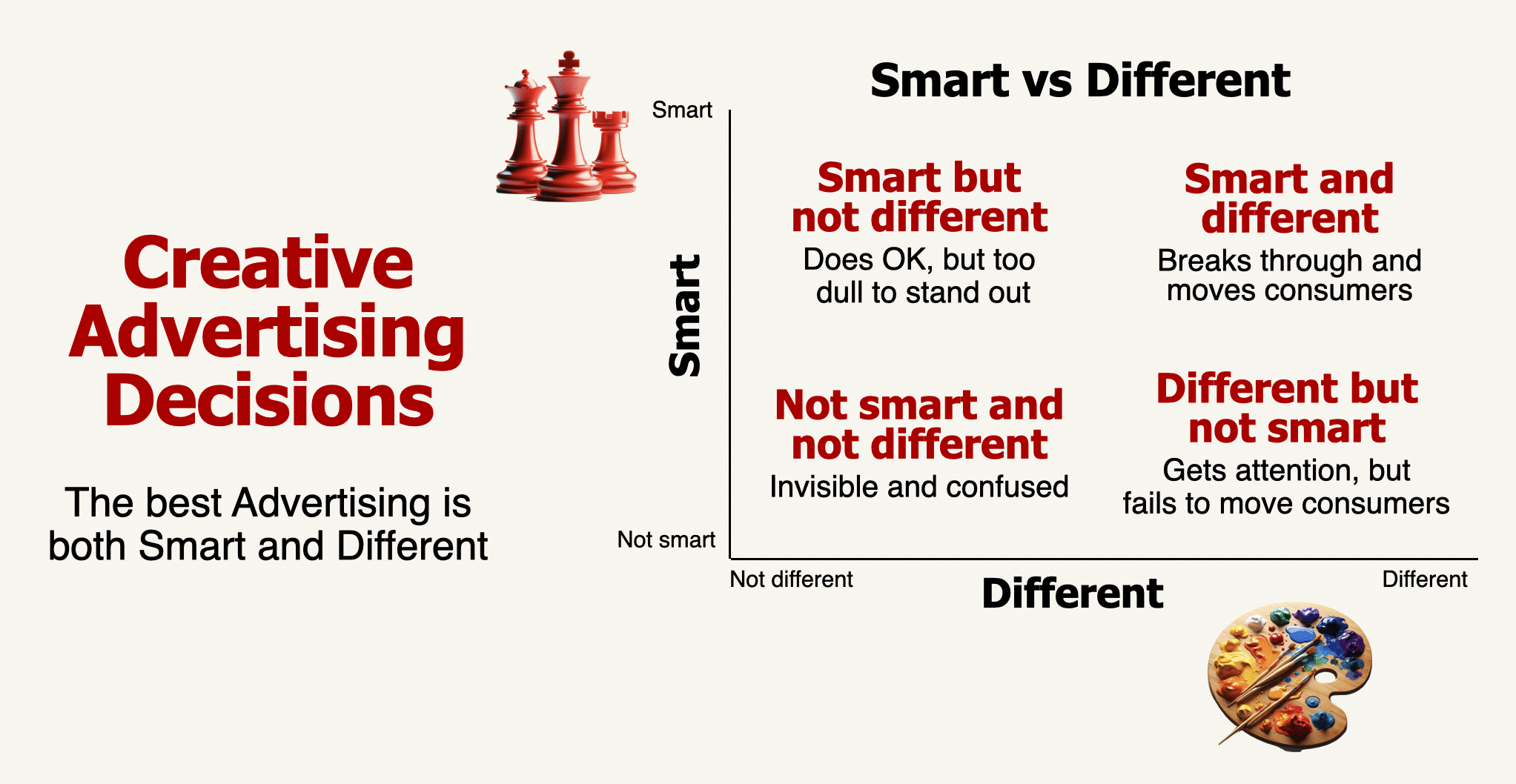
The matrix shows exactly what you're aiming for:
- Smart and different breaks through and moves consumers.
- Smart but not different does OK, but it’s too dull to stand out.
- Different but not smart gets attention but fails to move consumers.
- Neither smart nor different is invisible and confused. That’s where most forgettable advertising lives.

How to predict whether advertising will actually work
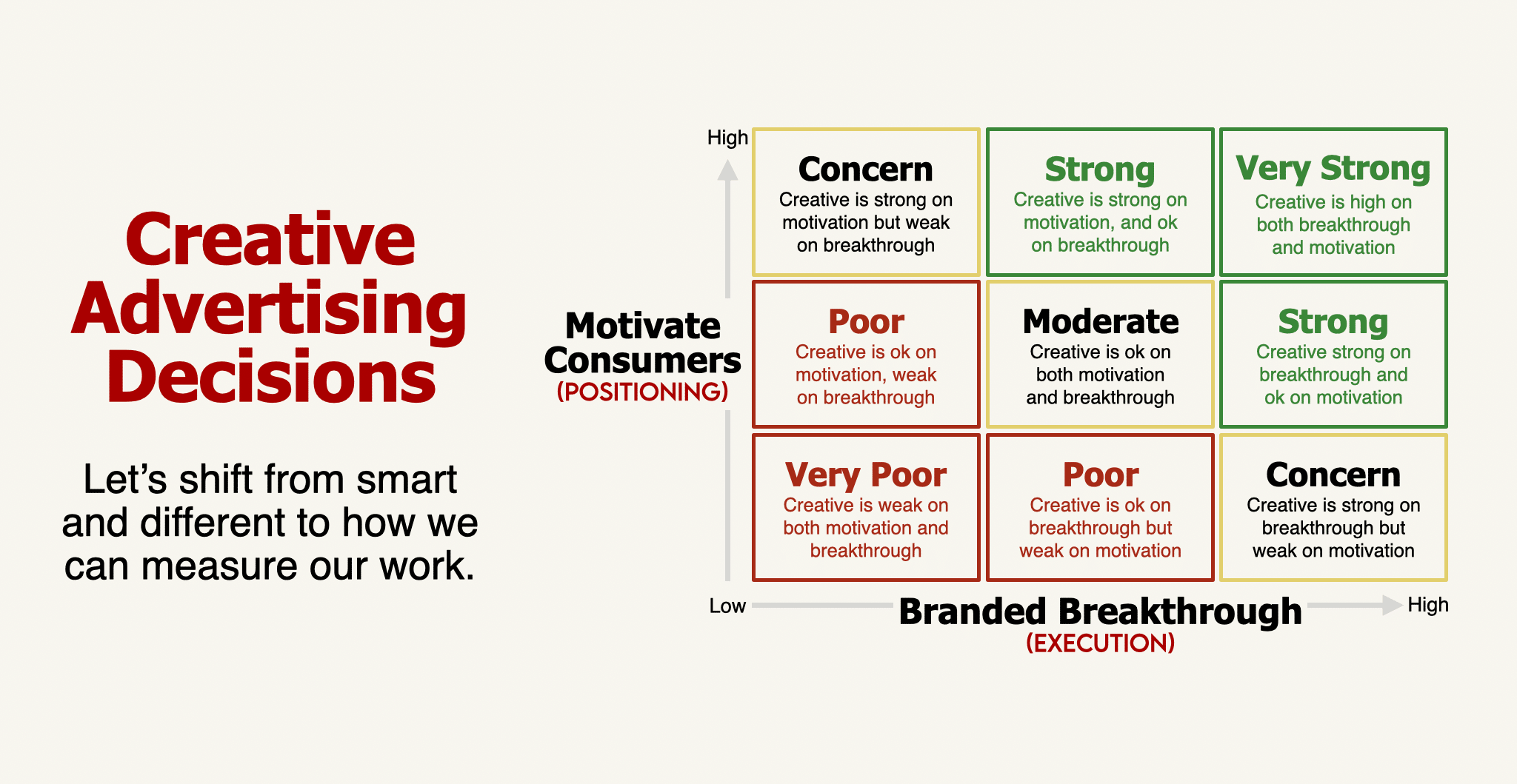
The Smart vs Different model tells you what you’re aiming for. This grid tells you how to score what you’re actually looking at.
When you evaluate advertising creative, you score two things at the same time. Branded Breakthrough is the execution dimension, or how you say it. It measures whether the creative stands out from the clutter while closely linking the brand to the story. Motivating Consumers is the positioning dimension, or what you say. It measures whether the main message connects and moves consumers to see, think, feel, or act differently than before they saw the ad.
Very Strong sits in the top right, high on both breakthrough and motivation. That’s the advertising worth approving and protecting. Every other spot on the grid tells you what’s missing and where the creative team needs to push harder. A Concern in the top left means the message is strong but the execution is too dull to earn attention. A Concern in the bottom right means the ad breaks through brilliantly but says nothing worth remembering.
Use the grid to move from a gut feeling about the work to a specific diagnosis of where the gaps are.
How to evaluate advertising creative — the ABCS framework
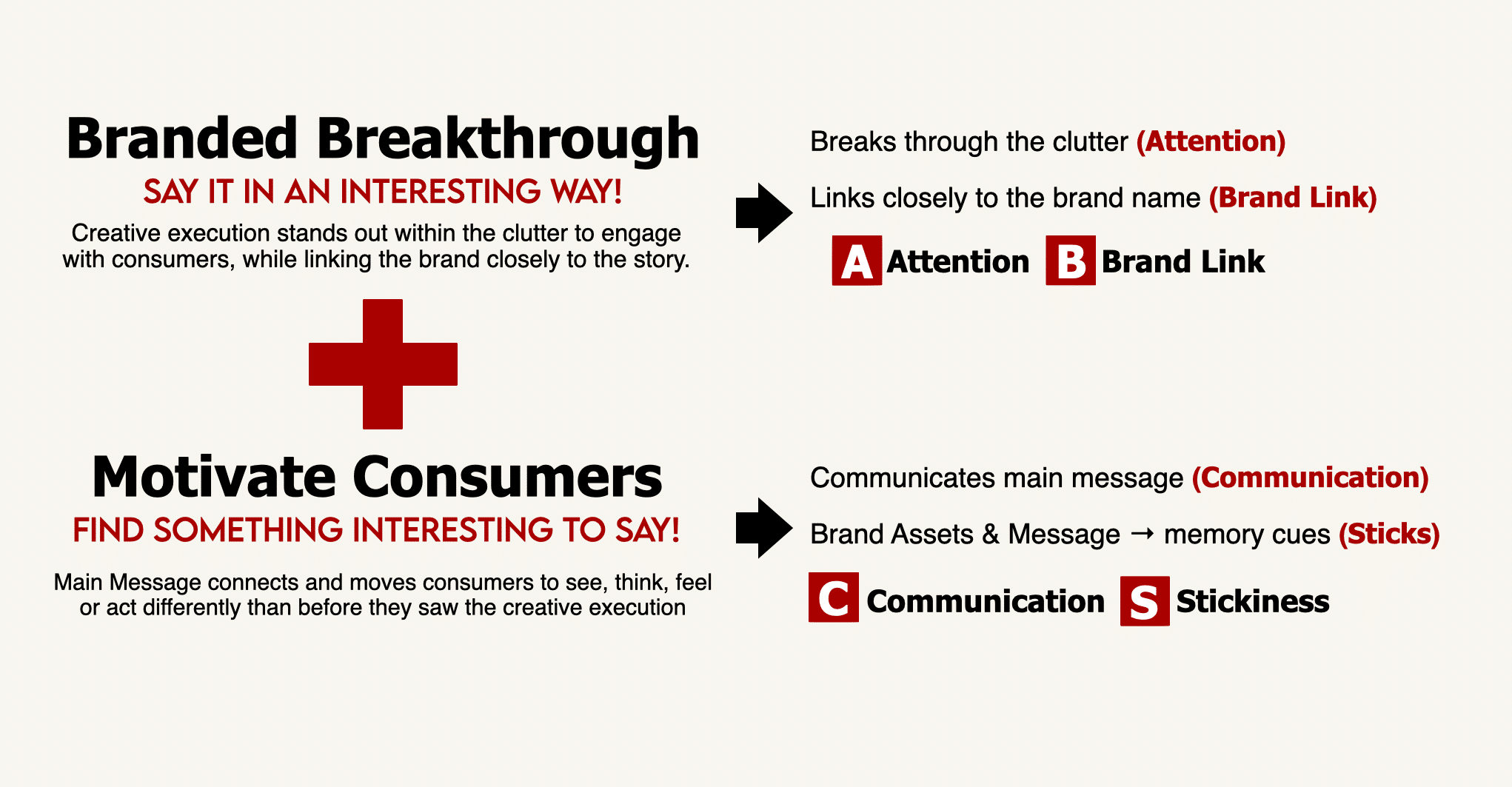
Branded Breakthrough and Motivating Consumers map directly onto the four ABCS dimensions.
- Branded Breakthrough, saying it in an interesting way, is driven by Attention and Brand Link. The creative execution needs to stand out from the clutter to engage consumers, and it needs to link the brand closely to the story so consumers know who’s talking to them.
- Motivating consumers by finding something interesting to say is driven by Communication and Stickiness. The main message needs to connect and move consumers to see, think, feel, or act differently than before they saw the ad. Brand assets and the message need to create memory cues that linger long after the ad ends.
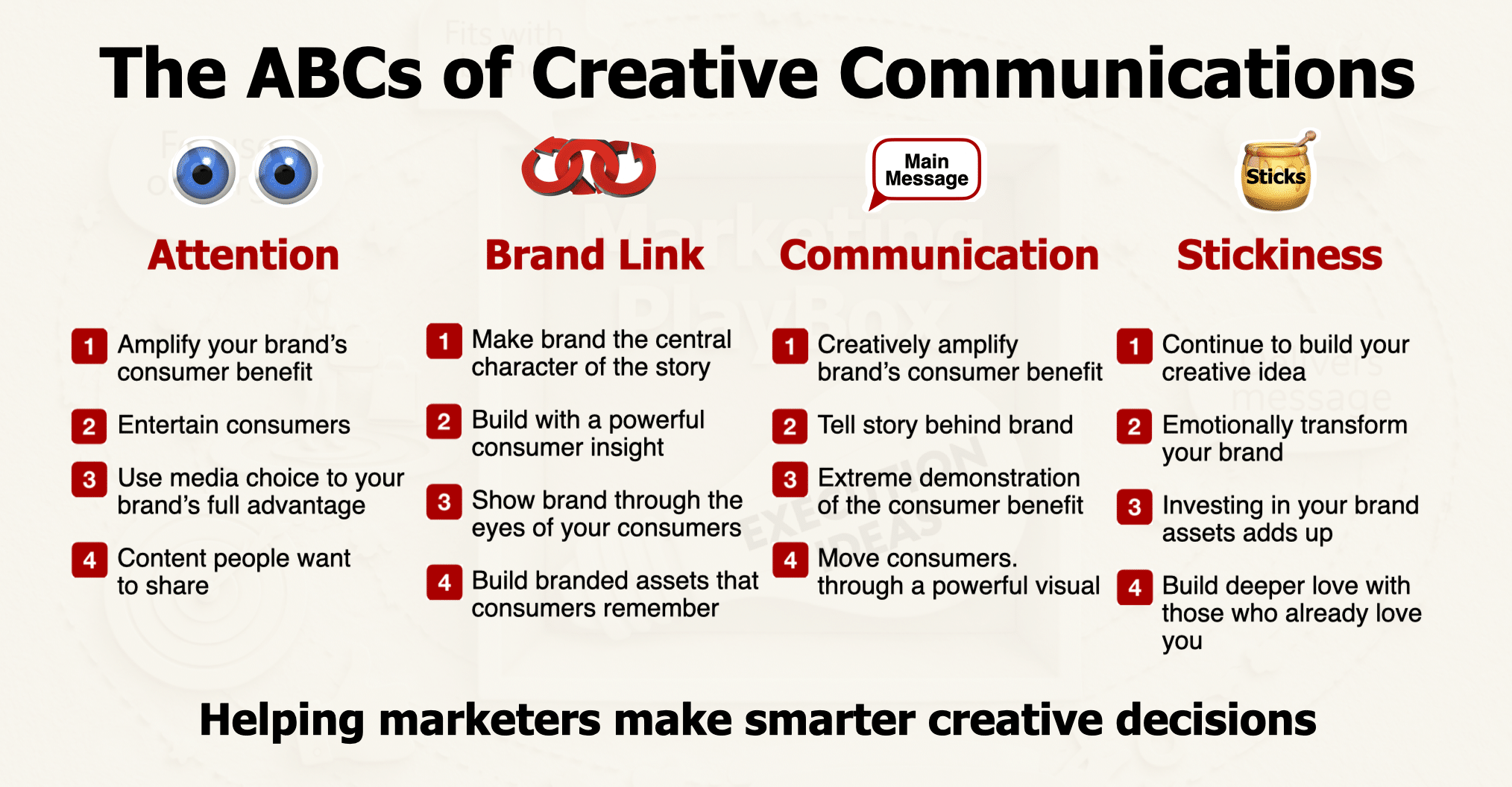
Together, Attention, Brand Link, Communication, and Stickiness make up the ABCS framework. Each one maps to a specific, measurable part of what makes advertising work.
A - Attention: the oxygen your brand cannot survive without
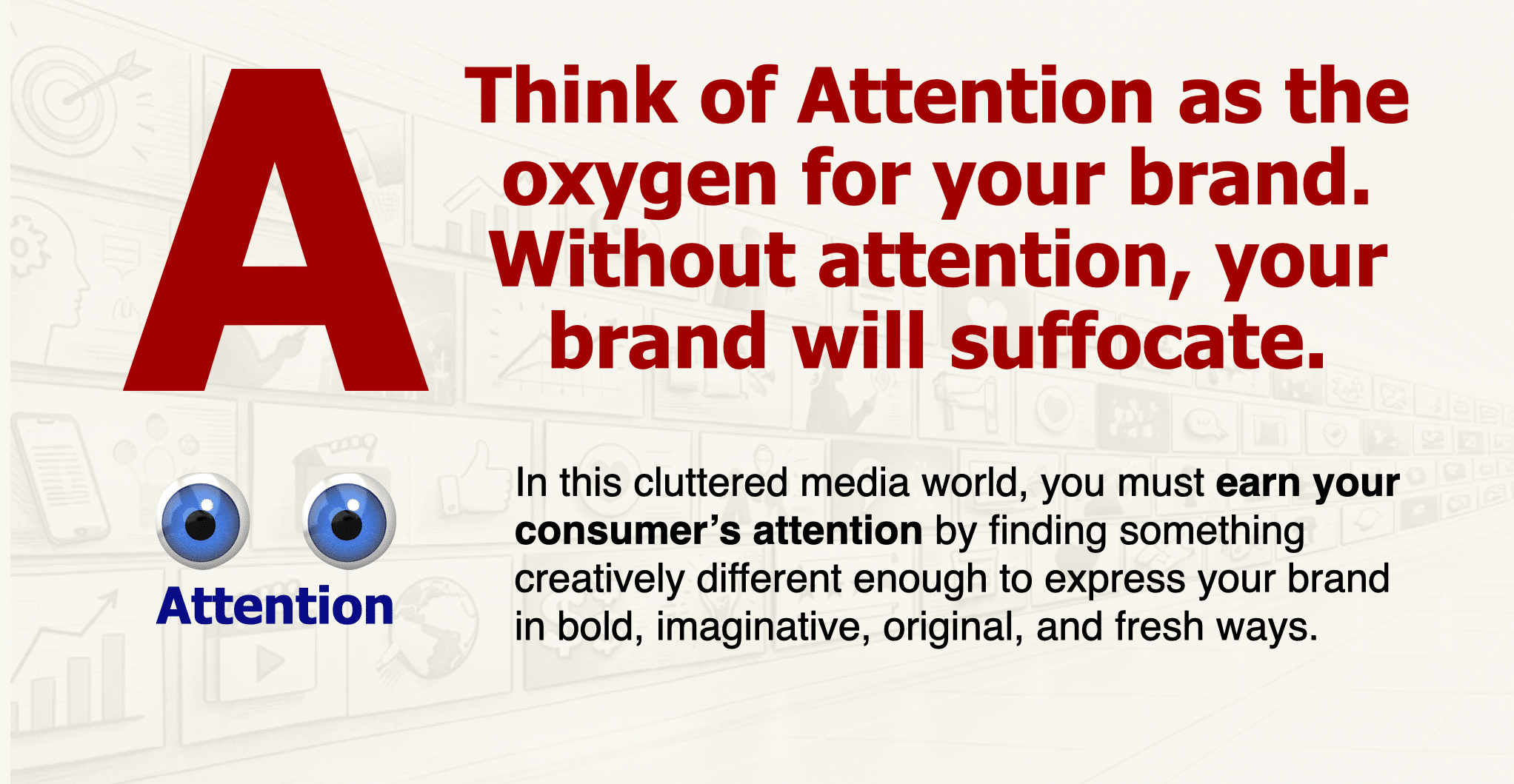
Think of attention as the oxygen for your brand. Without it, your brand suffocates.
In this cluttered media world, attention has to be earned. Consumers do not watch advertising — they tolerate it, skip it, or ignore it entirely unless something stops them. That something is a creative idea that expresses the brand in bold, imaginative, original, and fresh ways.
When you evaluate attention, watch the ad cold — no agency setup, no explanation of what they were going for. If it needs to be explained to be appreciated, it has an attention problem. Ask whether the ad would stop a consumer who wasn’t looking for it. Ask whether the creative device that earns attention is connected to the brand and the benefit, or whether it’s a standalone entertainment piece that happens to have a logo at the end.
Attention without brand connection is expensive entertainment. Your competitors benefit as much as you do.
B — Brand Link: connecting attention to your brand's memory bank
Brand link measures how much of the attention gained connects your brand into the consumer’s memory bank.
Getting attention is only half the job. The other half is making sure that attention lands on your brand specifically, not on the entertainment device you used to earn it.
The best brand link occurs when you connect your brand more closely to the climax of the story.
If the brand is a bystander in its own ad — present at the end but not essential to the narrative — the consumer will remember the joke, the visual, or the moment, but not the brand behind it. That’s attention wasted.
When evaluating brand link, ask the simplest possible question: could a competitor run this exact ad with their logo swapped in? If the answer is yes, the brand link is weak. The creative idea needs to be so specific to your brand that the swap would be obvious and jarring.
C — Communication: delivering the one message that moves consumers
If attention is oxygen, think of the communication of the main message as the brain cells of your brand.
With something interesting to say — your brand positioning — you now need to say it in an interesting way. Communication happens when you focus on the one main benefit that you know is different and ownable enough to move consumers.
The ad has one communication job. Not three messages, not a features list, not a brand values statement. One main benefit, communicated clearly enough that a consumer who saw the ad once could articulate it an hour later.
When evaluating communication, ask whether the creative execution helps or undermines the message it’s supposed to deliver.
Sometimes, a very strong creative device actually distracts from the benefit — the execution is so entertaining that the message disappears inside it. When that happens, the ad scores well on attention and poorly on communication, and that’s a specific problem to solve rather than a general note that it needs work.
S — Stickiness: building memory cues that last beyond the ad
Ads that stick build memorable cues that last in the minds and hearts of consumers.
Attention gets the consumer to watch. Brand link connects the experience to your brand. Communication delivers the message. Stickiness is what makes all three last beyond the moment the ad ends.
Build brand assets that stick in the minds of your consumers — a recurring character, a signature visual, a musical cue, a phrase that becomes shorthand for the brand — so that you can move them along their journey and build a bond over time.
Sticky advertising compounds.
Each exposure reinforces the same memory structure, makes the brand more familiar, and makes the next purchase decision slightly easier.
When evaluating stickiness, ask whether there’s something in the ad that will stay with the consumer after it ends. Ask whether it could anchor a long-running campaign rather than stand as a one-time execution. The best advertising doesn’t just work once. It gets better the more times people see it.
How to use the creative advertising checklist
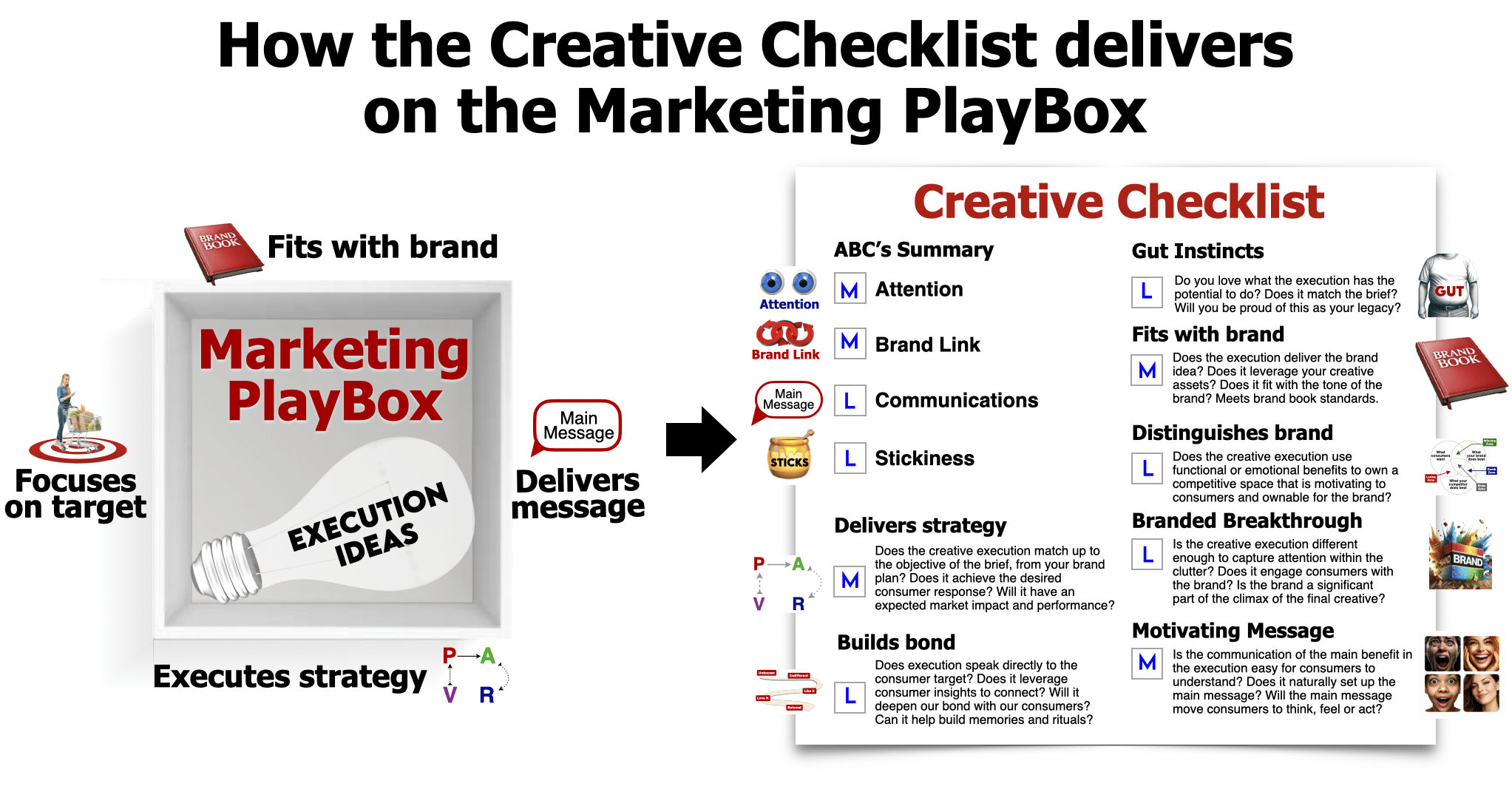
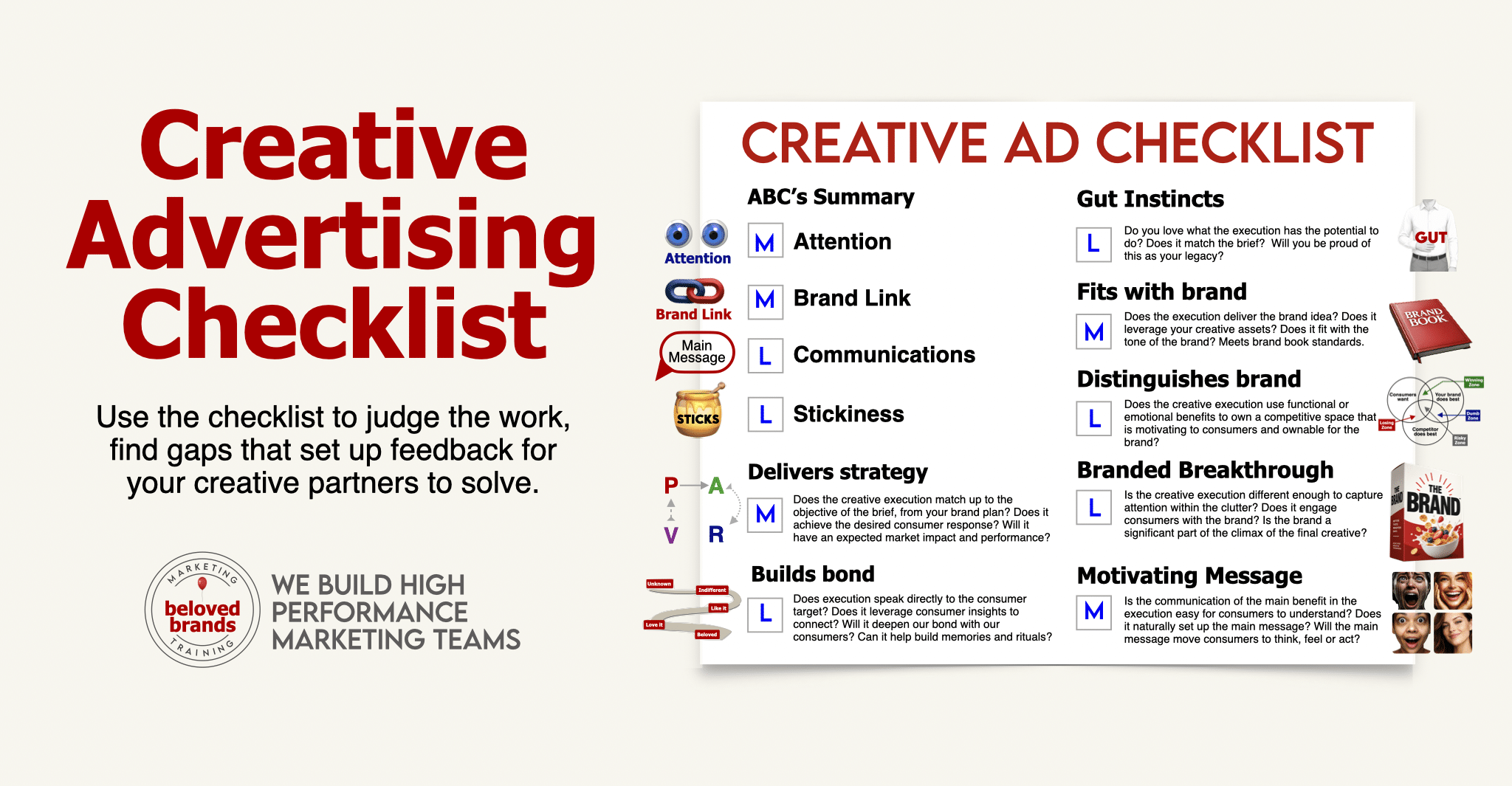
Now that you understand the four ABCS dimensions, use the checklist to score the work in front of you. Rate each element high, medium, or low. The pattern across your scores tells you more than any single rating.
The checklist runs across two columns. The left side covers the ABCS summary scores — Attention, Brand Link, Communication, and Stickiness — plus Delivers Strategy and Builds Bond. The right side covers Gut Instincts, Fits with Brand, Distinguishes Brand, Branded Breakthrough, and Motivating Message.
Gut Instincts. Before you analyze anything, what does your gut tell you? Do you love what the execution has the potential to do? Does it match the brief? Will you be proud of this ad as your legacy? Write down that first instinct before the room starts talking.
Delivers Strategy.
Does the creative execution match the objective in the creative brief and the brand plan? Will it achieve the desired consumer response? Will it have an expected market impact and performance? Check this in a quiet place after the meeting, not in the room while the agency is watching you.
Builds Bond.
Does it speak directly to the consumer target? Does it leverage consumer insights to connect? Will it deepen the bond with consumers and help build memories and rituals?
Fits with Brand.
Does the execution deliver the brand idea? Does it leverage your creative assets? Does it fit with the tone of the brand and meet brand book standards?
Distinguishes Brand.
Does the creative execution use functional or emotional benefits to own a competitive space that is motivating to consumers and ownable for the brand?
Branded Breakthrough.
Is the execution different enough to capture attention within the clutter? Does it engage consumers with the brand? Is the brand a significant part of the climax of the final creative?
Motivating Message.
Is the communication of the main benefit easy for consumers to understand? Does it naturally set up the main message? Will the main message move consumers to think, feel, or act?
Look at where your scores cluster. Consistent highs across the board — approve it and protect it. Consistent lows — reject it and explain specifically why. Mixed scores with one or two significant gaps — send back with directional feedback focused on the weakest dimensions. Now you can use this for how to give creative feedback to your agency.
The gaps on the checklist set up the feedback for your creative partner to solve
This is where the checklist moves from an evaluation tool to an action tool. The scores you’ve recorded aren’t just a verdict on the work.
Look at the example above.
- Attention and Brand Link are scoring medium.
- Communication and Stickiness are scoring low.
- Gut Instincts are low. Branded Breakthrough is low.
The pattern tells a clear story before a single word of feedback has been written: the executions are inconsistent, the idea isn’t strong enough to travel across media, and the main message isn’t landing with clarity or simplicity.
That pattern becomes the Creative Feedback Memo — a directional brief that tells the agency exactly what problems to solve in the next round, without telling them how to solve them.
In the Gray’s Cookies example shown, the checklist gaps translate into four specific directional challenges:
- Turn strategy into a unifying idea. The “feel less guilt” message shows up differently in each execution. The agency needs to land on a single ownable expression that carries consistently across all media.
- Build for media flexibility. Each execution currently feels like a different idea rather than one idea adapted for different contexts. The same core idea should flex across OOH, video, and in-store without changing its fundamental character.
- Simplify to amplify. Too much variation, too much copy, too many directions. Strip back to one headline and one visual that can adapt everywhere and eliminate unnecessary production costs.
- Match the medium to the moment. Each channel has a different job, but the same idea needs to run through all of them. OOH delivers instant impact. Video dramatizes the moment. In-store closes the decision.
Notice what the feedback memo doesn’t do. It doesn’t rewrite the headline. It doesn’t redesign the layout. It doesn’t tell the creative team what the ad should look like. It identifies gaps in the checklist and translates them into new problems for the agency to solve. That’s the discipline that separates brand managers who consistently get better creative from the ones who get stuck in endless revision cycles that never address the real issues.
The checklist gives you the diagnosis. The feedback memo gives the agency the brief. Used together, you will know how to give creative feedback.
How the creative checklist connects back to your brand strategy
The creative checklist doesn’t exist in isolation. It’s the evaluation tool that sits at the end of a strategic process that started with the creative brief, which itself came from the brand plan and the positioning.
The Marketing PlayBox has four requirements that every piece of creative execution needs to satisfy.
- It needs to focus on the right target consumer.
- It needs to fit with the brand — the idea, the tone, the creative assets.
- Then, make sure it delivers the message clearly enough that consumers take it away and remember it.
- And it needs to execute the strategy by achieving the desired consumer response outlined in the brief.
The creative checklist runs through all four requirements systematically.
Builds Bond checks whether the execution focuses on the right target consumer and speaks to them with genuine insight. Fits with Brand and Distinguishes Brand check whether the execution fits the brand identity and creative standards. Motivating Message checks whether the execution delivers the message clearly and compellingly. And Branded Breakthrough and Delivers Strategy check whether the execution executes the strategy in a way that will generate the expected market impact.
When you score the work against the checklist, you’re scoring it against every commitment made in the brief and every requirement of the PlayBox.
If the ad passes the checklist comprehensively, it’s ready to run. If it fails on specific dimensions, you have a precise brief for the creative team’s next round. If it fails broadly across every dimension, you have the evidence to reject it clearly and explain exactly why — which is far more useful than “we don’t think it’s quite there yet.”
The three advertising decisions — approve, kill, or send back
Every creative review ends with one of three decisions. Most brand managers are uncomfortable with all of them.
Approving the work
Approving outright is the rarest decision most brand managers make, and it shouldn’t be. When the work scores high across the ABCS framework, delivers the strategy, and makes you feel something, the right move is to approve it and protect it from the incremental changes that accumulate in every subsequent review and slowly strip out everything that made it good.
The hardest part of approving advertising is resisting the temptation to make small improvements. Every person in the review room can find something to tweak. But a great ad that gets tweaked by six different stakeholders on the way to production often arrives on screen as a mediocre one. If the work is good, say so, approve it, and defend that decision to anyone who tries to reopen it.
Kill the work
Rejection is the most uncomfortable decision for most brand managers, and the reluctance to reject outright is one of the most expensive habits in marketing. Weak work that survives creative review because nobody wanted the difficult conversation goes into production, runs in the market, fails to move consumers, and wastes the entire media budget behind it.
When work scores consistently low across the ABCS framework — when it doesn’t break through, doesn’t link to the brand, doesn’t communicate the benefit, and won’t stick — the right decision is to reject it and say so clearly.
The creative team would rather hear a clear rejection with a specific reason than a vague request to push it further that leaves them guessing what the real problem is.
When you reject, explain which of the four ABCS dimensions is the core problem. That gives the creative team a specific brief to solve rather than a general sense that the work wasn’t liked.
Sending back for changes
Sending back for changes is the most common decision and the most frequently mishandled. The mistake most brand managers make is providing solutions rather than identifying problems.
If you tell the creative team the headline needs to be rewritten, you’ve taken ownership of the communication problem. If you tell them the main message isn’t landing clearly enough and a consumer wouldn’t be able to articulate the benefit after one viewing, you’ve given them a problem to solve. The second approach almost always produces better work because it uses the creative team’s actual skills rather than replacing their judgment with yours.
Look at the ABCS scores from your checklist, identify the one or two dimensions with the biggest gaps, and turn those gaps into directional feedback. Give the creative team a new problem to solve — a tighter box with a clearer challenge — and let them find the solution. Stop giving creative people answers. Give them better questions.
How to give creative feedback that actually improves the work
Creative feedback is a skill most brand managers are never taught. The default is to either over-praise work that isn’t good enough to run, or to give such detailed prescriptive direction that the creative team stops trying to solve the real problem and just executes the brief they were handed.
Good creative feedback does three things.
It’s specific about the problem. “This isn’t quite right” is not feedback. “The brand link is weak — a competitor could run this exact ad with their logo” is feedback. The more precisely you can identify which ABCS dimension is failing and why, the more useful your feedback becomes.
It’s directional rather than prescriptive.
You’re pointing toward a better space for the work to occupy, not handing the creative team a solution. “We need to find a way to make the brand more central to the story — right now the creative device is working against us on brand link” is directional. “Move the logo to the top left and add a product shot in the second scene” is prescriptive. One uses the creative team’s skills. The other ignores them.
It’s honest about what’s working.
The best creative feedback acknowledges the elements that are strong before addressing the gaps. This isn’t about softening the blow — it’s about giving the creative team useful information about which parts of the work to protect as they solve the problems you’ve identified.
Frequently Asked Questions - Creative advertising decisions
What is the ABCS framework for evaluating advertising?
The ABCS framework is a four-question model for judging advertising creative developed by Graham Robertson at Beloved Brands. The four questions cover Attention (does the creative idea earn consumer attention), Brand Link (does the creative idea connect back to the brand specifically), Communication (does the creative idea set up and deliver the main message), and Stickiness (is the creative idea memorable enough to stay with the consumer and move them to act). The framework gives brand managers a consistent and repeatable way to evaluate advertising creative regardless of format or medium.
How do I know if the advertising creative is good enough to approve?
Use the ABCS framework to score the work across all four dimensions. Strong advertising scores high on all four. It breaks through the clutter, links clearly to the brand, communicates the main benefit, and creates a memory that sticks. If the work scores high across the board and delivers the strategy in the creative brief, it’s ready to approve. The most common mistake is approving work that scores well on one or two dimensions while ignoring significant weaknesses on the others.
What’s the difference between evaluating advertising on instinct vs strategy?
Instinct tells you whether the ad works emotionally, whether it moves you, surprises you, or creates a feeling that connects the brand to something real. Strategy tells you whether the ad is doing the right job, reaching the right consumer with the right message in a way that builds the brand’s competitive position. Both matter. An ad that passes the strategy test but fails the instinct test is technically correct and emotionally flat. An ad that passes the instinct test but fails the strategy test is creatively interesting and commercially useless. The best advertising passes both.
How should a brand manager give creative feedback on advertising?
Knowing how to give creative feedback starts with identifying the specific ABCS dimension where the work falls short and turning that gap into a directional brief for the creative team. Give them a problem to solve rather than a solution to execute. “The brand link is weak” is more useful than “move the logo.” “The communication isn’t landing clearly enough” is more useful than “rewrite the headline to say X.” The goal is to point the creative team toward a better space for the work, not to do the creative work yourself. Stop giving answers. Give better questions.
When should a brand manager reject advertising creative outright?
When the work consistently scores low across the ABCS framework and the gap between where it is and where it needs to be is too large to close with directional feedback, rejection is the right call. Weak work that gets sent back for incremental changes rarely becomes strong work. It usually becomes a slightly improved version of something that was fundamentally wrong from the start. A clear rejection with a specific explanation of which ABCS dimension is the core problem gives the creative team a better foundation to restart from than a prolonged revision cycle that never addresses the real issue.
Why do brand managers struggle with advertising creative evaluation?
Most brand managers are never trained in advertising creative evaluation. They’re trained in strategy, analytics, and brand planning, but the skill of sitting in a creative review, watching an ad cold, and making a confident judgment about whether it’s good enough is rarely taught explicitly. The result is brand managers who default to vague feedback, endless revision cycles, and a reluctance to either approve outright or reject outright. A clear framework like ABCS gives brand managers a language and a structure for a conversation that most find genuinely difficult.
How do I learn how to judge advertising across different formats?
The four ABCS dimensions apply to every advertising format including TV, digital video, social, print, outdoor, radio, and influencer content. The specific application of each dimension shifts slightly by format. Attention works differently in a six-second pre-roll than in a 30-second TV spot. But the underlying questions for judging advertising are the same regardless of medium. Does it break through? Does it link to the brand? Does it communicate the benefit? Will it stick?
How is advertising creative evaluation different from evaluating the creative brief?
The creative brief sets the strategic direction, covering who you’re targeting, what you want consumers to think or feel, what the main message is, and what the brand idea is. Evaluating the brief happens before the creative process begins and asks whether the strategy is right. Advertising creative evaluation happens after the agency has done their work and asks whether the execution delivers that strategy effectively. Both are critical skills for brand managers, and weakness in either one produces bad advertising. They require very different judgment at very different points in the process.