Consumer marketing is one of the most demanding roles in business. To succeed in brand management, you need to be strong across every dimension of the job — not just the parts that come naturally.
Running a brand means owning the analytics that tell you what’s happening in the market, the strategic thinking that decides where to compete, the positioning that gives consumers a clear reason to choose you, the plan that connects investment to financial outcomes, and the execution that makes it real. Most marketers are strong in one or two of those areas. The ones who reach the top are strong across all of them.
At Beloved Brands, our brand management training has helped marketing teams sharpen those skills across 30+ countries, with clients including National Geographic, Keurig Dr. Pepper, Honda, Reebok, and the NBA. This page covers everything a consumer marketer needs — from brand analytics and strategic thinking through to positioning, planning, and execution that actually moves consumers.
Click on the image to zoom in!
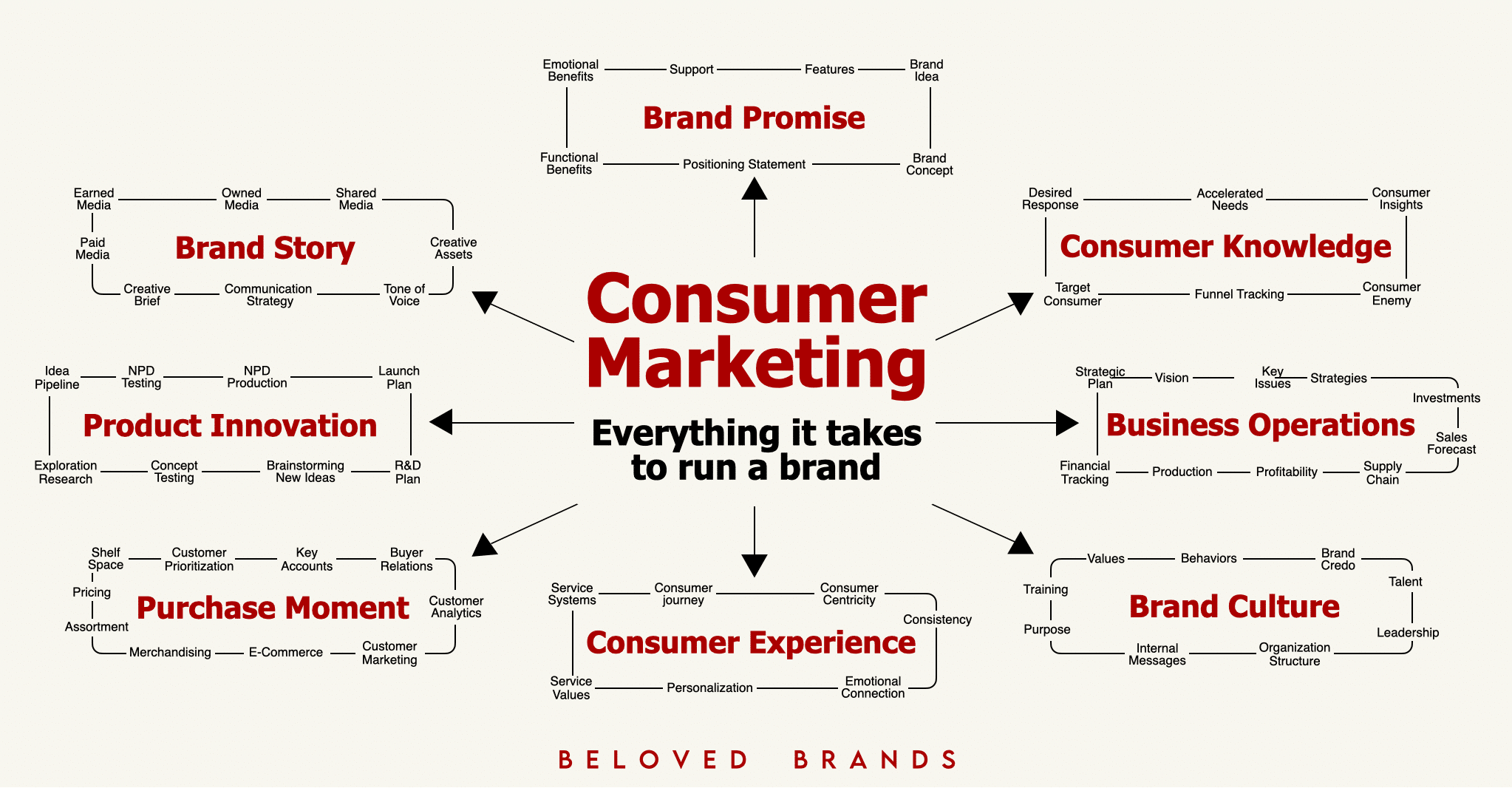
Everything it takes to run a brand
⭐ Brand Promise
Your brand promise is the backbone of your strategy. It forces clarity on the functional and emotional benefits you deliver, and it becomes the filter for every decision you make. When the promise is well-defined and consistently brought to life, consumers begin to understand exactly what you stand for.
📚 Consumer Knowledge
The best marketers know their consumers better than anyone else. Not just who they are, but what motivates them, what holds them back, and what moments in their life create opportunities for your brand. When you combine insights, tracking, analytics, and real human understanding, your strategy becomes far more obvious and far more powerful.
🏢 Business Operations
Great marketers understand the business they run. You manage the P&L, the forecast, and the decisions that influence profitability. That includes knowing the cost drivers, production realities, supply chain constraints, and the financial impact of your choices. When marketers connect strategy to the business model, they earn credibility across the organization.
🧭 Brand Culture
Brands are built from the inside out. Your people deliver the promise through their behaviours, decisions, and daily actions. When everyone understands the purpose, values, and expectations, the brand becomes more consistent and more authentic. A strong internal culture is often the biggest competitive advantage a marketer can create.
❤️ Consumer Experience
Consumers feel your brand through every touchpoint. Whether it’s service, digital interactions, packaging, or retail, these moments shape trust and perception. When the consumer experience matches the promise, you build stronger emotional connections and create the conditions for loyalty to grow naturally over time.
🛒 Purchase Moment
The purchase moment is where everything becomes real. Packaging, pricing, promotion, merchandising, and e-commerce all work together to help the consumer choose your brand. When you win here, you convert all your upstream marketing into actual sales and business growth.
💡 Product Innovation
Innovation works best when it is grounded in your brand’s strategic direction. It should solve real consumer problems in a way that strengthens your positioning. From idea pipeline to concept testing to launch planning, great marketers treat innovation as a disciplined system, not a random burst of creativity.
📣 Brand Story
Your brand story is how you connect with the world. Through advertising, communication, creative assets, and your tone of voice, you create meaning and memory for consumers. When your story is consistent, emotional, and easy to understand, your brand becomes instantly recognizable and much more influential.
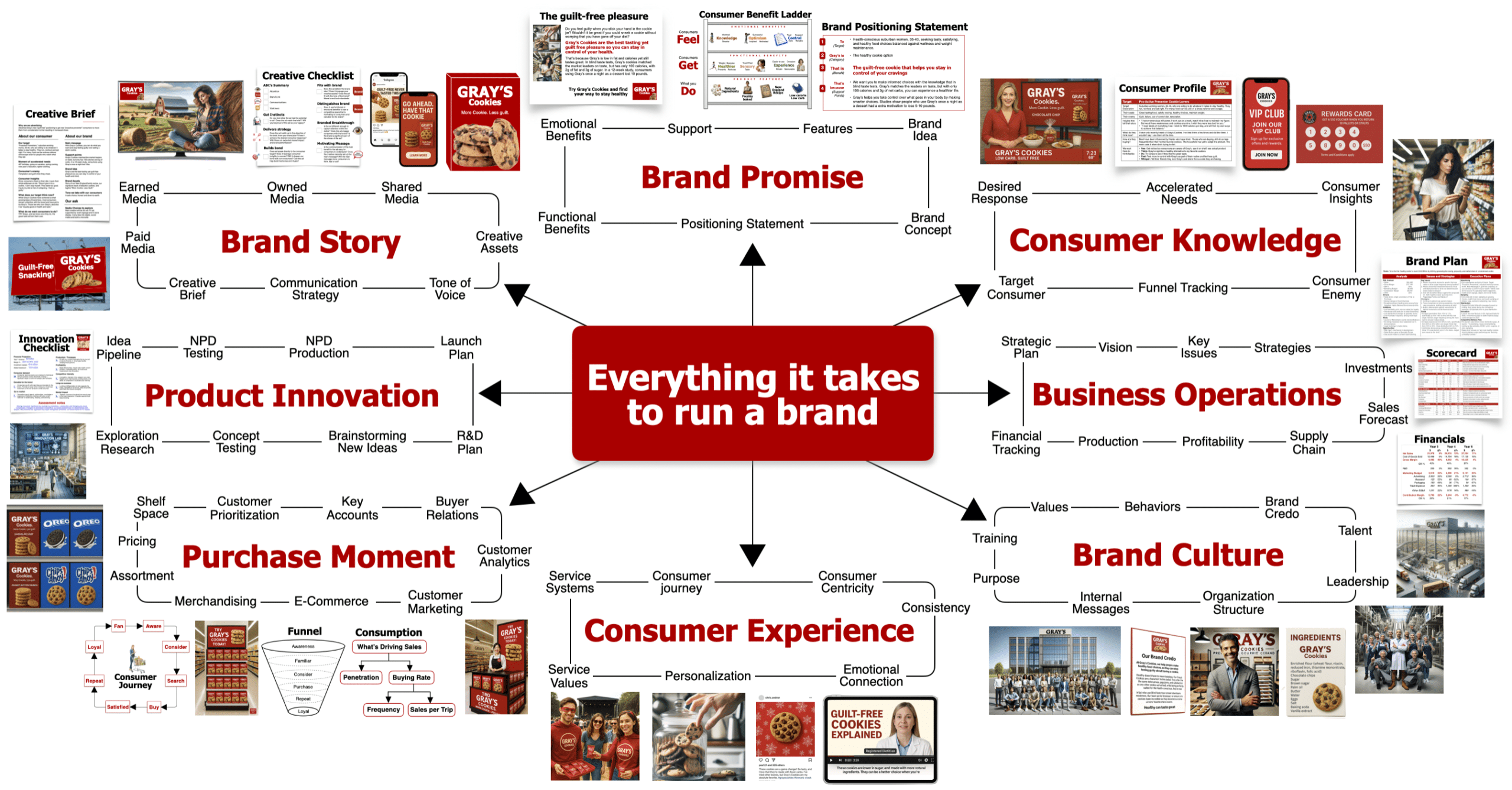
How to run a brand — the complete framework
Consumer Marketing - Click any topic
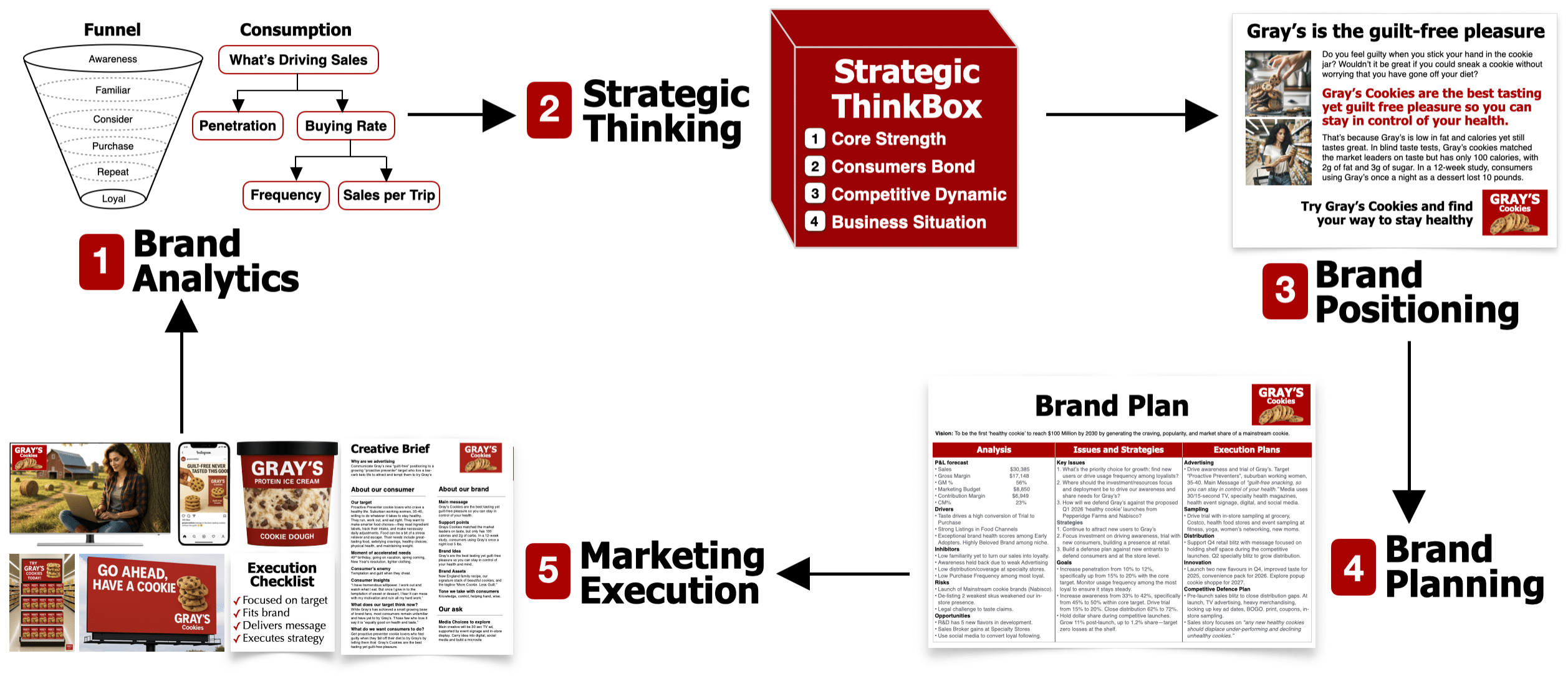
Brand Analytics
The best consumer marketers use Brand Analytics to hunt for opportunities to drive growth through higher penetration and frequency.
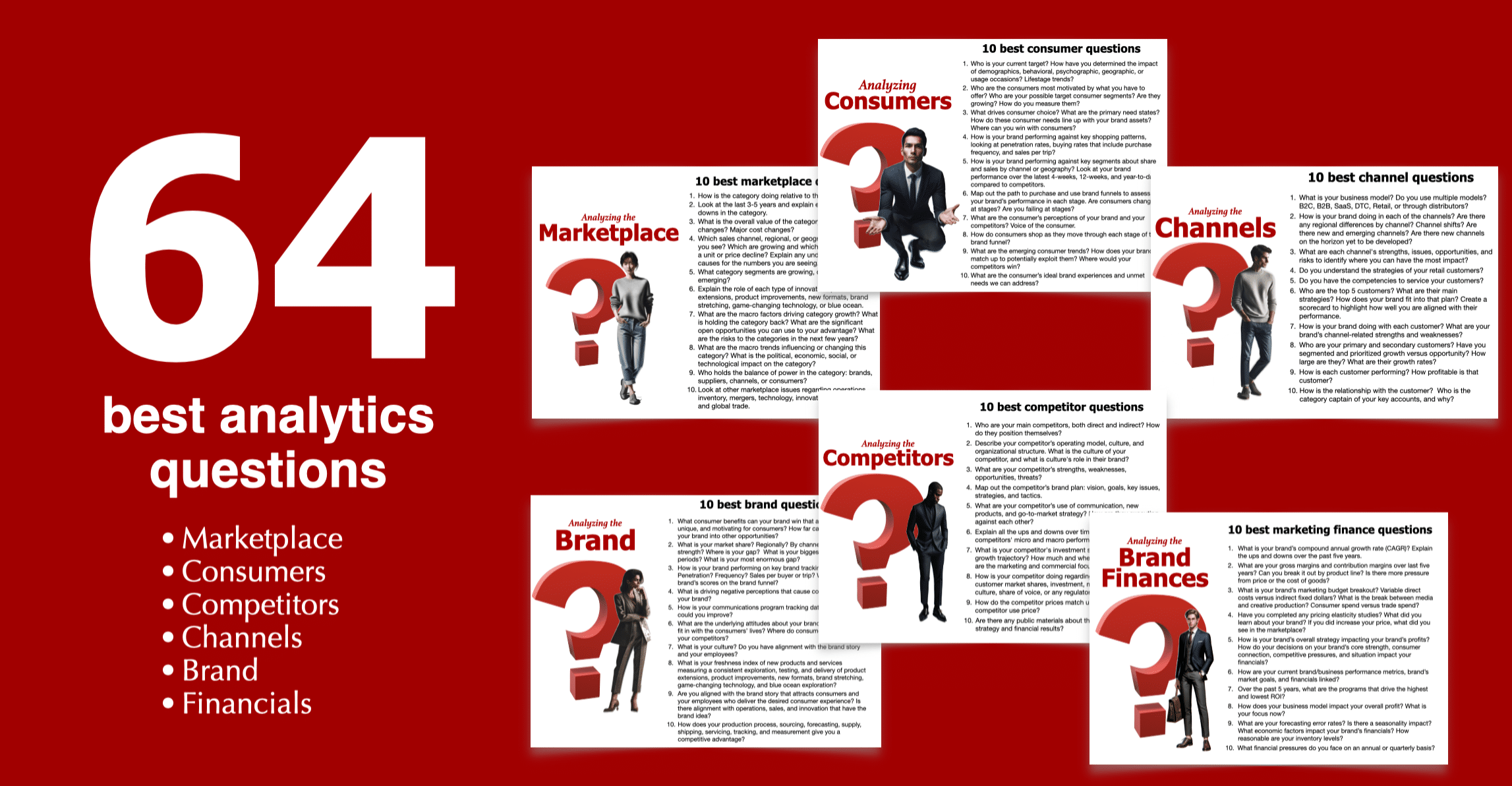
- The best marketers examine the marketplace, consumers, competitors, channels, the brand, and financials looking to find brand opportunities.
- They use analytics to inform the strategic thinking that sets up the investment decisions in the plan and helps define the brand positioning stance.
- Analytics sets up execution that moves consumers along their journey, drives penetration and frequency, leading to higher sales and margins.
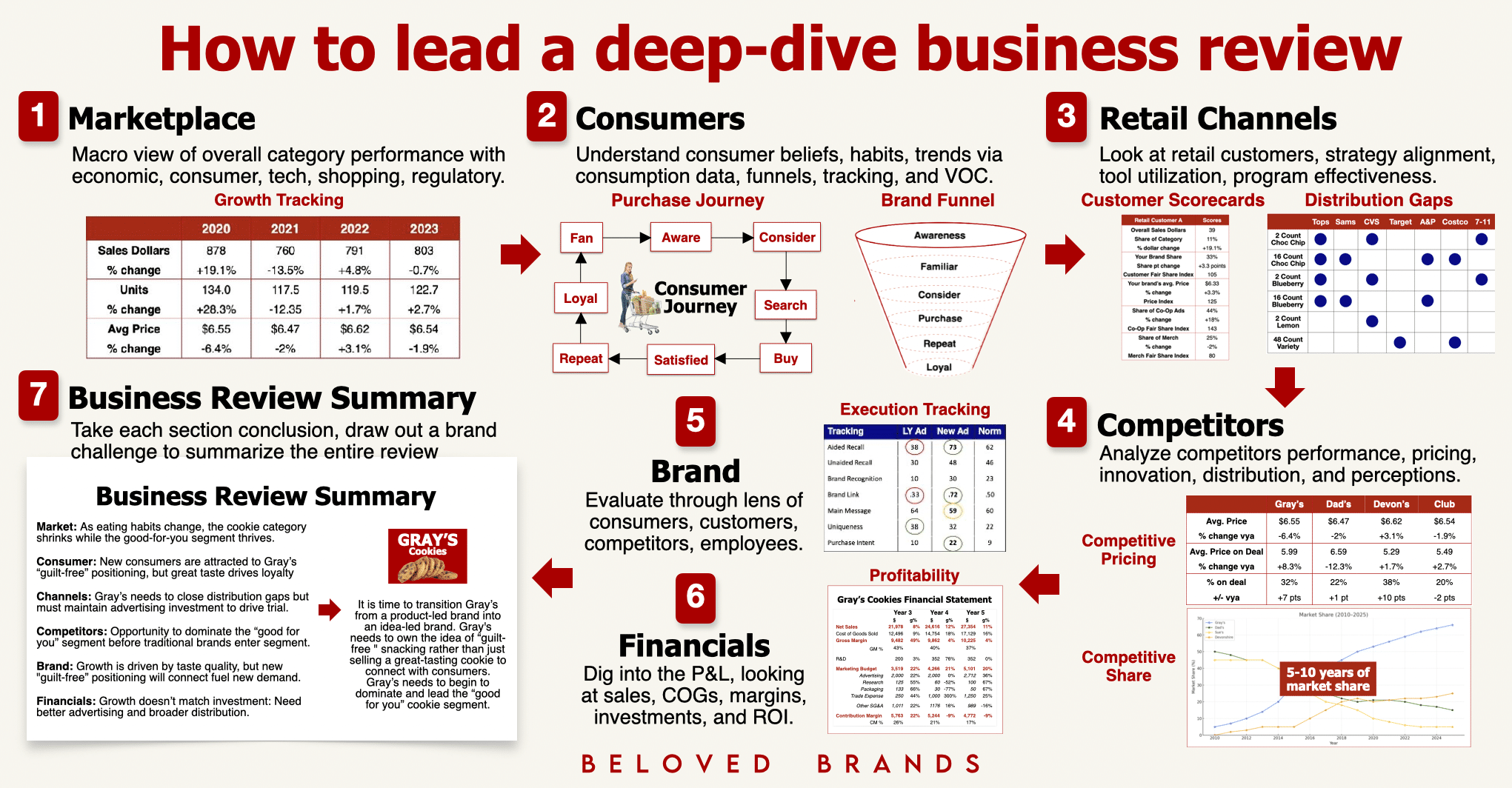
How to use marketing analytics to lead a deep-dive business review
Too many marketers aren’t taking the time to dig into marketing analytics. There is no value in having access to data if you are not using it. The best brand leaders can tell strategic stories through analytics. Conduct a deep-dive business review at least once a year on your brand. Look at it like a brand audit that helps you dig in and see what’s going on. Otherwise, you are negligent and blindly investing your resources without knowing how they are being paid back.
🌍 Marketplace
Start with a macro read of the category. How is the overall market performing? What headwinds and tailwinds are shaping growth? Dig into the forces that move categories—economic shifts, consumer behavior changes, technology disruption, shopper trends, and regulatory pressures. Then, scan adjacent categories for patterns that could spill over into yours or signal what’s coming next.
🧠 Consumers
Use analytics to truly understand your consumer target. Look for the beliefs, habits, and motivations driving their behavior—what’s growing, what’s declining, and why. Apply tools like brand funnel analysis and leaky bucket analysis to see how they shop, where you lose them, and what triggers their decisions. Layer in tracking studies, VOC data, and qualitative research to understand what they think and feel at every stage of the purchase journey.
📦 Channels
Evaluate how each distribution channel and every major retailer is performing. Understand their strategies, the tools they offer, and how effectively your brand is using them. Your brand must show up in a way that aligns with your customers’ priorities and supports their growth model.
⚔️ Competitors
Break down your closest competitors. Look at performance indicators, positioning, innovation activity, pricing, distribution, and how consumers perceive them. Use analytics to map out where they’re likely headed next—then use those insights to sharpen your own strategy.
🏷️ Brand
Assess your brand from every angle: consumers, customers, competitors, and employees. Bring together funnel data, tracking results, research, pricing analysis, distribution gaps, and financial indicators to get a full view of brand health. Manage both sides of the equation—brand health and brand wealth.
💰 Financials
Evaluate your full P&L to understand the economic drivers behind your brand’s performance. Know the levers that drive profitability—pricing, costs, market size, and market share—and understand when to pull each one. Strong financial discipline helps ensure that strategic choices also deliver the right economic outcomes.
Strategic Thinking
Strategic Thinking sets up decisions to win using your core strength, consumer bond, and battle competitors
- The best marketers start with a vision of a better future that becomes the brand’s stretch target to invest in and sets up financial expectations.
- They use key issue questions based on the brand’s core strength, how to build a bond with consumers, how to battle competitors, and leverage the business situation so the brand will win.
- They craft well-structured, performance-driven strategy statements that answer the identified issues and drive growth through higher penetration and profitability through steady frequency.
Strategic thinkers see questions before they see solutions
Ever hear someone say, “That’s a good question?” It usually means someone has just asked an interruptive question, designed to slow everyone’s thinking, so they reflect and plan before acting.
The strategic thinking side of marketing is logical and has to map out a range of intersecting decision trees by imagining how events will play out in the future. There is a risk of being too strategic if you think too long, you may spiral around, unable to decide. Moreover, you may miss an opportunity window.
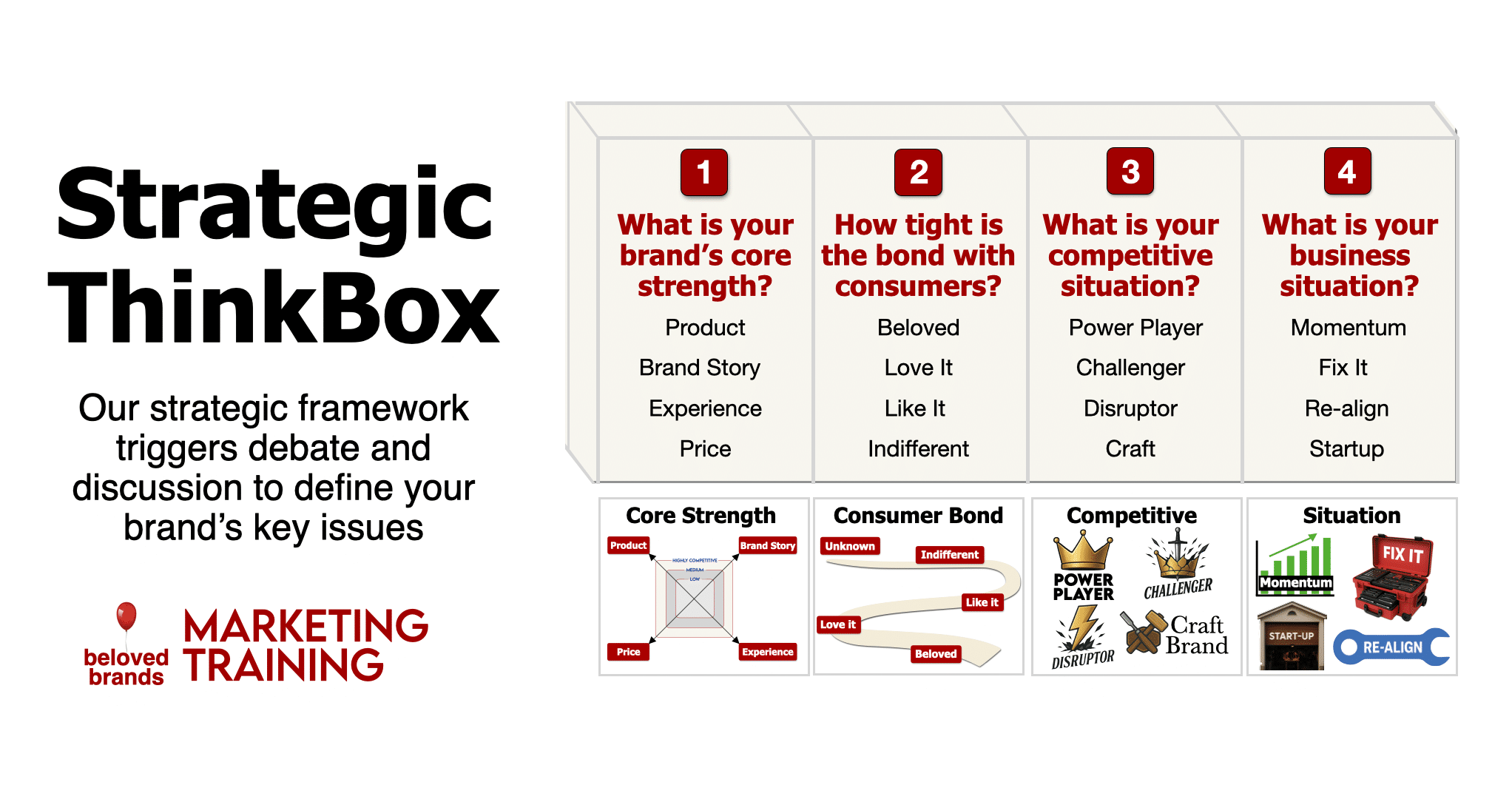
Our Strategic ThinkBox uncovers the Key Issues questions facing a brand
I always believe strategic thinkers see questions before they see answers. With that in mind, I want to introduce a process for you to discover and narrow down the best questions you can ask. Michael Porter argues that strategy must be based on the situation and its unique circumstances. So, let’s show you how to dig in and find those key issue questions that will help identify the unique circumstances facing a brand. These key issue questions are the foundation of any strategic plan. Our Strategic ThinkBox tool helps you ask tough, interruptive questions about your brand’s core strength, consumer bond, competitive dynamic, and business stuation.
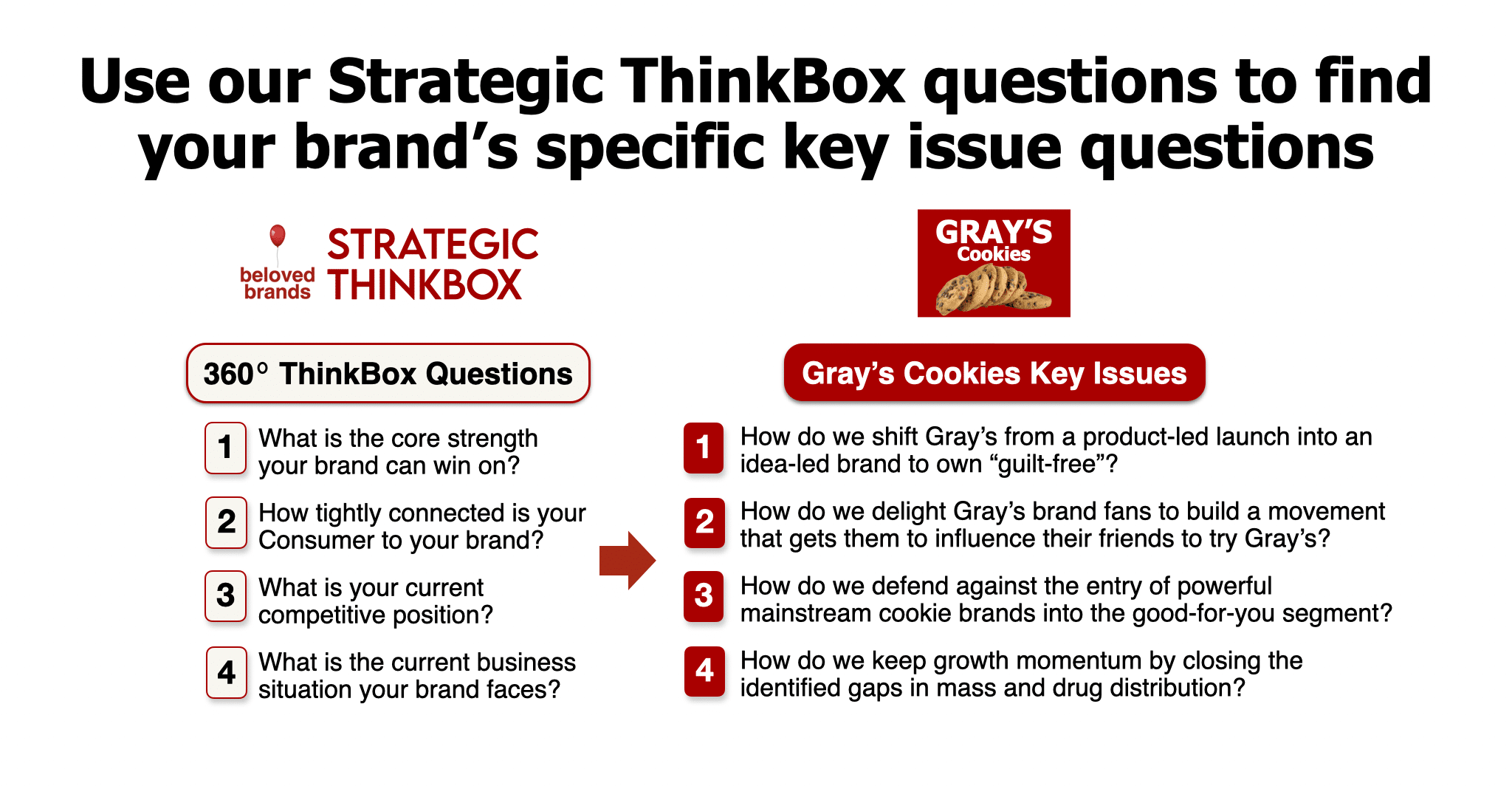
The Key Issues should trigger your strategic thinking
Take all your thinking on your brand and start organizing the best strategic questions and answers. The key issues answer, “Why are we here?” Then, use the summary findings of the deep-dive analysis. Draw out the significant issues that are in the way of achieving your stated brand vision.
Our methodology for finding key issues is to use our Strategic ThinkBox with my four strategic questions model from the strategic thinking chapters. Our Strategic ThinkBox ensures you take a 360-degree view of your brand—its strengths, consumer bond, competitive dynamics, and business situation.
- First, what is the core strength that will help your brand win?
- Second, how tightly connected is your consumer to your brand?
- Third, what is your current competitive position?
- Finally, what is the current business situation your brand face?
How to turn smart strategic thinking into strategic objective statements
Now, let’s look at turning your smart strategic thinking into writing a strategic statement that can provide specific marching orders to everyone who works on the brand. Writing strategy is an essential skill for consuemr marketers to know.
The process covers all five elements of smart strategic thinking. You can see that the brand vision and key issue statement cover the first strategic element. However, you need the strategic objective statement to cover the remaining four other strategic elements, including the program investment, focused opportunity, market impact, and the performance result.
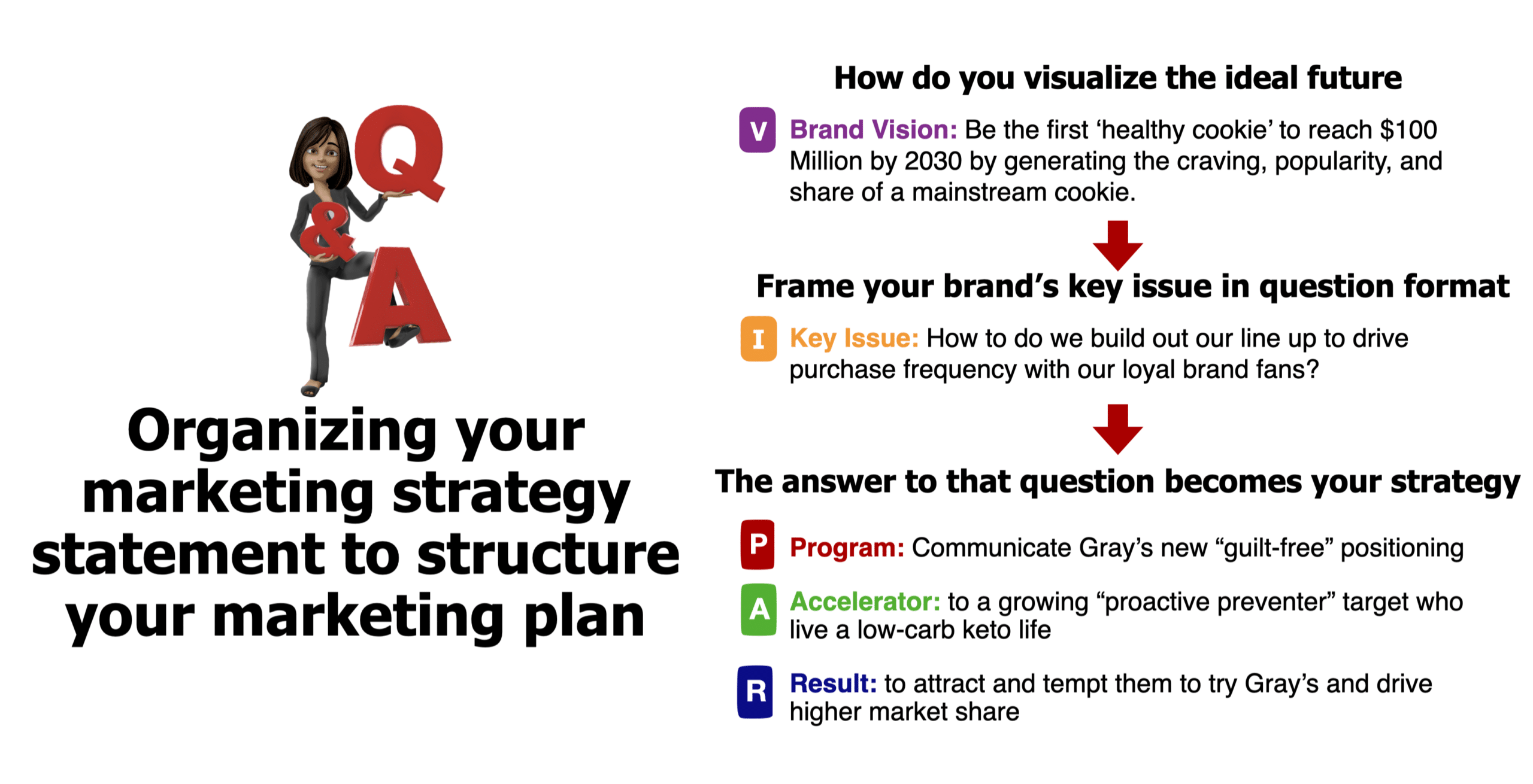
To illustrate brand strategy to help consumer marketers, click to zoom in. Essential to know in brand management.
Here’s how that consumer strategic statement breaks down:
Program investment:
- The strategy statement calls out the investment in a strategic program, with crystal clear marching orders to the team, leaving no room for doubt, confusion, or hesitation. In this example, the strategic program is to “Communicate Gray’s new ‘guilt-free’ positioning to new consumers.”
Focused Acclerator:
- A breakthrough point where the brand will exert pressure to create a market impact. In this example, the focused accelerator is “to meet the changing needs of proactive preventers.”
Market impact and performance result
- Achieves a specific desired market impact with a stakeholder you will attempt to move, whether it is consumers, sales channels, competitors, or influencers. In this example, the desired impact is to “attract and tempt them to try Gray’s.to drive higher market share.”
Writing your brand strategy statements
This unique strategic model will force you to pick answers to build a strategy statement with marching orders for those who follow your plan. As you develop your brand plan, I recommend using these four elements of smart strategic objective statements to ensure you structure the thinking.
Below is how we teach writing strategy statements in our Consumer Marketing Training program
The strategic program addresses what you are investing in and the target? And, focus provides a distinct opportunity to take advantage of. A market impact maps out the desired response as you move the consumers along their journey. And, the performance result harnesses the power or profit.
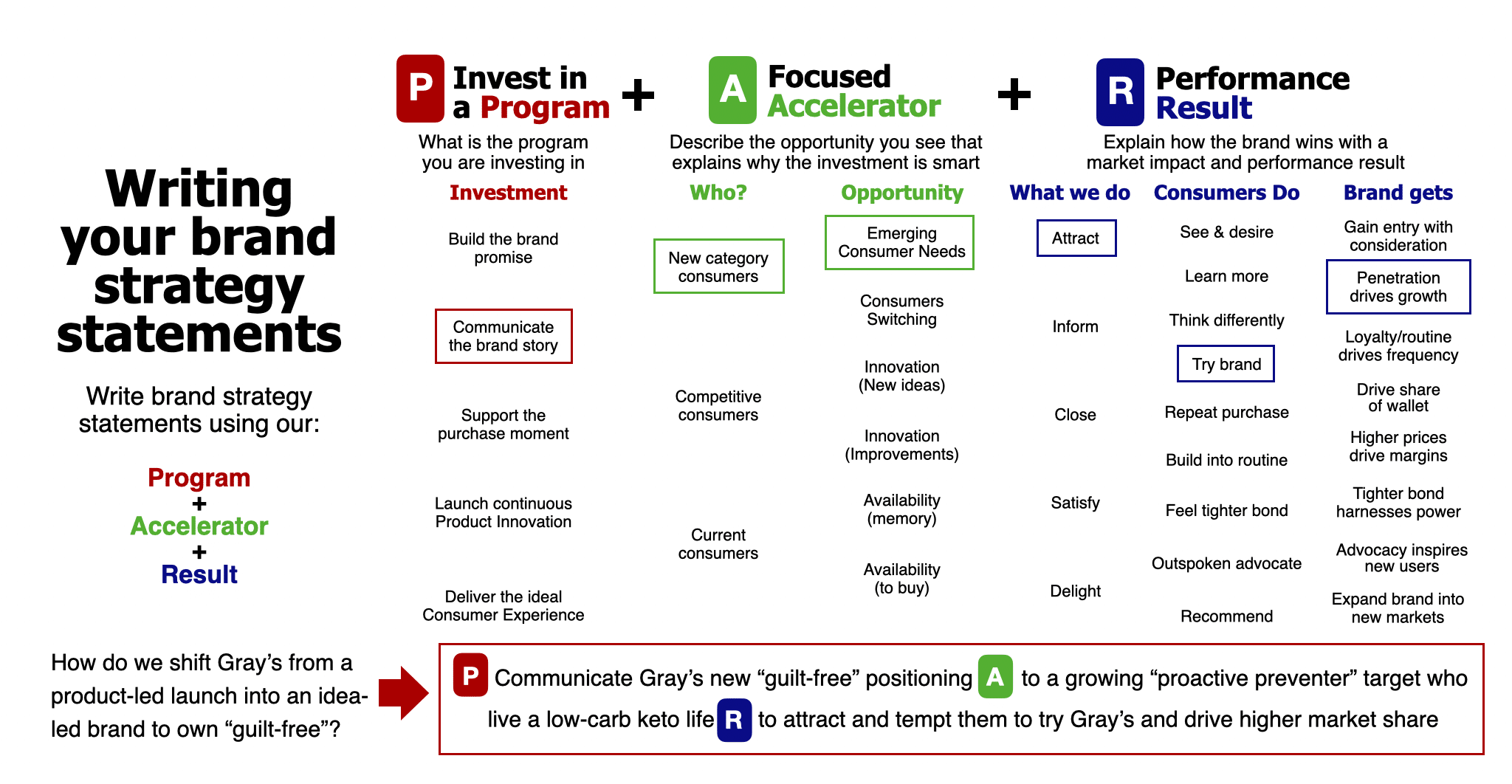
To illustrate how consumer marketers must write strategy, click to zoom in. Essential to know in brand management.
Is your marketing team meeting your expectations?
🛠️ We build essential Marketing Skills
Our Beloved Brands Marketing Training program equips your team with the core skills required to raise performance, including brand analytics, strategic thinking, positioning, planning, and execution.
📈 Marketers will work on their own brand
We drive real performance improvement by having marketers apply every tool, method, and framework directly to their own brands. They build their brand’s business review, brand positioning, plan, and creative brief.
🚀 Our marketing coaching is like having a VP in the room
Our hands-on coaching recreates real-world pressure, expectations, and decision-making—the same standards encountered in leadership meetings and boardrooms.
🌍 Custom-Tailored Marketing Training Programs
We tailor each program to your business model — Consumer, B2B, Retail, and Healthcare — using industry-specific examples that make it easy for teams to apply learning immediately.

Brand Positioning
Brand Positioning uses your brand’s core strength to connect with consumers and move them along their journey
A winning Brand Positioning creates an idea that motivates consumers and owns a defendable space in the market.
- The best marketers define a motivated consumer target we know we can win, and build a brand positioning with the highest motivation to consumers, driving both drive penetration and frequency.
- They understand competitors to ensure the brand positioning is ownable in ways that protect the business and drive brand profitability in the long run.
- Then, they summarize into an organizing brand idea that steers everyone who works on the brand who deliver the brand promise, story, product innovation, purchase moment, and consumer experience.
How to define your brand positioning to set up your brand to win
If you do not define your brand, then you run the risk of the possibility that your competitors will define your brand. And you might not like it.
I will show you the homework you must do to figure out a winning brand positioning statement. The tools are designed to help decide who your brand will serve and what you will stand for as a brand. Narrow the target to those consumers who are most capable of loving what your brand does best.
I will show you how to find the ideal balance between the functional and emotional benefits, to find which ones are simple, interesting, motivating, and ownable for your brand.
Below, click to zoom in on our consumer brand positioning process. If you work in brand management, you’d better understand brand positioning.

To illustrate what consumer marketers must know, click to zoom in.

Brands have four choices: be better, different, cheaper, or else not around for long.
As you create your brand positioning statement, look for the ideal space to play and space your brand can win. Your brand might be fast, but if your competitor is even faster, then you will lose out if you try to play in that space.
Defining the ideal target market
Most marketers think of the type of consumers they want to attract. Why not change your thinking and go after those consumers who are already motivated by what your brand offers? So instead of asking, “Who do we want?” you should be saying, “Who wants us?”
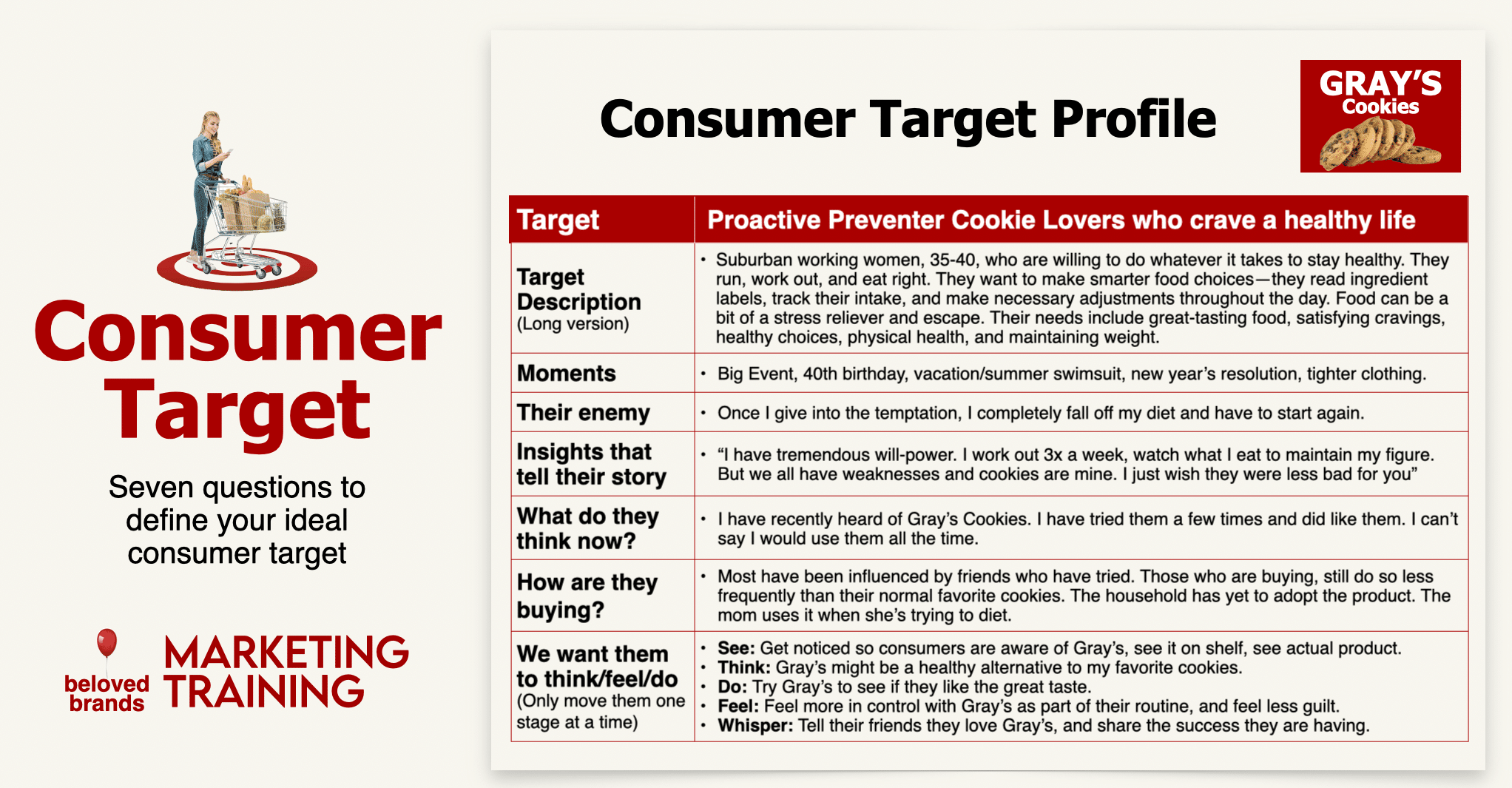
I use seven fundamental questions to define and build a profile of your ideal consumer target:
- Description of the ideal target?
- What are their main needs?
- Who is their enemy who torments them every day?
- What are the insights we know about the ideal target?
- What does they think now?
- How do they buy?
- What do we want them to see, think, do, feel or whisper?
Using the consumer benefits ladder for consumer brands
Once the consumer profile has been completed, brainstorm all possible brand features that give your brand a competitive advantage. Move up to the functional benefits by asking, “So, what do I get from that?” Then move up to the emotional benefits by asking, “So, how does that make me feel?”
To help brand leaders, I have created benefit cheatsheets with over 50 potential functional benefits and 40 potential emotional benefits. We show how to build your brand positioning around the right benefits. Then, add in the ideal reasons to believe that allow you to complete the brand positioning statement. Below is the brand positioning statement for Gray’s Cookies

Building your brand idea
To me, the brand idea simplifies everything, not just for the consumer or channel customers, but for everyone working on the brand. The dictionary definition of the word “idea” means a thought, opinion, belief, or mental impression. A brand idea must be all those things. Consumer marketers must know how to define their brand idea. Describe the products or services. What is the consumer reputation? What about influencer reputation? Cultural inspiration? And, then figure out the brand idea.
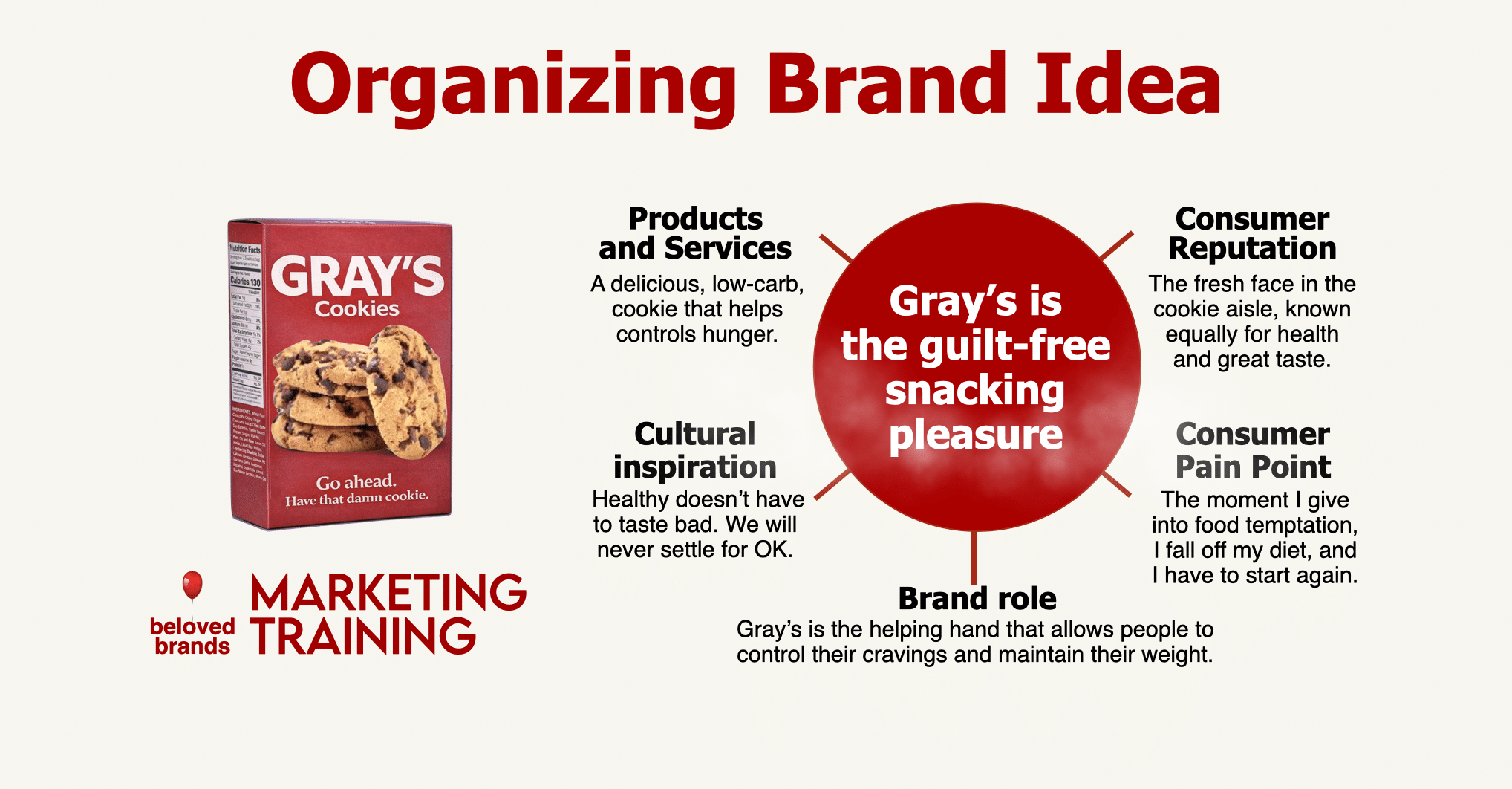
To illustrate what consumer marketers must know, click to zoom in.
Brand idea checklist
For consumer brands, find a brand idea that is interesting enough to engage and entice consumers on a first encounter to want to know more. Keep it simple enough to gain entry into the consumer’s mind.
Your idea must be easily layered to organize everything you do to match up with the five consumer touchpoints, including the brand promise, brand story, innovation, purchase moment, and consumer experience.
Build a brand reputation
The idea must be unique enough to build a reputation so consumers will perceive the brand as better, different, or cheaper. It must be able to motivate consumers to think, feel, and act in ways that benefit your brand. And, it must embody the brand’s inner soul, inspiring employees to deliver the brand promise and create amazing experiences.
Finally, the brand idea must be ownable so no other competitor can infringe on your space, and you can confidently build your brand reputation over time.
Brand Plans
Use the Brand Plan to set up investment decisions and organize everyone who works on the team
The strategic plan defines the investments that match marketing goals to P&L goals.
- The best marketers use a plan to define how the brand’s resources will be invested to build communications, innovation, and retail capabilities that link marketing goals (penetration, frequency) with business goals (sales, margin, profit).
- Each strategy statement must include the program investment in capabilities, a focused accelerator that shows the strategy will work, and performance results tied to the business results.
- The best marketers use the plan to organize everyone who works on the brand and set up smarter execution decisions that always focus on the expected results.
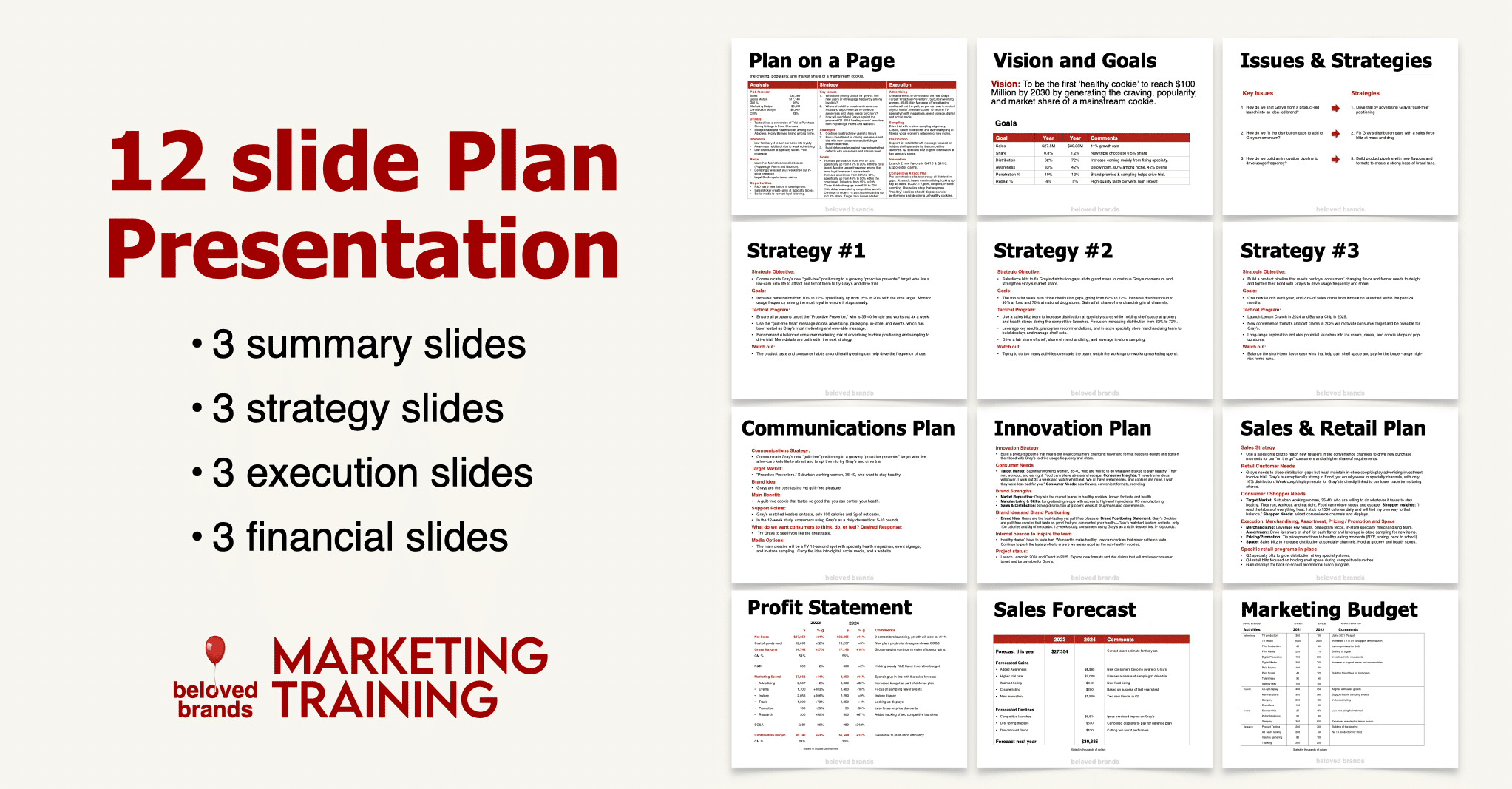
Consumer marketers must look at the plan as a decision-making tool that guides everyone who works on the brand. We teach how to come up with the brand vision, purpose, goals, key issues, strategies and marketing execution plans. If you are a consumer marketer, you need to know how to build a plan.
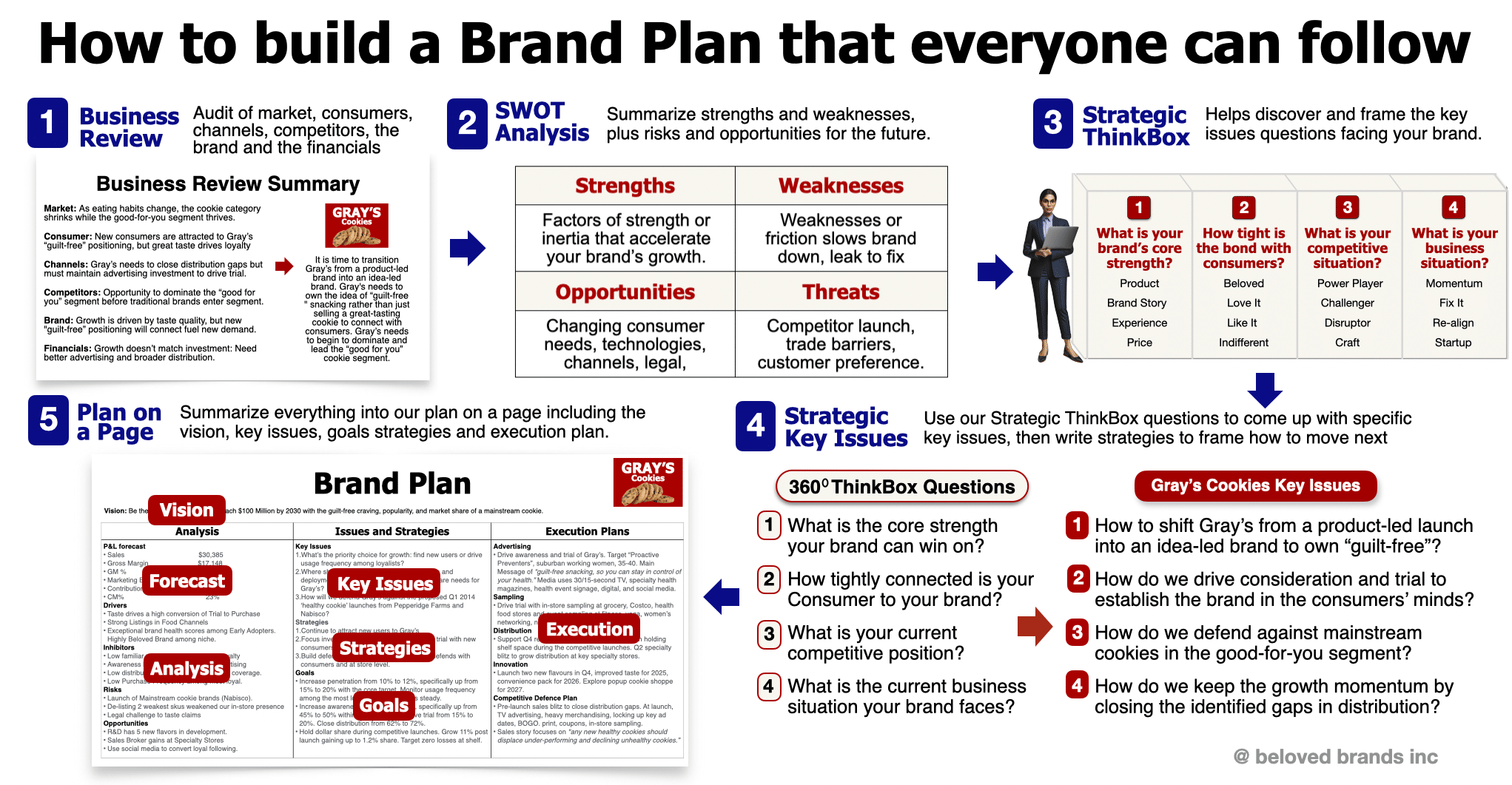
To illustrate the consumer brand plan process, click to zoom in. Essential in brand management.
As you write the annual brand plan, use the vision to steer the decisions. Then lay out the key issues and strategies as the guts of the plan. Lay out in a one pager. Or, use our Consumer Brand Plan template presentation.
Analysis:
The analysis section lays out the summary from the deep-dive business review with an overview of the top three points, which envelop what is driving your brand’s growth, what is inhibiting your brand’s growth, which threats could hurt your brand and what opportunities your brand faces.
Key issues and strategies:
The key issues and strategies section focuses on the top three issues getting in the way of achieving your vision, which you should put in question format. Moreover, the strategic solutions are the answers that match up to each of those questions. Set goals to measure your brand’s performance against each strategy.
Execution section:
The execution section maps out the specific plans for each of the chosen execution areas that aligns with the most essential consumer touchpoints.
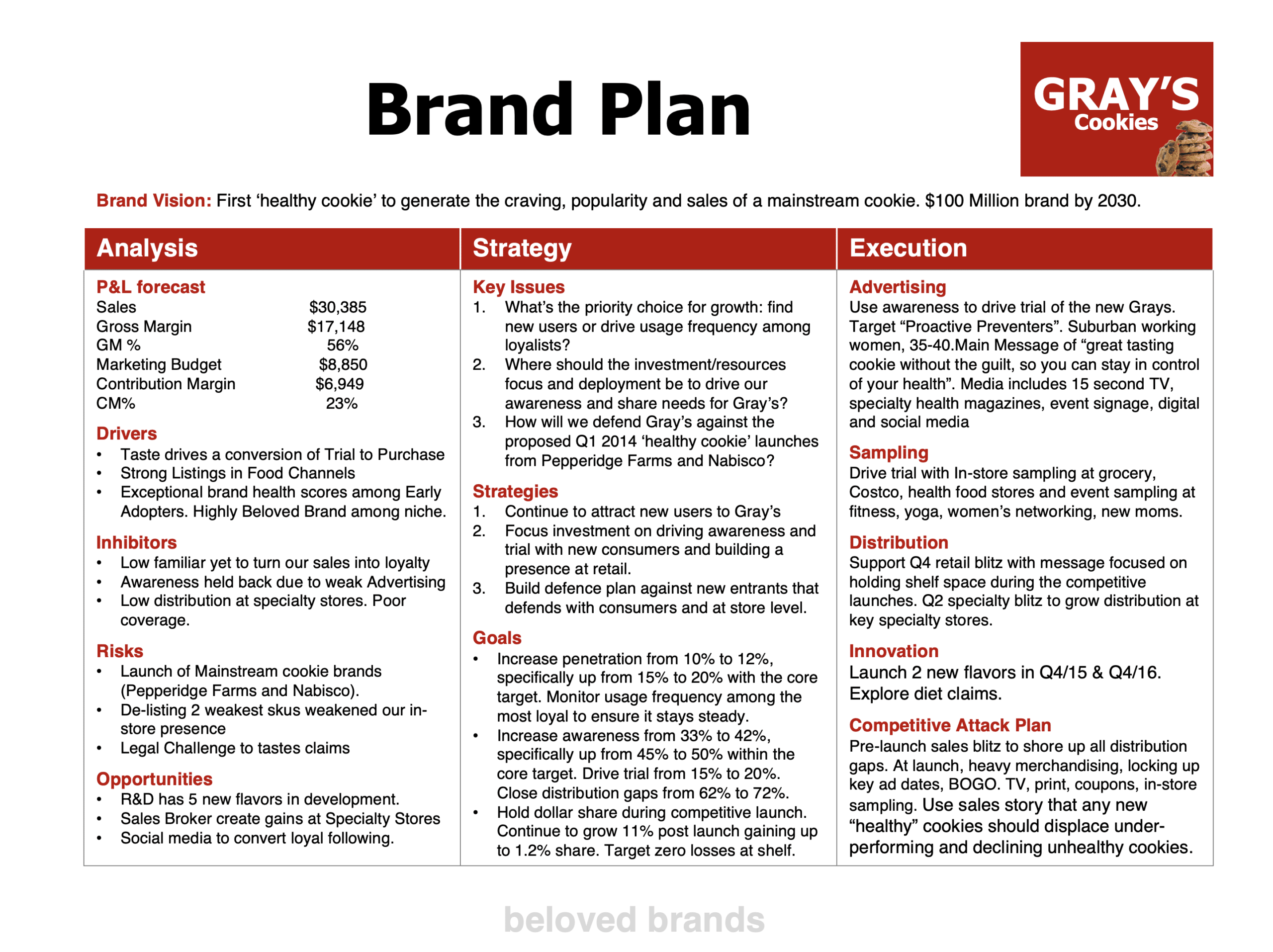
To illustrate how to do a consumer Marketing plan, click to zoom in.
I first came up with this “brand plan-on a page” format when I led a team with 15 brands. It helped me see the big picture quickly, rather than having to hunt through a big thick binder. Also, the sales team appreciated the ability to see the entire plan on one page quickly. Most salespeople also had 15 brands to manage with each of their customers. Everyone who works on your brand should receive the one-page plan and keep it close by to steer their day-to-day decisions.

Marketing Execution
Make smart, creative Marketing Execution decisions that executes on the strategy and deliver expected results
- The best marketers communicate strategies to experts and make decisive, effective execution decisions that focus on the ideal target, fit the brand’s strengths, deliver the main message, and execute the strategy.
- They lead advertising, product innovation, and in-store activities that attract, link to the brand, communications, and sticks (execution goals) in ways that resonate and move consumers along the journey (funnel) to drive marketing goals (penetration and frequency) and links to business goals (sales, margin profits).
- They create executional magic that reflects the analytics, strategic thinking, brand positioning, and the work of the brand plan.
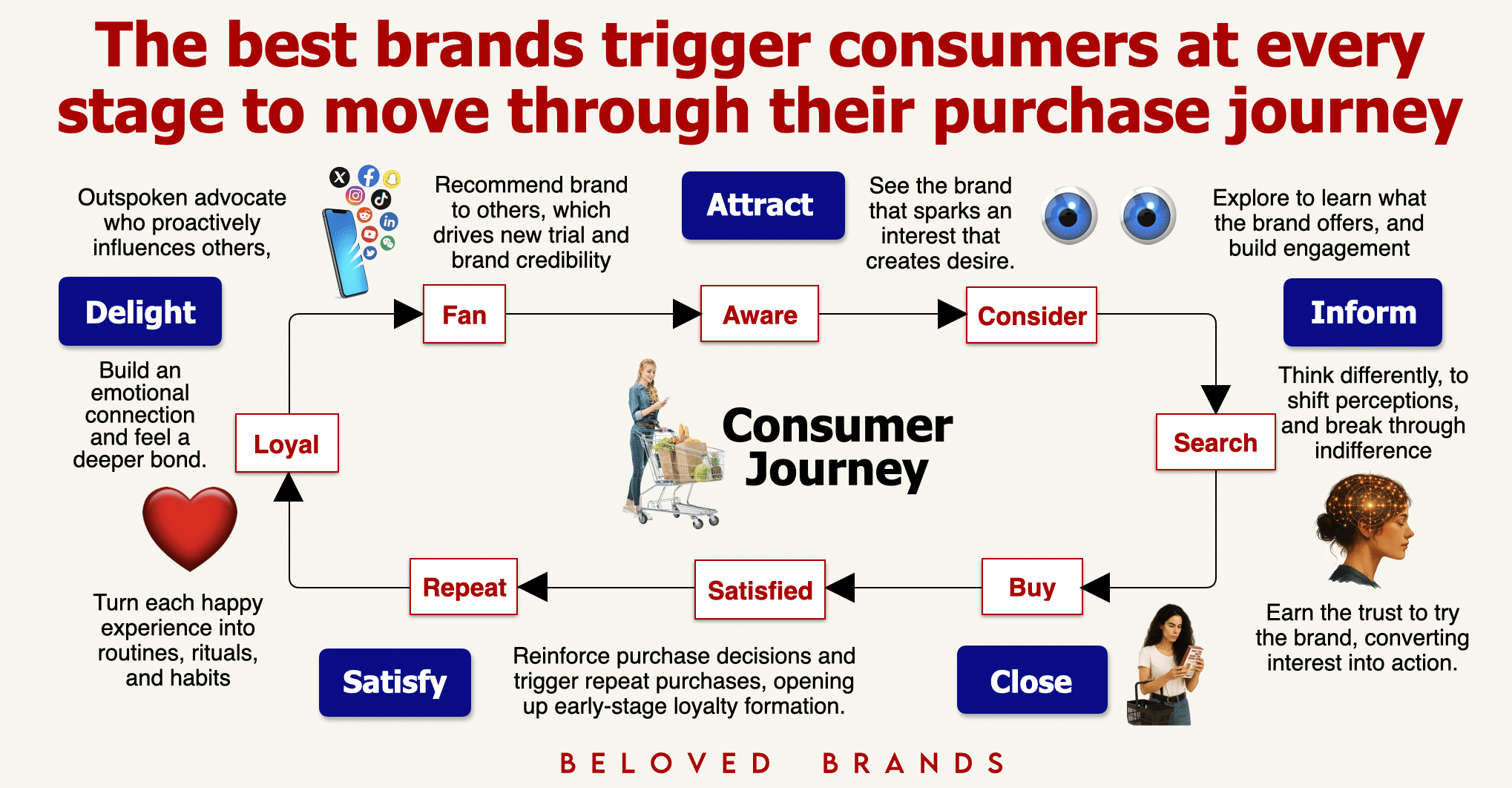
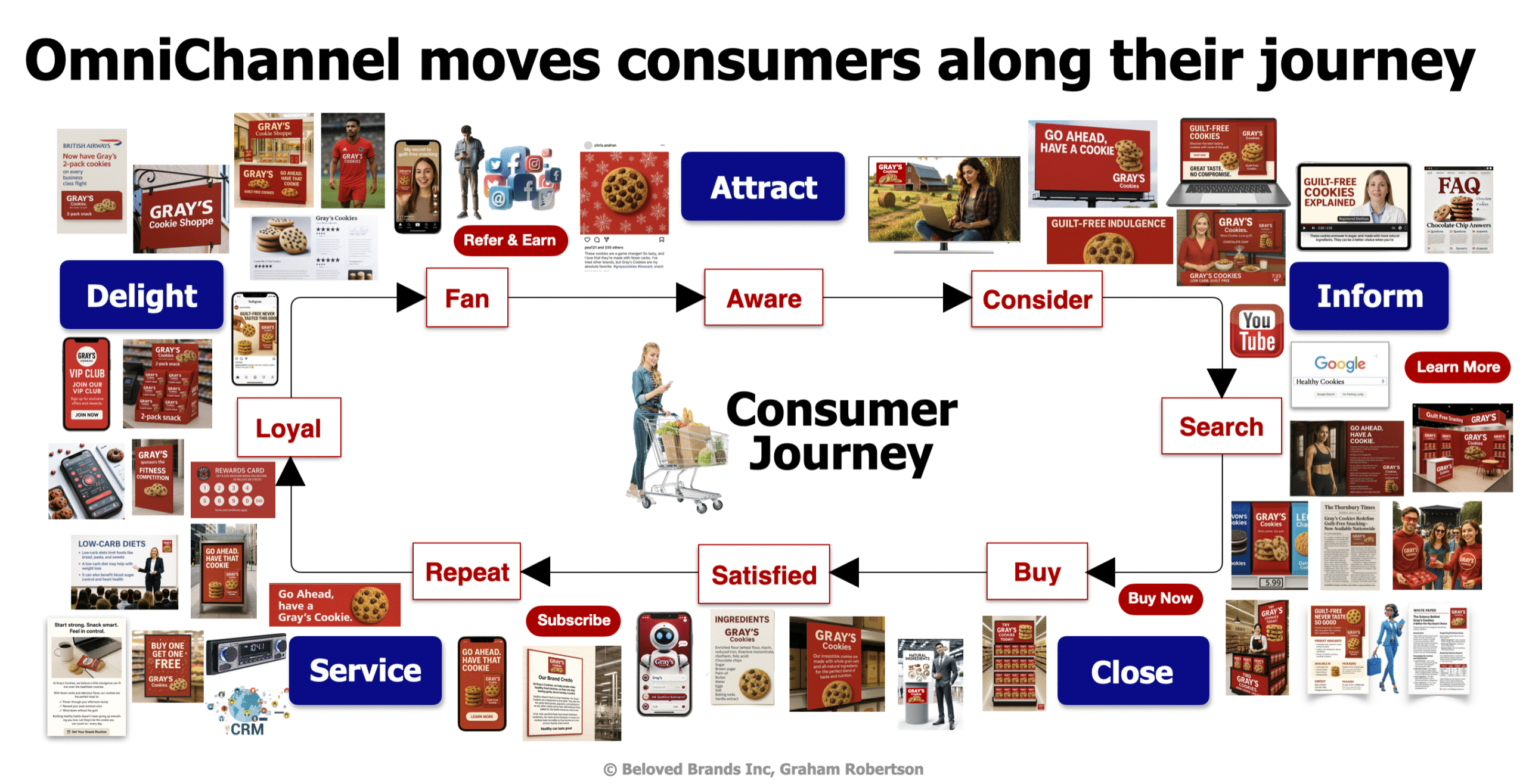
While we talk a lot about consumer-based social media options, we are seeing bigger opportunities for consumers brands. It allows us to find prospects and move them through their journey. We look at attract, inform, close, service and delight.
Attract and inform
To drive awareness, you need your marketing communications to stand out and be seen in a crowd using messaging that balances being creatively different and strategically smart. When your messages are smart but not different, they get lost in the clutter. On the other hand, when your messages are different but not smart, they will entertain consumers, but do nothing for your brand. Your communications must be smart enough to trigger the desired consumer response to match your brand strategy.
To move consumers to the consideration stage, use influencers to teach those who seek to learn more. Use public relations to make the brand part of the industry news, whether through traditional, social, or blogger channels. Engage online user reviews or industry-specific review sites.
For more complex or higher risk purchase decisions, many consumers will rely on search for almost everything, even if to confirm what makes sense. Consumers marketers can use search sites, such as Google, expert review sites, and online content or long copy print media.
Over the last decade, I see a shift where consumers prefer to take the time to do their own research rather than a face-to-face call from a sales rep. Think of how you now buy a car. You do all the work before you get to the dealer. The brand website comes into play and should include the right information to close off gaps or doubts, then move consumers towards the purchase decision.
Servicing through account based marketing
Account-based marketing (ABM) can be used to move consumers along their purchase journey to help trigger an initial purchase with displays, trial programs, or sales materials to prompt consumers. Remarketing is a great tool to push consumers who might feel stuck at the consideration stage to reconsider and buy.
After the purchase, use the account-based marketing to turn usage into an early purchase into a ritual among your most loyal users. Cultivate a collection of brand fans, using VIP programs and experiential events with exclusive deals — layer in emotional marketing communications to tighten the bond.
Delighting those who love the brand
Once you have a strong base, you can mobilize your brand lovers by intentionally creating shareable experiences, which will trigger brand lovers to share your brand communications with their network through social media. With the new social media tools, the smartest brands are getting their most engaged consumers to drive awareness by sharing your message – and even enthusiastic user-generated content.
As you shift to engaging individuals, recognize the stage they are at, and then match up your marketing communication to their specific needs.
The long and the short of building a brand.
The long and short of building your brand through media strikes a balance between long-term brand building and short-term sales activation. There is a lot of proof in the marketing world that half your marketing efforts should focus on brand building and the other half on transactions. We are seeing too many brands go for the short-term sale, without establishing the brand.
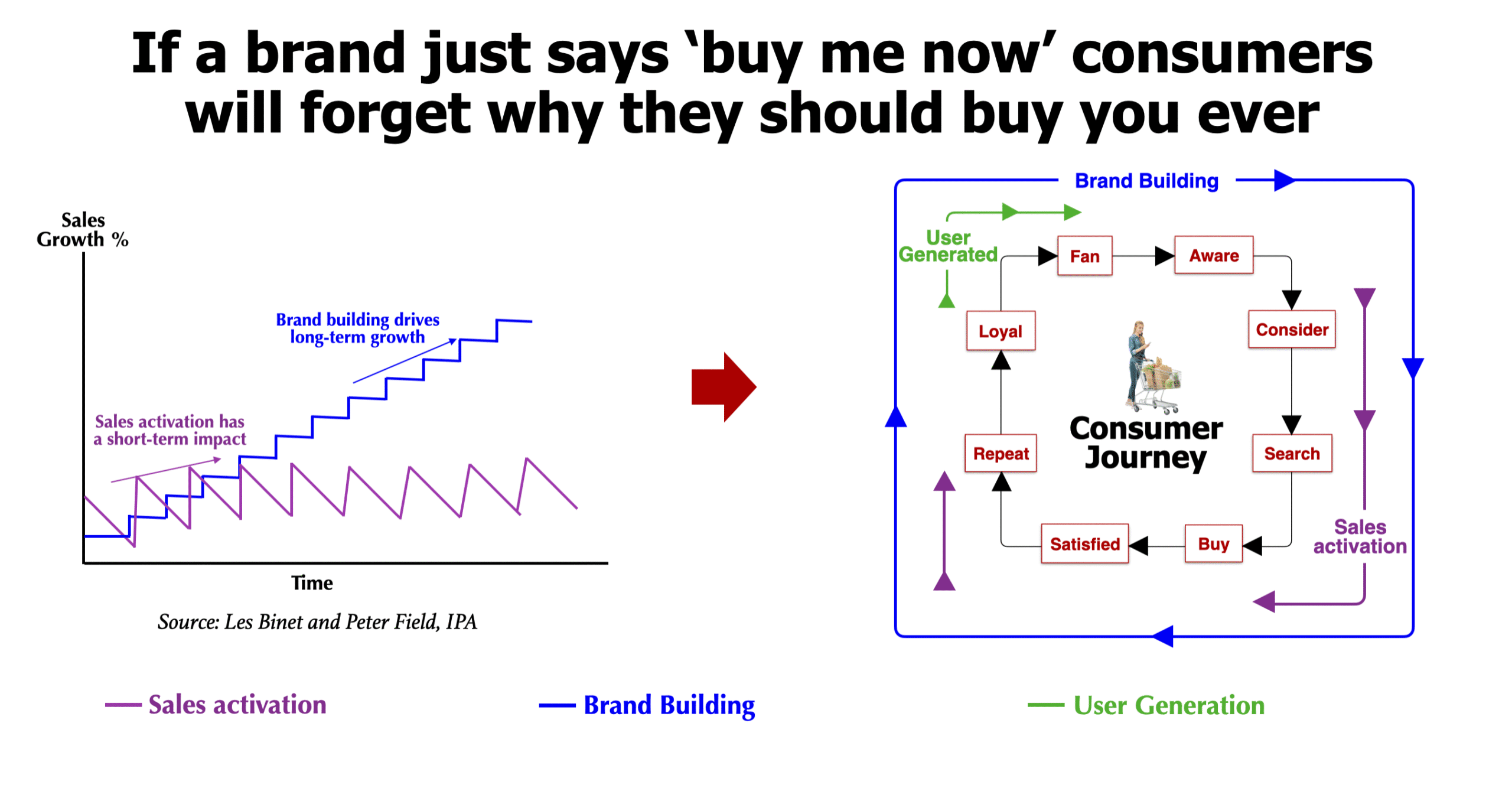
How marketers need to work the long and short work together to build your brand.
I like to use brand-building anthemic advertising to establish the brand positioning, to create an emotional connections with your target audience, to strengthen brand identity, and foster consumer loyalty.
Brand-building establishes a sustainable competitive advantage and brand love, which translates to increased sales growth, market share, and profitability over time.
Short-term transactional advertising pushes for immediate results, such as boosting sales, increasing website traffic, or generating leads. These campaigns often leverage desires and impulses, promotions, discounts, or limited-time offers to create a sense of urgency and drive quick consumer actions.
While short-term advertising can yield immediate returns, over-reliance on this approach can harm brand equity and long-term growth. If all you do is say “buy me now” consumers will not know why they should ever buy you.
Brands must skillfully balance their advertising strategies to ensure both short-term gains and long-term success. By aligning brand-building efforts at the beginning of the consumer journey and employing transactional advertising to close the sale, brands can create a cohesive experience for their audience.
Moreover, using personalized messaging to engage loyal brand fans helps establish brand rituals, fostering a deeper and more enduring connection with consumers to drive a foundation for lasting brand power and affinity.
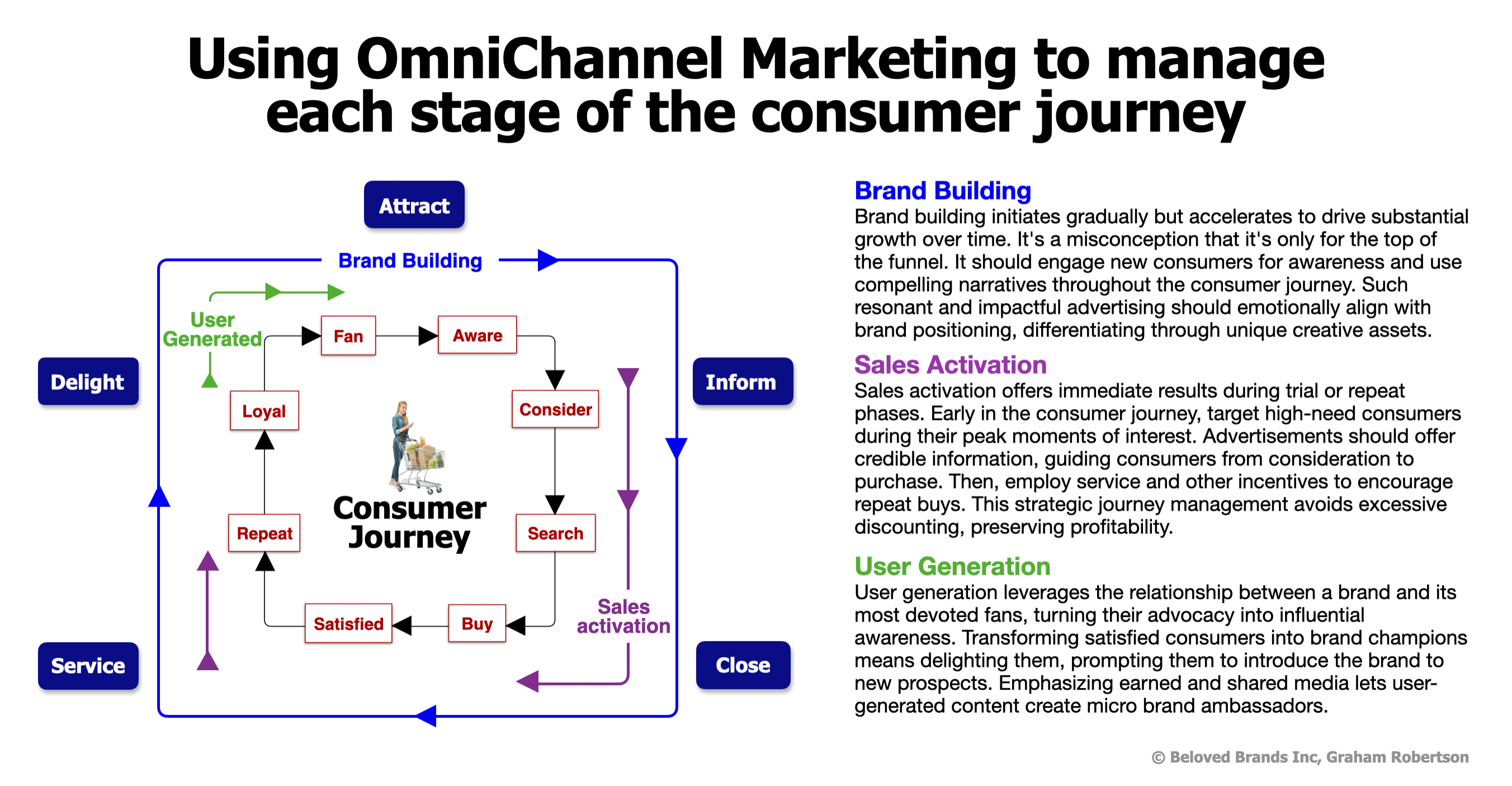
First, let’s illustrate the interplay of brand building, sales activation, and user-generated content. The diagram above showcases their combined influence on the consumer’s journey.
Brand Building
Brand building initiates gradually but accelerates to drive substantial growth over time. It’s a misconception that it’s only for the top of the funnel. It should engage new consumers for awareness and use compelling narratives throughout the consumer journey. Such resonant and impactful advertising should emotionally align with brand positioning, differentiating through unique creative assets. Paid media provides extensive reach using an always on strategy, bolstered by standout placements. Integrate owned media for consumers seeking more details.
Sales Activation
Sales activation offers immediate results during trial or repeat phases. Early in the consumer journey, target high-need consumers during their peak moments of interest. Advertisements should offer credible information, guiding consumers from consideration to purchase. Then, employ service and other incentives to encourage repeat buys. This strategic journey management avoids excessive discounting, preserving profitability. Utilize a mix of paid, earned, owned, and shared media to envelop the consumer.
User Generation
User generation leverages the relationship between a brand and its most devoted fans, turning their advocacy into influential awareness. Transforming satisfied consumers into brand champions means delighting them, prompting them to introduce the brand to new prospects. Emphasizing earned and shared media lets user-generated content create micro brand ambassadors. Use CRM (Customer Relationship Management system) for personalization that deepens connections, turning everyday habits into cherished rituals.
There are so many media choices. Make sure you choose the right one to move consumers along their journey.
Take a look at our fmedia chart below. While it looks a bit cluttered, it shows how many choices there are in an OmniChannel Media world that can help you deliver at each stage of the consumer journey.
Beloved Brands Marketing Training
Our consumer marketing training will make your marketing team smarter so they deliver their best possible performance on your brand. At Beloved Brands, we empower the ambitious consumer marketers to achieve the extraordinary. Below is our brochure for our training programs. If you work in brand management, this is your course.

Frequently Asked Questions - Consumer Marketing
What is consumer marketing?
Consumer marketing is the practice of building and managing brands that connect directly with individual buyers rather than businesses. It covers everything from understanding consumer insights and defining brand positioning, to writing marketing plans, managing a P&L, directing advertising, winning at retail, and driving product innovation. Consumer marketers are responsible for the full brand experience — from the first time a consumer hears about the brand through to the moment they become a loyal advocate.
What skills does a brand manager need to succeed?
The strongest brand managers are capable across five areas. Analytics come first: they reflect what’s actually happening in the market rather than relying on assumptions. Strategic thinking narrows it to the right issues and the right places to compete. Brand positioning gives consumers a clear, compelling reason to choose the brand. Planning connects that strategy to financial outcomes. And execution, across advertising, innovation, retail, and consumer experience, moves consumer behavior. Weakness in any one area limits how far a brand manager can go.
How is brand management different from general marketing?
Brand management takes a broader ownership of the brand than most marketing roles. A brand manager isn’t just responsible for campaigns or communications — they own the full business, including the P&L, the innovation pipeline, the retail strategy, the consumer relationship, and the long-term positioning. It requires both strategic thinking and executional capability, and the ability to lead cross-functional teams across sales, finance, R&D, and operations toward a common brand direction.
What does brand management training cover?
Good brand management training builds capability across the full range of skills the job requires. At Beloved Brands, our training covers brand analytics and business reviews, strategic thinking and key issue identification, brand positioning and brand concept development, marketing plan writing, creative brief development, media and communications strategy, and how to connect marketing investment to financial results. The training is hands-on and built around real brand examples so marketers can apply the frameworks immediately.
How do I learn how to run a brand?
Running a brand well requires developing skills across analytics, strategy, positioning, planning, and execution simultaneously. The best way to accelerate that development is through a combination of structured training, real-world practice on live brands, and frameworks that give you a consistent way to approach each type of problem. The Beloved Brands playbook and training program are built specifically to give brand managers the tools, frameworks, and thinking models they need to run a brand at a higher level.
What is the difference between consumer marketing and B2B marketing?
Consumer marketing targets individual buyers making personal purchase decisions, often driven by a mix of functional and emotional factors. B2B marketing targets organizational buyers making decisions on behalf of a business, with longer sales cycles, multiple decision-makers, and a stronger emphasis on ROI and risk reduction. Many of the underlying skills overlap — positioning, analytics, planning, and execution all matter in both contexts — but the consumer dynamics, the buying journey, and the role of brand emotion differ significantly between the two.
How long does it take to become a strong brand manager?
Most brand managers develop their core skills over three to five years of hands-on experience, assuming they’re working on brands that give them exposure across analytics, strategy, positioning, planning, and execution. Training programs and structured learning can significantly accelerate that timeline by giving marketers the frameworks and vocabulary to make sense of their experience more quickly. The brand managers who develop quickest are the ones who actively seek feedback, study what the best brands do, and treat every campaign and plan as a learning opportunity.
Who is Beloved Brands brand management training designed for?
Our training is designed for brand managers, senior brand managers, and marketing directors at consumer goods, B2B, and healthcare companies who want to operate at a higher level. We also work with marketing VPs and CMOs who want to build a more capable, strategically aligned team. Clients have included Mondelez, Hershey’s, Keurig Dr Pepper, Honda, the NBA, National Geographic, and Mayo Clinic, across more than 30 countries.