You spend weeks building a 50-slide deck. Leadership sits through it once. The sales team never sees it. The agency gets a summary three months later. And by Q3, nobody can remember what the top three priorities actually were.
The one-page brand plan solves all of that.
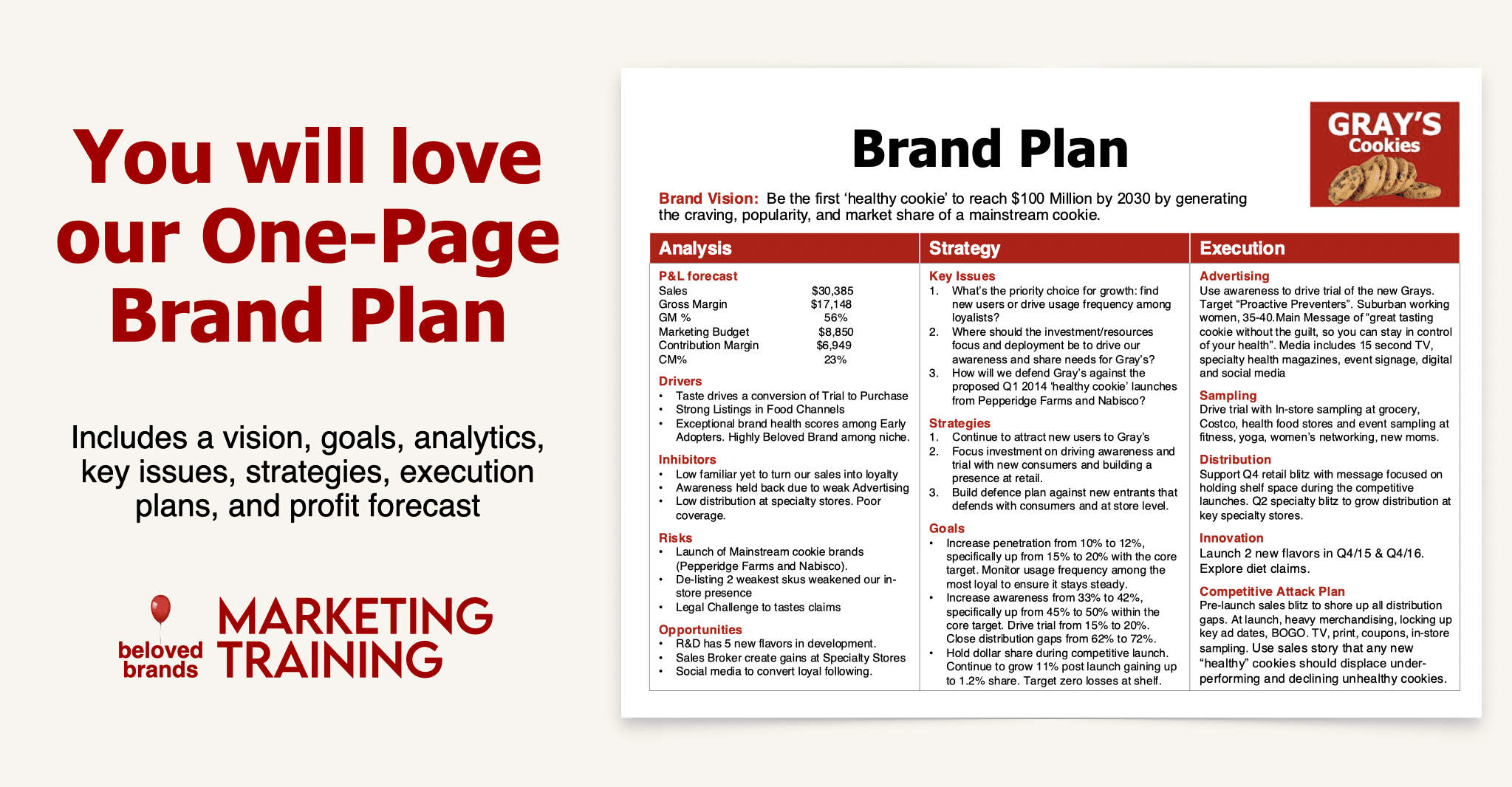
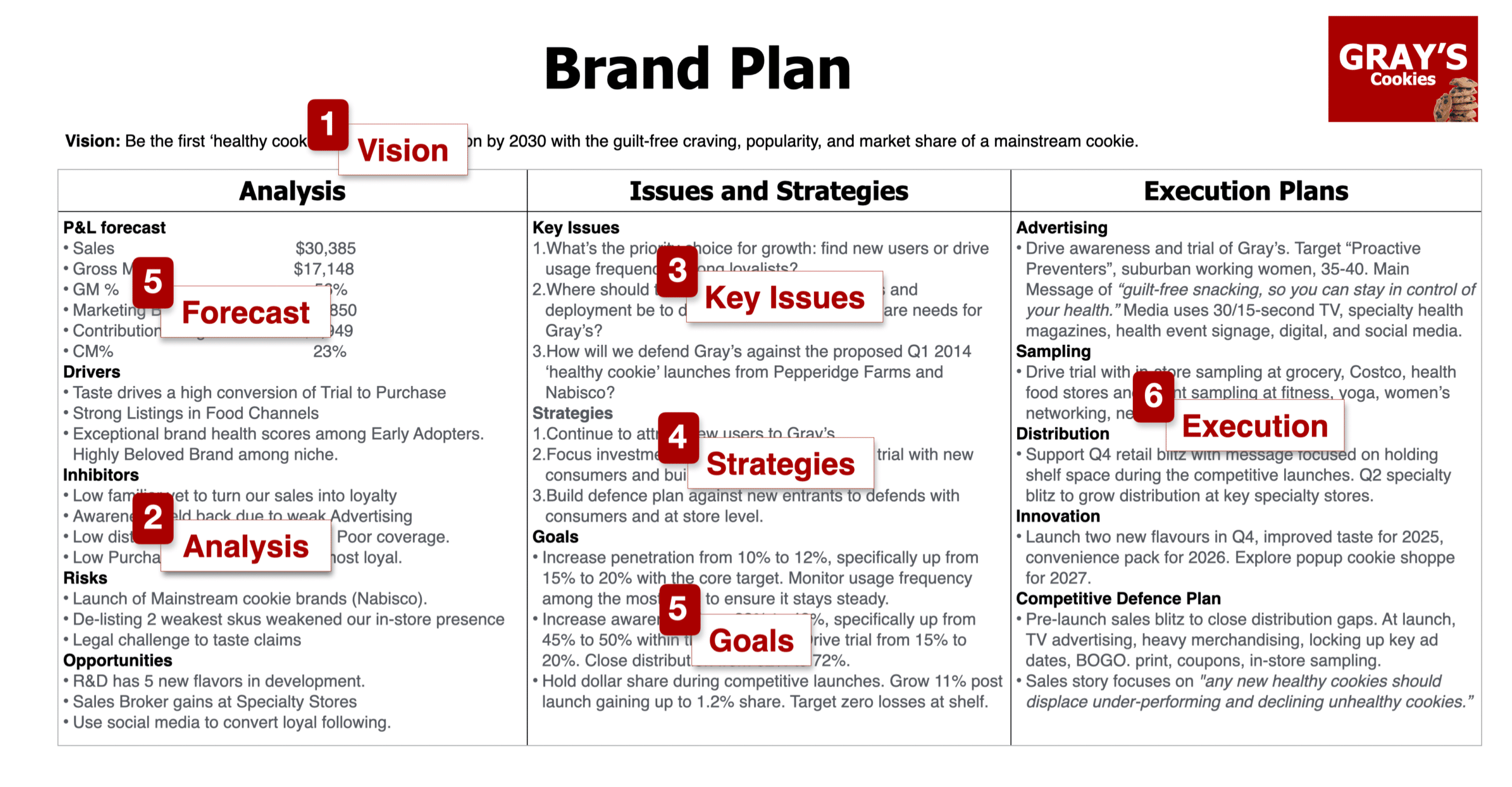
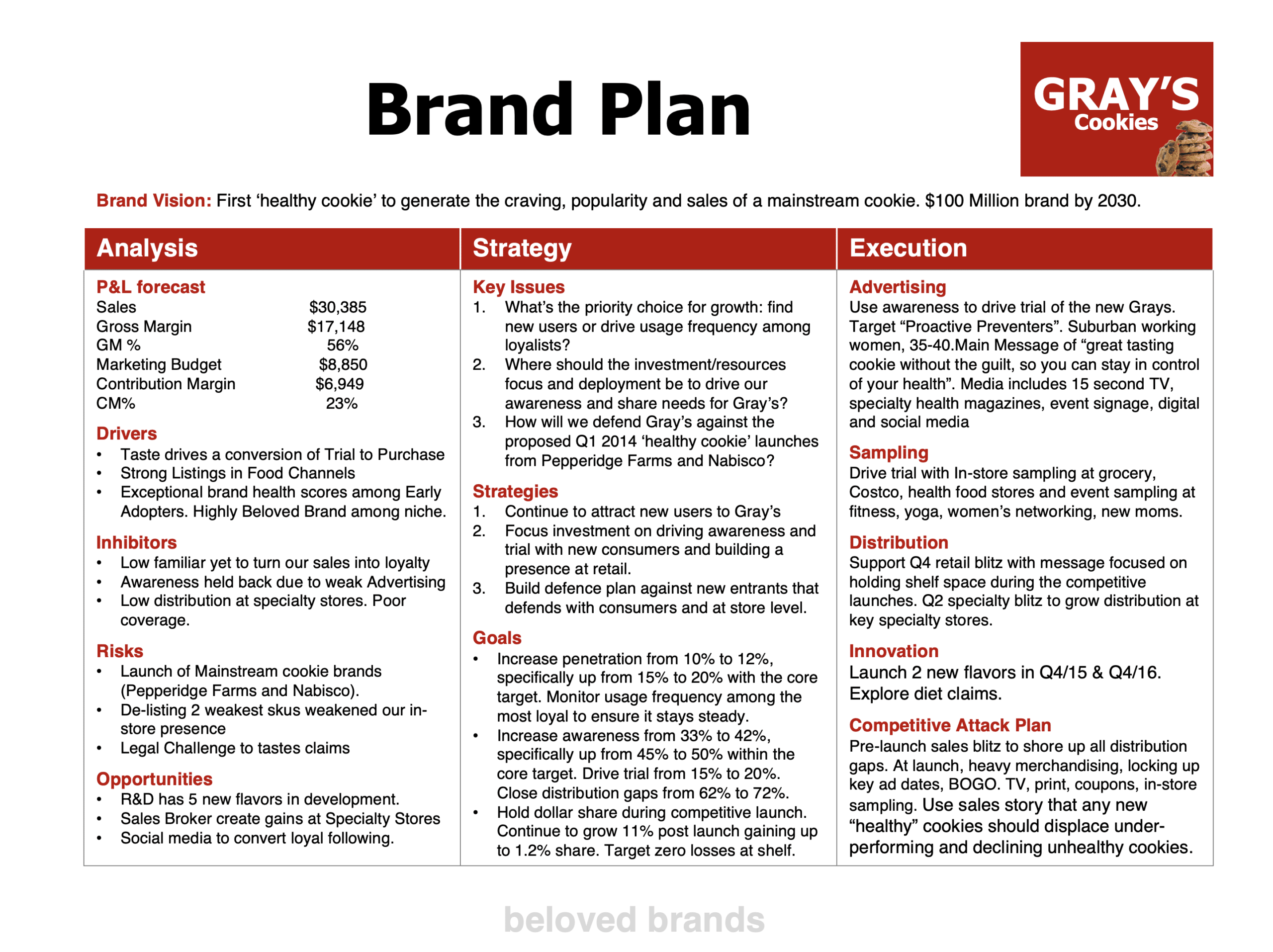
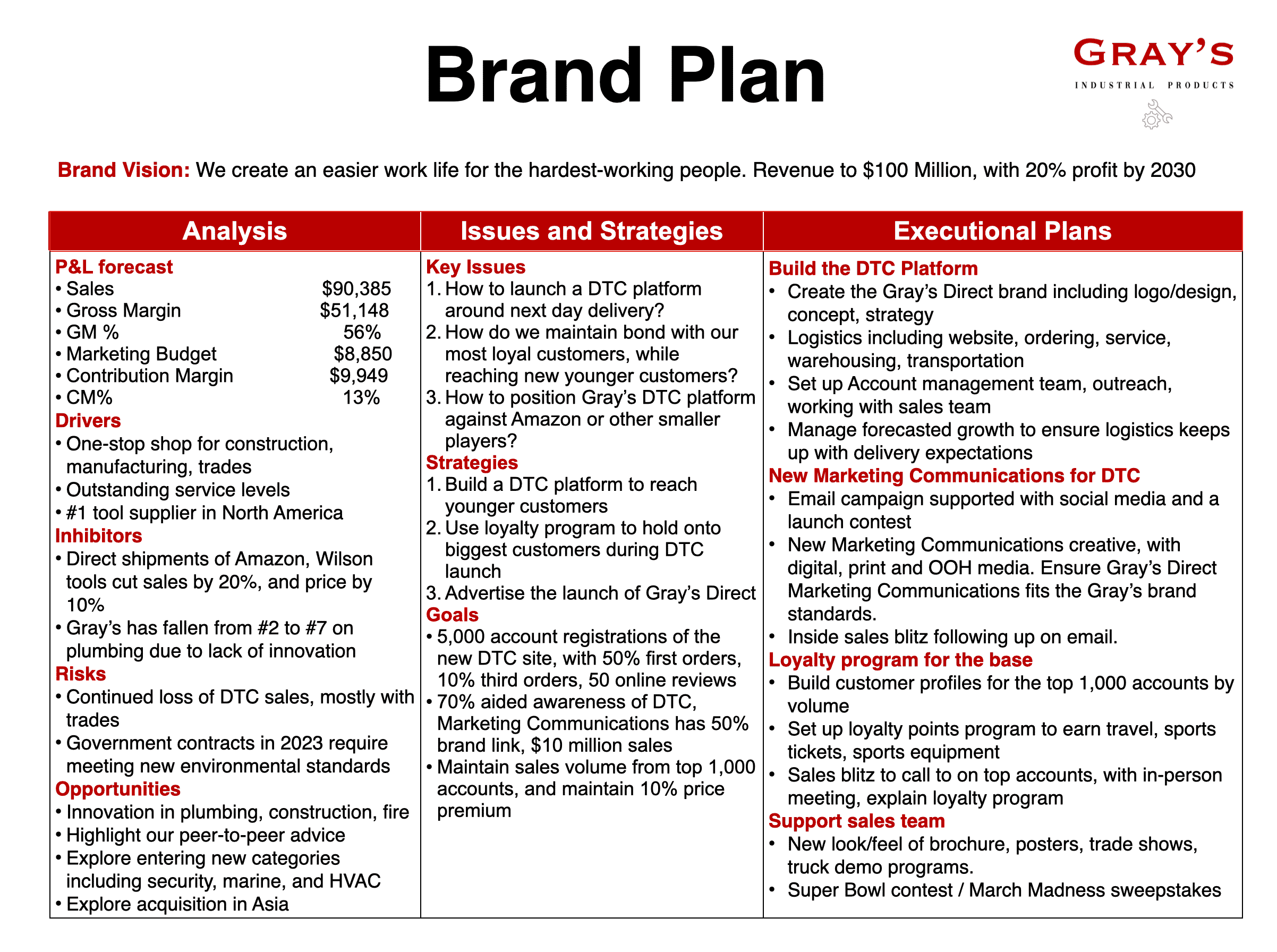
It forces you to make the hard choices — the choices most brand managers avoid by adding more slides. One vision. Three key issues. Three strategies. Nine tactics. Everything your team needs to align around, on a single page they can keep at their desk, pin to the wall, or laminate back-to-back with their execution plan.
I’ve used this format at Coca-Cola, General Mills, and Johnson & Johnson. I’ve reviewed hundreds of brand plans at the VP level. The ones that earned fast approval and drove real results were never the thickest ones. They were the most focused.
This guide walks you through every section of the one-page brand plan. We cover what to write, what not to write, and what separates a sharp plan from a weak one, with real examples so you can see exactly how it works.
What's Inside the Brand Plan Template
Our template covers five core areas:
Vision – where the brand is headed
Analysis – key growth drivers, barriers, threats, and opportunities from your annual business review
Key Issues – the top three strategic questions standing between you and your vision
Strategies & Goals – answers to each key issue, with measurable targets
Execution Plans – specific initiatives mapped to consumer touchpoints (communications, innovation, sales)
How to Write Each Section of the Brand Plan
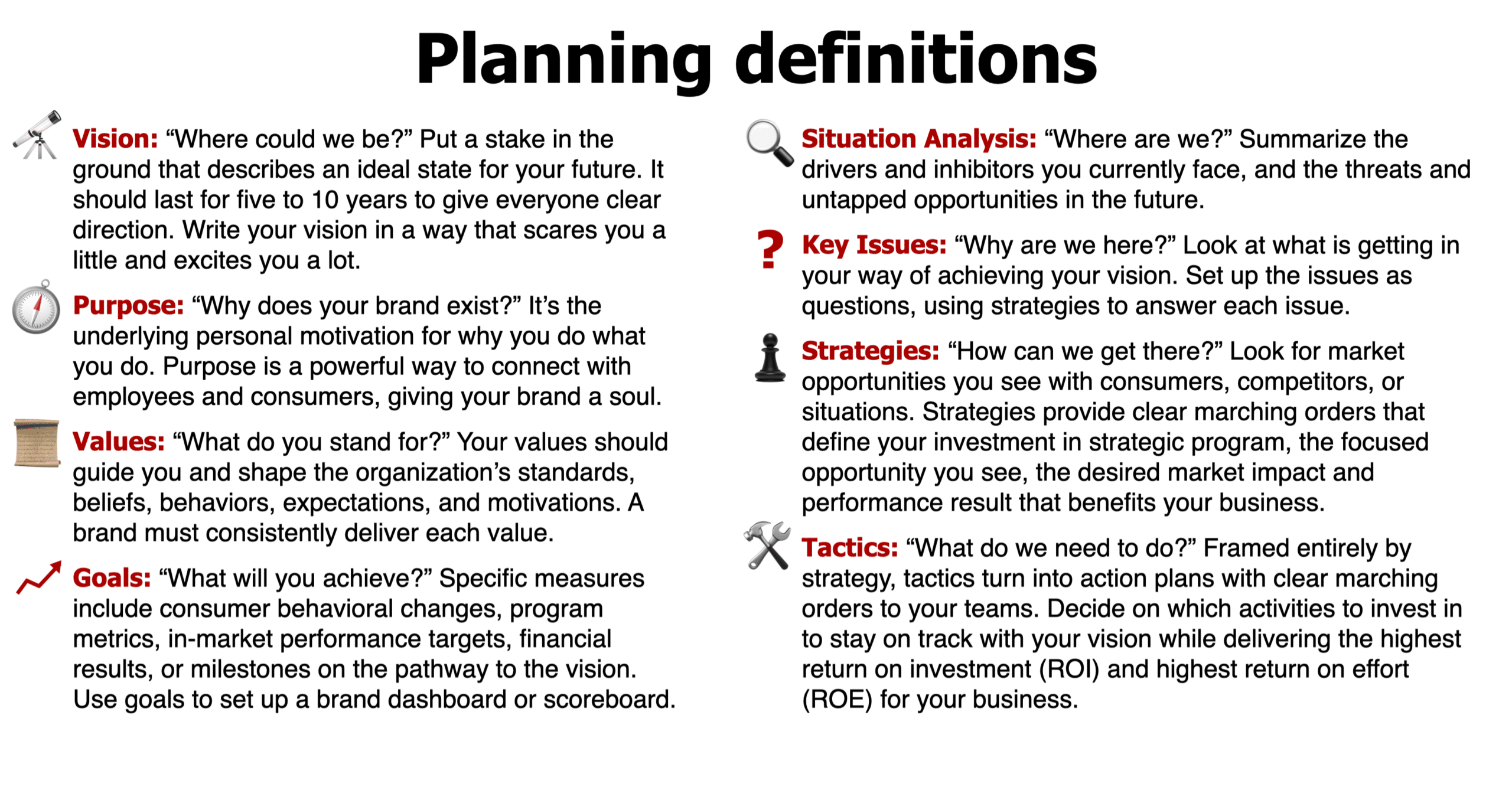
Vision: Where could we be?
Your vision sets the destination. It combines a qualitative future state — what you want the brand to stand for — with a quantitative target that puts a stake in the ground. The mistake most brand managers make is writing a vision that’s either too vague (“be the leader in our category”) or too operational (“grow revenue by 10%”). A good vision scares you a little and excites you a lot.
Weak vision: “Grow Gray’s Cookies to become a leading better-for-you brand.”
Strong vision: “Gray’s Cookies will reach $50M in sales by 2028 by becoming the go-to guilt-free indulgence for health-conscious snackers who refuse to give up on taste.”
The strong version tells you who you’re targeting, what you stand for, and what winning looks like. Every strategy on the page should trace back to it.
Analysis: What does the data tell you?
Before you write a single strategy, you need to know where you stand. Your analysis section should distill your annual business review into four clean summary points:
What is driving growth? — the tailwinds you can accelerate
What is holding growth back? — the barriers you need to overcome
What threats could hurt the brand? — competitive or market risks on the horizon
What opportunities exist? — white space you could move into
The discipline here is brutal editing. Your business review might surface 30 findings. Your brand plan has room for four. Force yourself to choose the ones that most directly shape your strategy.
Gray’s Cookies example:
Driver: Growing demand for low-carb, keto-friendly snacks
Barrier: Low awareness — only 18% unaided among the target
Threat: Major CPG players launching better-for-you extensions
Opportunity: Underdeveloped gym and health food store distribution
Key Issues: What's standing between you and your vision?
Key issues are the three strategic questions your plan must answer. They bridge the gap between where you are (analysis) and where you’re going (vision). Write them as questions — that forces you to think about them as problems to solve, not statements to make.
Weak key issue: “We need to build awareness.”
Strong key issue: “How do we build awareness among health-conscious snackers from 18% to 40% in the next 12 months?”
The strong version is specific, measurable, and time-bound. When you read it, the strategy almost writes itself.
Gray’s Cookies three key issues:
How do we build awareness of Gray’s guilt-free positioning among keto and low-carb snackers?
How do we get health-conscious consumers who try Gray’s once to become regular buyers?
How do we expand distribution into health food and specialty retail to meet the target where they shop?
Strategies and Goals: How will you get there?
Each strategy is the direct answer to its key issue. Use this formula: invest in [program] focused on [target/opportunity] to drive [result].
Each strategy needs a measurable goal attached — a lagging indicator that tells you whether it worked.
Gray’s Cookies strategies:
Strategy 1: Invest in digital and influencer communications targeting the keto community to build awareness of Gray’s guilt-free positioning and drive trial — Goal: grow unaided awareness from 18% to 35%.
Strategy 2: Launch a loyalty and sampling program at point of purchase to convert first-time buyers into repeat purchasers — Goal: improve repeat rate from 22% to 40%.
Strategy 3: Expand distribution into 200 health food and specialty retail locations by Q3 — Goal: increase distribution from 1,400 to 1,600 SKU-weighted outlets.
Execution Plans: What specifically will you do?
Execution plans are where strategy meets reality. For each strategy, map out the three tactics that will make it happen — the specific programs, campaigns, or investments your team will execute.
Each tactic should have an owner, a timeline, and its own measurable goal. This is where the one-page format connects to your full marketing plan, creative brief, innovation plan, and sales plan.
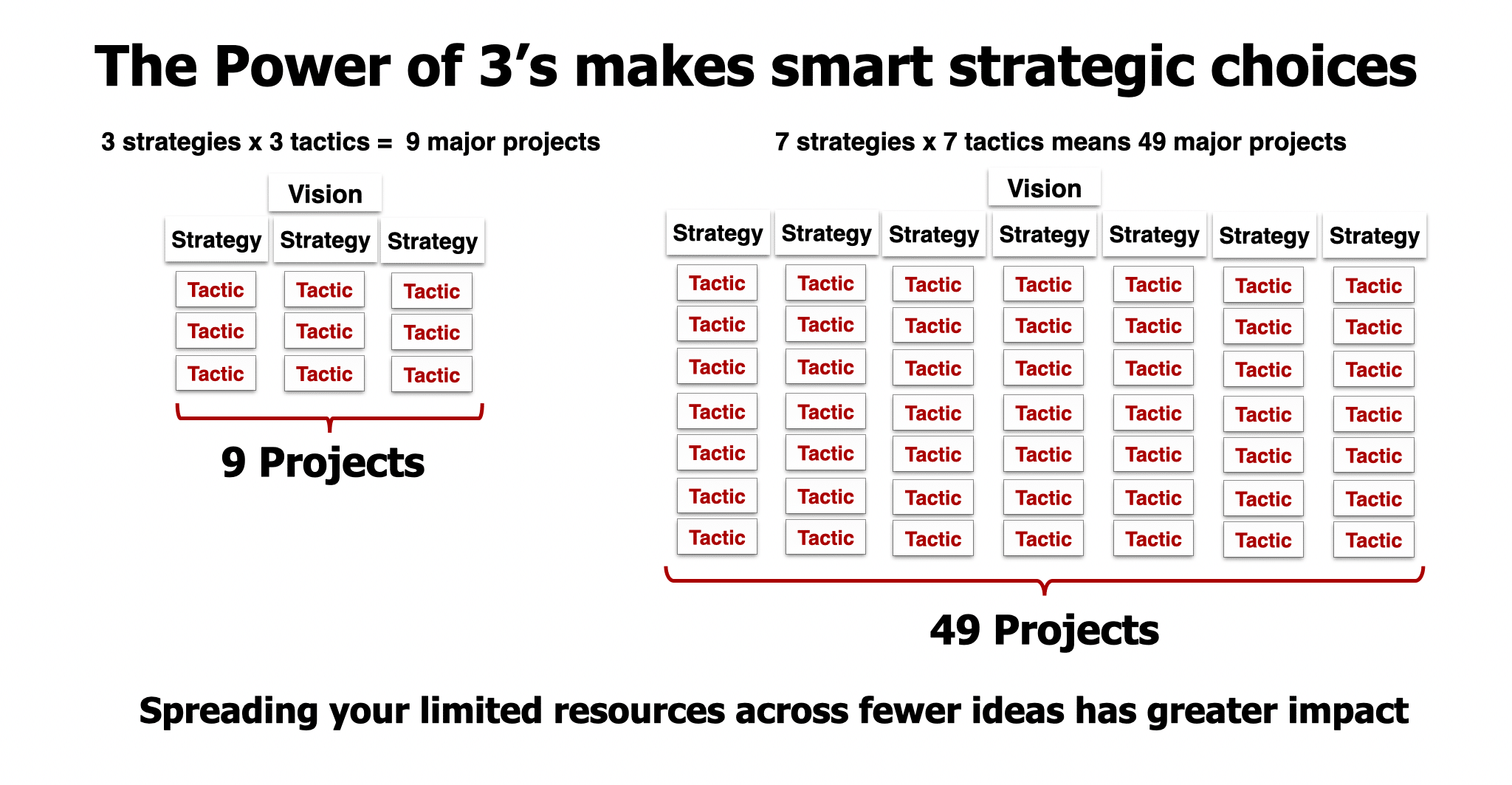
The Power of Threes:
3 strategies × 3 tactics = 9 focused projects your team can execute brilliantly. Compare that to 5 × 5 = 25 projects, or 7 × 7 = 49. With 49 projects and a finite budget, nothing gets the resources it needs to work. With 9, everything does.
A focused plan isn’t a small plan. It’s a smart one.
Back-to-Back One-Pagers for Every Team
Pair the plan with a relevant execution document for each function. Laminate them back-to-back so everyone keeps their version close at hand:
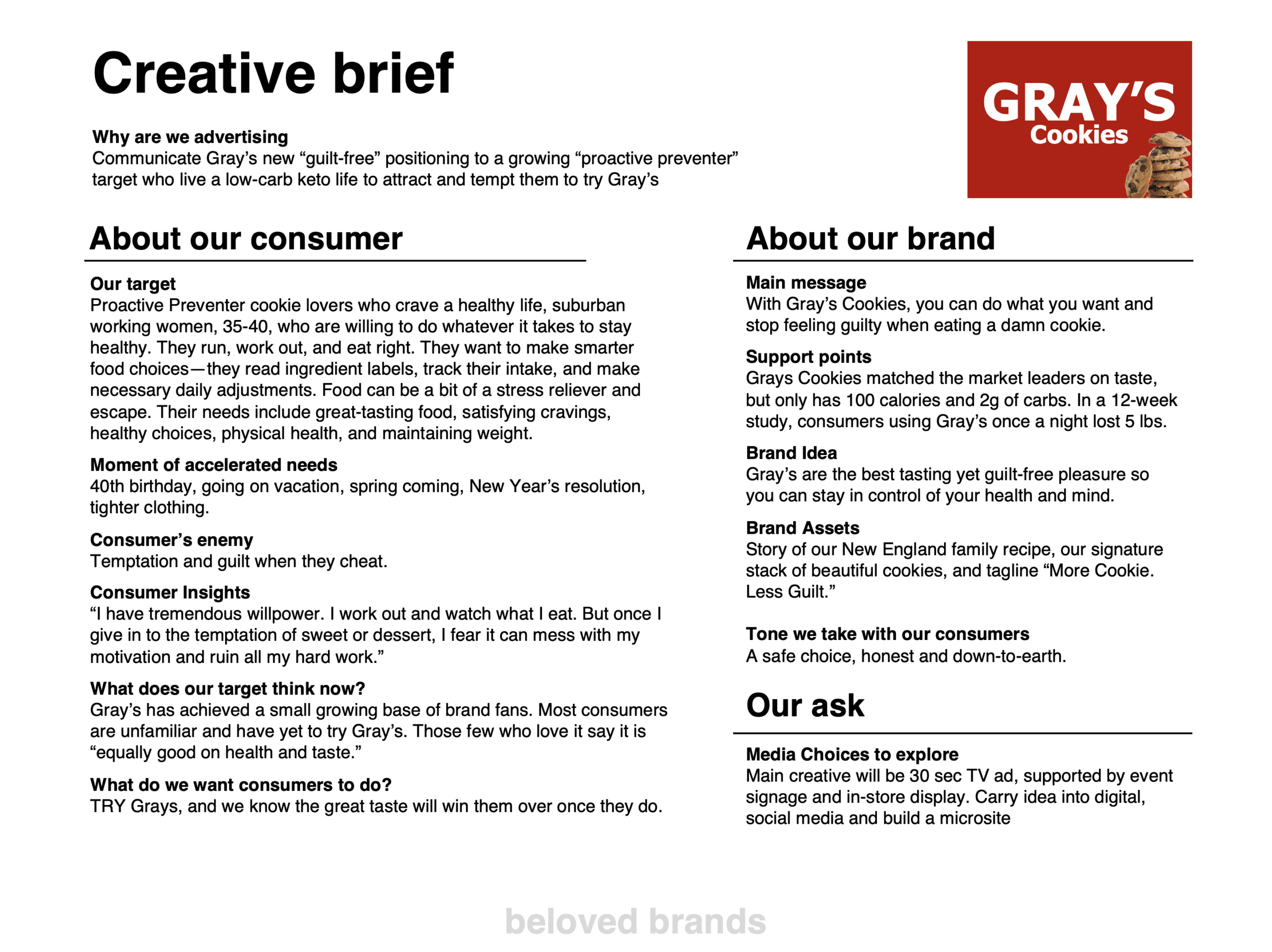
Ad agencies: Brand Plan + Creative Brief
R&D: Brand Plan + Innovation Plan
Sales: Brand Plan + In-Store Merchandising Plan
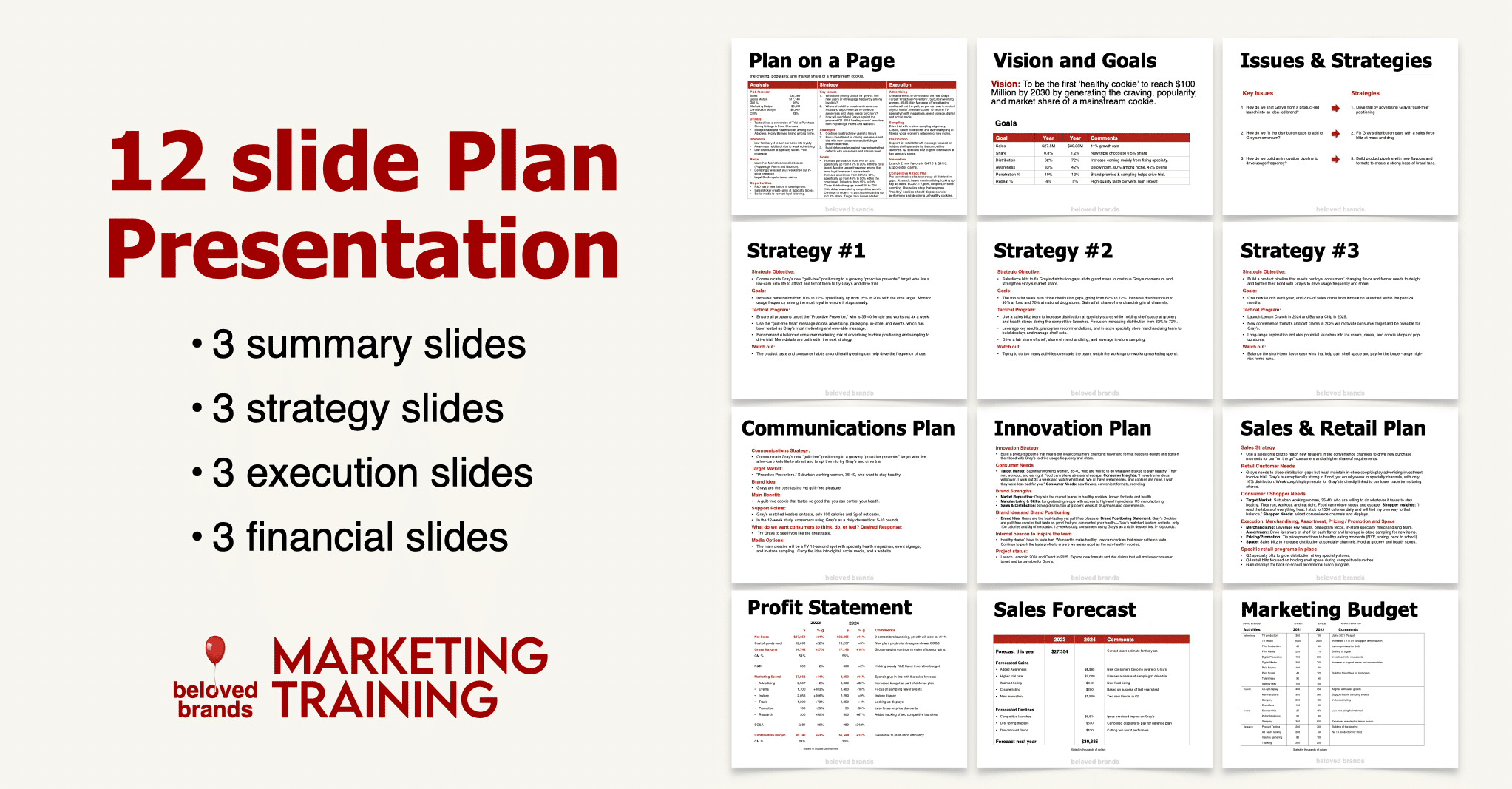
If you are building a Plan Presentation, make sure you keep it to 12 slides
The marketing teams that get their plans approved fast aren’t the ones who work harder. They are the ones who follow the right sequence, build from vision down to execution, and identify their key issues before writing a single strategy. They show leadership exactly where the brand is, why it’s there, and what it will take to move it forward, and they present a plan worth investing in.
Read our post on How to Write a Marketing Plan that covers how to write your vision, goals, key issues, strategies, and activation plans.
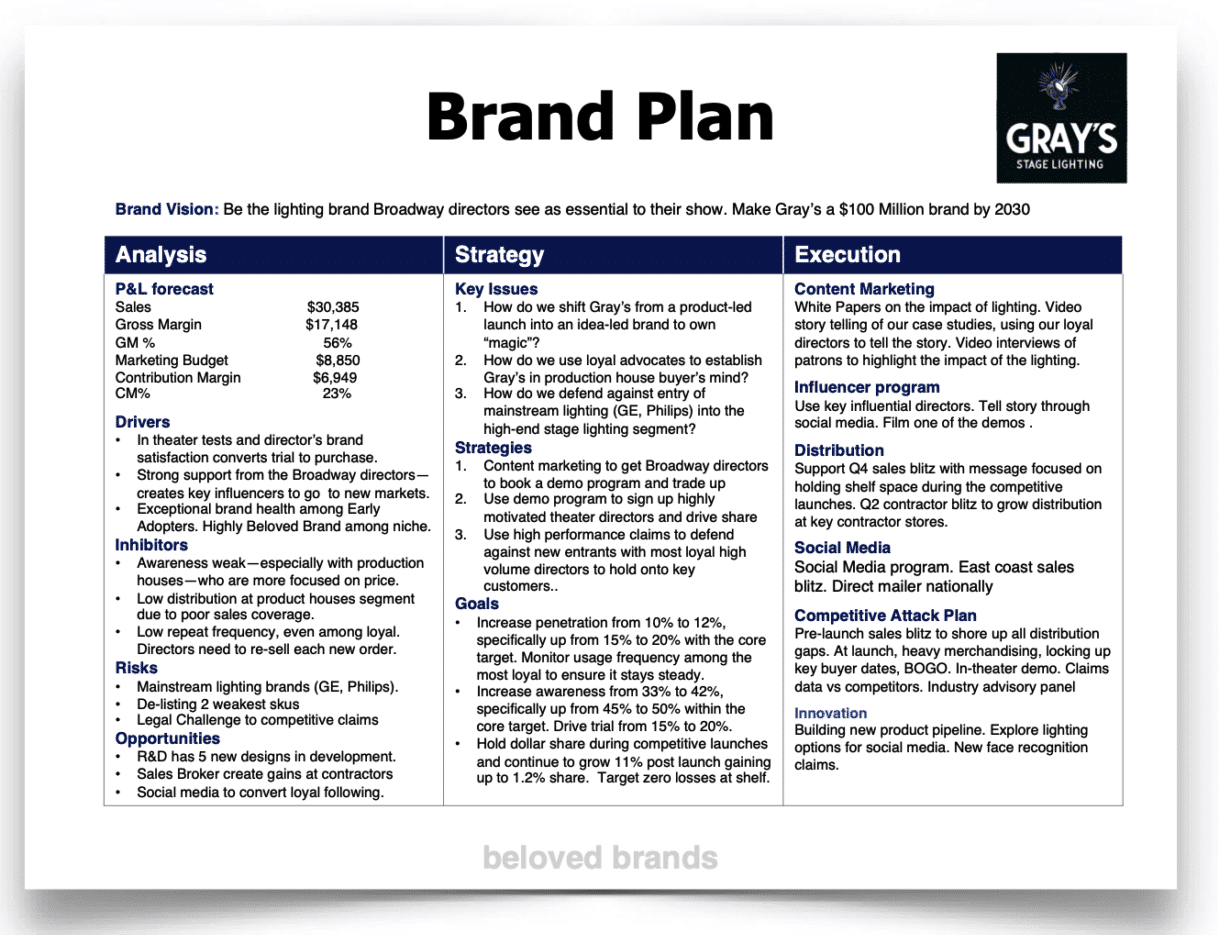
One-Page Brand Plan Examples
We provide ready-to-use examples across four brand categories. Click any template to see it in full:
B2B example — structured around sales, partnerships, and competitive positioning
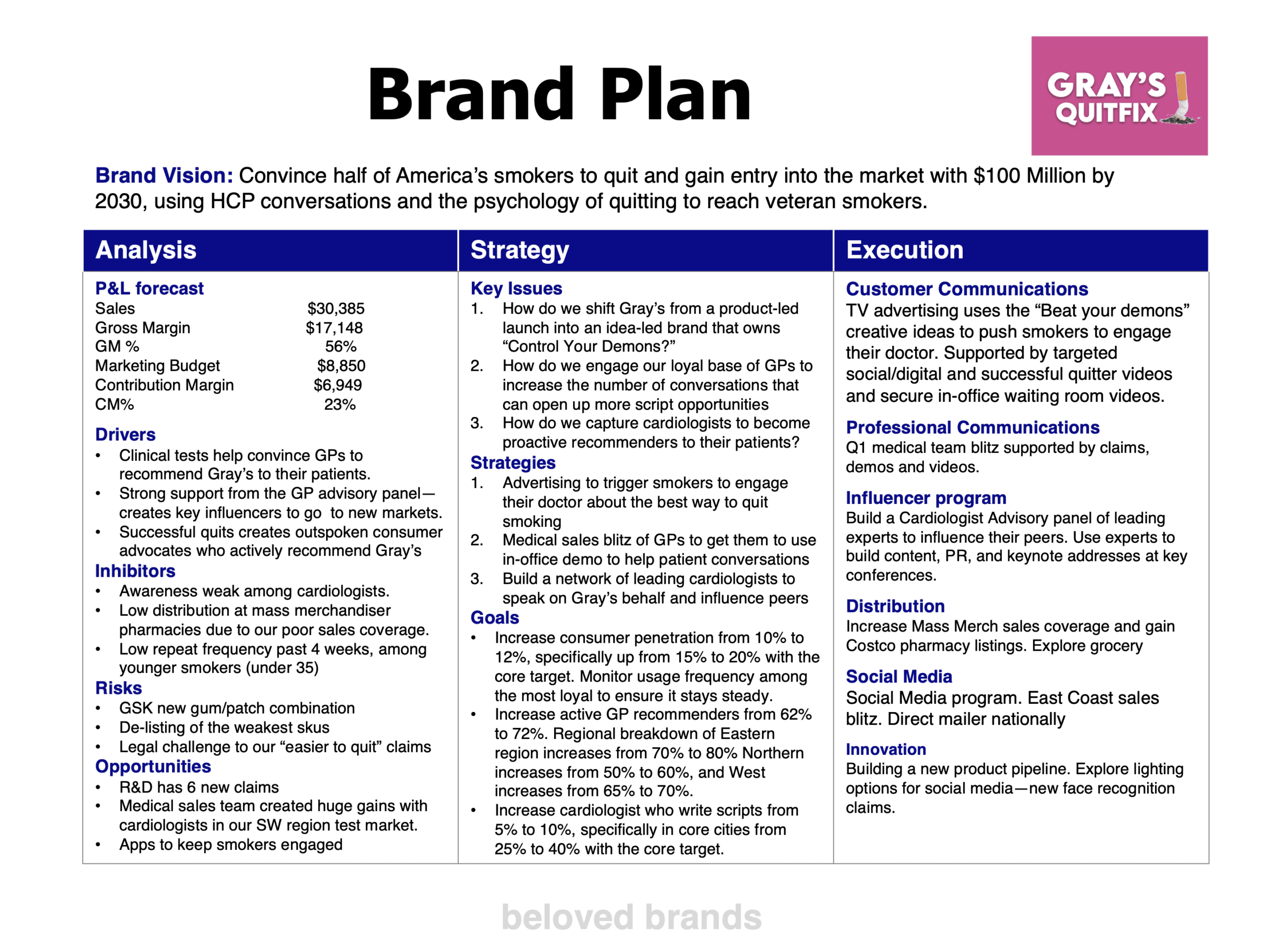
Healthcare example — built for pharmaceutical and consumer healthcare brands.
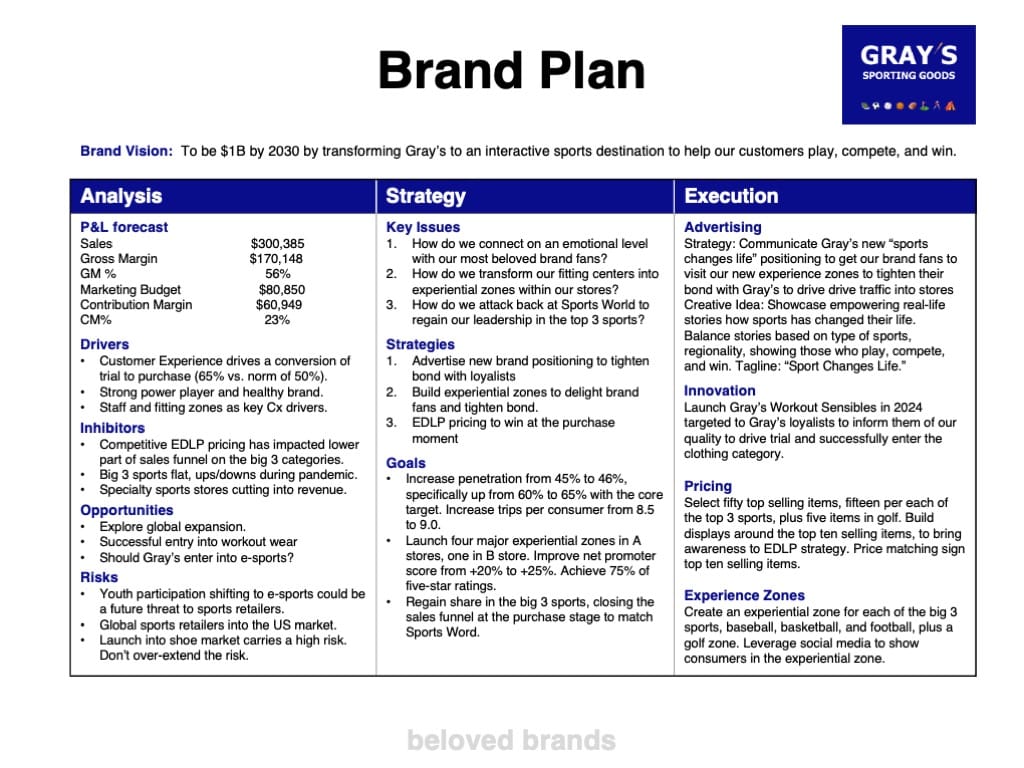
Retail example — focused on in-store execution and category leadership
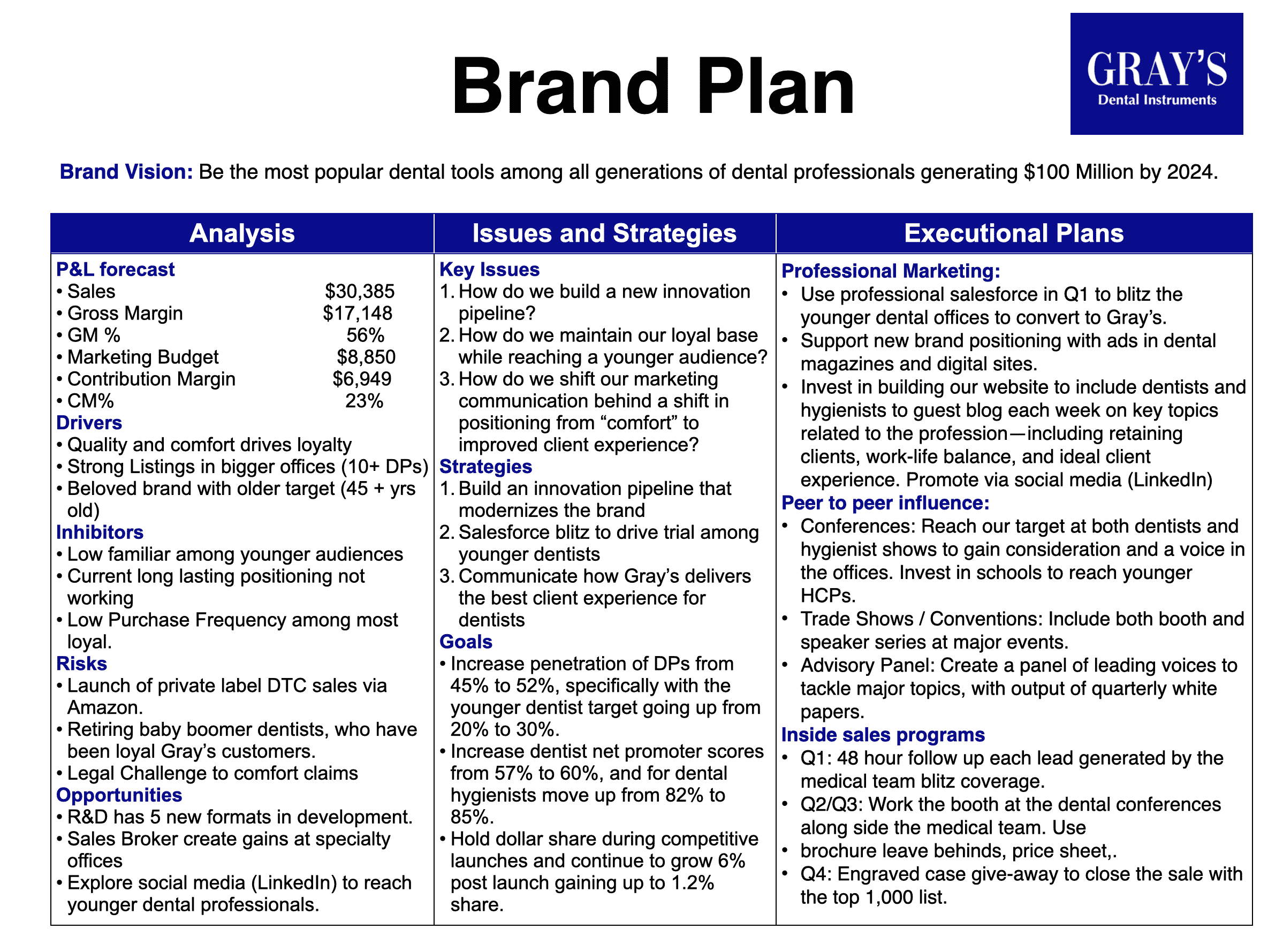
B2B industrial and medical equipment examples — adapted for complex, long-cycle sales environments
B2B brand plan example
Healthcare brand example
Retail example
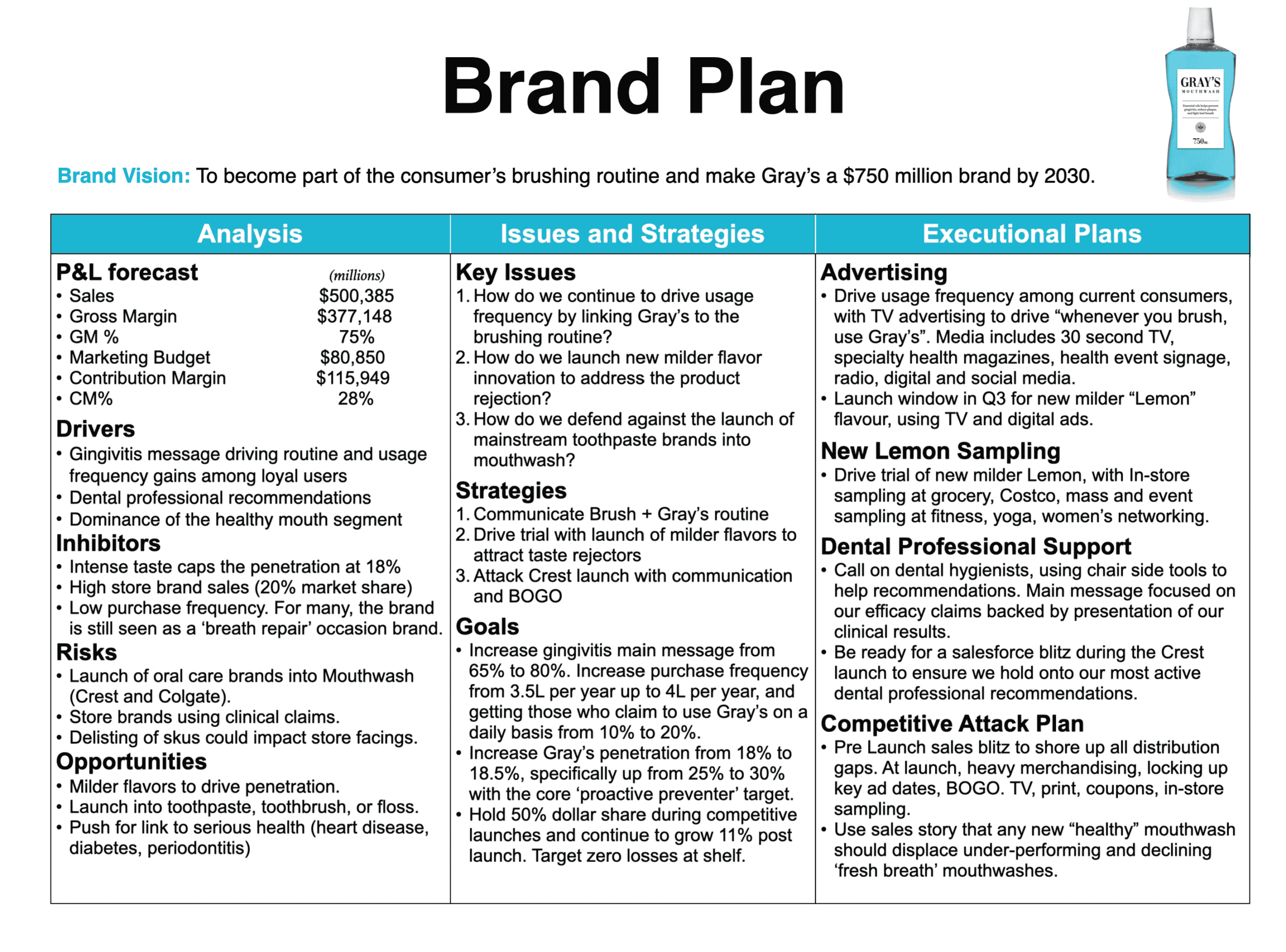
Consumer Healthcare example
B2B medical equipment example
Example for a B2B industrial brand
Frequently Asked Questions
What are the major steps in writing a brand plan?
Set a clear vision tied to a sales goal.
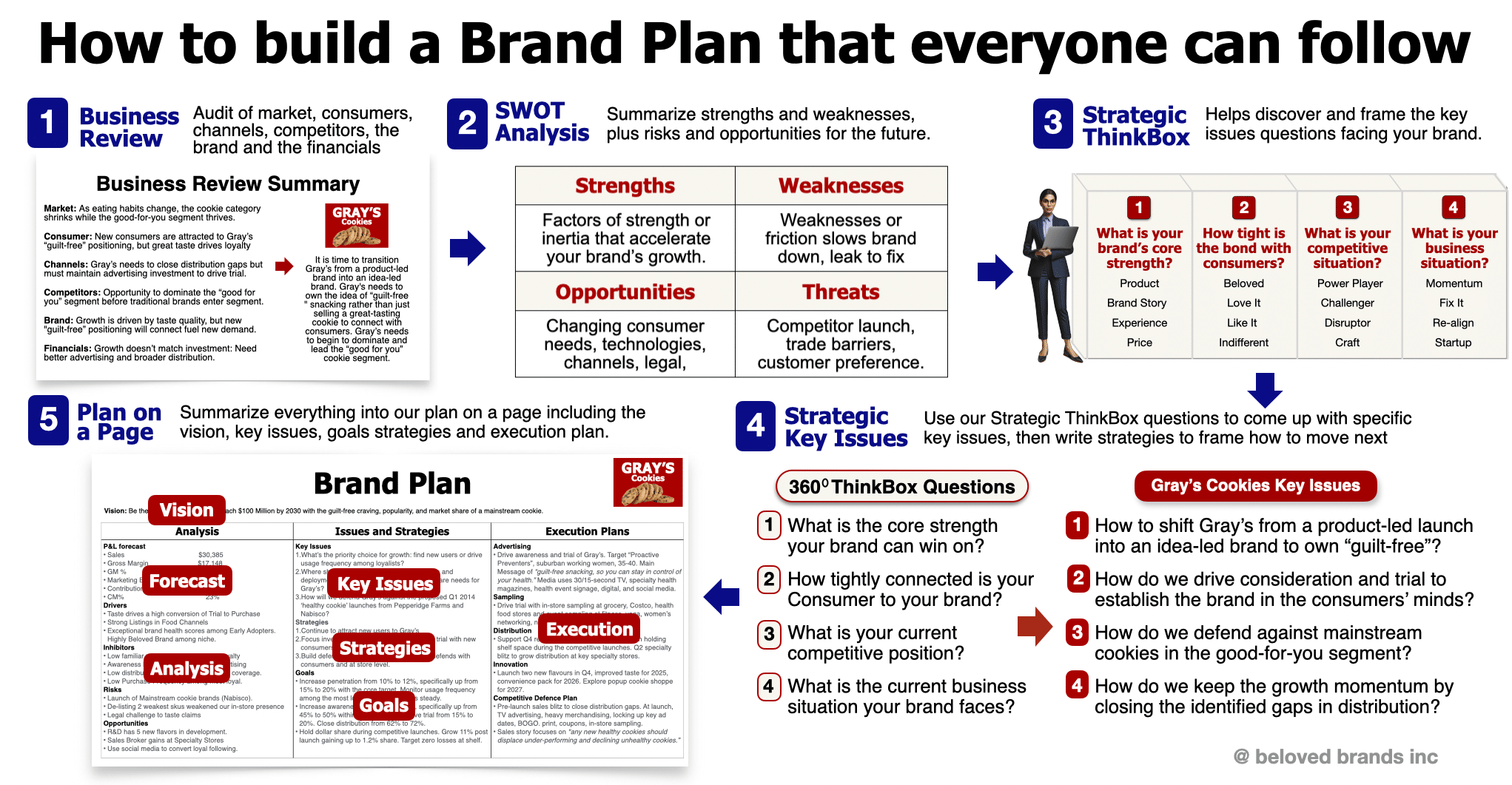
Conduct an annual business review (market, consumer, channels, competitors, brand).
Use the Strategic ThinkBox to identify key issue questions.
Write strategies that answer each issue; brainstorm tactics with your team.
Set measurable goals for each strategy and tactic
Why is a brand plan important?
A brand plan serves two purposes: it wins approval from leadership by showing how you’ll deploy resources to drive growth, and it gives your entire team a shared roadmap — with clear vision, priorities, strategies, and tactics — to work from all year.
What makes a good brand plan?
Focus and coherence. A good brand plan tells a unified story and forces hard choices about where to concentrate limited resources. It should answer the question: “If we could only do three things this year, what would they be?” — and then commit fully to executing those three things brilliantly.
What is the difference between a brand plan and a marketing plan?
A brand plan captures the overall strategic direction — vision, key issues, strategies, and goals — for the brand as a whole. A marketing plan goes deeper into specific execution: media, communications, campaigns, and channel activity. The one-page brand plan is the anchor document; the marketing plan is one of the execution layers beneath it.
Related
Search our site for any marketing topic
"Beloved Brands is the Cheat Code for Brand Managers"
If you run a brand, our Beloved Brands playbook will equip you with the marketing skills, tools, strategies, and insights needed to tackle every challenge in managing it. This is your essential resource for navigating the complexities of building and growing a successful brand.
📊 Build Brand Analytics that uncover what others miss
Our Beloved Brands playbook shows you how to run deep-dive brand audits that expose hidden challenges, surface real growth opportunities, and focus your team on the few issues that truly matter.
💡 Challenge your Strategic Thinking
You’ll learn to ask smarter, tougher questions that change how you see your brand, your market, and your role as a marketer—unlocking sharper strategies and clearer choices.
🎯 Sharpen your Brand Positioning
We give you proven tools and consumer benefit frameworks that help you define positioning that is meaningful, motivating, and defensible—turning functional and emotional benefits into competitive advantage.
📝 Build a Brand Plan that sets your future direction
You’ll learn how to create a clear, aligned brand plan that focuses priorities, mobilizes teams, and drives smarter decisions across your organization.
📺 Master the decisions that drive Marketing Execution
From writing stronger creative briefs to making confident calls on advertising, innovation, and campaigns, this book helps you lead execution that gets noticed and gets results.
⭐ Trusted by marketers who demand real-world impact
Over 80% of our Amazon reviews are 5-star. Marketers tell us this playbook stays within arm’s reach when the pressure is on and the decisions matter most.
Our Beloved Brands Marketing Training builds high-performing marketing teams that think, act, and perform at a higher level
Experience the Beloved Brands difference. Our marketing training program is hands-on, intensive, challenging, real-world, and designed to elevate the marketer’s performance.
We don’t teach theory. We build capability.
Your marketing team gains sharper thinking, stronger tools, practical frameworks, and the confidence to operate at a higher level from day one.
You will see the difference in how your team thinks, acts, and performs.
Our Beloved Brands Marketing Training program
🛠️ We build essential Marketing Skills
Our program equips your team with the core skills required to raise performance, including brand analytics, strategic thinking, positioning, planning, and execution.
📈 Marketers will work on their own brand
We drive real performance improvement by having marketers apply every tool, method, and framework directly to their own brands. They build their brand’s business review, brand positioning, plan, and creative brief.
🚀 Our marketing coaching is like having a VP in the room
Our hands-on coaching recreates real-world pressure, expectations, and decision-making—the same standards encountered in leadership meetings and boardrooms.
🌍 Custom-Tailored Marketing Training Programs
We tailor each program to your business model — Consumer, B2B, Retail, and Healthcare — using industry-specific examples that make it easy for teams to apply learning immediately.