Every brand competes. The ones that struggle are usually the ones that haven’t been honest about what kind of competitor they actually are.
I’ve seen power players run challenger strategies and wonder why their market share keeps slipping. And I’ve seen challenger brands try to outspend the category leader and burn through their budgets with nothing to show for it. I’ve seen disruptors get so focused on being different that they never build the mainstream appeal they need to grow beyond their niche.
Competitive strategy starts with an honest read of your position in the market. Where do you sit relative to the leader? What consumer group is most available to you right now? What does winning actually look like for a brand in your situation?
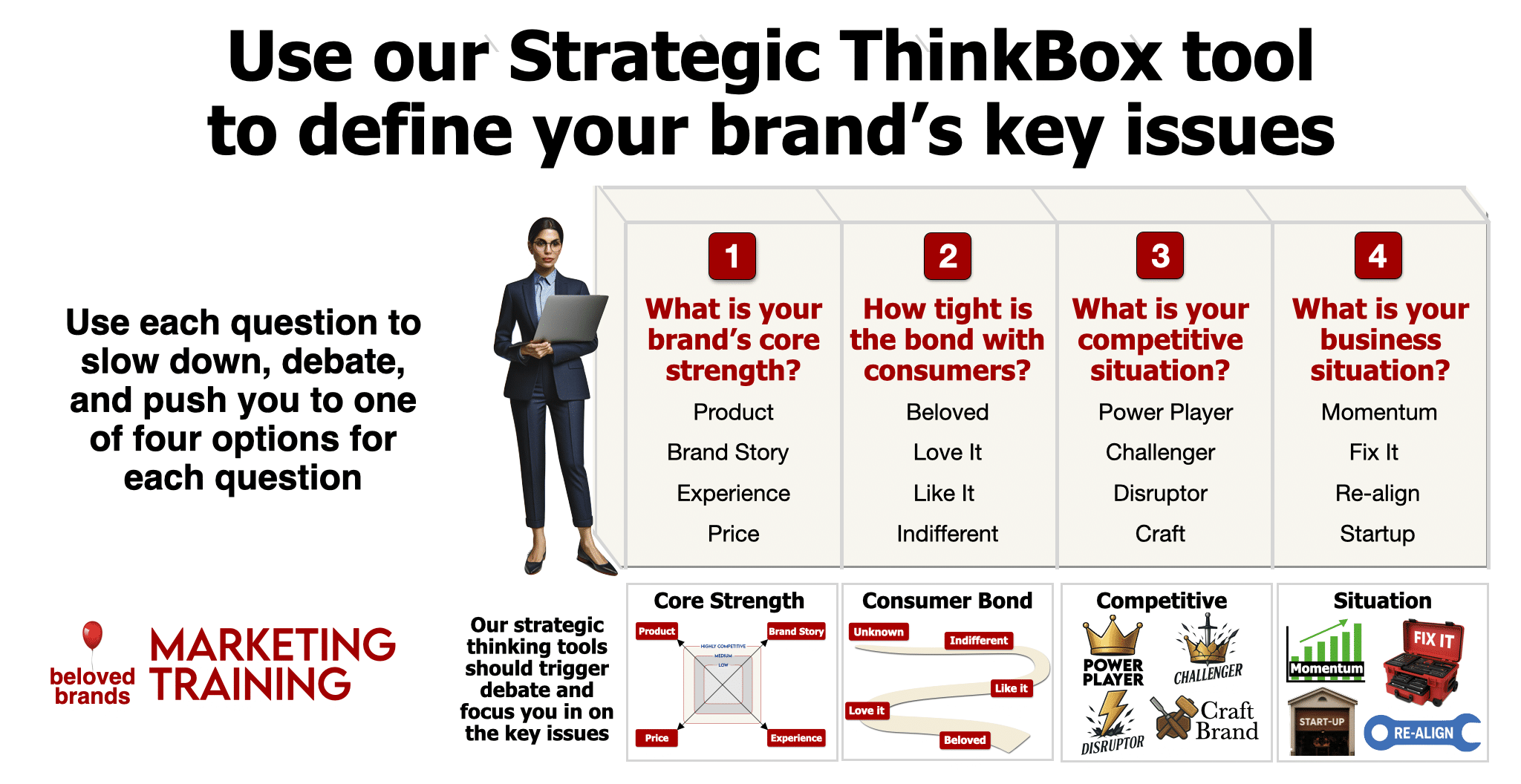
The Beloved Brands competitive strategy framework maps four situations: power player, challenger, disruptor, and craft brand.
Each one describes a different competitive reality, a different set of strategic priorities, and a different way of thinking about investment, positioning, and growth. The framework is the third question in our Strategic ThinkBox, sitting alongside core strength, consumer strategy, and business situation.
Before you write a strategy, you need to know which of these four situations your brand is actually in.

Competitive Strategy - Table of Contents
Strategic ThinkBox steers your brand strategy
Our Strategic Thinkbox looks at core strength, the consumer bond you have, the competitive situation you face. I’ve always believed that strategic thinkers see questions before they see solutions. Ever hear someone say, “That’s a good question?”
It means someone just asked an interruptive question, designed to slow everyone’s thinking, so they reflect and plan before they act.
The strategic thinking side of marketing is logical and helps you map out a range of decision trees that intersect, by imagining how events will play out in the future.
With this in mind, I created the Strategic ThinkBox, which asks questions that set up your strategy. We look at four strategic questions to force you to look at:
- Core strength.
- Consumer Strategy.
- Competitive Strategy.
- Business Situation.
The Venn Diagram — Winning Zone, Losing Zone, Risky Zone
How to find the space where your brand can win
Every competitive situation can be mapped through three circles. The first circle contains everything the consumer wants. And the second contains everything your brand does best. The third contains everything your main competitor does best.
Where those circles overlap tells you everything about your competitive position.
The winning zone is where consumer needs meet your brand’s strengths — and your competitor can’t match you. This is the space you want to own. It’s defensible, it’s motivating to consumers, and it gives your brand a clear reason to exist. The strategic priority in the winning zone is to make sure consumers know you own it and to invest in staying ahead of anyone who tries to take it from you.
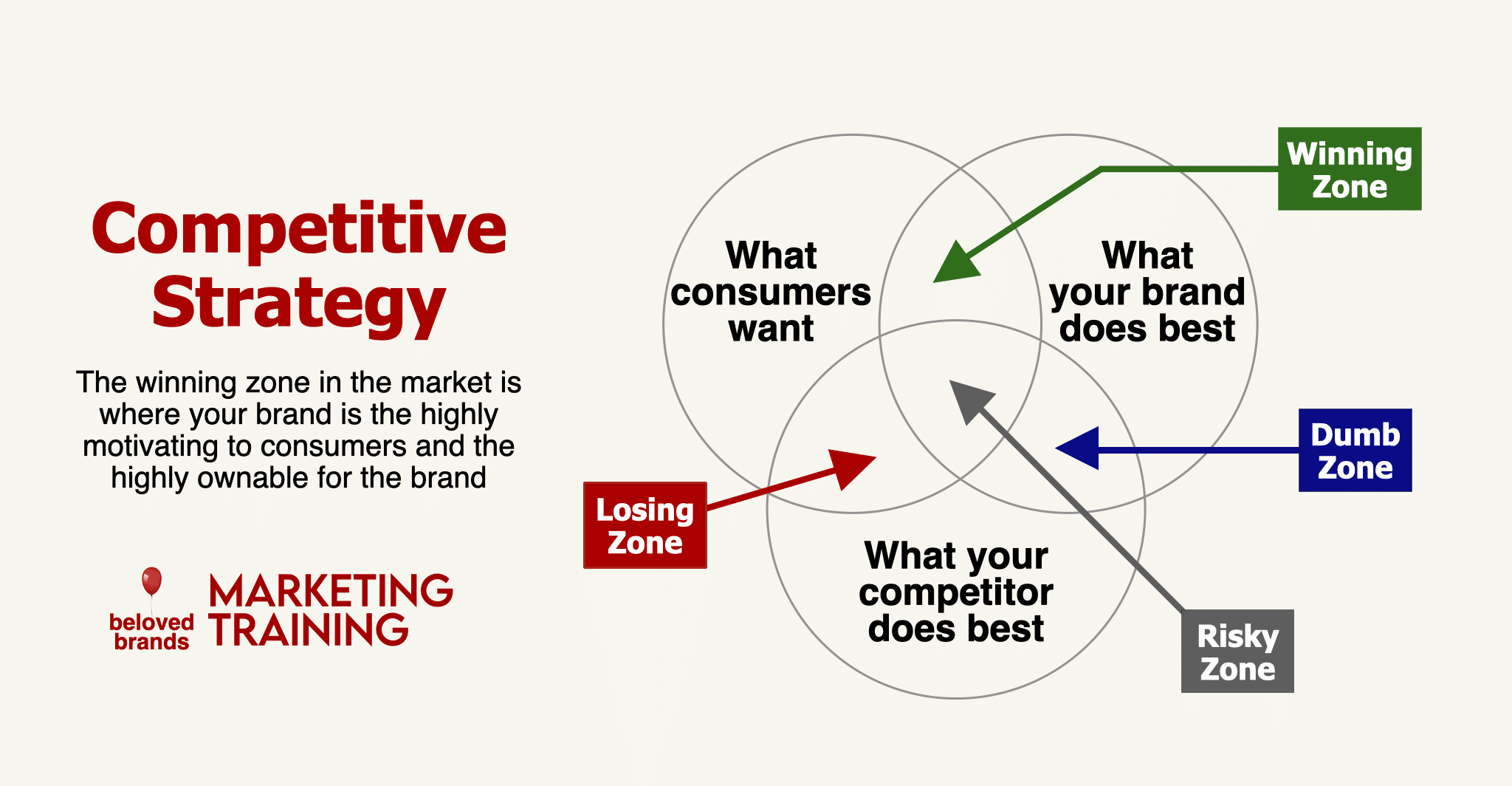
The losing zone is where consumer needs meet your competitor’s strengths — and your brand falls short.
Competing here is a long-term mistake. Your competitor will beat you consistently, and every dollar you spend trying to win in the losing zone is a dollar not spent reinforcing where you actually have an advantage. The strategic move is to acknowledge the losing zone honestly and stop allocating resources to it.
The risky zone is the most interesting and the most misunderstood. It’s the overlap where both your brand and your competitor can satisfy the consumer’s needs — a genuine tie on the functional merits. As markets mature, more and more of the competitive battle moves into this zone. Products get copied, quality gaps close, and it becomes harder to claim a definitive product win.
Brands can still win the risky zone.
There are four ways to do it — use your market power to squeeze out lesser competitors, be first to claim and defend a position before anyone else does, win through innovation and creativity that keeps you a step ahead, or build an emotional connection strong enough that consumers perceive you as better even when the functional gap is narrow. Perception becomes reality when the functional scores are tied.
The dumb zone is where two competitors battle over something consumers don’t actually care about. One brand says it’s faster. The other says it’s just as fast. A competitive war breaks out, and nobody thought to ask whether speed matters to the consumer at all. It’s a surprisingly common and expensive mistake. Before you invest in a competitive claim, make sure consumers care about the territory you’re fighting over.
Beloved Brands Marketing Training
To view, use the arrows to see our Beloved Brands Marketing Training program brochure.
It's time to elevate your marketing team's performance with our Beloved Brands Marketing Training program.
Our marketing training makes your marketers smarter with brand analytics, strategic thinking, brand positioning, brand plans, and marketing execution.

The Four Competitive situations
Regarding marketing war games, I will use this Venn diagram to map out four types of competitive brands:
- Power players
- Challenger brands
- Disruptor brands
- Craft brands.
Power Player brands
Power players are the share leader or the perceived category leader. The brand consumers think of first. The brand retailers give the most shelf space. And the brand competitors benchmark themselves against.
The power player’s greatest strategic asset is scale. They reach more consumers, get more favorable trade terms, have more data on the category than anyone else, and can absorb competitive attacks that would seriously damage a smaller brand. When a challenger launches a new product, a power player can react with speed and resources that most challengers simply can’t match.
The strategic priority for power players is to protect and expand. Protect the core consumer base by staying culturally relevant, maintaining product quality, and never giving loyal consumers a reason to drift. Expand by growing the category itself — power players benefit more than anyone when the overall category grows, so investing in category growth is often more valuable than fighting for share point by share point against challengers.
Importantly, the investment priorities are broad-reach advertising to keep the brand top of mind with the mass market, continuous product improvement to maintain the quality gap over challengers, and retail investment to secure shelf space and display priority.
The biggest watch-out for power players is complacency.
The brands that fall from power player status almost always do so gradually, then suddenly. They cut the marketing budget when times are good, let the product quality slip, or get so focused on defending against known challengers that they miss the disruptor building from below

Challenger brands
Challenger brands are number two or three in the category. And they are big enough to be taken seriously, but not big enough to outspend or outdistribute the leader. They have a real consumer base, real distribution, and a genuine claim in the category. Their strategic problem is that if they play the game exactly as the power player does, they lose. The power player has more money, more shelf space, and more consumer trust built up over time.
The challenger’s advantage is focus.
A challenger brand doesn’t need to appeal to everyone — it needs to find the consumer segment where it can win more consistently than the leader, and own that segment so completely that it becomes a defensible base for growth.
The strategic priority is to identify the specific consumer group or usage occasion where the power player is vulnerable or indifferent, and attack that space with a clarity and intensity the leader can’t easily replicate.
Challengers win by being more relevant to a specific consumer group, not by trying to out-execute the leader across the entire market.
The investment priorities are targeted communication that speaks directly and compellingly to the core consumer segment, product innovation that addresses the specific needs the leader ignores, and distribution focused on the channels where the target consumer shops most.
The biggest watch-out is trying to out-power the power player. Challengers that compete on the leader’s terms: broad-reach advertising, full distribution coverage, category-wide promotions, that burn through their resources without moving their competitive position.
Focus wins more than scale for a challenger.

Take your brand knowledge to new heights with our Beloved Brands playbook
Beloved Brands is a comprehensive guide that covers the fundamentals of brand management. It goes deep on strategic thinking, brand positioning, brand plan development, advertising decisions, media planning, marketing analytics, and the brand financials. This is an opportunity to build your marketing skills to help your career. And, it will provide you with the roadmap for driving growth on your brand.

Marketers see Beloved Brands playbook as a go-to resource, as they keep it within arm’s reach for any new project. We are thrilled to see that it has received a 5-star rating from nearly 90% of Amazon reviewers. Additionally, we have also created playbooks for B2B Brands and Healthcare Brands, catering to specific industries.
Disruptor brands
Disruptor brands enter the market with a fundamentally different proposition. It could be a new business model, a new technology, a new format, or a new idea that makes the existing category rules feel outdated.
They don’t compete with the power player on existing terms. They change the terms.
The disruptor’s consumer is the early adopter — the group of consumers who are actively looking for something better, something newer, something that signals they’re ahead of where the market is going. These consumers are disproportionately influential. When they adopt a disruptor brand, they talk about it, they share it, and they pull the early mass market along behind them.
The strategic priority for a disruptor is to build credibility and momentum within the early-adopter community before attempting to go broad.
Disruptors that try to reach the mass market too early — before the product is truly ready, before the brand story is sharp, before early adopters have generated enough word of mouth — often burn their best asset: the perception of being genuinely different.
The investment priorities are earned media, influencer relationships, content that spreads organically, and product experiences that generate genuine advocacy. Disruptors rarely have the budget to win through paid reach, so every dollar needs to work harder by generating conversation rather than just impressions.
The biggest watch-out is staying in the disruptor stage too long. At some point a disruptor needs to cross into the early mass market or it becomes a niche brand permanently. That crossing requires investment in broader reach, more accessible positioning, and distribution in mainstream channels — all of which feel uncomfortable for a brand that built its identity on being different. The ones that navigate it well make the transition gradually while protecting the credibility they built with early adopters.



Craft brand
Craft brands operate in a deliberately narrow space. They serve a small, passionate consumer group — trend influencers and early innovators who value exclusivity, authenticity, and specificity over mainstream appeal. A craft brand is often built around a founder’s conviction, a specific ingredient or process, a geographic origin, or a cultural community that the mass market hasn’t discovered yet.
The craft brand’s consumer doesn’t want the brand to go mainstream. Part of what they value is that not everyone has it. The craft brand’s strategic challenge is to generate enough revenue to sustain and grow the business while preserving the authenticity and exclusivity that made consumers love it in the first place.
The strategic priority is depth over breadth. Serve the core consumer exceptionally well, build genuine community around the brand, and resist the pressure to broaden too quickly. A craft brand that chases distribution before it’s ready to scale production and quality consistently will lose the thing that makes it worth chasing.
The investment priority is brand experience — the quality of the product itself, the packaging, the retail environment or direct-to-consumer channel, the founder’s story and presence, and the community events and touchpoints that make consumers feel like they’re part of something. Craft brands rarely win through mass advertising. They win through experience and word of mouth.
The biggest watch-out is the acquisition trap.
Many craft brands get acquired by a power player looking to capture the brand’s credibility and consumer base, and the mass distribution that follows destroys the very authenticity that made the brand valuable. The brands that survive acquisition intact are the ones where the acquirer understands that the craft brand needs to stay separate, stay small in feel, and stay true to the founding story — even as the business scales behind the scenes.

Frequently Asked Questions
What is a competitive strategy in brand management?
Competitive strategy is how a brand identifies its position relative to competitors and makes deliberate choices about where to compete, who to target, and how to win. It goes beyond knowing who your competitors are — it requires an honest assessment of where your brand has a genuine advantage, where it is vulnerable, and what kind of competitive situation it is actually in. The Beloved Brands framework identifies four situations: power player, challenger, disruptor, and craft brand.
How do I know which competitive situation my brand is in?
Look at market share, distribution, brand awareness, and consumer perception relative to the category leader. Power players lead on most of those measures. Challengers are established but trail the leader. Disruptors are growing fast from a small base with a meaningfully different proposition. Craft brands are deliberately small with a highly engaged niche consumer base. The honest answer is usually obvious when you look at the data without the filter of internal optimism.
Can a brand move between competitive situations?
Yes, and the best brand growth stories are usually about a brand that successfully navigated a transition — from craft to disruptor, from disruptor to challenger, or from challenger to power player. Each transition requires a different strategy, a different investment model, and often a different way of thinking about the consumer target. The transition from disruptor to challenger is particularly difficult because it requires giving up some of the exclusivity and differentiation that drove early growth.
What is the winning zone in competitive strategy?
The winning zone is the overlap between what consumers want and what your brand does better than competitors. It’s the space your brand can own, defend, and invest in over time. Finding the winning zone requires an honest assessment of both consumer needs and competitive strengths — not where you want to be, but where you genuinely have an advantage today that you can build on.
What makes a challenger brand strategy different from a power player strategy?
Power players compete broadly — they protect their position across the full market through reach, distribution, and scale. Challenger brands compete selectively — they find the specific consumer segment or occasion where the power player is weakest and attack that space with focus and intensity. A challenger that tries to compete on the power player’s terms almost always loses. A challenger that finds its specific winning zone and goes deep there can build a position the leader finds genuinely difficult to dislodge.
How do disruptor brands eventually lose their edge?
Disruption is a moment, not a permanent state. Disruptors lose their edge in one of three ways: the power player copies the innovation and uses its scale to commoditize what made the disruptor different, the disruptor tries to scale too fast and loses the quality and authenticity that drove early adoption, or the disruptor gets acquired and loses its identity in the process. The disruptors who sustain their edge are the ones who keep innovating faster than the market can copy.
How does competitive strategy connect to the other Strategic ThinkBox questions?
Competitive strategy is the third of four questions in the Strategic ThinkBox. It connects directly to core strength — a product-led brand competes differently than a story-led brand does, and the winning zone is often defined by whichever core strength your competitor is weakest on. It connects to consumer strategy through the Brand Love Curve — a craft brand targets trend influencers while a power player targets the late mass. And it informs business situation, because a challenger brand in a declining category faces a fundamentally different strategic problem than a disruptor in a growing one.
Does competitive strategy apply to B2B brands?
The four competitive situations apply directly to B2B. The B2B power players dominate their category through scale, relationships, and switching costs. And the B2B challengers win by serving a specific industry vertical or buyer type better than the generalist leader does. B2B disruptors use technology or a new business model to make the existing category solutions feel outdated. The B2B craft brands build deep expertise and reputation within a narrow community of practitioners. The dynamics of each situation are the same — only the language and the sales cycle change.