Every brand has one thing it does better than anything else. The brands that grow are the ones that figure out what that is — and build everything around it.
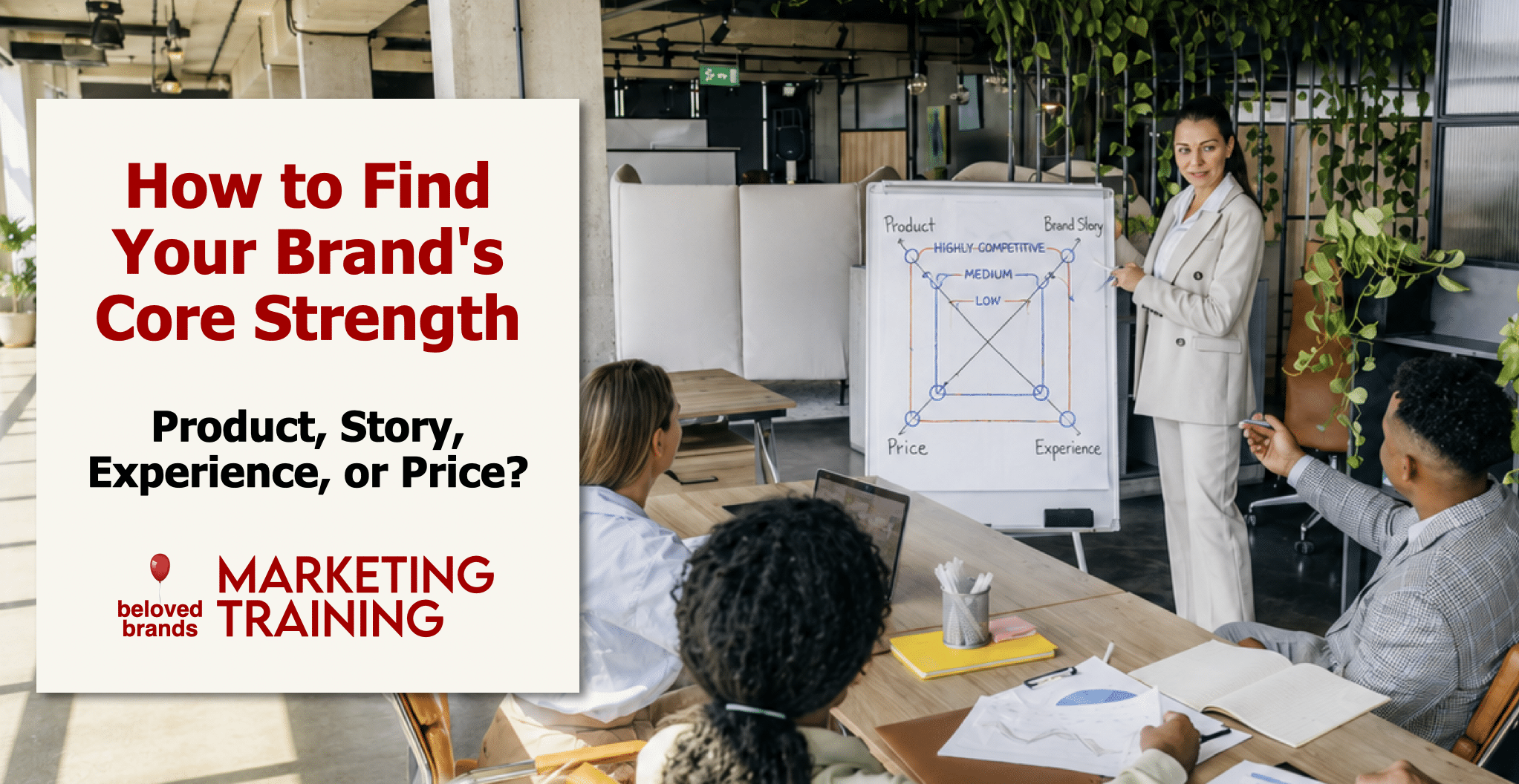
The Brand Core Strength framework is part of the Beloved Brands Strategic ThinkBox, a set of strategic questions designed to force sharper thinking before you commit to a strategy. The core strength question is the most fundamental one: what does your brand actually win on?
There are four options: product, story, experience, or price.
The framework forces you to choose one as your lead strength, two as supporting strengths, and acknowledge one as a weakness. That last part is where most marketers resist. They want four strengths. But a brand that claims four strengths has none that consumers actually believe.
When you commit to one core strength, your strategy gets sharper. Your investment decisions get clearer. And your brand starts to stand for something real in the consumer’s mind.
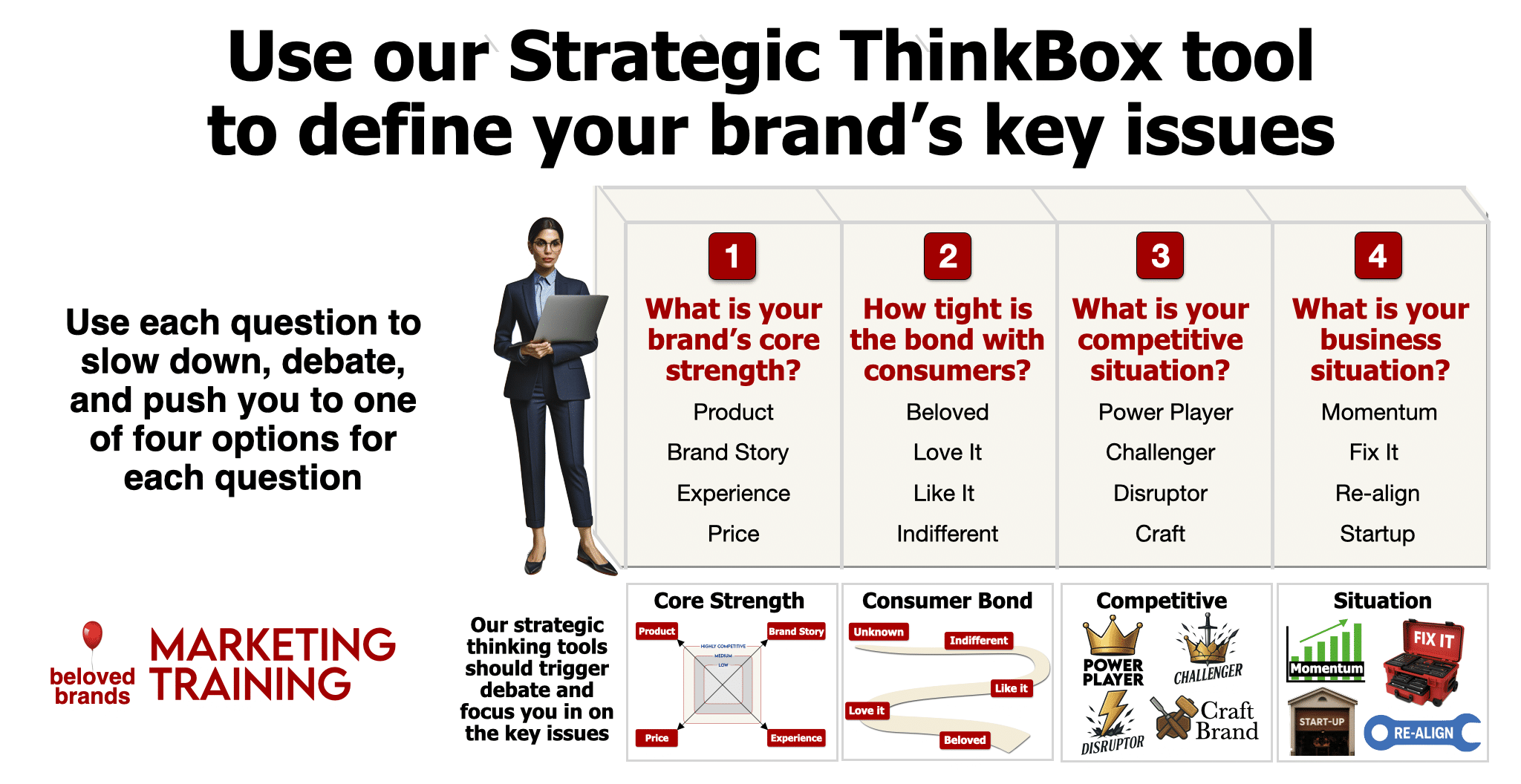
Strategic ThinkBox steers your brand strategy
Our Strategic Thinkbox looks at core strength, the consumer bond you have, and the competitive situation you face. I’ve always believed that strategic thinkers see questions before they see solutions. Ever hear someone say, “That’s a good question?”
It means someone just asked an interruptive question, designed to slow everyone’s thinking, so they reflect and plan before they act.
The strategic thinking side of marketing is logical and helps you map out a range of decision trees that intersect, by imagining how events will play out in the future.
With this in mind, I created the Strategic ThinkBox, which asks questions that set up your strategy. We look at four strategic questions to force you to look at:
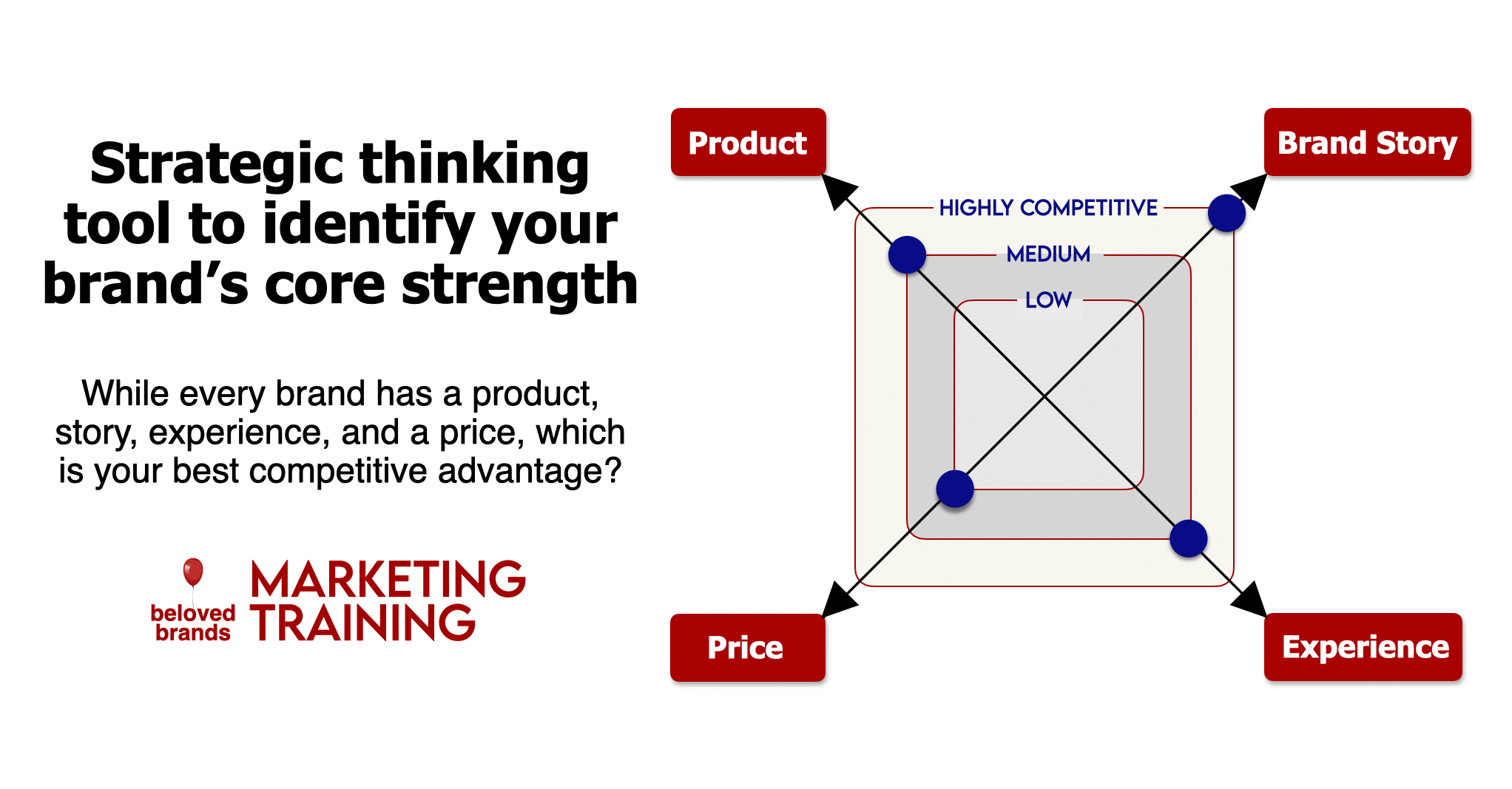
How to identify your brand's core strength — the chip game
This is the exercise we run in our training sessions, and it reliably generates the best strategic debate of the day.
Give your team four chips. Place them on the diagram across the four core strengths — product, story, experience, and price.
The chip game rules are simple but deliberately difficult:
- One chip must go at the highest level. This is your lead core strength — the one area where you have a genuine competitive advantage and can credibly own a position in the consumer’s mind.
- Two chips go at the medium level. These are supporting strengths that reinforce and back up your position as the lead.
- One chip must go at the lowest level. This is a deliberate throwaway — a weakness you accept as part of the trade-off of being focused.
The chip that goes at the lowest level is always the hardest decision. Most teams will fight it. Someone in the room will argue that you can’t afford to be weak on price, or that the product needs to be strong too. That argument is exactly the point. Accepting one weakness is what makes the other choices meaningful.
Run this with your leadership team before you write your next brand strategy. The debate it creates will surface assumptions that have never been spoken out loud, and it will force alignment on where your brand actually competes.
Four types of brands
- Product-led brands should invest in R&D while communicating the consumer benefits, features, and claims for what makes the brand better.
- Story-led brands need to invest in advertising, with the story, idea, or brand purpose communicating what makes the brand different.
- Experience-led brands have to invest in creating a culture with strong operations. Build your brand communications around the idea that, “Our great people make the difference in creating amazing experiences.”
- Price-led brands must invest in operational efficiency. And, the brand communications explains how “We are smarter and able to deliver the same quality at a lower cost.”
As you figure out your brand’s core strength, it helps focus what you should be investing in and what your main communication message should be. Product led brands should invest in R&D and communicate how you are better. Story led brands should invest in advertising to communicate how they are different. Experience led brands should invest in building the culture and communicating how your people make you better. Price led brands must focus on efficiency and communicate how you can offer the same quality at a lower price. To illustrate, click to zoom in.

Product led brands focus on being better
- Establish your reputation as the superior product in the category, defending against any challengers to your position. Continue to source the best products with a specific focus on product innovation to stay ahead of competitors, whether being the leader in leading edge technology, new formats, product quality, and claims.
- Leverage product-focused mass communication, directly calling attention to the superiority and differences in your product offering versus the competitors. Use product reviews and key influencers to support your brand. Build the “how you do it” into your brand story, to reinforce the point of difference.
- Use rational selling to guide consumers through their buying journey and build an emotional connection with loyal consumers to continue evolving the brand and driving growth.

Rolex
Rolex is a product-led brand that has done an incredible job of building emotion into their brand. Consider Rolex’s language choices.
- “Crafted from the finest raw materials.”
- “Assembled with scrupulous attention to detail.”
This conveys the brand’s commitment to product design and production, ensuring the Rolex brand epitomizes prestige and success. Rolex uses beautiful writing for a product-led brand. Their brand communications are subtle in tone, sticking to high-profile, refined sponsorships events like Wimbledon tennis and the Master’s golf.

Brand Story led brands focus on being different
- Focus on building a brand idea that quickly connects with a core group of motivated consumers, and then align everything (story, product, experience) under it.
- Invest in emotional brand communication that connects with a motivated audience. Build a community of core “brand lovers” to influence others in their network. A soft-sell approach, tapping into emotions that helps to influence the potential consumer.
- Make sure you have a good solid product so you don’t create brand lust, where people love the idea but you fail to deliver.

Some of the more successful story-led brands include Apple, Nike, Virgin, and Dove. These are some of the most beloved brands of our generation.
Tesla
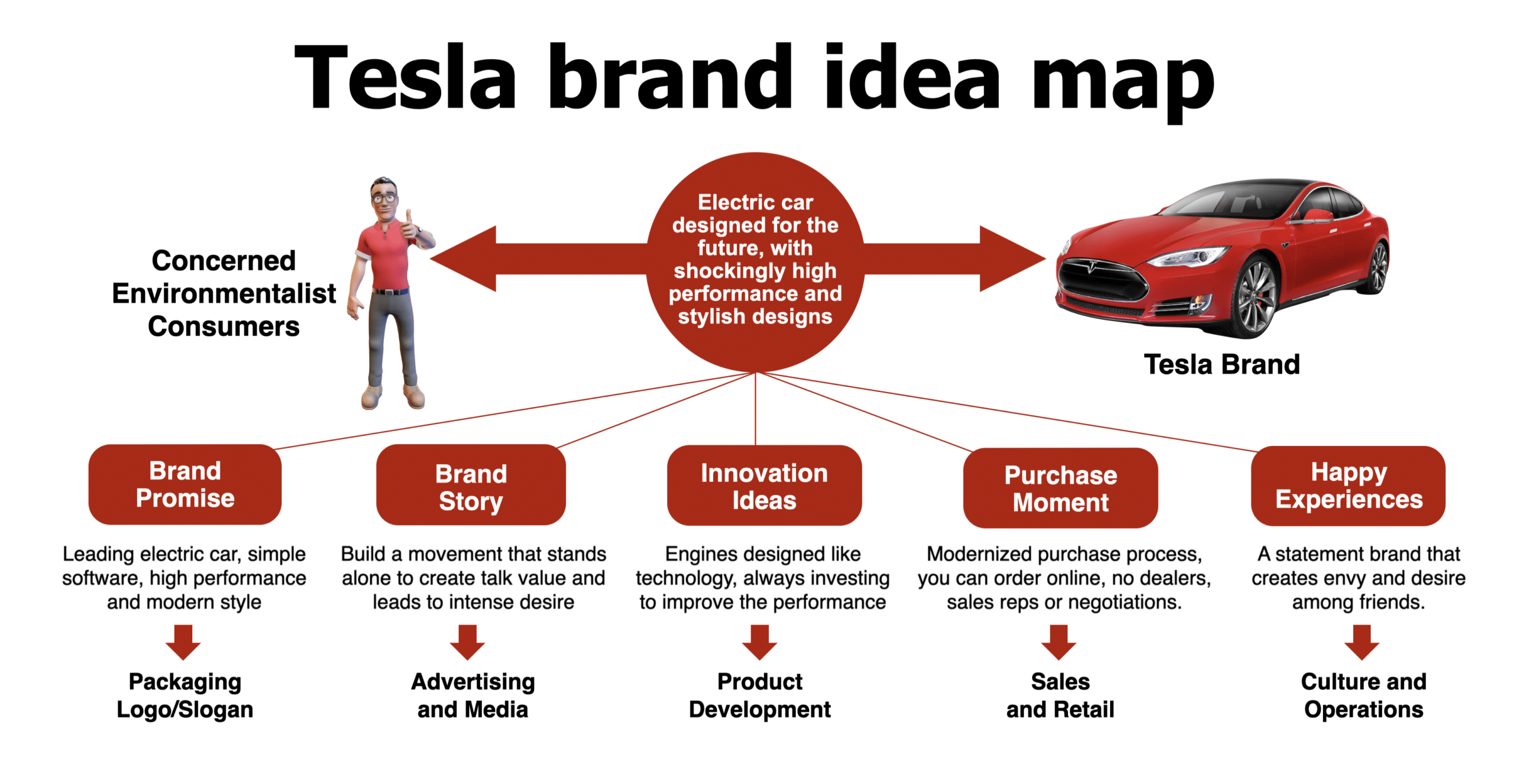
Most recently, the Tesla brand has borrowed a lot of Apple’s core principles. Tesla builds everything around the story of “Tesla will save the planet with innovation.” Tesla uses many innovative approaches, including the visionary charm of their leader, Elon Musk, who appears to be the new generation’s answer to Steve Jobs. Musk has become a spokesperson for a generation of consumers who want to save the planet. Tesla’s environmental activities around the world go far beyond expectations.
A great example of the mystique of the Tesla brand is how quickly it mobilized to help out Puerto Rico after a hurricane knocked out the island’s power in 2017. Even as various levels of government were arguing over who should do what, Tesla brought 700 solar panels to the Hospital del Niño, where the batteries restored service to 3,000 patients who needed constant care.
In 2016, Tesla topped Consumer Reports’ Annual Owner Satisfaction Survey at an incredible 91% rating, 5% higher than a Porsche, and 15% higher than Toyota and Honda. The same year, over 400,000 consumers put down $1,000 for a specific Tesla model that did not yet exist. On top of that, these new cars would not roll off the factory lines for another three to four years. Consumers see Tesla as more than just a vehicle, but rather an investment in a movement for the future. Even as Tesla struggles to meet demand, the company keeps adding to its brand story.
Beloved Brands Marketing Training
To view, use the arrows to see our Beloved Brands Marketing Training program brochure.
It's time to elevate your marketing team's performance with our Beloved Brands Marketing Training program.
Our marketing training makes your marketers smarter with brand analytics, strategic thinking, brand positioning, brand plans, and marketing execution.

Experience led brands focus on being memorable
Magical experience through high service or high playful brands.
- For service brands, your people matter. Focus on building a culture and organization with the right people who deliver incredible experiences. Invest in training your people, as they are the face of the brand. Use brand purpose (“Why you do what you do”) and values to inspire and guide the team with service behaviors.
- Playful brands create an engaging experience. Additionally, there are tech-driven brands that can replicate an amazing experience.
- In Marketing Communications, be patient with a slower build, as consumers need to experience the brand for themselves. Effective tools include word-of-mouth, earned media, social media, online reviews, influencer outreach, and testimonials.

Airbnb
Airbnb does a fantastic job of delivering a fabulous consumer experience. They deliver on their brand idea of “Don’t just go there. Live there.” Airbnb takes all the hard work travelers have been doing, and they put it right in front of the consumer. You can sort by city, even down to the neighborhood. Sort by the type of residence, specify a few needs (Wi-Fi, pet-friendly), then enter your price range.
With most of the rentals, you can see 15-20 photos to give you an idea of the space. You make your choice. Select the dates. Provide government ID to confirm your identity. And then your offer goes to the owner. Moments later, or when they wake up, they reply saying yes. There is a bit of hunting that goes on. But it adds a thrill to the travel experience. Overall, it is so much easier than everything the traveler, looking to rent a house or flat, has done in the past.
Airbnb has nailed the creation of the brand idea of “Don’t just go there. Live there.” Airbnb’s data says 86% of the consumers who use Airbnb pick the platform because they want to live more like a local. That insight of living rather than visiting inspired the brand’s latest and largest marketing campaign, “Live There.”

Price led brands should focus on being efficient
- Focus on ways to drive efficiency to ensure the lowest possible cost structure. Invest in the fundamentals around production and sourcing to maintain a low-cost competitive advantage. Use the brand’s power to win negotiations and fiercely attack any potential competitive challenges to your low-price positioning.
- Regarding advertising, the smartest message explains your secret for how you are smarter than your competitors in how you can offer lower prices. Use call-to-action marketing to keep high sales turns.
- There is a big difference between low-price and cheap. Price-driven consumers are not always willing to sacrifice product quality. They expect lower prices but still want robust performance standards.

Walmart
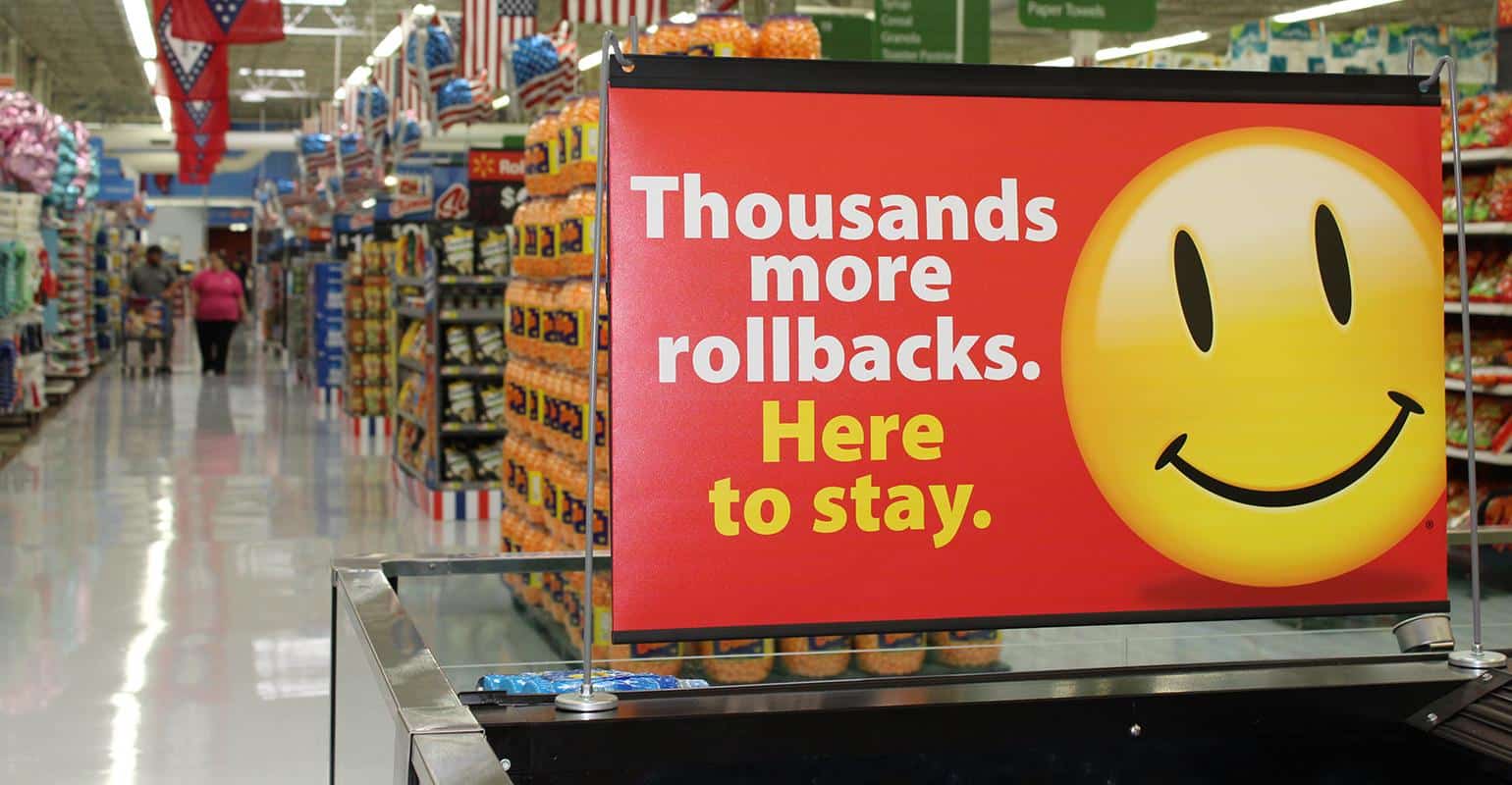
Walmart is one of the best price-led brands. No one is more efficient at brick-and-mortar retail. While many department store competitors sell through their inventory in 100 to 125 days, Walmart sells through its inventory in 29 days – one day before they even have to pay for it.
Walmart successfully beat century-old retailers, such as Sears, Kmart, and JC Penney. It also destroyed the “mom and pop” shops of small towns across America. The company’s outward sales pitch is price, but efficiency drives its internal culture, and their real secret is to focus on fast-moving items. Walmart uses its brand power to bully suppliers, who give in just to be part of Walmart’s high sales volumes.
Now Walmart faces its toughest battle with Amazon, in what some are calling, “Clicks versus Bricks,” as online has disrupted traditional retail. While Walmart has struggled to create an emotional bond with consumers, one significant advantage for Amazon is its reputation as one of the most beloved brands on the planet. Amazon uses smart pricing with extraordinary customer service to delight its consumer base. Walmart will be in the most desperate battle of its life.
Communicating your brand's core strength
We start to see one of the significant benefits of finding your core strength is that you can focus your investments in the right areas. When you are a product-led brand, you need to invest in product innovation with a robust R&D team. When you are brand story-led, you need to make sure your advertising, PR, social media is delivering. For experience-led brands, it’s about the culture, with values, service behaviors, and motivation fo your people. Price-led brands are not cheaper; they have lower costs. You need to focus on efficiency through high volume, fast-moving items, and lower costs.

Frequently Asked Questions - Strategic Thinking
What is a brand’s core strength?
Brand core strength is the one area where your brand has a genuine competitive advantage — whether that’s a superior product, a compelling brand story, an exceptional consumer experience, or a lower price. The Brand Core Strength framework forces brand leaders to identify their lead strength and build their strategy, investments, and communications around it.
Can a brand have more than one core strength?
Every brand has supporting strengths, but only one lead strength. The framework asks you to place your highest chip on one of the four options. Brands that try to lead on two or three strengths typically end up with muddled positioning, scattered investment, and unclear consumer perception. Focus on one, support it with two, and accept one trade-off.
How do I know which core strength to choose?
Start with an honest read of where your brand has a genuine and defensible advantage — not where you want to be, but where consumers already give you credit. Look at your brand health data, your consumer research, and your competitive landscape. The core strength you choose should be one you can invest in, communicate clearly, and defend over time.
Can a brand change its core strength over time?
It happens, but it’s rare, and it takes time. Apple started as a product-led brand and gradually became story-led as the brand idea became as powerful as the product itself. A brand can evolve its core strength, but trying to shift it quickly usually creates confusion in the market. If you are considering a shift, treat it as a multi-year strategic decision, not a repositioning exercise.
How does core strength connect to brand investment decisions?
This is one of the most useful applications of the framework. Product-led brands need to invest heavily in R&D and product innovation. Story-led brands need to invest in advertising, consumer insights, and brand communications. Experience-led brands need to invest in people, culture, and service systems. Price-led brands need to invest in operational efficiency and supply chain. Once you know your core strength, you know where your marketing budget needs to go.
How does this framework connect to brand positioning?
Core strength is one of the four strategic questions in the Beloved Brands Strategic ThinkBox, alongside consumer strategy, competitive strategy, and business situation. Once you identify your core strength, it directly informs your brand positioning — specifically what you lead with as your main consumer benefit and how you differentiate from competitors.
Is this framework relevant for B2B brands?
Yes. B2B brands face the same strategic choice. Many B2B brands default to product as their core strength because the sales conversation is highly technical. But some of the strongest B2B brands win on experience — the relationship, the service, the implementation support — or on story, where the brand idea attracts clients before the sales team even makes contact.