One of the most consistent mistakes I see from brand leaders is applying the wrong strategy to the situation they’re actually in.
A brand in trouble gets a momentum strategy with lots of new ideas, big swings, wholesale changes when what it actually needs is a clear diagnosis and a disciplined fix. A brand with genuine momentum gets a change plan imposed on it by a new leader who wants to make their mark, when what it needs is someone who will protect what’s working and quietly close the gaps.
Business situation is the fourth question in the Beloved Brands Strategic ThinkBox, and, in many ways, it’s the most grounded.
It doesn’t ask what you want to do. It asks what the business reality actually demands. Your situation determines how much urgency you have, what resources are available to you, what kind of leadership the team needs, and where investment will have the most impact.
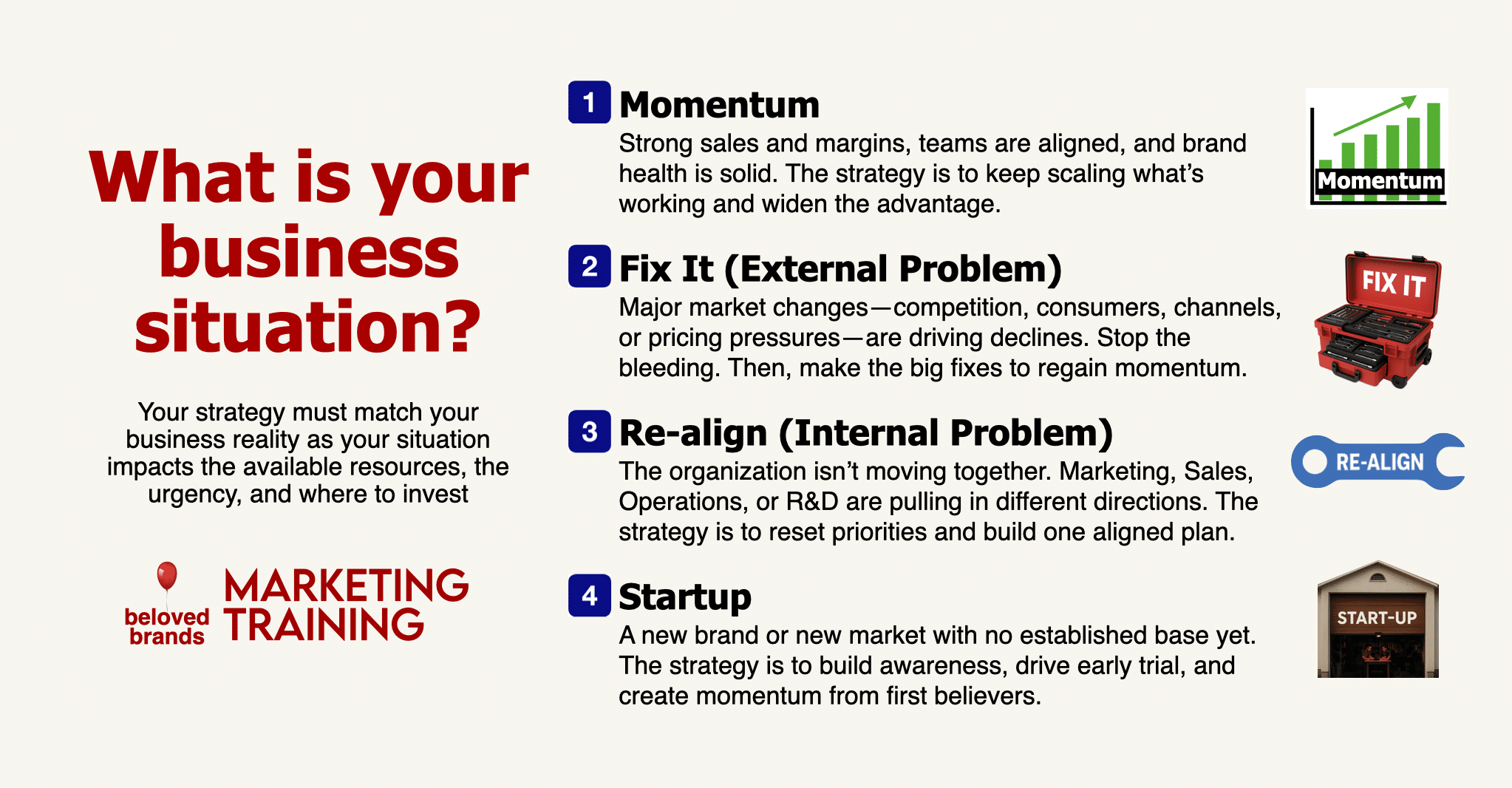
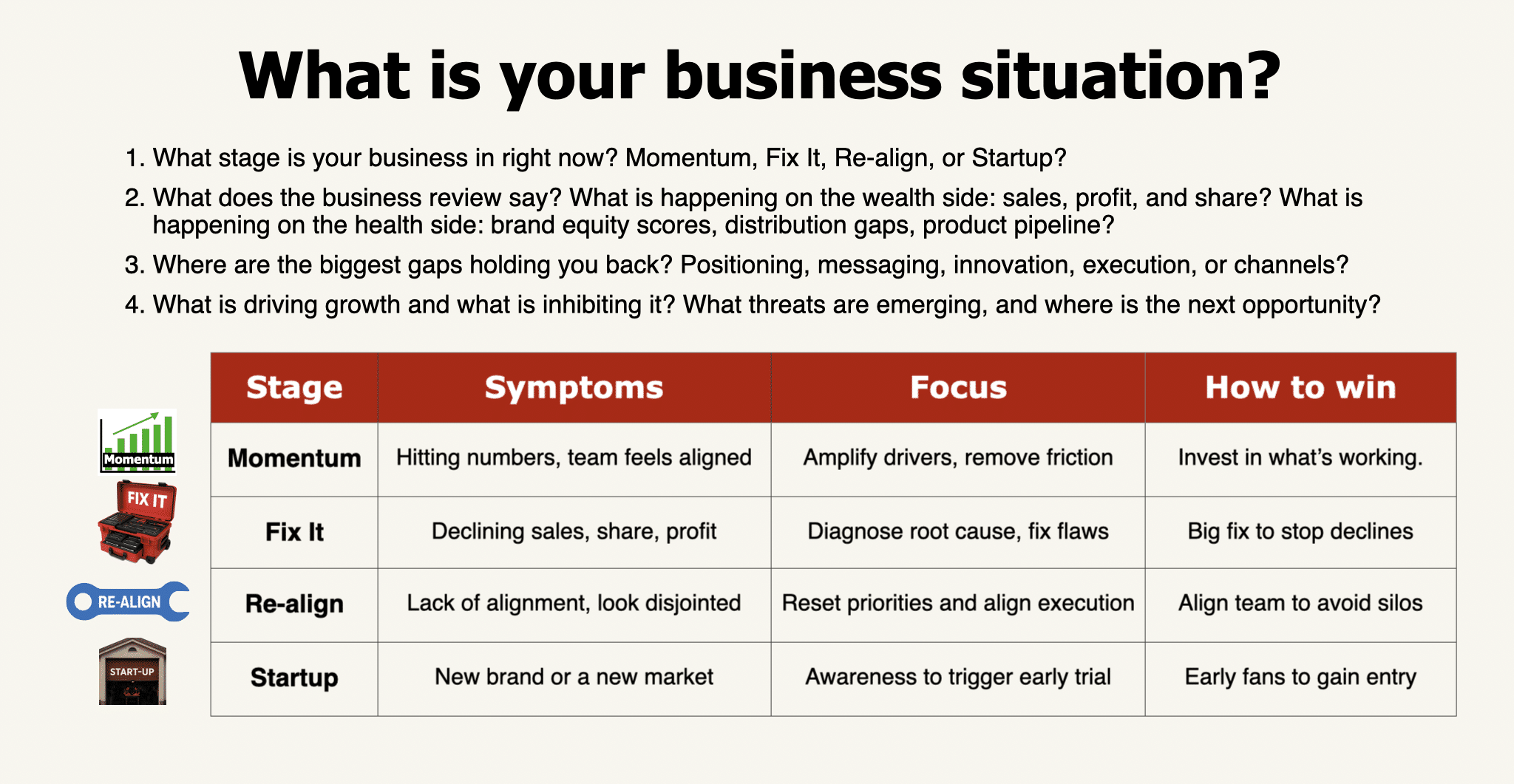
There are four situations a brand can be in: momentum, fix it, re-align, and startup. Each one calls for a fundamentally different strategy, pace, and leadership approach. Getting the diagnosis right is the first job.
Strategic ThinkBox steers your brand strategy
Our Strategic Thinkbox looks at core strength, the consumer bond you have, and the competitive situation you face. I’ve always believed that strategic thinkers see questions before they see solutions. Ever hear someone say, “That’s a good question?”
It means someone just asked an interruptive question, designed to slow everyone’s thinking, so they reflect and plan before they act.
The strategic thinking side of marketing is logical and helps you map out a range of decision trees that intersect, by imagining how events will play out in the future.
With this in mind, I created the Strategic ThinkBox, which asks questions that set up your strategy. We look at four strategic questions to force you to look at:
- Core strength
- Consumer Strategy
- Competitive Strategy
- Business Situation
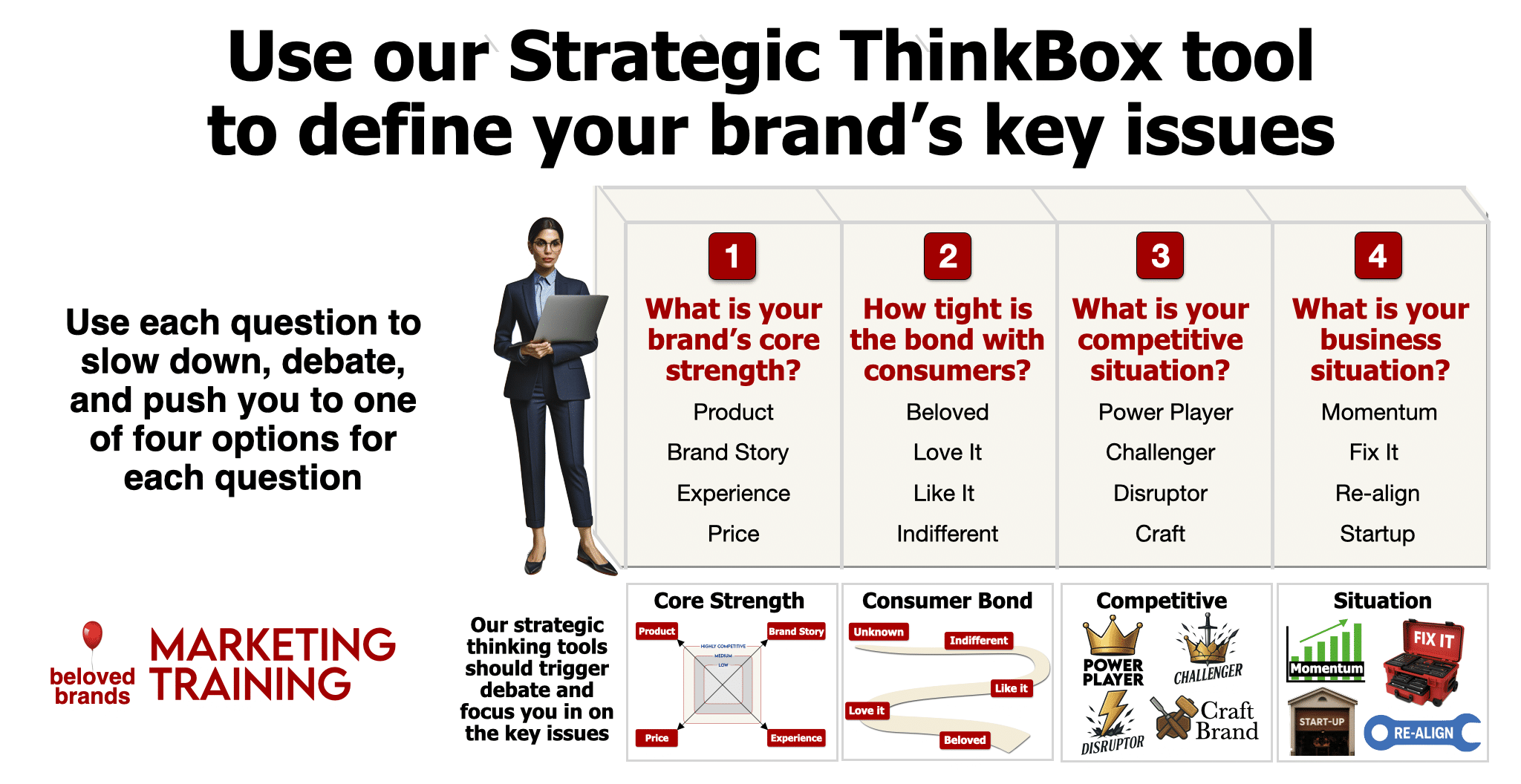
The Four Situations
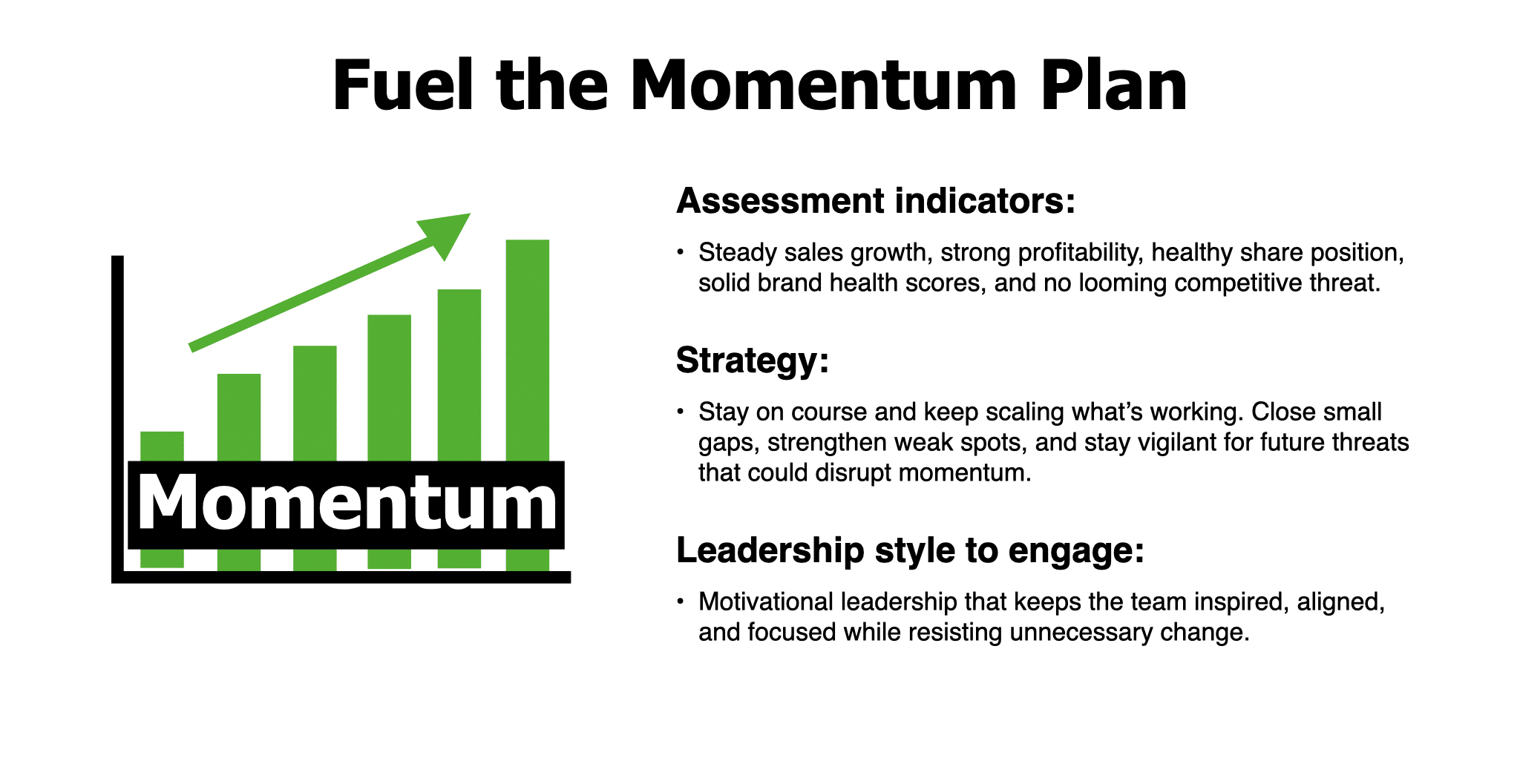
Situation 1: Momentum
A brand in the momentum situation has strong sales, healthy margins, solid brand health scores, and a team that’s aligned on where it’s going. The numbers are moving in the right direction, and the consumer relationship is strong.
The strategic priority is to keep scaling what’s working and widen the advantage.
That sounds straightforward, but in practice, it’s one of the hardest situations to manage well. Every new leader coming into a momentum brand sees a list of things they’d do differently. The temptation to make changes. To put a personal stamp on the brand, to fix what looks like small inefficiencies, to accelerate growth by trying new things, is constant.
Resist it. A change plan imposed on a healthy brand creates resistance, disrupts the team’s focus, and introduces unnecessary risk. The strategic job in a momentum situation is to understand what’s driving the success well enough to protect it, close small gaps that could become vulnerabilities, and look ahead at the scenarios that could threaten the current trajectory.
Leadership style here is motivational.
Your role is to keep the team inspired, aligned, and moving together. Celebrate progress. Protect the culture that got you here.
The investment priority is to double down on what’s already generating returns. If a specific media channel is driving trial, invest more. Or, if a specific product line is building loyalty, extend it carefully. If a retail relationship is delivering disproportionate results, deepen it. Momentum brands should be looking to widen their lead, not experiment with unproven approaches.
Beloved Brands Marketing Training
To view, use the arrows to see our Beloved Brands Marketing Training program brochure.
It's time to elevate your marketing team's performance with our Beloved Brands Marketing Training program.
Our marketing training makes your marketers smarter with brand analytics, strategic thinking, brand positioning, brand plans, and marketing execution.

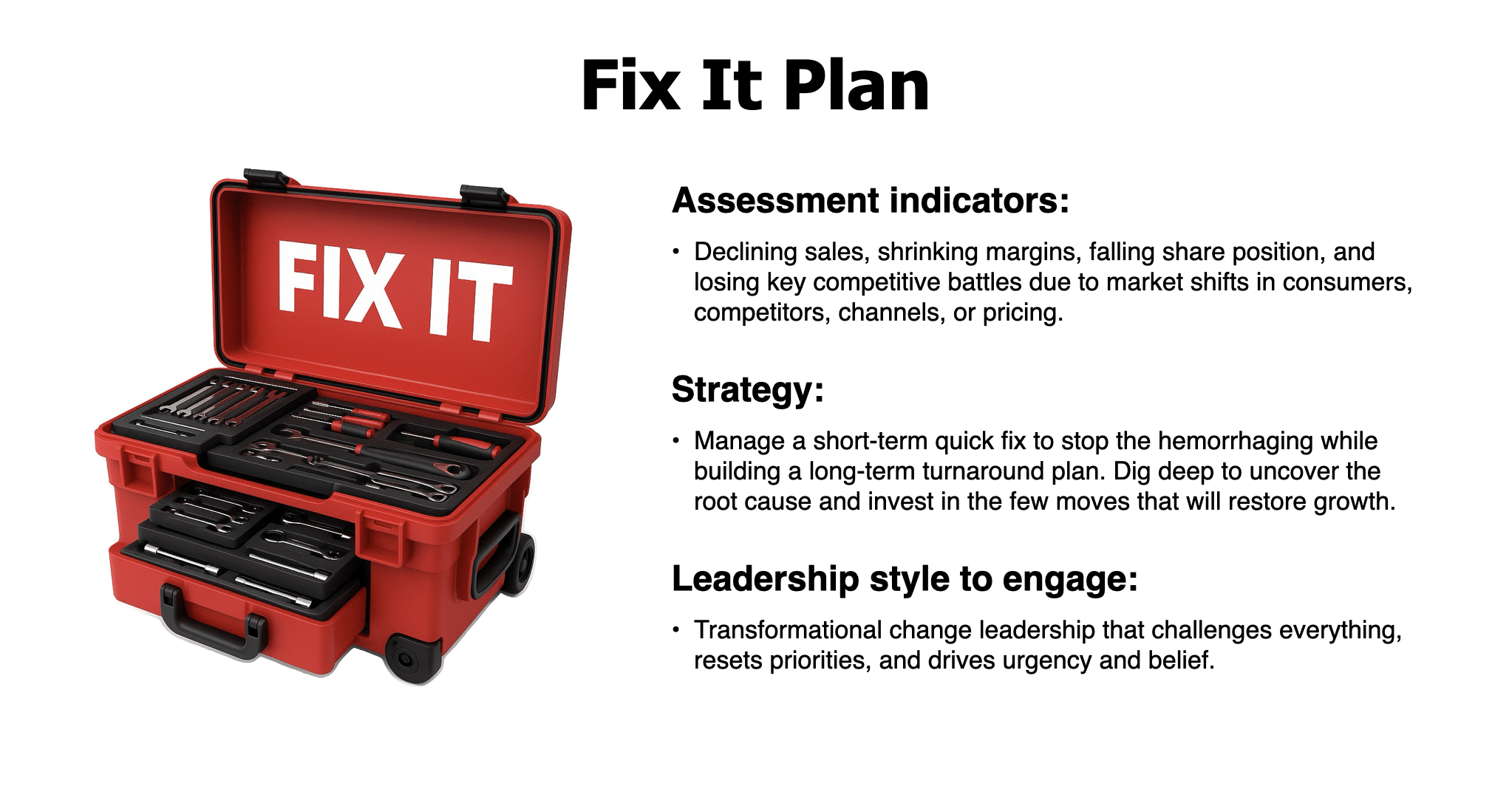
Situation 2: Fix It (External Problem)
A brand in a fix-it situation is facing declining sales, shrinking market share, margin pressure, or some combination of all three — and the cause is external. And a major competitor has launched. Consumer needs have shifted. A channel has changed. Pricing dynamics have moved against the brand. Something in the market has turned and the brand hasn’t responded effectively yet.
The strategic priority is to stop the bleeding first, then rebuild.
These two tasks have to run simultaneously, which is what makes fix it situations so demanding. The quick fix buys time with management and gives the team a much-needed win to rally around. But quick fixes rarely solve the underlying problem — and leaders who confuse a short-term stabilization with a real turnaround find themselves back in the same conversation six months later.
The longer-term fix requires a genuine deep-dive into what consumers actually want now, into where competitors have moved, into which investment decisions are still generating returns, and which ones have stopped. Cut spending that isn’t working without hesitation. Reinvest with focus on programs that have a real chance of an early breakthrough win.
Leadership style here is challenging.
The team needs to feel the urgency, understand that the old playbook isn’t sufficient, and be genuinely motivated to find a new approach. Losing can become contagious in a brand culture if the leader doesn’t create early wins that show the situation is turning.
Watch out for the temptation to do too many things at once. Fix it situations generate long lists of problems and it’s easy to spread resources across all of them. Pick the two or three issues that matter most and fix those properly.
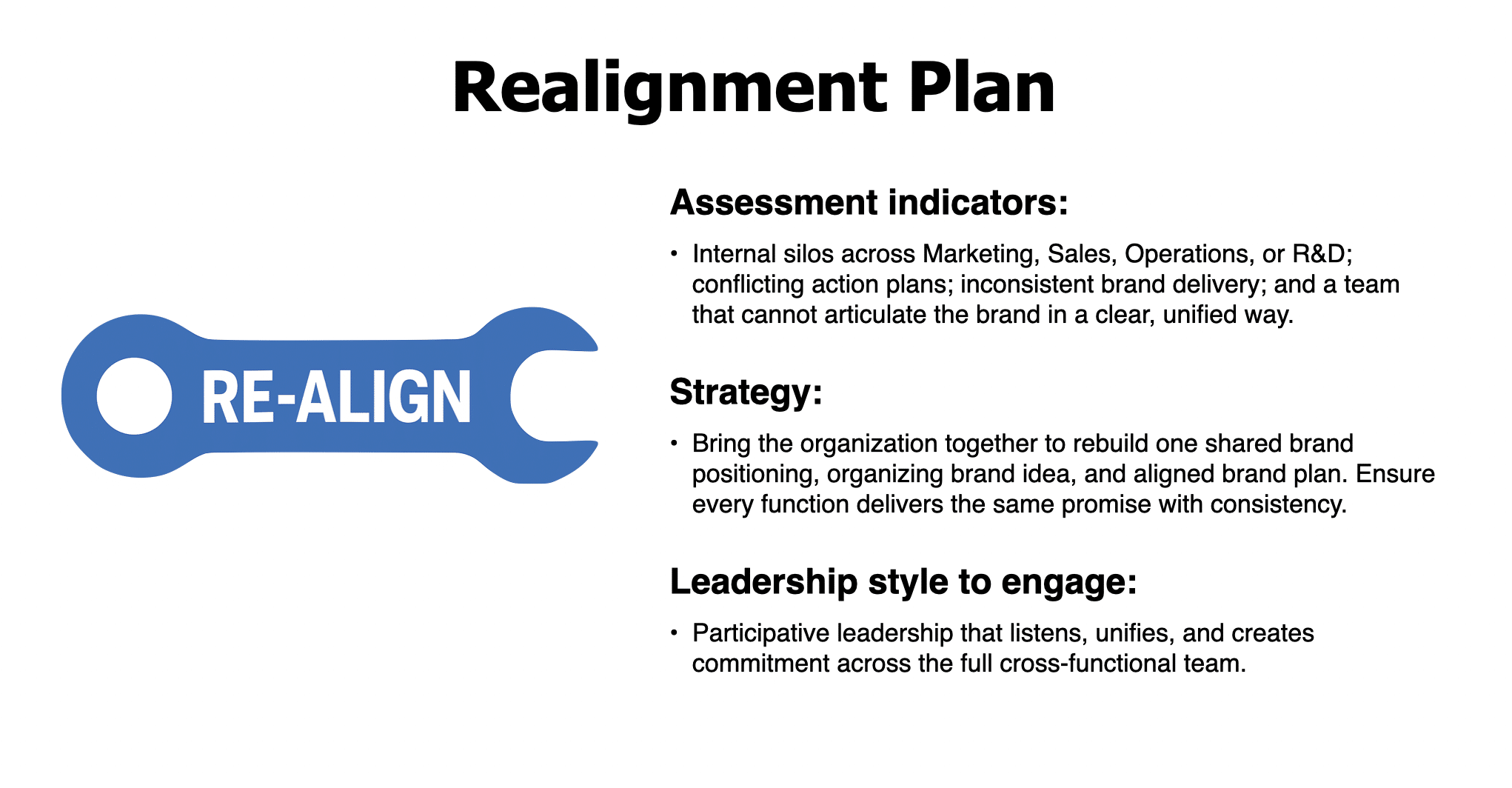
Situation 3: Re-align (Internal Problem)
A brand in a re-align situation isn’t failing because of market forces — it’s being held back by internal ones. Marketing, Sales, Operations, and R&D are pulling in different directions. There’s no shared vision. Decisions get made in silos. The brand story changes depending on who’s presenting it. Resources get deployed based on internal politics rather than strategic priority.
This is a different problem than fix it, and it requires a different solution. The market may actually be fine. The brand may have real potential. But none of it gets realized because the organization can’t move together.
The strategic priority is to reset priorities and build one aligned plan that everyone owns.
That means getting the right people in the room before the plan is written, surfacing the conflicts and assumptions that create silos, and building explicit alignment on the brand’s vision, key issues, and strategic choices before anyone starts working on tactics.
Leadership style here is collaborative but directive. The leader needs to create space for every function to have genuine input into the plan, while being clear that once the direction is set, everyone moves together. Alignment built through genuine participation holds. Alignment forced through authority doesn’t.
The investment priority is clarity before spending.
A realignment situation often reveals that resources are being spread across too many priorities because nobody agreed on the top three priorities. Getting to a focused plan often means cutting good initiatives to fund the best ones — and doing that work before adding new investment.

Situation 4: Startup
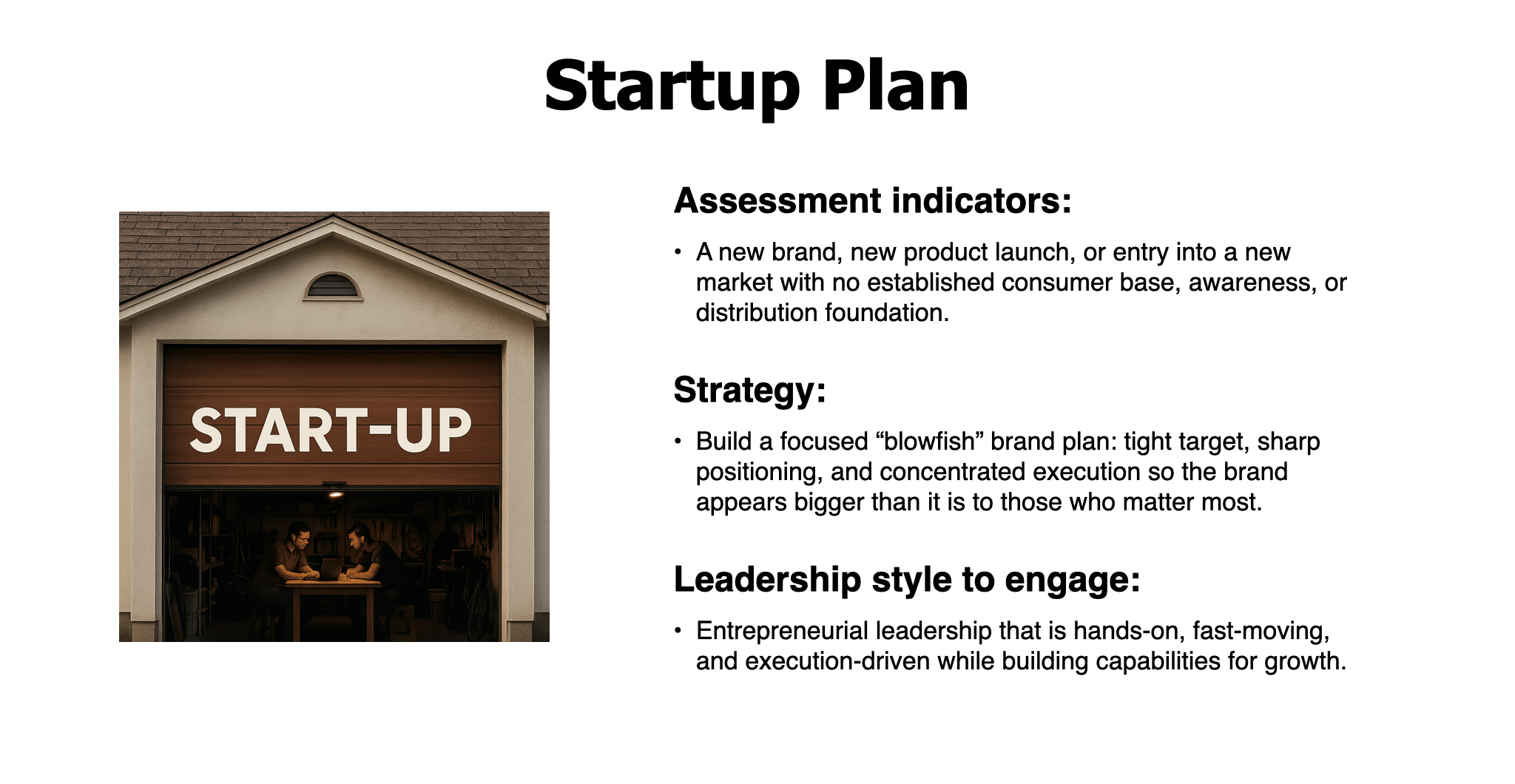
A startup situation is a brand with no established base — either a genuinely new brand entering the market, or an existing brand entering a new category or geography where it has no history, consumer base, or distribution.
The strategic priority is to build awareness, drive early trial, and create momentum from first believers.
Everything is harder in a startup situation because there’s no existing equity to lean on. The brand has to earn every consumer relationship from scratch.
The startup situation demands extreme focus on the consumer most likely to try something new and talk about it. These early believers are disproportionately valuable — they generate the word of mouth, the reviews, and the social proof that makes the next wave of consumers feel comfortable taking a chance on an unknown brand. Invest in reaching them first and giving them an experience worth talking about.
The biggest mistake in a startup situation is trying to be too broad too early.
Mass awareness spending before the product experience is proven, distribution in mainstream channels before the brand story is sharp, promotions designed to drive trial before the quality is consistently delivering — all of these waste resources and can actually set back the brand by generating trial before the brand is ready to convert it to repeat.
Build the foundation first. Get the product right, get the story right, and get the experience right. Then scale.
Frequently Asked Questions - Business Situation
What is a business situation in brand strategy?
A business situation is an assessment of a brand’s overall health and context before any strategic decisions are made. It answers the question: what does the business reality actually demand right now? The Beloved Brands framework identifies four situations — momentum, fix it, re-align, and startup — each requiring a different strategy, investment approach, and leadership style.
Why does the business situation matter before writing a brand strategy?
A strategy that’s right for one situation can be actively harmful in another. A momentum strategy applied to a brand in crisis wastes time and resources on growth initiatives when the priority should be stabilization. A fix it strategy applied to a healthy brand creates unnecessary disruption and resistance. Getting the situation diagnosis right before writing any strategy is what ensures the plan matches reality.
How do I know if my brand is in a momentum situation?
Look for consistent sales growth, healthy and stable margins, strong brand health tracking scores, good distribution and retail relationships, and a team that’s aligned and performing well. If most of those conditions are true, you’re in momentum. The strategic job is to protect it and widen the lead — not redesign what’s already working.
What’s the difference between fix it and re-align?
Fix it is driven by external problems — market forces, competitive attacks, consumer shifts, or channel changes that have caused the brand’s results to decline. Re-align is driven by internal problems — organizational misalignment, siloed functions, conflicting priorities, or a lack of shared direction — that prevent the brand from reaching its potential. Fix it requires a market diagnosis. Re-align requires an organizational one. The solutions are very different.
Can a brand be in more than one situation at the same time?
It’s possible, but rare. A brand can have both an external market problem and an internal alignment problem simultaneously, which makes the situation significantly harder to manage. When that happens, the internal alignment issue usually needs to be addressed first — a fractured organization can’t execute a fix it plan effectively. Get the team aligned on direction before committing to a major strategic change.
How does the business situation affect investment decisions?
Each situation has a different investment logic. Momentum brands double down on what’s already generating returns. Fix it brands cut unproductive spending and reinvest in high-probability wins. Re-align brands focus investment on clarity and planning before adding new spending. Startup brands invest heavily in reaching early believers who will generate word-of-mouth and hold back from broad-reach spending until the product experience is proven.
How does the business situation connect to the other Strategic ThinkBox questions?
Business situation is the fourth and final question in the Strategic ThinkBox, alongside core strength, consumer strategy, and competitive strategy. It functions as the grounding question — it takes the answers from the other three and puts them in the context of what the business can actually support right now. A startup brand with a product core strength and a disruptor competitive position still needs to match its strategy to the resource constraints and urgency of the startup situation. The four questions work together to define both the direction and the reality of what’s possible.
Does this framework apply to B2B brands?
The four situations apply directly to B2B. A B2B brand with strong renewal rates, a growing pipeline, and an aligned sales and marketing team is in momentum. And, a B2B brand losing accounts to a competitor or facing pricing pressure from a new market entrant is in fix it. A B2B brand where sales is selling one story and marketing is telling another is in re-align. And a B2B brand entering a new vertical or launching a new product line is in startup. The diagnostic questions are the same — only the metrics change.