Most Brands Lose Because They Talk Product Features and Not the Functional and Emotional Benefits of a Winning Brand Positioning
I’ve spent 20 years watching great products underperform because the marketing talked about what the product had instead of what the consumer gets. The brief listed features. The ads explained specs. And the positioning tried to say everything and ended up saying nothing.
Features are what your product does. Functional benefits are what the consumer gets from those features. Emotional benefits are how they make them feel. The brands that win aren’t the ones with the best product – they’re the ones who figured out how to connect their product to something the consumer genuinely cares about.
Most brand managers know this in theory. The problem is making the climb in practice. It requires discipline to move past the features your R&D team spent years building and ask the harder question: so what does that actually mean to the person buying it?
Brand positioning is where that question gets answered. Get it right, and every dollar you spend in the market compounds. Get it wrong and you’re paying to confuse people.
This page walks you through the process I’ve used across CPG, B2B, healthcare, and retail brands. Gray’s Cookies runs as the example throughout because it shows every step clearly.
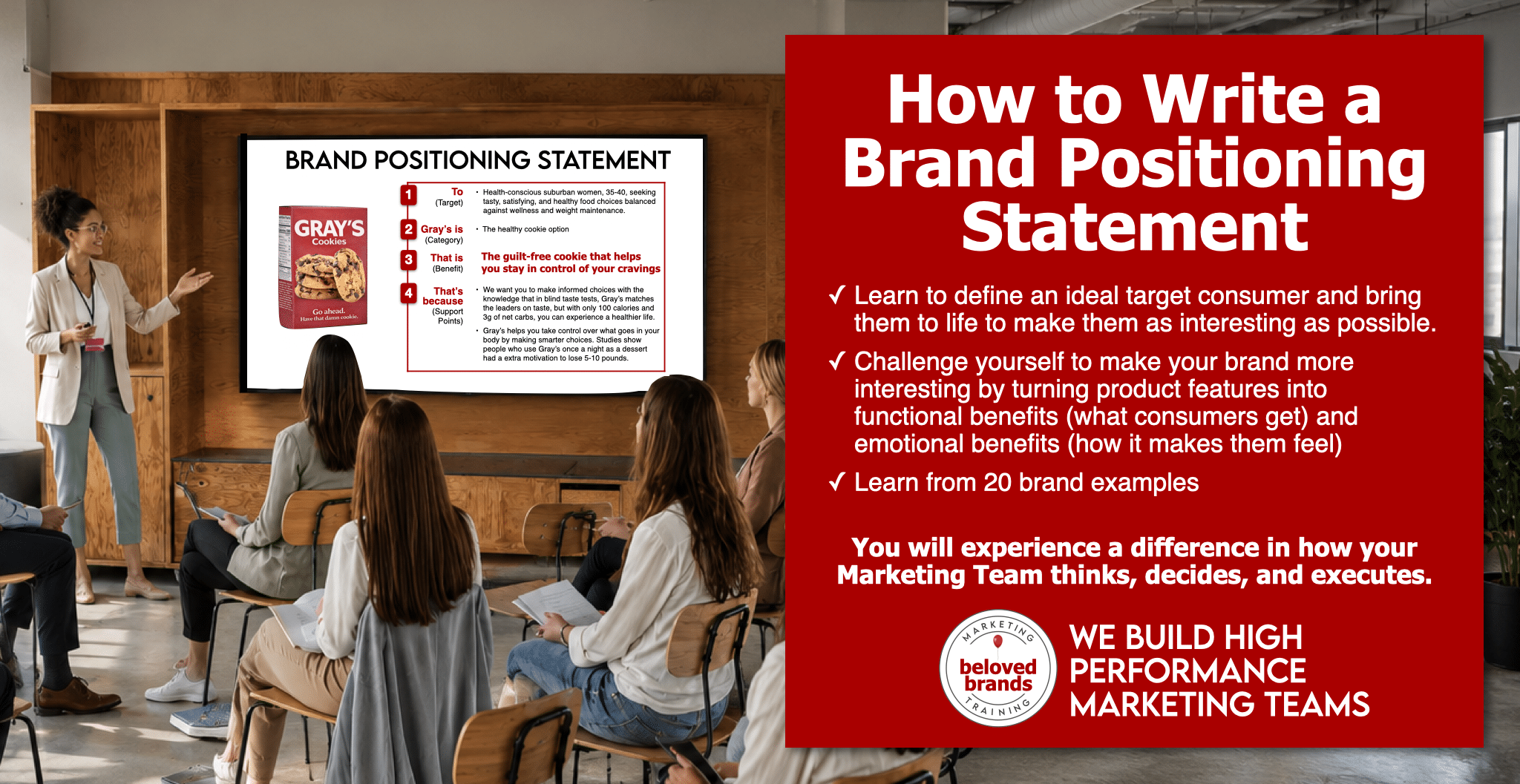
Table of Contents - How to write a Brand Positioning Statement
What Brand Positioning Actually Is
Positioning is the specific place your brand occupies in a consumer’s mind relative to the competition. Not what you sell. Not your tagline. The one idea a consumer holds about your brand when they’re standing at the shelf or scrolling past your ad.
Every effective positioning statement contains four elements.

The Four Elements of a Positioning Statement
- Consumer target. Not everyone. The specific people who are most motivated by what you uniquely offer. Narrowing your target doesn’t shrink your sales – it sharpens your message enough to actually move someone.
- Competitive frame. The category you’re competing in and the specific set of competitors you’re asking consumers to choose you over. Where you place yourself in the frame changes everything about how consumers evaluate you.
- Main benefit. The central promise that differentiates you. What they get functionally, and how it makes them feel emotionally. This is where most positioning falls short – brands stop at the functional and never climb to the emotional truth.
- Reasons to believe. The two support points that close the gap between your claim and consumer skepticism. Not five. Two. Logic only needs two premises to draw a conclusion.
The Brand Positioning template:
- “For [consumer target], [brand] is the [competitive frame] that [main benefit] because [reasons to believe].”
Simple to write. Hard to get right. The difficulty isn’t the template – it’s making the strategic choices that determine whether your positioning helps you win or keeps you invisible.
The Four Zones - Where Brands Win, Lose, and Waste Money

Think of three overlapping circles:
- Circle 1: Everything consumers want or need
- Circle 2: Everything your brand does best
- Circle 3: Everything your competitors do best
The Winning Zone (Green)
Where consumer needs overlap with what your brand does best – and competitors can’t match you. This is the most sustainable position. You satisfy consumer needs better than anyone else, and you can defend the space. But with competitors copying each other, this space can get squeezed.
Volvo owns safety in the winning zone. Consumers care deeply about protecting their families, Volvo has decades of safety innovation, and no competitor can credibly challenge them there.
The Losing Zone (Red)
Where consumer needs overlap with what competitors do best. If you compete here, you lose. Your competitor is stronger, more credible, and already owns this space in consumers’ minds. Every dollar you spend there just reminds people of your competitor.
The Risky Zone (Grey)
Where you and your competitors are tied on meeting consumer needs. You can win the tie, but only by owning the emotional benefit your competitor hasn’t claimed. Southwest Airlines operates in a category where most functional benefits are tied – they all fly you to the same places safely. Southwest wins by owning the emotional benefit of freedom and friendliness.
The Dumb Zone (Blue)
Where you’re battling competitors on something consumers don’t care about. I see this constantly – two brands arguing about specs that sound important internally but mean nothing to the person making the purchase decision. Being the best at something nobody cares about is not a competitive advantage.
For Gray’s Cookies, the winning zone was clear: guilt-free indulgence. Consumers wanted it. The low-calorie recipe could deliver it. No major competitor owned it. But finding that zone requires a systematic process, not intuition.
The Brand Positioning Process: From Features to Feelings
Most marketers start with what their product does and stop there. Features are not positioning. They’re the raw material. The process moves you from features up to the emotional truth that actually moves consumers.

Step 1 - Define Your Consumer Target
The biggest myth in marketing is that a bigger target means more sales. It doesn’t. Trying to appeal to everyone means you appeal to no one with enough intensity to win.
Your target isn’t a demographic. It’s a human being with a specific tension, an unmet need, and a behavior pattern you can reach. Demographics tell you who they are. Psychographics tell you why they’d choose you.
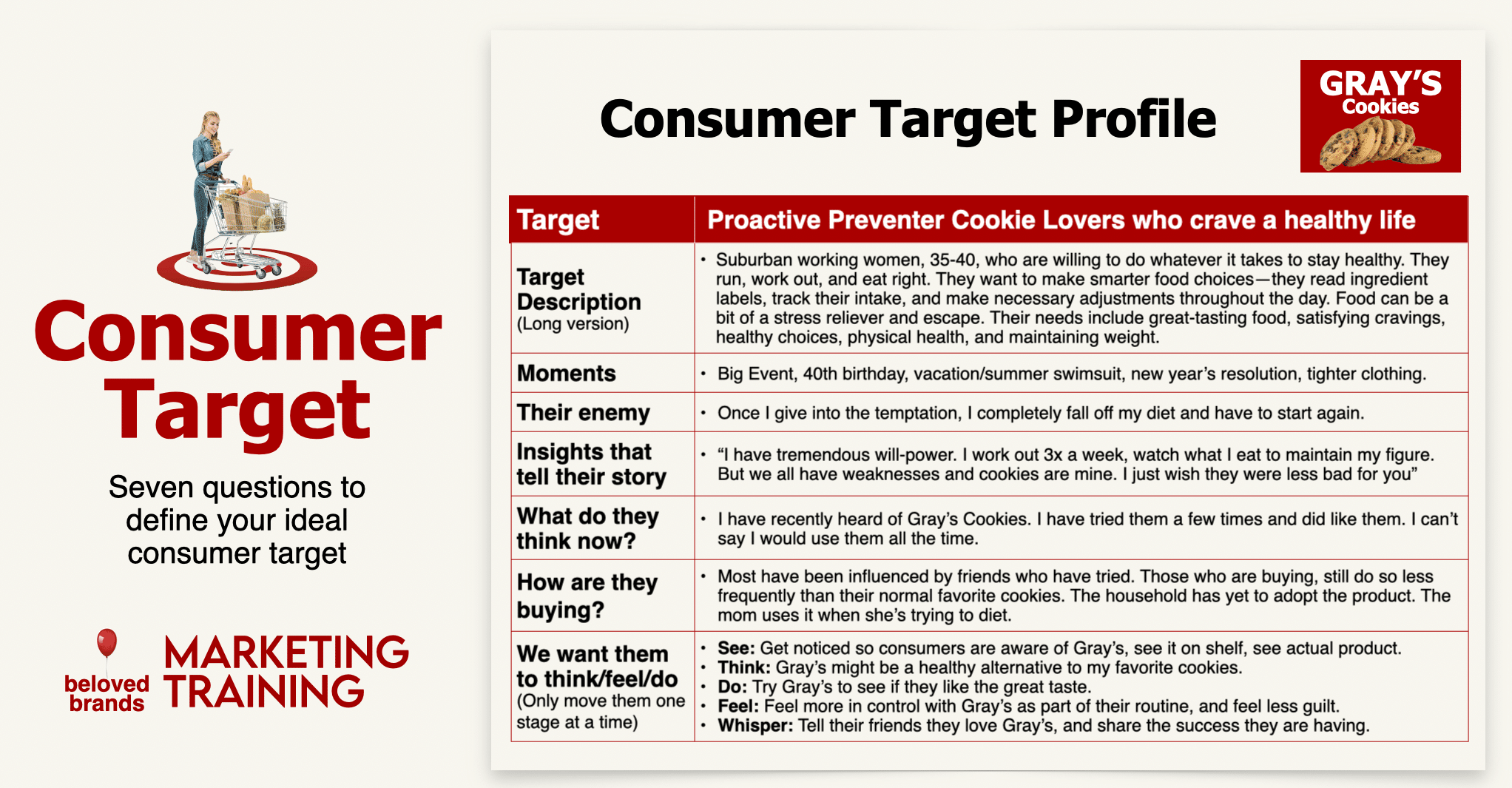
Example: Gray’s Cookies Consumer Target
Suburban working women, 35-40, who are willing to do whatever it takes to stay healthy. They run, work out, and eat right. They want to make smarter food choices—they read ingredient labels, track their intake, and make necessary adjustments throughout the day. Food can be a bit of a stress reliever and escape. Their needs include great-tasting food, satisfying cravings, healthy choices, physical health, and maintaining weight.
That’s not a demographic. That’s a person with tension. And tension is what positioning resolves.
The focusing question: if you could only afford to reach one specific person, who would feel most motivated by what you offer?
Step 2 - Build Your Consumer Benefits Ladder
Features are what your product has. Functional benefits are what the consumer gets from those features. Emotional benefits are how they make them feel. The benefits ladder forces you to climb from features up to emotions – because emotions are what drive decisions and build loyalty.

Start with features.
List everything your product has or does that gives you a genuine competitive advantage.
- Gray’s example: We are the low-calorie cookie – We are a great tasting, soft cookie – We are the low-carb, low sugar cookie that tastes great
Move to functional benefits.
For each feature, ask: if I’m the consumer, what do I get from that? Keep asking until you reach a benefit that actually differentiates.
- Gray’s example: I get to battle against my cravings – I get to indulge without derailing my health goals – I get guilt-free indulgence.
Climb to emotional benefits.
For each functional benefit, ask: how does that make me feel? Keep asking until you hit the emotional truth.
- Gray’s example: I feel in control of my choices – I feel no guilt with this cookie – I feel confident and optimistic about maintaining my healthy lifestyle.
The pattern that emerged for Gray’s: 80 calories per serving (feature) leads to indulging without the guilt (functional benefit) leads to feeling in control and confident (emotional benefit). That’s the foundation the positioning is built on.

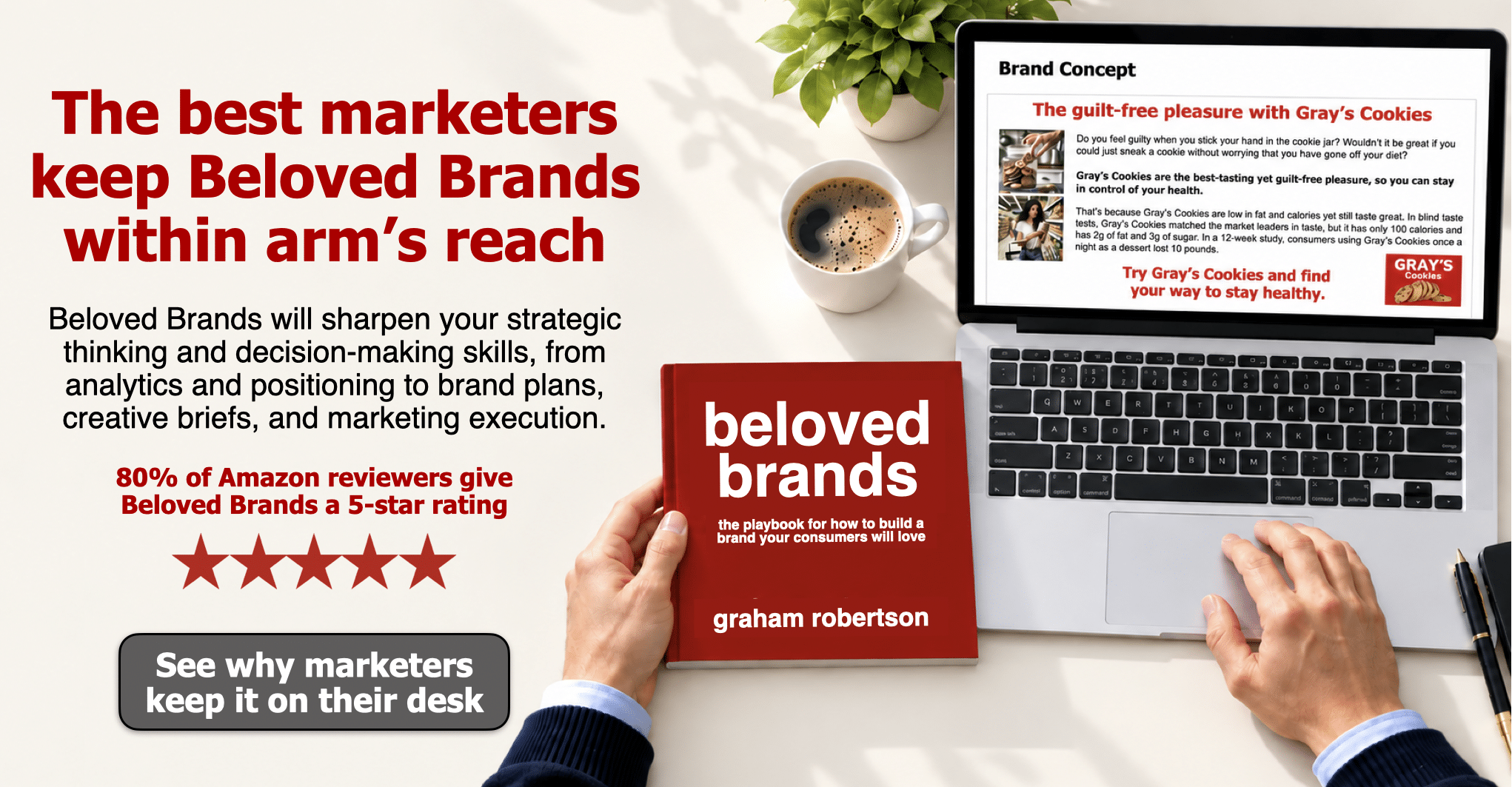
Beloved Brands Marketing Training Program Builds High-Performing Brand Management Teams
If you’re leading marketing and your team isn’t performing at the level the business needs, you’re not alone — and the answer isn’t more headcount. It’s better thinking.
Our Beloved Brands Marketing Training Program is the hands-on brand management training built by a former VP of Marketing at Johnson & Johnson. We work with marketing leaders who want to know how to improve marketing team performance.
This isn’t theory. It’s real-world marketing team training applied directly to your brands, using the same frameworks senior marketers who manage the best brands in the world use. Your team will be smarter on brand analytics, strategic thinking, positioning, planning, and execution. You will see the difference in how they think, decide, and execute.
Use our > button to flip through our brand management training book.

Step 3 - Choose Your Benefit Territory
Once you’ve built the features list, you need to choose which benefit territory to own. I’ve created two cheat sheets that give you pre-tested options across 12 zones for both functional and emotional benefits.
Functional Benefits - 12 Zones to Choose From

The 12 functional zones: Stay Connected, Makes Me Smarter, Saves Me Money, Simplifies My Life, Helps Me Be Healthier, Helps My Family, Provides Sensory Appeal, Enhances My Experience, Works Better, Enhances Professional Standing (B2B), Drives Business Results (B2B), Helps Me Execute (B2B).
For Gray’s Cookies, the relevant zones were Helps Me Be Healthier (low-calorie, whole-grain), Provides Sensory Appeal (tastes amazing), and Enhances My Experience (indulgent moment).
Emotional Benefits - 12 Zones to Choose From

The 12 emotional zones: Knowledge, Control, Comfort, Self-Assured, Optimism, Feel Myself, Liked, Freedom, Get Noticed, Sense of Belonging, Revitalized, Pride.
For Gray’s, the strongest emotional territories were Control (staying in control of health goals), Self-Assured (confident in smart choices), and Optimism (positive about maintaining a healthy lifestyle).
The functional benefit wins the mind. The emotional benefit wins the heart. You need both.


Click on the images above to see Gray’s Cookies Consumer Benefits

Step 4 - Brainstorm Your Specific Benefit Statements
Once you’ve chosen your benefit zones, you need to turn them into specific, written statements before you can test them. This is where the real work happens – and where most teams rush. They pick a zone and jump straight to the positioning statement without ever writing out the individual benefit options. That’s how you end up with generic positioning.
Take each zone you’ve chosen and write three to five specific statements using your own category language.
Functional benefits – write each as “I get…”
Push yourself to be specific. “I get a healthier cookie” is too vague to test. “I get to eat a cookie with only 80 calories and still feel like I’m treating myself” is testable.
Gray’s functional benefit statements:
- I get a delicious cookie that doesn’t derail my health goals
- I get to indulge without the calorie guilt
- I get great taste and nutritious ingredients in the same cookie
- I get a treat that actually fits my healthy lifestyle
Emotional benefits – write each as “I feel…”
The emotional statements are harder to write and easier to get wrong. Generic emotions like “happy” or “satisfied” won’t help you. Push to the specific feeling that your target consumer would recognize as their own.
Gray’s emotional benefit statements:
- I feel in control of my health and still able to enjoy the things I love
- I feel confident I’m making smart choices for my body
- I feel optimistic about maintaining my healthy lifestyle without giving up everything
- I feel proud that I don’t have to choose between taste and health

Now you have the raw material to test. Take every statement you’ve written and map it on the positioning grid. The ones that land in the winning zone become the foundation of your positioning statement. The ones that land in the losing or dumb zone get cut – no matter how much the team likes them.


Step 5 - Test Your Benefit Statements on the Positioning Grid
Once you’ve identified your benefit territory, write five to ten specific benefit statements and test each one on the positioning grid. The grid has two axes: how motivating is this to consumers, and how ownable is it for your brand.

- Winning zone: High consumer motivation, high brand ownership. This is where you focus everything.
- Losing zone: High consumer motivation, but a competitor already owns it. Don’t fight here.
- Risky zone: High consumer motivation, tied with competitors. You can win with the right emotional claim.
- Dumb zone: Low consumer motivation regardless of ownership. Walk away.
Gray's Cookies Positioning Grid Results
- Winning zone: “Guilt-free indulgence” and “feel in control of your health while still enjoying treats.”
- Losing zone: “Favorite cookie” and “best-tasting cookie” – Oreo owns this space.
- Risky zone: “Made with real ingredients” – every competitor can say the same.
- Dumb zone: “Proprietary sweetening technology” and “25 years in business” – consumers don’t care.
The clarity this creates is the point. Before mapping the grid, Gray’s was spending money in the losing and dumb zones. That’s where most brands are.

Step 6 - Build Your Reasons to Believe
You’ve identified your winning benefit. Now consumers are thinking: prove it. Reasons to believe close the gap between your claim and consumer skepticism. You only need two. Logic requires exactly two premises to draw a conclusion – more than that creates clutter and dilutes focus.
- Process support. How is your product made differently? What you do in production that competitors don’t.
- Product claims. Ingredient advantages, formulation benefits, quality standards.
- Third-party endorsement. Expert recommendations, clinical validation, award recognition, customer proof.
- Behavioral results. Clinical data, usage studies, performance metrics, before and after results.

Gray's Cookies Final RTBs
- RTB 1: Only 80 calories per serving – 75% fewer calories than leading cookies.
- RTB 2: Rated equally delicious to regular cookies in blind taste tests.
Those two premises make the conclusion – guilt-free indulgence – both believable and defensible.
The Complete Brand Positioning Statement: Gray's Cookies
For health-conscious women 25-45 who love cookies but feel guilty about the calories, Gray’s Cookies is the indulgent cookie that delivers guilt-free indulgence with amazing taste and only 80 calories, because we use whole grain flour and monk fruit sweetening in our proprietary low-temperature baking process, creating cookies rated as delicious as regular cookies in blind taste tests with 75% fewer calories.

Why this works: the target is specific enough to speak directly to one person’s tension. The competitive frame keeps it in cookies, not diet food. The benefit resolves that tension with an ownable emotional claim. And the RTBs are specific enough that no competitor can simply copy them.
What a Finished Brand Positioning Presentation Looks Like
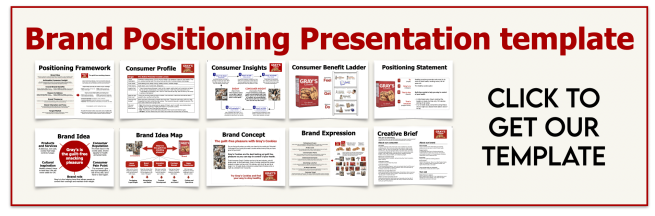
The six steps produce more than a statement. They produce a deck your team can actually present, defend, and hand to an agency. Here are the ten slides I build with every client.

Brand Positioning Presentation - 10 key slides
- Positioning Framework. The one-page summary that holds the brand idea, the consumer insight, the overall benefits, the reasons to believe, and the character of the brand. This is the slide people take a photo of.
- Consumer Profile. Who is in the target and who is out, plus what they need, what they battle, and what you want them to think, feel, and do.
- Consumer Insights. How the insight was built, from what you read in the data to what you see, hear, and feel in the consumer’s life. The enemy sits at the center of this slide.
- Consumer Benefit Ladder. The climb from product features to functional benefits to emotional benefits. This is the slide that proves the positioning is earned rather than asserted.
- Positioning Statement. The four elements in order. Target, competitive frame, main benefit, reasons to believe.
- Brand Idea. The single phrase that captures the brand, surrounded by the products and services, the consumer reputation, the cultural inspiration, the consumer pain point, and the brand role.
- Brand Idea Map. How the idea steers the five consumer touchpoints: brand promise, brand story, innovation, purchase moment, and happy experiences.
- Brand Concept. The idea written in consumer language, ready to test.
- Brand Expression. Packaging, product look, communication cues, distinctive brand assets, advertising look and feel, in-store look and feel.
- Creative Brief. The output that turns all of it into work. Why you are advertising, what you know about the consumer, what the brand promises, and what you are asking the agency to do.
The order matters. Each slide feeds the next. Skip the benefit ladder and your positioning statement has no proof underneath it. Skip the brand idea and your creative brief will read like a list of features.
How to Position a Portfolio of Brands
When you run more than one brand under a master brand, the positioning has to cascade so that the whole family reinforces one idea rather than pulling in different directions.

There are three ways to build that family. You can start with the master brand positioning and carry its benefits down to each sub-brand, you can stretch an original brand into new forms that keep its personality, or you can use the master brand as a sponsor that signs sub-brands serving different roles. We cover all three.
Pressure-Testing Your Positioning
Before you finalize your positioning statement, run it through five questions.
- Is it simple? Can you explain it in one sentence? If it takes a paragraph, you haven’t made the choices yet.
- Is it motivating? Does it tap into a real tension or desire your target consumer actually feels?
- Is it unique? Could a competitor credibly claim the same positioning? If yes, keep digging.
- Is it ownable? Can you defend this position through your product, service, or brand equity?
- Does it have proof? Can you back the main benefit with two specific, credible RTBs?
If the answer to any of these is no, the positioning isn’t ready.
Brand Positioning Examples Across Industries
Click on any Brand Positioning example below to zoom in:
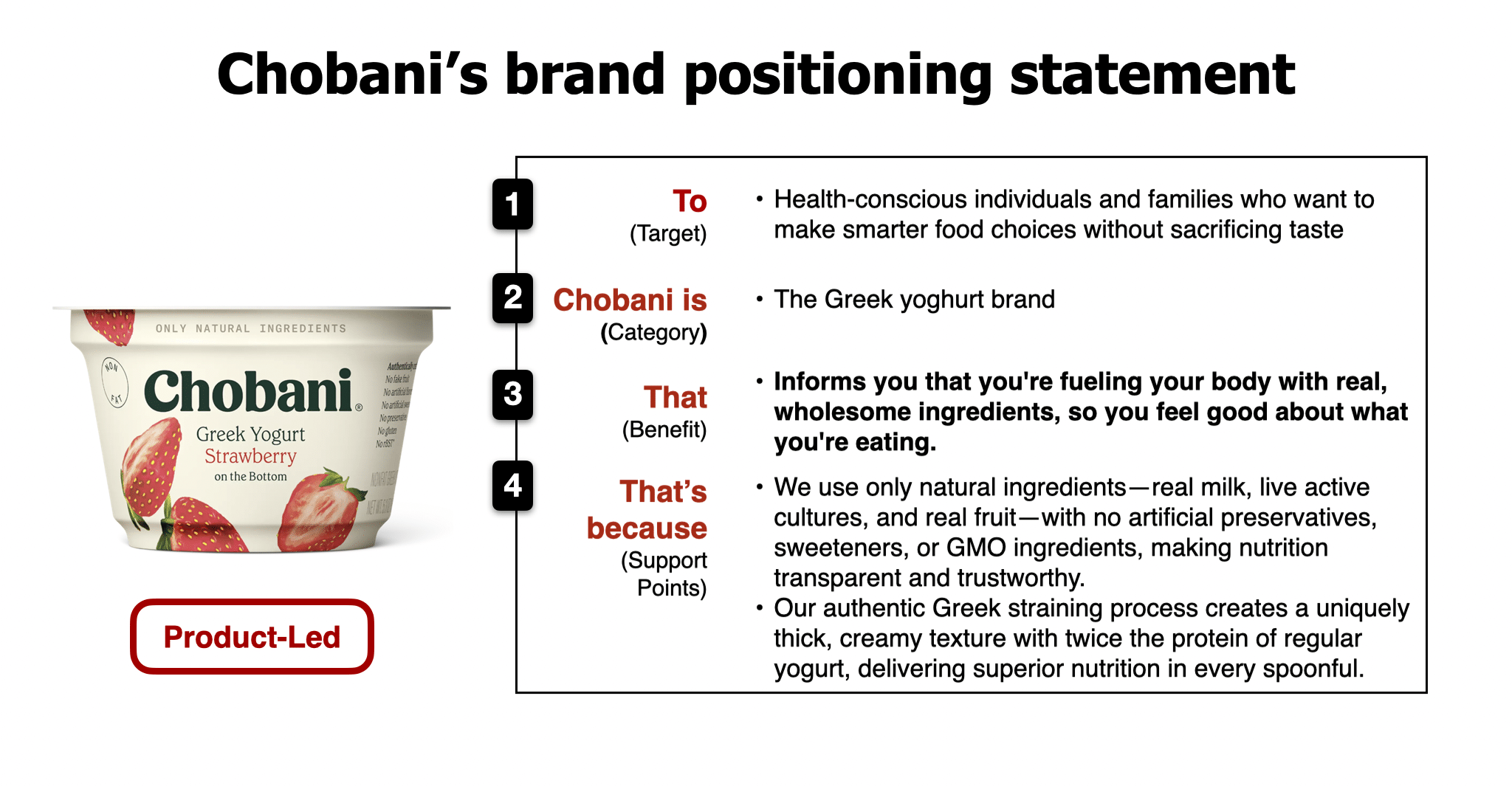
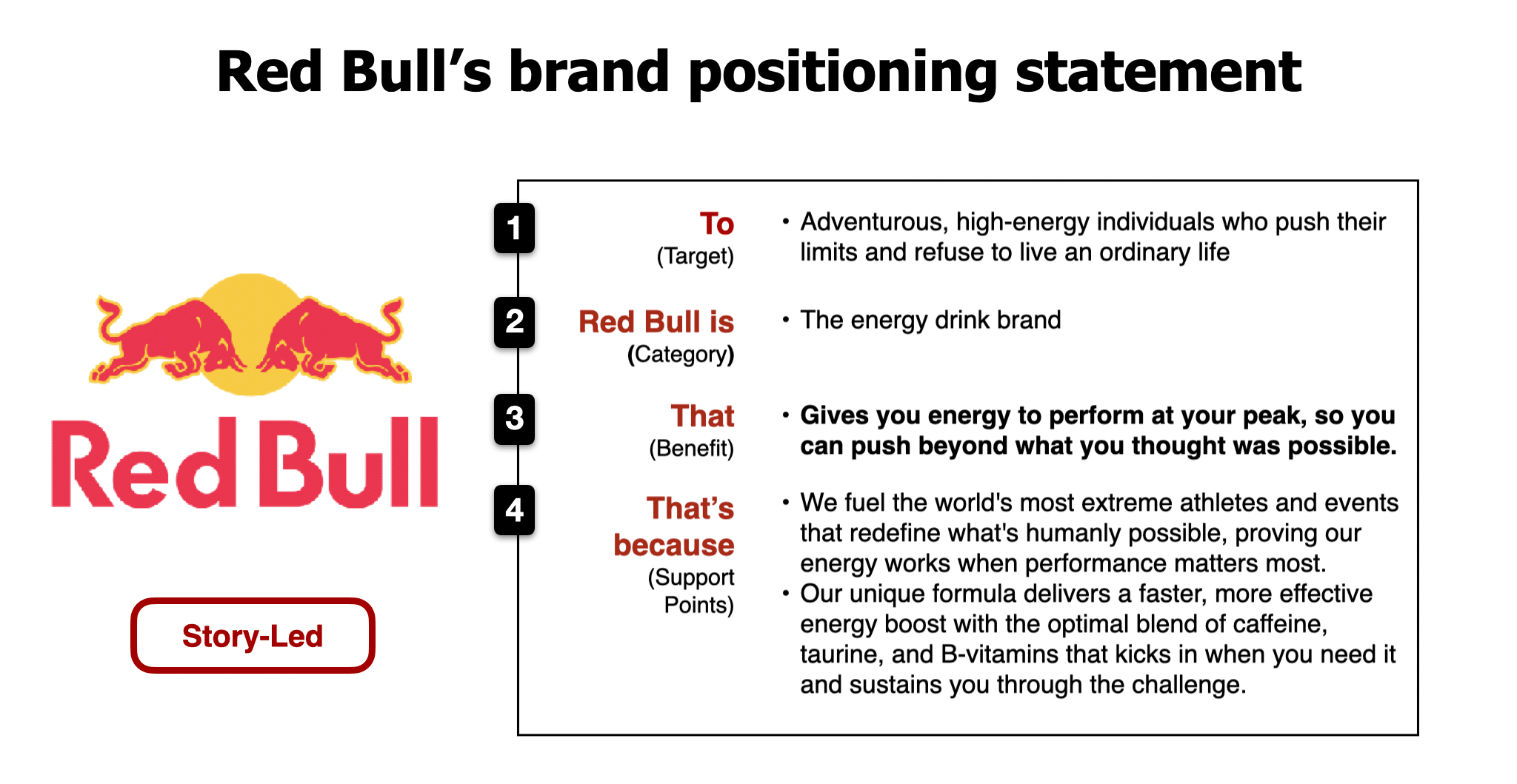
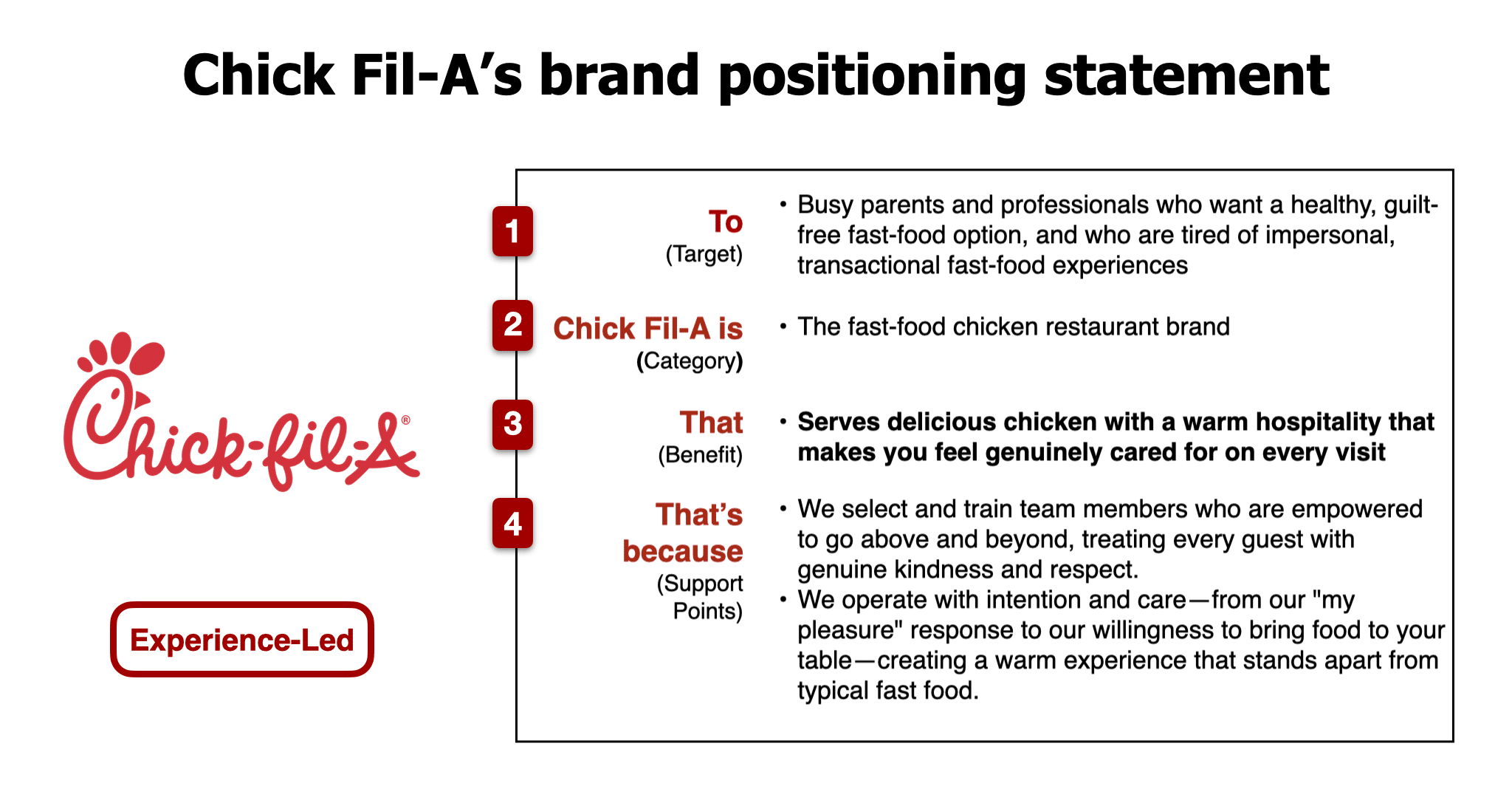
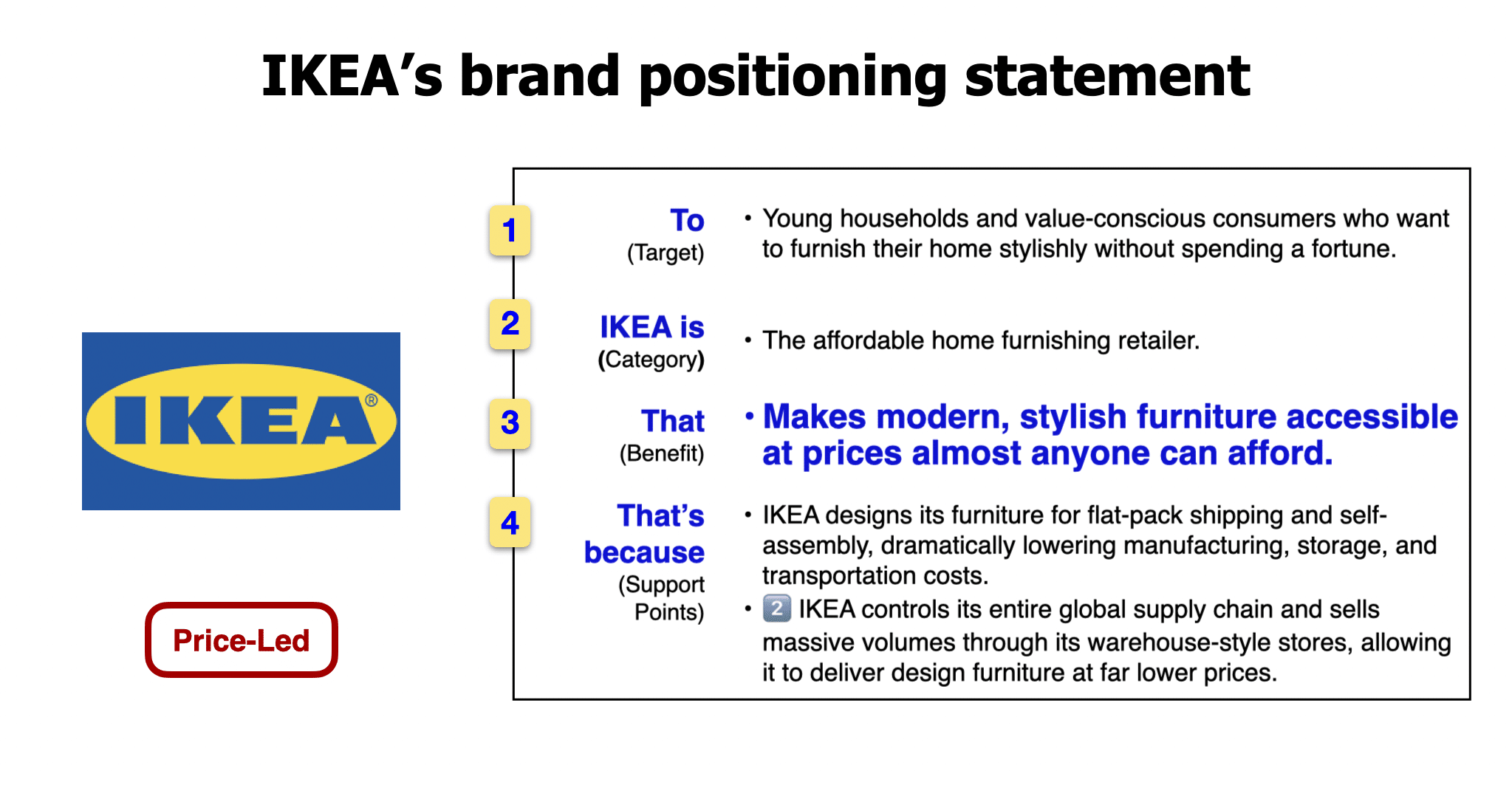
12 other Brand Positioning examples
Apple iPhone
- For creative professionals and design-conscious consumers, the Apple iPhone is the smartphone that seamlessly integrates into your creative life with intuitive design and powerful performance, because only Apple controls both hardware and software, creating an ecosystem that just works.
Dove
- For women who feel pressured by narrow beauty standards, Dove is the personal care brand that celebrates real beauty in all its forms, because we feature real women (not models) in all our advertising and donate to self-esteem education programs worldwide.
Patagonia
- For outdoor enthusiasts who care about the environment, Patagonia is the outdoor gear that performs in extreme conditions without harming the planet, because we use recycled materials, repair products for free, and donate 1% of sales to environmental causes.
Corona
- For young adults seeking escape from routine, Corona is the beer that transports you to a beach mindset, because we’re brewed in Mexico, served with lime, and exclusively associated with relaxation and escape in all our marketing.
Guinness
- For beer connoisseurs who appreciate craftsmanship, Guinness is the stout that delivers complex flavor through a ritualistic experience. That’s because we use a 128-second pour process, proprietary nitrogen widget technology, and 250+ years of brewing expertise.
Chipotle
- For young adults who want fast food without the guilt, Chipotle is the quick-service restaurant that serves real food with integrity, because we use responsibly-raised meat, organic produce, and prepare everything fresh in-house daily.
AirBnb
- For travelers seeking authentic local experiences, Airbnb is the accommodation platform that helps you live like a local anywhere, because we offer homes (not hotels) and connect you with hosts who share insider tips.
Salesforce
- For sales leaders who need visibility into their pipeline, Salesforce is the CRM that gives you complete control over your sales process. That’s because we provide real-time dashboards, automated forecasting, and mobile access to every customer interaction.
The Mayo Clinic
- For patients with complex medical conditions, The Mayo Clinic is the healthcare system that solves the unsolvable, because our integrated team approach means specialists collaborate on your case, and we see 1.3M patients annually from all 50 states.
Tesla
- For early adopters who want the future now, Tesla is the electric vehicle that delivers supercar performance with zero emissions, because our electric motors generate instant torque, a 300+ mile range eliminates range anxiety, and over-the-air updates make your car better over time.
Trader Joe’s
- For curious food lovers on a budget, Trader Joe’s is the grocery store that makes discovery affordable, because 80% of our products are private label, we buy directly from suppliers, and we create exclusive products you can’t find anywhere else.
Disney World
- For families wanting to create magical memories, Disney World is the theme park that brings stories to life and makes everyone feel like a kid again, because we maintain obsessive attention to detail, train cast members to create magic, and continuously innovate attractions.
The Mistakes That Kill Brand Positioning
Targeting everyone.
- When you’re for everyone, you’re for no one. Narrow your target to those people most motivated by what you uniquely offer.
Leading with features.
- Consumers don’t buy what your product has. They buy what it does for them and how it makes them feel. Climb the consumer benefit ladder.
Generic emotions.
- “Trust” and “reliability” mean nothing because every brand claims them. Yawn! Use the emotional benefit cheat sheet to find something specific and ownable.
Too many benefits.
- Focus on your optimized benefit that combines the functional and emotional. If you’re claiming six things, you own nothing. Consumers can’t hold six ideas about your brand.
Competing in the dumb zone.
- If consumers don’t care about the dimension you’re competing on, being the best at it is worthless.
No proof.
- A claim without a Reason to Believe creates skepticism rather than belief. Two specific, credible support points change that.
Frequently Asked Questions About Brand Positioning
How long should a positioning statement be?
One to two sentences for the core positioning. Add 1-2 sentences for RTBs. If it’s longer than 100 words total, it’s too complex.
Should our positioning statement be public-facing?
No. Your positioning statement is an internal strategic tool. It guides your marketing, but consumers will never see it word-for-word. They’ll experience it through your advertising, website, packaging, etc.
How often should we update our positioning?
Your core positioning should last 3-5+ years. You might refresh the language or add new RTBs as proof points emerge, but frequent positioning changes confuse the market. Brands like Volvo have owned “safety” for 50+ years.
What if our competitors copy our positioning?
If your positioning is truly ownable (based on product superiority, brand heritage, or owned associations), competitors can try to copy but won’t succeed. If they DO successfully copy you, you didn’t pick an ownable space.
Can we have different positioning for different segments?
Generally, no. One brand = one positioning. If you need radically different positioning across segments, you likely need separate brands (or sub-brands). Exception: B2B brands sometimes have customer-type variations while maintaining core positioning.
What’s the difference between positioning and messaging?
Positioning is strategic (where you compete and win). Messaging is tactical (what you say in marketing). Positioning informs messaging, but isn’t messaging itself.
Do small brands need positioning as much as big brands?
MORE. Big brands can succeed through distribution and awareness alone. Small brands must win through superior positioning because that’s their only competitive advantage.
Graham Robertson is the founder of Beloved Brands and a former VP of Marketing at Johnson & Johnson, with experience at Coca-Cola and General Mills. His positioning frameworks have been applied across consumer, B2B, healthcare, and retail brands in 30+ countries.
Contact: graham@beloved-brands.com | 416-885-3911
Last Updated: Sept 28, 2026
Reading Time: 18 minutes