
Knowing how to succeed as a CMO is genuinely different from knowing how to succeed at every level that came before it. The Chief Marketing Officer and VP of Marketing roles are the final level in a brand management career, and the skills that got you here are largely not the skills that will define your success at this level.
A VP marketing career reaches its peak when the person in the role fully understands that their personal marketing capability has become secondary. What matters now is whether the people around them are operating at the highest level they can reach. The CMO who stays too close to the work, makes every decision, and keeps themselves at the center of every significant output has misunderstood what the job actually requires.
This page covers the five skills that define great CMOs and VPs of Marketing — and addresses one reality about the role that rarely gets written about honestly.
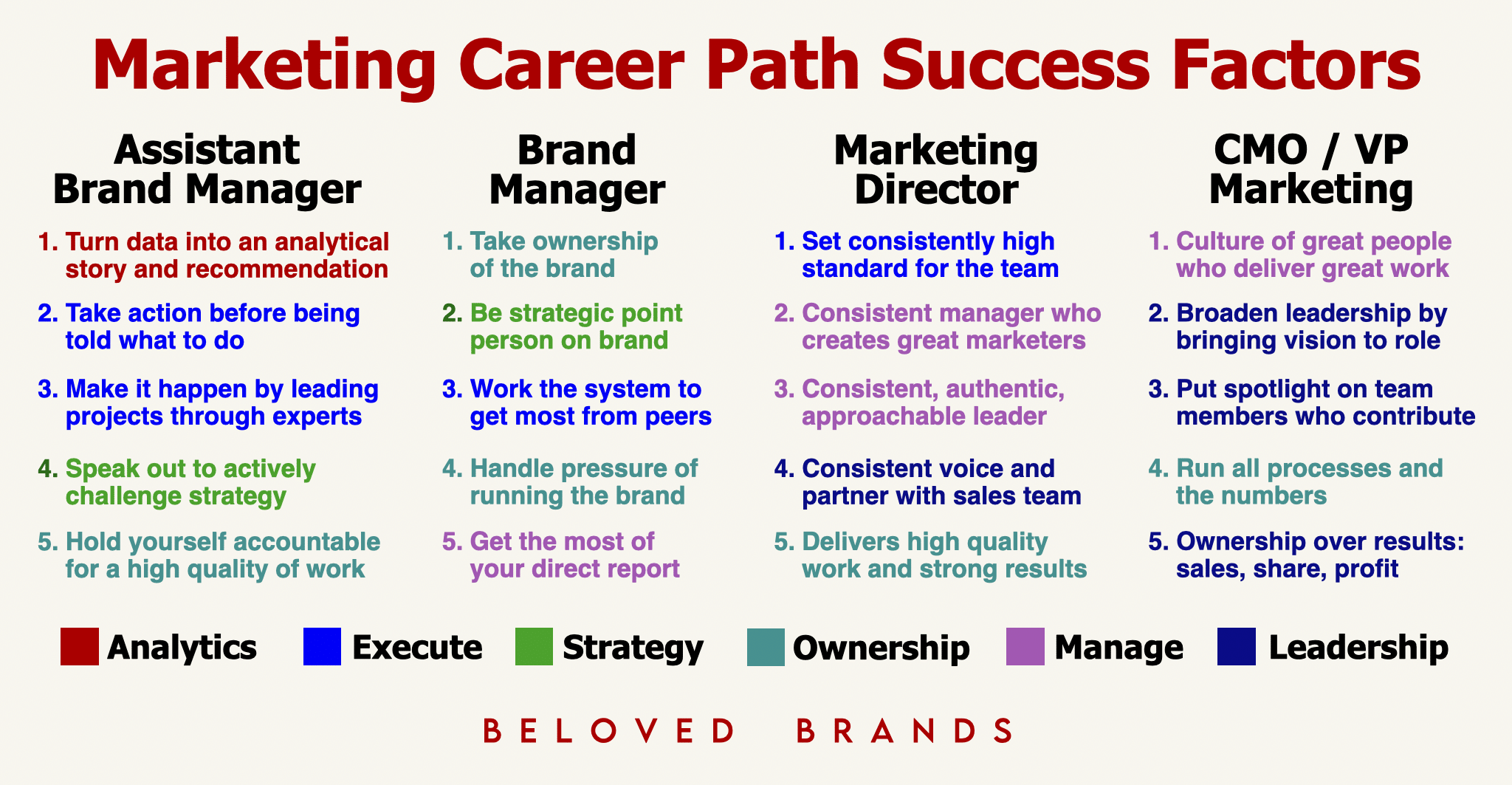
Where the CMO and VP of Marketing role sits in the career path
The brand management career has four levels and the CMO or VP of Marketing is the final one. Each level requires a fundamentally different set of skills and a genuine behavioral shift from what came before.
The assistant brand manager role is about executing, analyzing, and signaling future leadership potential. The brand manager role is about owning a brand and developing strategic direction. The marketing director role is about leading a team and developing people’s capability. And at the CMO or VP of Marketing level, the job is about vision, organizational talent, business results, and building the systems that make great marketing possible at scale.
The failure pattern at each level is consistent. Directors fail when they keep acting like brand managers. CMOs fail when they keep acting like marketing directors — staying too operationally involved, managing individual brands rather than managing the organization that manages those brands, and making decisions their direct reports should be making and growing from.
The CMO who operates at the wrong level creates a team that doesn’t develop and an organization that depends on one person too heavily.

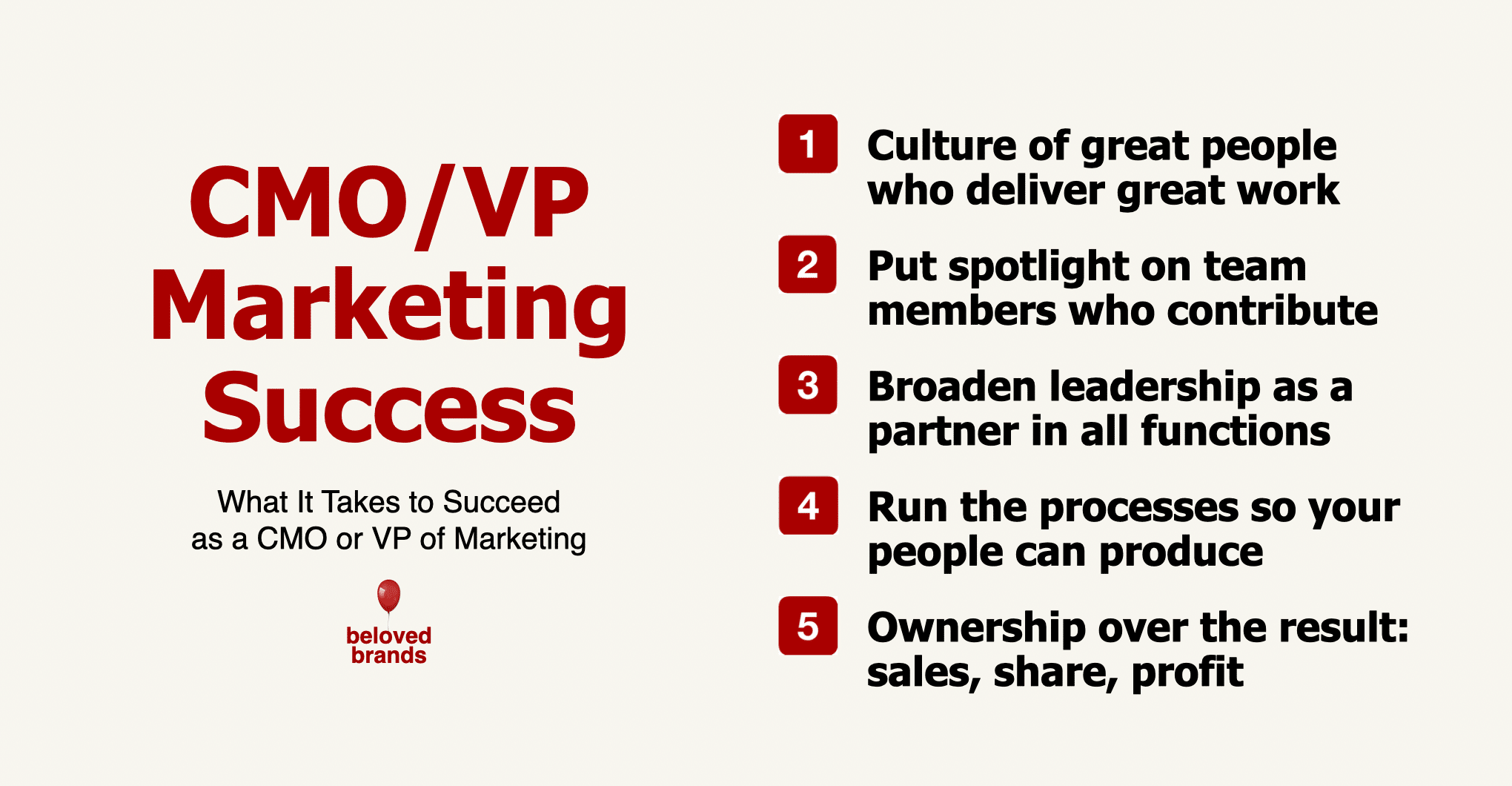
The 5 factors that define great CMOs and VPs of Marketing
1. Culture of great people who deliver great work
People come first at the VP Marketing and CMO level. Smart people produce great work, and great work drives outstanding results. Build a culture where that chain is deliberately supported rather than left to chance.
Invest in training and development.
Marketing fundamentals matter — strategic thinking, brand positioning, brand planning, creative briefs, and advertising judgment. Marketers are not getting the same development they did in prior generations, and that gap shows up in the quality of the work. Investing in your people makes them better at their jobs and signals that their growth matters to the organization. Both things motivate people to stay engaged and push harder.
Review your talent regularly with your directors. Build a system to give everyone on the team feedback, preferably quarterly. A strong culture requires active attention — it does not maintain itself.
Beloved Brands playbook
Our Beloved Brands playbook goes in-depth on everything you need to build brand consumers will love. Learn about strategic thinking, brand positioning, writing brand plans, advertising decisions, media planning, marketing analytics, and financials.

Our readers tell us they keep our Beloved Brands playbook nearby whenever they need to take on a new project. Clearly, we are thrilled that 89% of Amazon reviewers have given Beloved Brands a 5-star rating. Also, we wrote a B2B Brands playbook and a Healthcare Brands playbook.

2. Put spotlight on team members who contribute
Let your people own the work and take the credit for it. A VP or CMO who inserts themselves into every decision, makes every call, and needs to be seen on every win pulls themselves down two levels and takes over the jobs of the people they are supposed to be developing.
Ask questions rather than give answers. Challenge your team to think harder rather than directing them toward your conclusion. Recognize great work loudly and publicly. One habit worth adopting: instead of saying “thank you,” say “you should be proud” — because they did it for themselves, not for you. People who feel seen and recognized consistently produce at a higher level.
Your results come from their effort. Make sure everyone in the organization knows it.

3. Broaden leadership as a partner in all functions
A VP Marketing or CMO who operates as the head of a silo will always be limited. Building genuine working relationships across sales, finance, operations, and HR is part of the job. Peers want to know you will run Marketing well and give them room to run their areas. Showing up as a partner rather than a competitor for resources or attention earns that trust over time.
Get visible inside your organization. Walk around, engage with people at every level, and create a team theme that reflects the purpose, beliefs, and behaviors you expect to reward. Approachable leaders get better information, because people bring them real problems rather than managed ones. Leaders who stay behind closed doors tend to find out about issues after the damage is done.
Follower-ship is earned. Build an environment where people want to go the extra mile because they believe in the direction you are taking the team.
4. Run the processes so your people can produce
Own the P&L and the marketing processes. Investment choices need an ROI and ROE (Return on Investment and Effort) mindset, because getting those decisions right is what creates the financial breathing room to run things the way you want. Missing the numbers reduces your options and your credibility.
Good processes in brand planning, advertising, and creative briefs are not about control — they are about channeling your team’s energy toward the work that actually reaches consumers. When the process is clear and well-run, people spend their best thinking on the brand rather than navigating internal confusion. Remove the friction that has nothing to do with making better marketing.
Approve confidently when the work is fundamentally sound. Sending strong ideas back through endless revisions trains your team to play it safe. Set a high standard and hold to it, but recognize great work when it arrives.
5. Ownership over the result: sales, share, profit
Creating demand for your brands is the primary job. Gaining share, growing sales, and contributing to company profit is what the role exists to deliver. Results follow from making sound strategic choices, executing at a level beyond your competitors, and building a team motivated to do great work consistently.
Ownership at this level means knowing the numbers before anyone asks. Know why market share moved the way it moved. Have a hypothesis ready when a program underperforms. Bring a point of view to every leadership conversation rather than waiting for the agenda to reach you.
Freedom in how you run things comes from making the numbers. Falling short of them narrows every option available to you. Own the outcomes completely — the strong results and the setbacks — and your standing across the organization will reflect it.
The loneliness of the CMO/VP role
This part doesn’t get written about often enough so it’s worth being direct about it.
When I first became VP Marketing, I was surprised by how isolated the role felt. Everyone on the marketing team is naturally “on” whenever you’re in the room. You rarely experience the real version of the people around you because your presence changes their behavior. The casual conversations, the honest frustrations, the unfiltered opinions — most of that stops happening around you the moment you take the senior role.
Your new peer group is the other functional heads — the VP of Sales, the head of Finance, HR, Operations. Building those relationships takes time and genuine effort, and the distance feels greater than you expect at first. They’re managing their own worlds and the specific challenges of the CMO role aren’t always ones they fully understand or appreciate.
Your boss gives you significant autonomy, which is good, but it also means less coaching and feedback than you had in every previous role. Most CMOs and VPs of Marketing find they need an external mentor or executive coach at this point — someone who understands the role, has no stake in the internal politics, and can give you a genuine outside perspective on what you’re navigating.
That relationship is worth investing in. The CMO who tries to figure out the role in isolation, without anyone to think out loud with, is operating at a disadvantage.
The one rule that governs everything else — Deliver the results!
Everything described above — the people investment, the process discipline, the vision, the talent development, the leadership style — only works if the numbers are getting made.
The CMO’s primary commercial responsibility is to create demand for the brands. Gaining share, driving sales growth, and contributing to the company’s profit are the fundamental deliverables. When the numbers are coming in, you earn the organizational trust and the operational freedom to run marketing the way you believe it should be run. When they’re not, everything else comes under scrutiny.
Make the investment choices that will deliver the results. Hold the organization to those choices. Own the misses when they happen and put a credible recovery plan in front of the CEO before they have to ask for one. The CMO who manages the numbers with that level of transparency and accountability earns the kind of organizational credibility that sustains a long and influential career.
Frequently Asked Questions About the CMO and VP Marketing Role
What does a CMO do?
A CMO or VP of Marketing is responsible for the strategic direction of all brand marketing, the organizational P&L for marketing investment, and the development of the marketing team. The role involves setting a clear vision for the brands and the organization, making major investment decisions, building talent capability, managing relationships across the C-suite, and ultimately driving demand creation for the company’s portfolio of brands.
What is the difference between a CMO and a VP of Marketing?
In most organizations, the titles are used interchangeably, though CMO typically implies a broader organizational scope and a seat on the senior leadership team reporting directly to the CEO. VP of Marketing often implies a similar functional responsibility within a specific division or business unit. Both roles carry responsibility for the marketing P&L, organizational vision, talent development, and brand strategy at the highest level.
What skills does a CMO need?
The five skills that define great CMOs are investing seriously in people and organizational capabilities, running the process and the P&L with real discipline, bringing a clear and compelling vision, putting the spotlight on the team rather than themselves, and consistently showing up as an authentic and approachable leader. Of these, people investment and authentic leadership tend to be the factors that determine whether a CMO builds an organization that performs well beyond their direct tenure.
How is the CMO role different from the marketing director role?
The marketing director role is primarily about developing a team of brand managers and delivering results across a defined portfolio. The CMO role is about building the entire marketing organization, setting the vision for where the brands and the team are going, making the major investment decisions, and operating as a member of the senior leadership team. The marketing director manages marketing. The CMO leads the marketing organization.
How do CMOs manage the marketing P&L?
Effective CMOs bring a return-on-investment mindset to every major spending decision, regularly evaluating which investments are generating real market impact and which are continuing by habit. They set clear financial expectations with their directors, review performance against plan consistently, and own misses transparently rather than waiting for someone above them to surface the problem. The P&L discipline is what earns the organizational freedom to run marketing with the kind of autonomy the role requires.
What makes a CMO effective with their C-suite peers?
The CMOs who build strong relationships with the CEO, CFO, and other functional heads tend to do three things consistently. They speak in business outcomes rather than marketing metrics, connecting their investment decisions directly to revenue, margin, and share. They bring solutions to cross-functional problems rather than just raising concerns. And they’re honest about what marketing can and can’t deliver, which builds credibility with peers who are often skeptical of marketing’s ability to drive measurable results.
How do CMOs develop great marketing talent?
Effective CMOs invest in structured training and development rather than relying entirely on on-the-job learning. They conduct regular talent reviews with their directors, build systems for providing genuine feedback to everyone on the team, and create development plans that reflect each person’s career ambitions rather than just the organization’s immediate needs. The CMO who treats talent development as a genuine strategic priority rather than an HR obligation builds a marketing organization that performs well and retains its best people.
Is the CMO role lonely?
Many CMOs find the role surprisingly isolating, particularly in the early stages. The marketing team behaves differently when the CMO is in the room, which limits access to honest information. Peer relationships with other functional heads take time to develop and those peers don’t always understand the specific challenges of the CMO role. And the level of coaching and feedback available drops significantly compared to more junior positions. Having a trusted external mentor or executive coach at this level is genuinely valuable and worth investing in.