If you lead a marketing team, you are judged on results your team has to deliver. When your marketers are busy but the work lacks analytics, strategic thinking, or a clear link to the plan, those results stall.
Marketing excellence is how the best companies close that gap. It gives every marketer on the team the same high standard for how to think, plan, and execute, so the quality of the work no longer depends on who happens to be on the brand.
This guide shows what marketing excellence looks like, the five marketing capabilities that define it, how to assess your team, and how to build a marketing training program that improves your team’s performance.
Written by Graham Robertson, former VP of Marketing at Johnson & Johnson and founder of Beloved Brands.
What is marketing excellence?
Marketing excellence is a marketing team that thinks, plans, and executes to a consistent, high standard across every brand it manages. It is built on shared marketing capability: the skills, tools, and judgment marketers use to make brand decisions every day.
At the classically trained CPG companies, marketing excellence is a formal function. Teams with names like Marketing Excellence or Marketing Capability set the standards, run the training, and coach marketers as they move up. I came up through that system at General Mills and Johnson & Johnson, and it is why those companies keep producing strong marketers.
Most companies don’t have that structure. Their marketers learn on the job, picking up habits from whoever briefed them last. The result is uneven work, where one brand team runs a sharp plan and the brand next door runs a laundry list of tactics.
Marketing excellence can be built, and it starts with being clear about the capabilities that matter most.
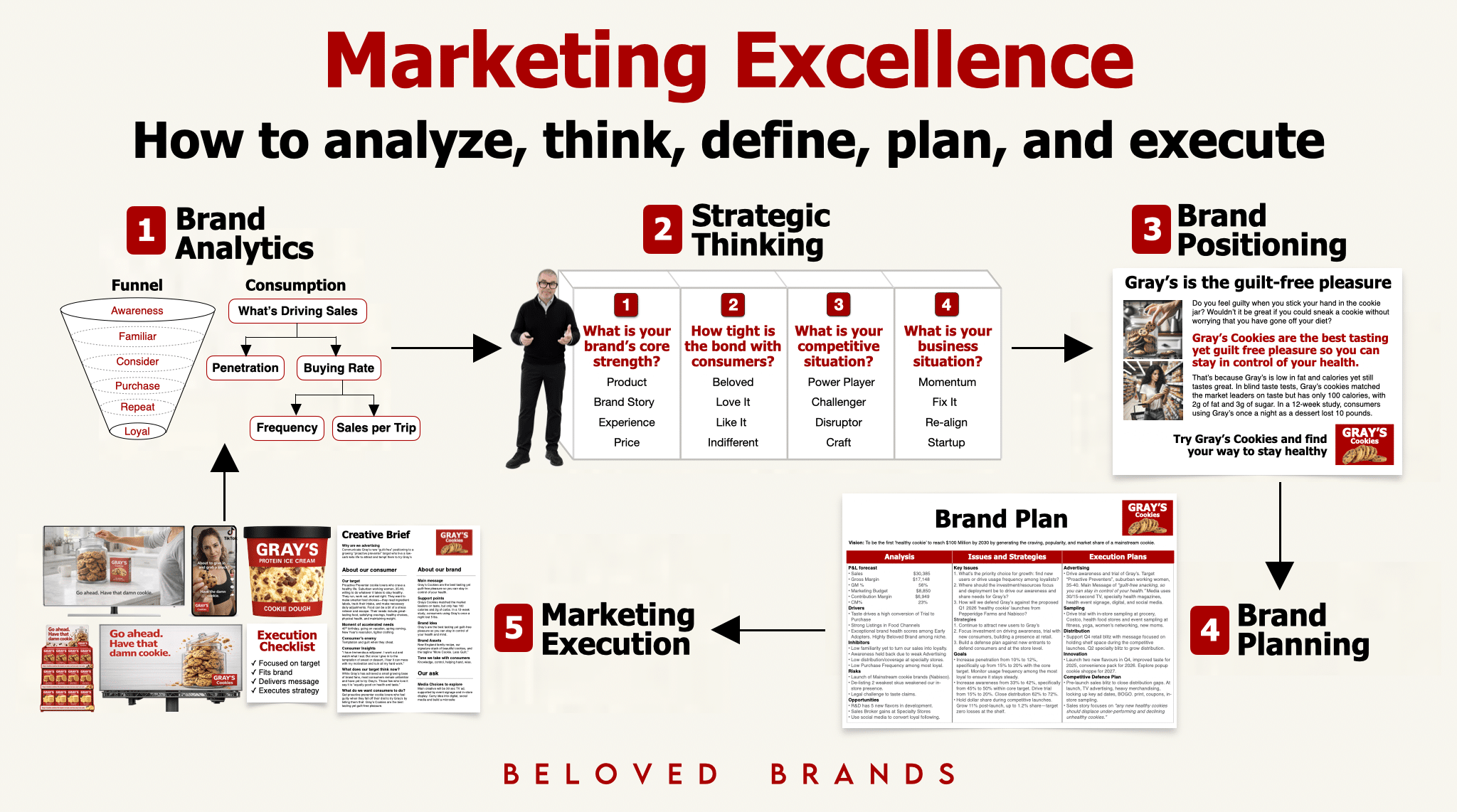
The five marketing capabilities that define marketing excellence
High-performing marketing teams share five core capabilities. When one is weak, it shows up later.
- Brand analytics. Great marketers dig into market share, funnels, consumer data, and financials to find the real issues facing the brand. Teams that skip this step end up solving the wrong problems. Learn how to run a deep-dive business review.
- Strategic thinking. Strategic marketers frame the problem before jumping to solutions, asking tough questions about the brand’s core strength, consumer bond, competitors, and business situation. See how to define your brand’s key issues.
- Brand positioning. Excellence means a precise consumer target, a benefit that motivates consumers and is ownable to the brand, and a brand idea that guides every touchpoint. Read our guide to brand positioning.
- Brand planning. A strong plan guides where to invest limited resources and links every activity to strategy and results. A weak one is a laundry list. See our marketing plan framework.
- Marketing execution. The best marketers write tight creative briefs, judge advertising with confidence, and keep innovation and in-store work on strategy. Learn how to write a creative brief.
Our Beloved Brands marketing capability training program centers on these five capabilities, with marketers applying each to the brand they run.
How to assess your marketing team
Before you can improve your marketing team, you need an honest read of where the gaps are. Look at the work your team produces, since a marketer’s capability shows up in their business reviews, plans, and briefs far more clearly than in a self-assessment.
Use this scorecard to rate each marketer on the five capabilities, then look for the patterns across the team.
A gap on one or two marketers is a coaching issue. A gap that runs across most of the team is a training issue, and it usually traces back to how the team was trained, or wasn’t.
How to improve your marketing team's performance
Improving marketing team performance comes from raising the standard of everyday work, one capability at a time.
- Set a common standard. Give the team one shared way to write a business review, a positioning statement, a brand plan, and a creative brief. When everyone uses the same frameworks, it becomes far easier to coach the work and compare brands.
- Train on real work. Marketers learn fastest when they apply a new tool to the brand they run, with a deadline that matters. Classroom theory fades by the following Monday.
- Coach the output. Review the actual plans and briefs, and give specific feedback against the standard. This is where most of the growth happens.
- Make leaders the teachers. Directors and VPs should ask the strategic questions in every review, so marketers learn what good looks like before they reach the boardroom.
- Measure the change. Score the team again after six months. Better business reviews, sharper plans, and stronger creative show the investment is working.
For most teams, steps 1 and 2 are the hardest to do on your own, which is why many leaders bring in outside training to launch the standard.
How to build your own marketing training program
A marketing training program works when it is built around the capabilities your business needs and the real work your marketers do. Here is the approach I use when designing programs for clients.
- Define your capability model. List the five capabilities and write what good looks like at each level, from Assistant Brand Manager to VP. This becomes the standard everyone trains toward.
- Start with the biggest gap. Your assessment will show where the team is weakest. Train there first, since that is where results will move fastest.
- Build the curriculum in order. Analytics feeds strategy, strategy feeds positioning, positioning feeds the plan, and the plan sets up execution. Teaching them in that sequence helps marketers see how the pieces connect.
- Make every session hands-on. Each module should end with marketers producing a draft on their own brand, such as a business review, a positioning statement, or a creative brief.
- Give them tools to keep. Templates, checklists, and a shared playbook keep the standard alive long after the sessions end.
- Plan the follow-up. Feedback on the drafts a week or two later turns a good workshop into lasting change in how the team works.
Many companies build part of this in-house and bring in a partner for the core curriculum. An outside expert brings tested frameworks and a fresh, credible voice, while your leaders reinforce the standard day to day.
What marketing excellence looks like at each level
The standard changes as marketers move up, so your training and coaching should change with it.
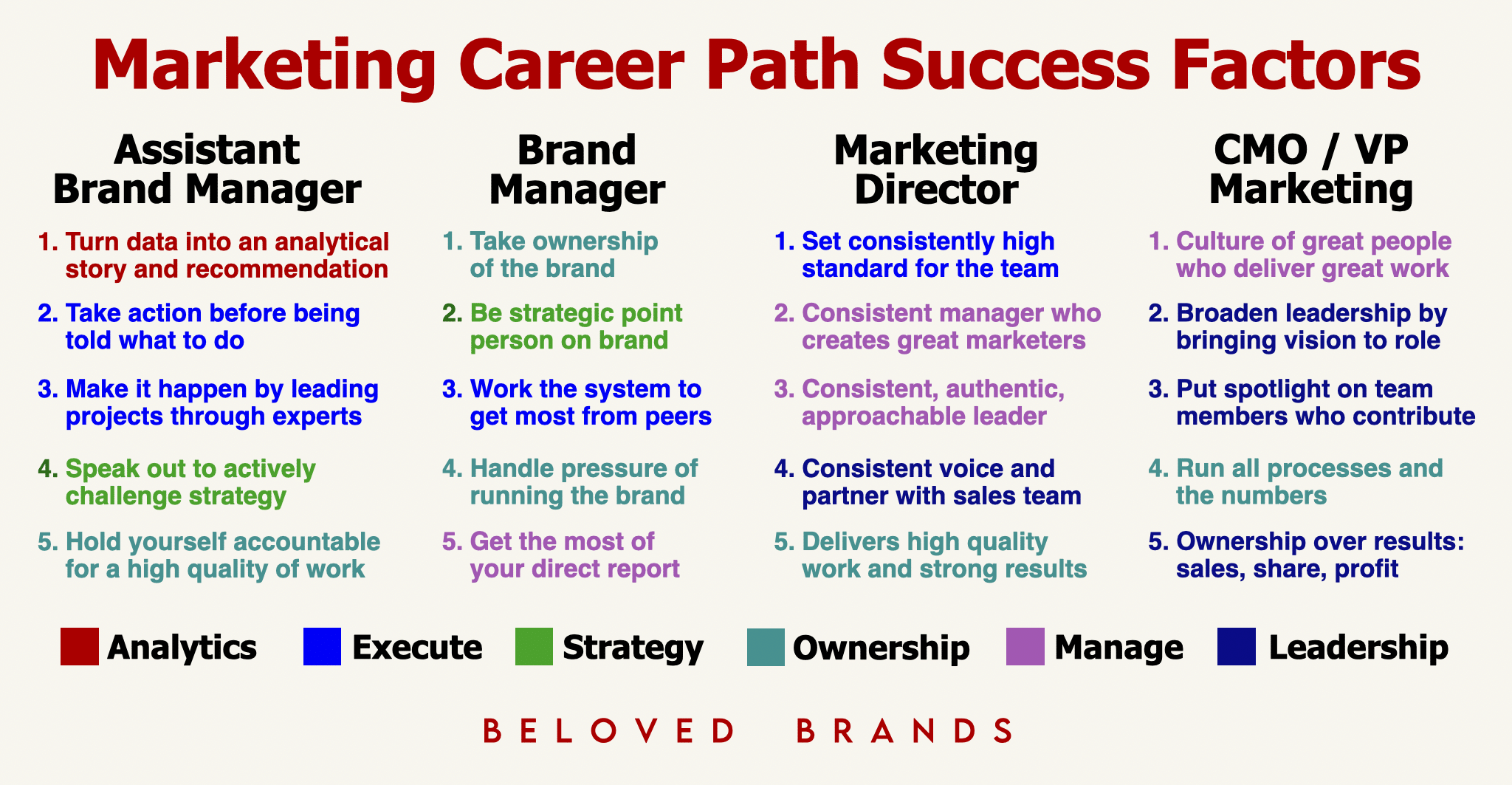
The jump from Brand Manager to Director catches many marketers off guard. Most Brand Managers struggle with their first direct report and only find their stride a few hires later, which is why coaching new managers is one of the best investments a marketing leader can make. Go deeper on Brand Management Careers
How Beloved Brands helps Marketing Excellence teams
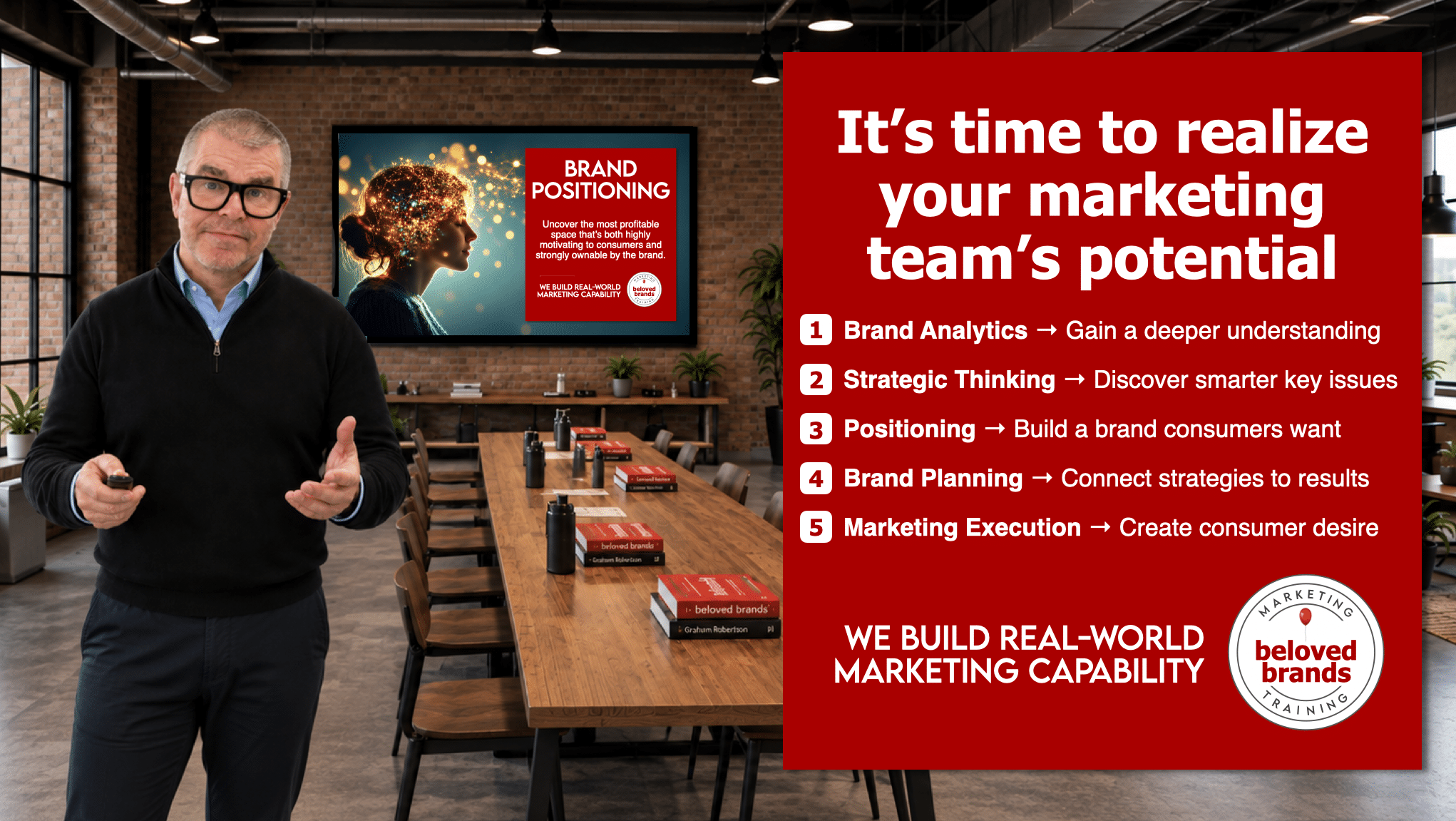
If you want to build marketing excellence without designing a program from scratch, our Beloved Brands Markting Training program gives your team the classic CPG training most marketers never received.
We build the five core capabilities over four intensive days, with every marketer applying each tool to their own brand. They leave with a draft business review, positioning statement, brand plan, and creative brief already started, and we follow up with feedback on their work.
We have trained marketing teams in more than 30 countries, at companies including Molson-Coors, Hershey, Dr Pepper, and Mondelēz. Each program is tailored to your business, with versions for consumer, B2B, retail, and healthcare.
See our marketing training program, or email Graham Robertson at graham@beloved-brands.com to discuss your team.

"Beloved Brands is the best marketing training that I've ever attended!"
Erin Grosberg
Marketing Excellence, The Hershey Company
Beloved Brands Marketing Training Brochure
Use our > button to flip through our brand management training brochure
Frequently asked questions
What is marketing excellence?
Marketing excellence is a marketing team that thinks, plans, and executes to a consistent, high standard across every brand. It rests on five capabilities: brand analytics, strategic thinking, brand positioning, brand planning, and marketing execution.
What is the difference between marketing excellence and marketing capability?
Marketing capability is the set of skills and tools your marketers use. Marketing excellence is the result when that capability is strong and consistent across the whole team.
How do you improve a marketing team’s performance?
Assess the team against a common standard, train on the work marketers actually do, coach their output, and measure the change after six months.
How do you build a marketing training program?
Define what good looks like at each level, start with the team’s biggest gap, teach the five capabilities in order, and make every session hands-on with follow-up feedback.
Should we build marketing training in-house or use an outside partner?
Many companies do both. A partner brings proven frameworks and a credible outside voice for the core curriculum, while internal leaders reinforce the standard every day.