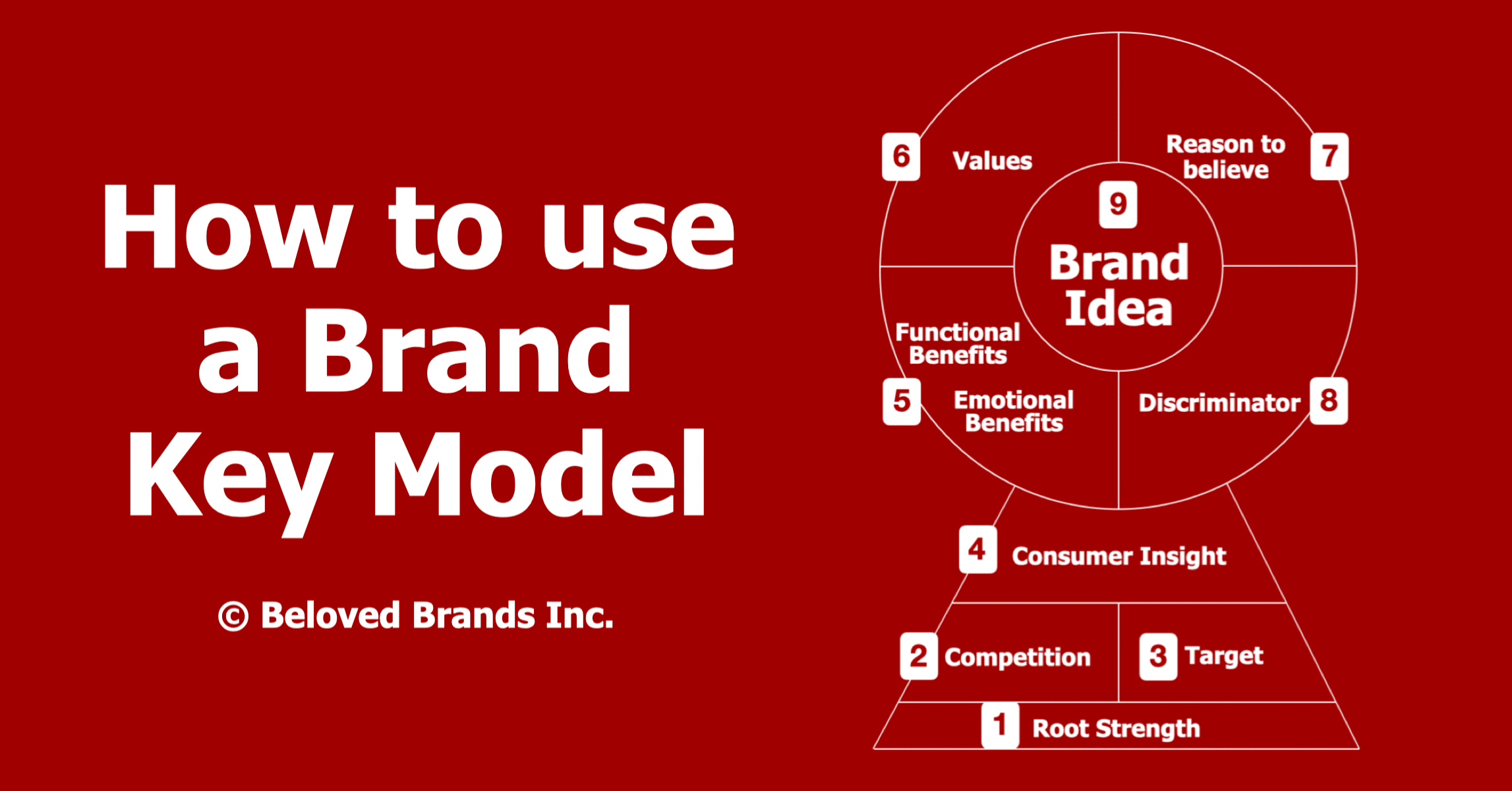
The Brand Key Model exists for one reason: most marketing teams can’t draw their brand’s USP on one page. They have pieces — a target, a few benefits, a tagline — but nothing that pulls them together. So when the team is asked to sell it, they fumble. When the agency is asked to build campaigns around it, they guess. When the CFO is asked to fund it, they push back.
The Brand Key Model fixes that.
Originally built within Unilever and used by brand teams across every category since, the framework organizes everything that defines your brand’s USP into nine interlocking elements on a single page. Work through all nine and you’ll have a complete, defensible USP — one your team can recite, your CFO can fund, and your agency can build campaigns around.
Below: each of the 9 elements explained, the questions you need to answer at each stage, plus worked examples for CPG, B2B, healthcare, and the Apple and Tesla brands.
How to use a Brand Key Model - Table of Contents
The Brand Key Model Explained
Let's go through each of the nine elements of the Brand Key Model Explained
1. Root Strength / Core Strength
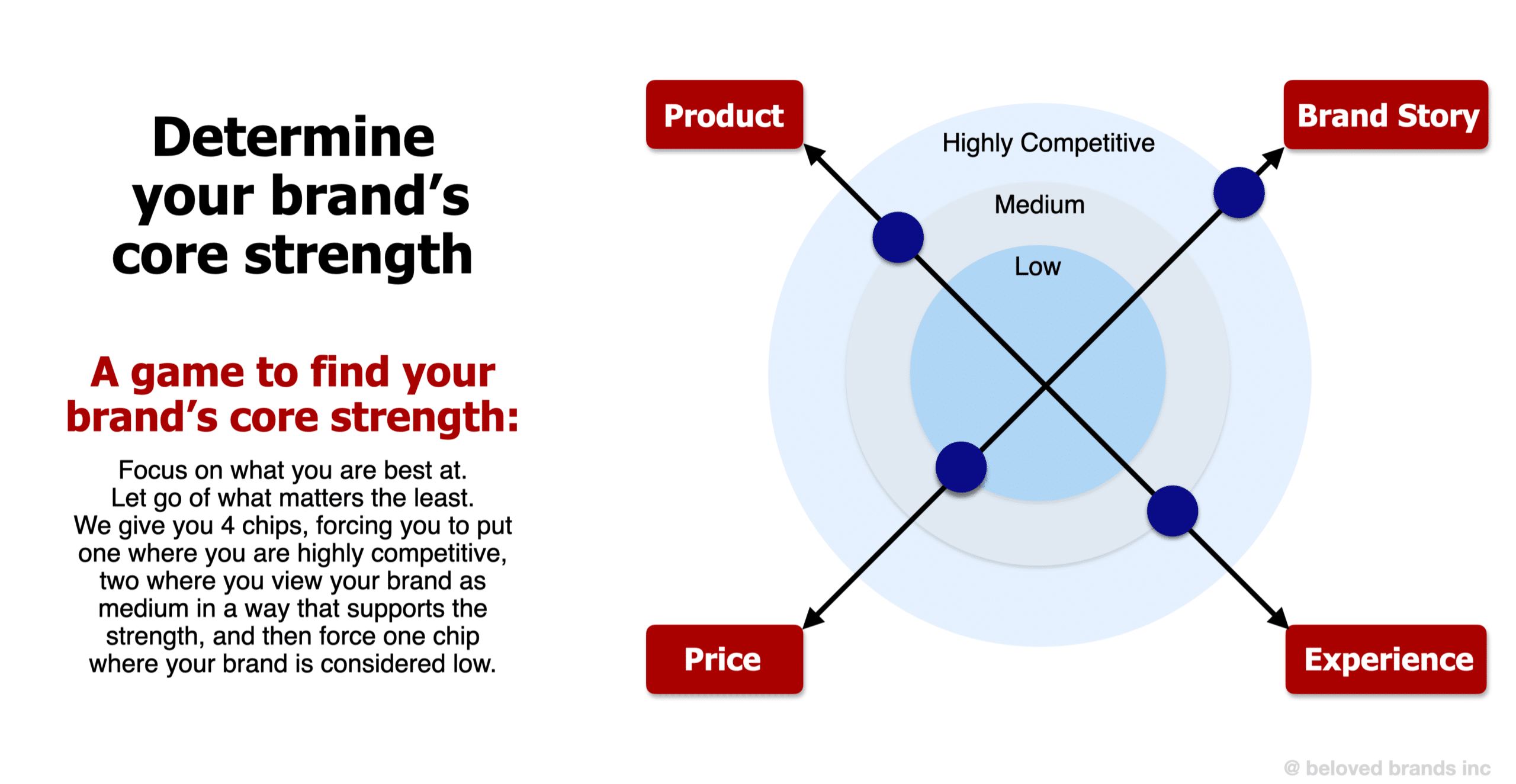
To start, one of the first decisions to get to a unique selling proposition (USP), you need to make is to find your brand’s core strength. What is it that can make your brand great. Is it the product or service? Alternatively, could it be the idea or story you tell? Is it the consumer experience you create? Or, have you figured out a way to deliver more at a lower price?
For too many marketers, their immediate response is an urge to pick two or three core strengths. This clutters up their brand positioning, so they end up with no real perceived strength that stands out. Our core strength model forces you to select one of four possible options for you to win with. Is it the product, brand story, experience, or price?
To read more about building your unique selling proposition (USP) around your brand’s core strength, click on this link: How to build your brand around your core strength.
2. Competitive Environment
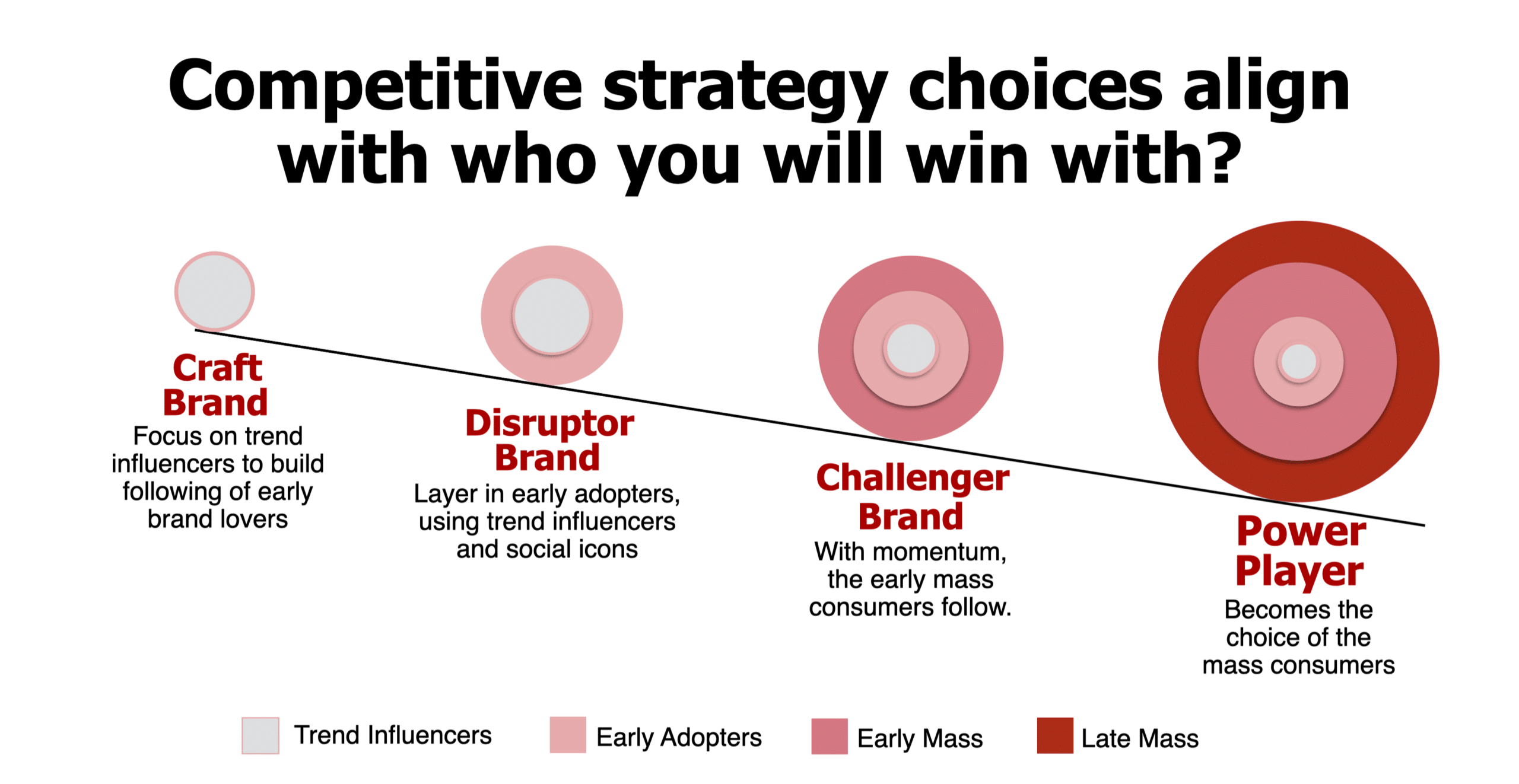
To find your unique selling proposition (USP, you need to understand what your competitors are doing. The competitive environment looks at the market in which a brand competes as well as the relative value the brand offers in that particular market. Importantly, our competitive strategy model looks at four types of competitive brand strategy situations: the power player, challenger brand, disruptor brand and the craft brand. To read more, click: How to use competitive strategy to help your brand win the battles.
3. Ideal Consumer Target
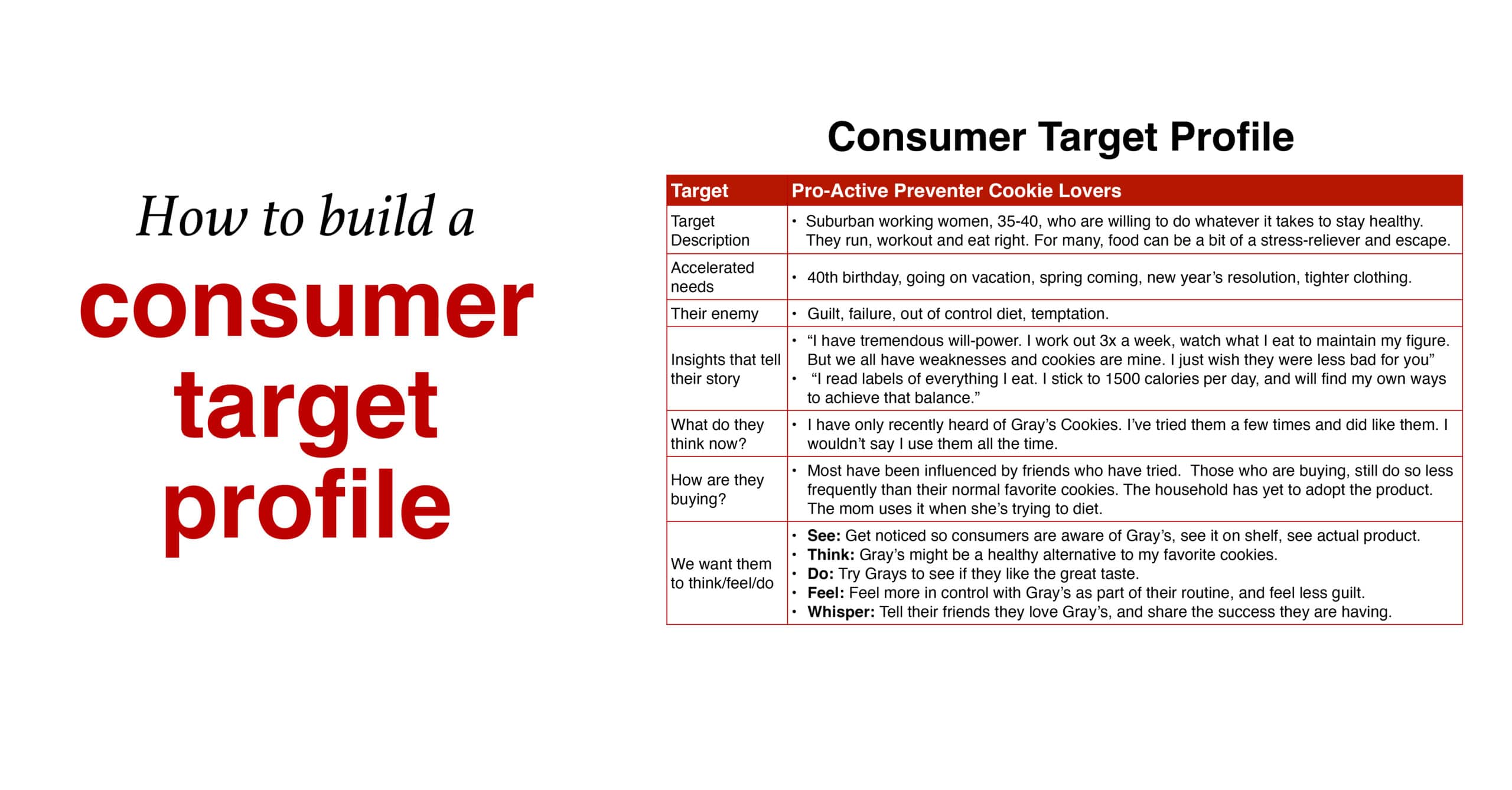
Importantly, we need to understand the needs of the target. Who is the ideal target? One of the biggest mistakes I see marketers make is picking too broad of a consumer target market.
A tight consumer profile helps you decide who is in the target and who is not in the target. Instead of going after who you want, go after those who want you. You should focus your limited resources on those consumers who have the highest likelihood of responding positively to your brand positioning, advertising, and new product innovation. A tighter consumer target market provides the fastest and highest return on investment. To read more, click: How to find and focus on your ideal consumer target.
4. Using Consumer Insights
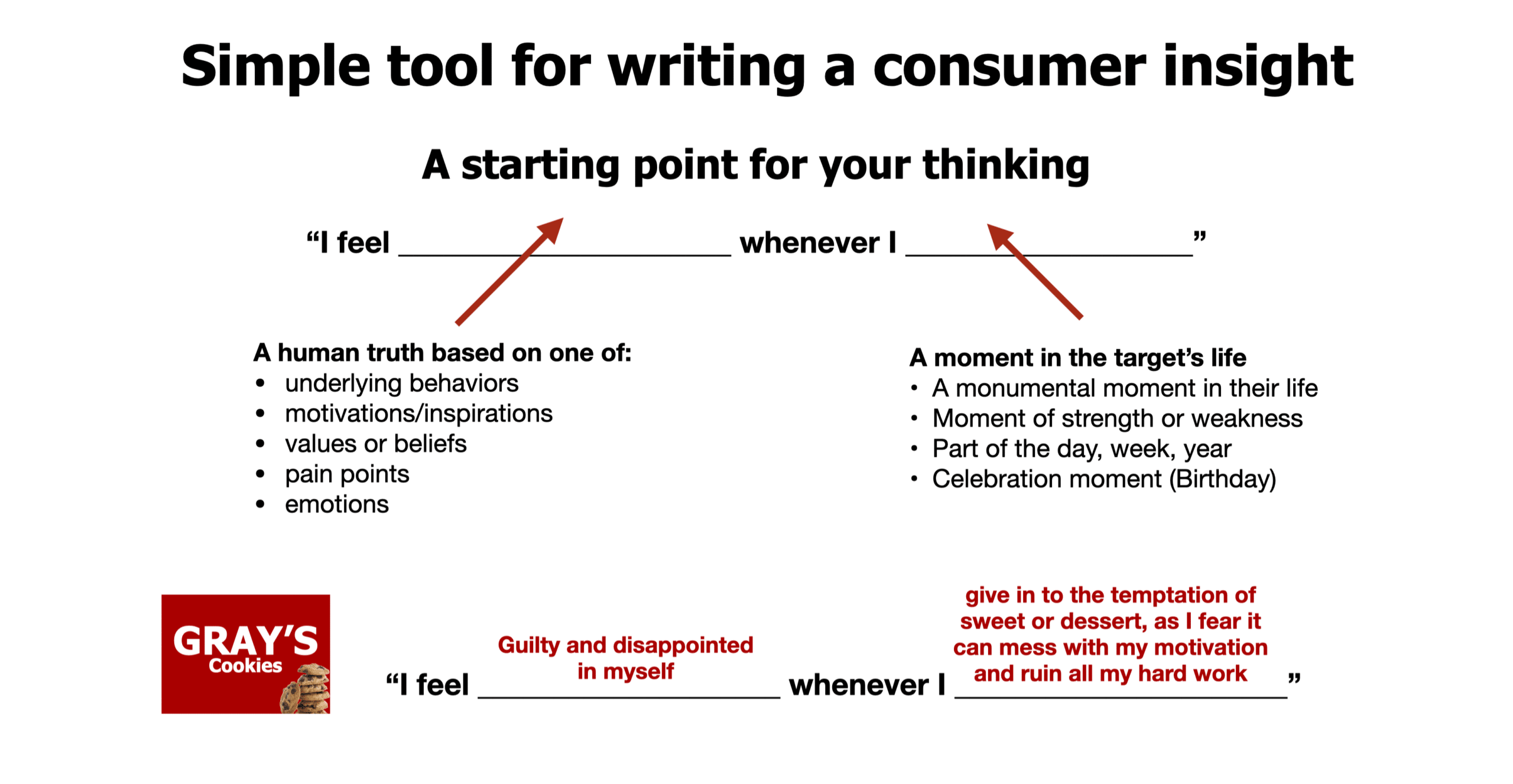
Consumer insights are little secrets hidden beneath the surface. They explain your consumers’ underlying behaviors, motivations, pain points, and emotions. Your consumers may be unable to explain the insight until you play it back to them. You want consumers to say, “Yeah, that’s exactly how I feel.” Brands must think of consumer insights as a potential competitive advantage. They are equal in importance to intellectual property. To learn more, click A simple way to find meaningful consumer insights that connect.
Our Beloved Brands Marketing Training will make your marketing team smarter
Invest in our Beloved Brands Marketing Training today and start seeing an immediate impact with smarter solutions, better work, and stronger results for your team.
Our Beloved Brands Marketing Training is specifically designed to tackle the key challenges that hold marketing teams back, from insufficient strategic thinking to poor alignment between strategy and execution. We equip your team with the essential marketing skills they need, including brand analytics, strategic thinking, brand positioning, brand plans, and marketing execution. We teach how to make smarter decisions about creative advertising, new product innovation, and OmniChannel media options.
To view, use the arrows to see our Beloved Brands Marketing Training program brochure.
With hands-on coaching that mirrors real-world pressures, your marketers will learn to apply every tool and strategy directly to your brand.
🛠️ We build essential Marketing Skills
Our Beloved Brands Marketing Training will equip your marketing team with the essential marketing skills to meet your expectations, including brand analytics, strategic thinking, brand positioning, strategic planning, and marketing execution.
📈 Marketers will work on their own brand
We impact your marketing team’s on-the-job performance by ensuring your marketers apply every new tool, method, and skill directly to their brand.
🚀 Our marketing coaching is like having a VP in the room
Our hands-on coaching replicates real-world challenges, with your marketers experiencing the pressure and expectations they face in a boardroom
🌍 Custom-Tailored Marketing Training Programs
We provide specialized marketing training tailored to different business models, including Consumer, B2B, Retail, and Healthcare brands. Our industry-specific examples demonstrate how easily our tools work on a brand like the marketer is working on.

5. Consumer Benefits
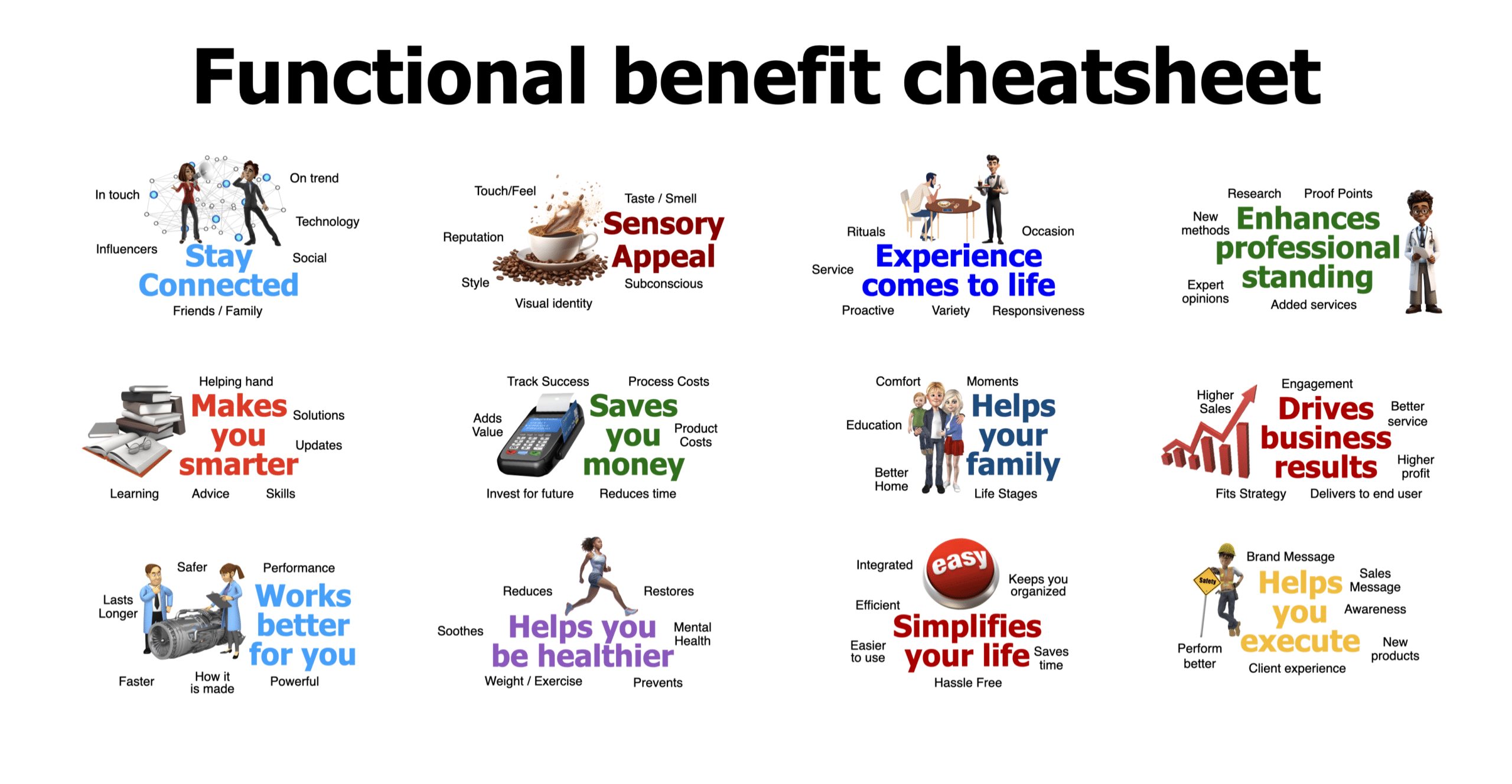
Functional Benefits
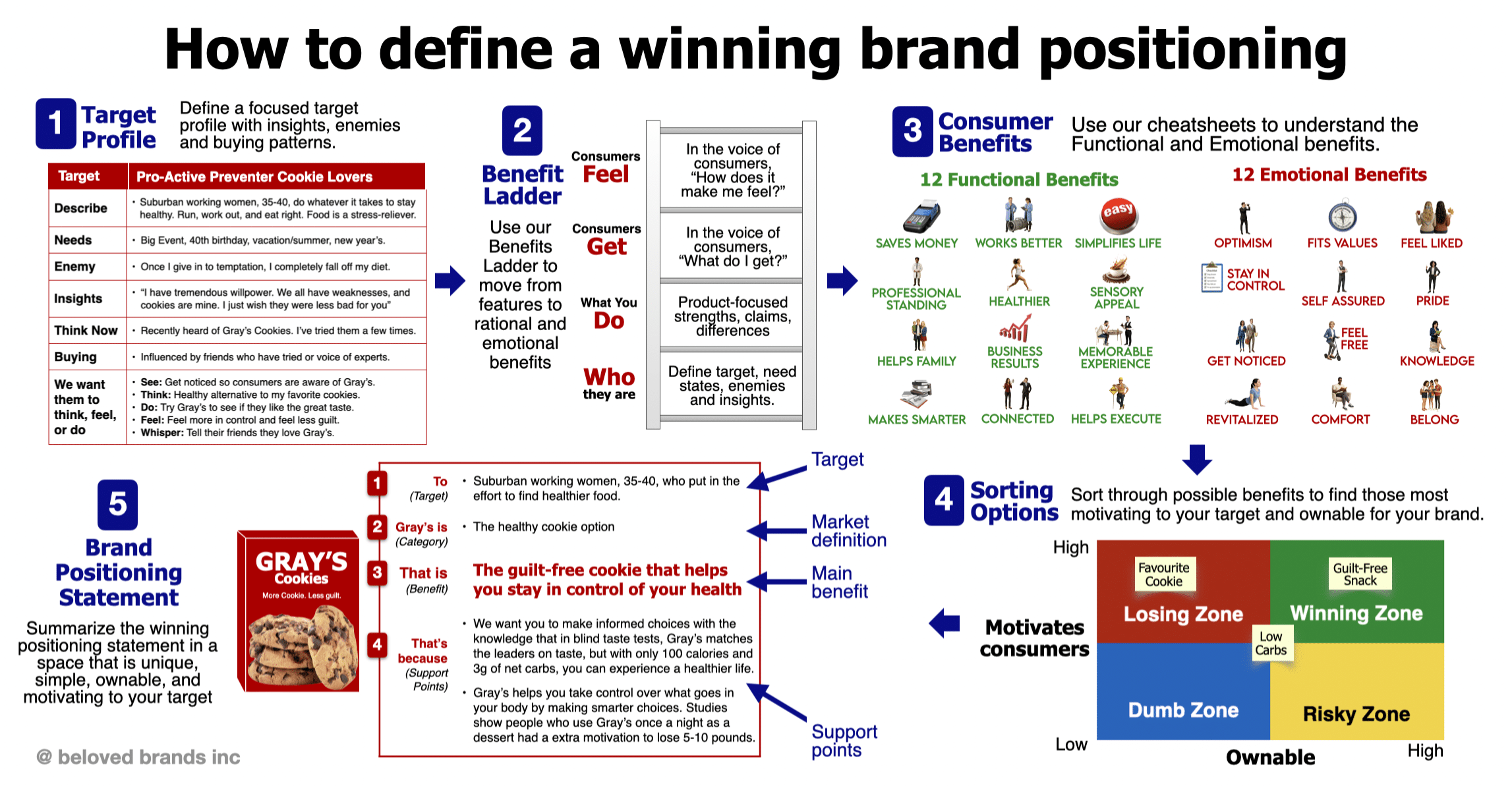
To help brand leaders build their consumer value proposition, I have created 12 functional zones that expands to over 50 potential functional benefits. For instance, as you look through the list, gravitate to the functional benefits you think will fit the needs of your consumers and differentiates your brand by looking for words where your brand does it better than competitors. While you might start with our words, try to layer in your own creative language with the specific category or consumer language.
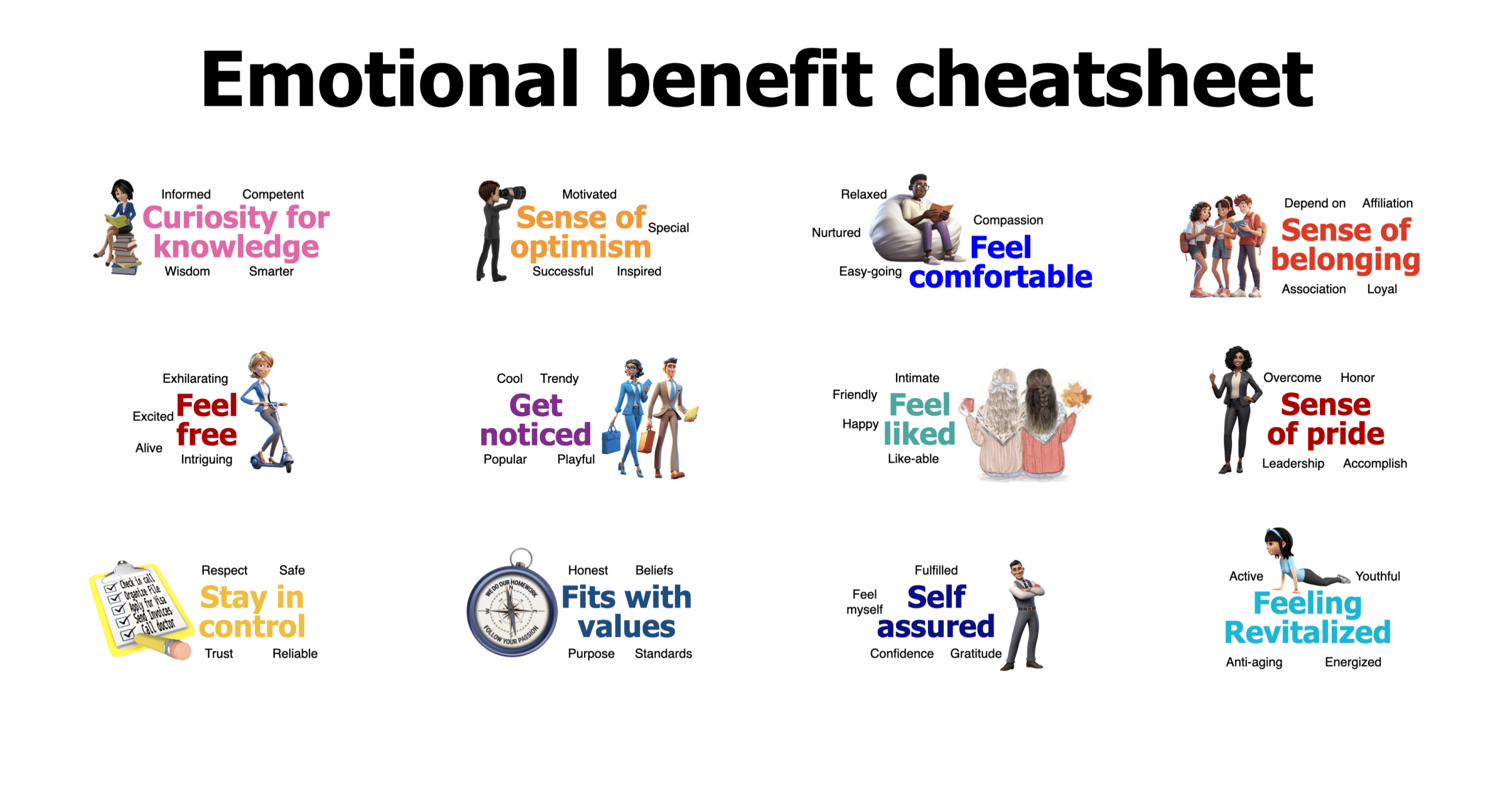
Emotional Benefits
Below is a list of 40 potential emotional benefits help build an emotional brand positioning statement that differentiates your brand. Importantly, you want to own one emotional space in the consumer’s heart as much as you own the rational space in the consumer’s mind.
If you wish to learn how to play around with consumer benefits to build your unique selling proposition, click this link: How to write a Brand Positioning Statement.
6. Values, Beliefs & Inspirations
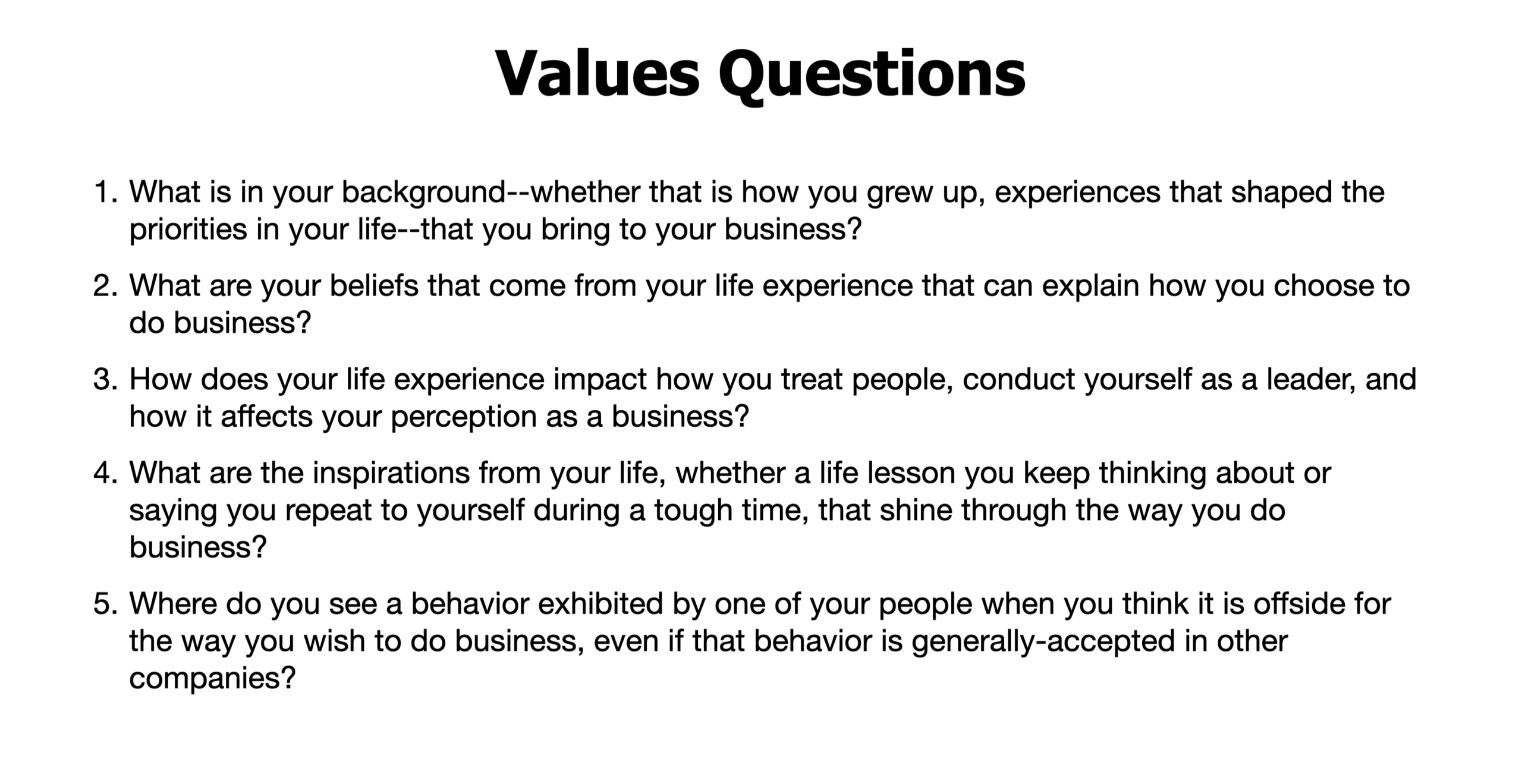
Brand values form the backbone of the culture behind your brand. They may come from your background. It could be how you grew up. Or maybe, it is rules you identify with. It could be how you see your priorities in life.
Your beliefs come from your experience. They explain why and how you choose to do business, how you treat your people, how you conduct yourself as a leader and as a person in the community. These beliefs should be personal, ethical, or rooted in frustration for how you see things happening in the world.
Your inspirations should excite the team members who work behind the scenes of the brand. They should stimulate your people to go beyond the norms of effort or passion.
To read more, click on this link: Ten questions to help you define the culture behind your brand.
Click on either slide below to zoom in for details

7. Reasons to Believe (RTBs)
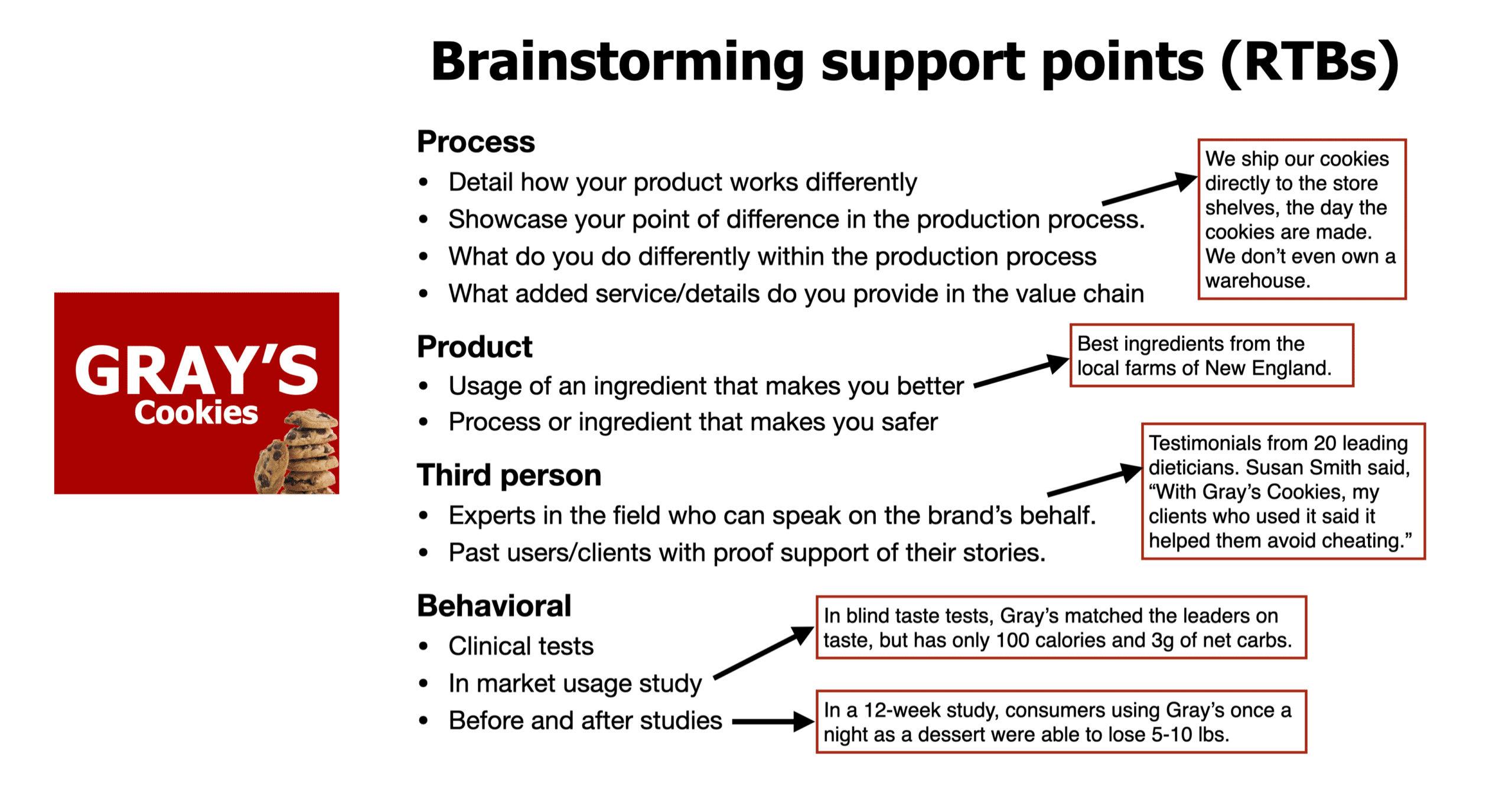
You can use four types of brand claims as reasons to believe (RTBs) in support of your unique selling proposition (USP).
Process support
- How your product works differently
- Showcase what you do differently within the production process
- What added service do you provide in the value chain
Product claims
- Usage of an ingredient that makes your brand better
- Process or ingredient that makes your brand safer
- A process that makes your brand cheaper
Third-person endorsement
- Experts in the field who can speak on your brand’s behalf.
- Past users/clients with proof support of stories or reviews
- Recognized awards, such J.D. Power
Behavioral results
- Clinical tests
- In market usage study
- Before and after studies
8. Discriminator
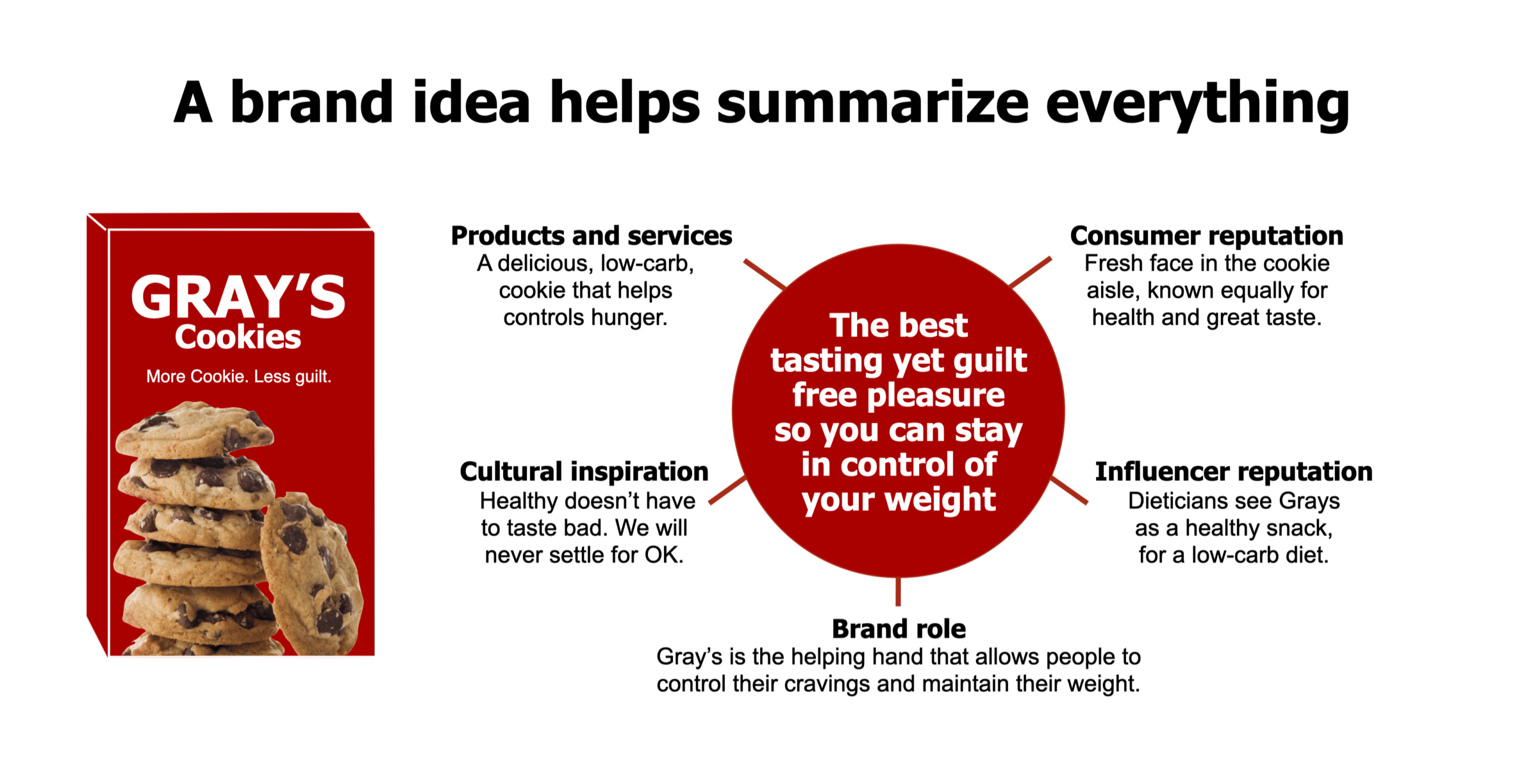
Narrow down to your single most compelling and competitive reasoning for consumers to choose the brand over its competitors. We use the brand role from our Brand Idea tool, which we define as the summary link between the internal soul and the external reputation.
9. Using a Brand Idea or Brand Essence
Everyone seems to call the short-form description of a brand by different names; brand DNA, big idea, brand essence or shout from the mountain. I keep it simple by calling it the brand idea. Essentially, to win in the marketplace, your brand idea must be interesting, simple, unique, inspiring, motivating, and ownable.
When your brand idea is interesting and simple, it helps the brand gain quick entry into the consumer’s mind, so they will want to engage and learn more about the brand. And, with the consumer being bombarded by 5,000 brand messages every day, the brand only has 7-seconds to connect, or else consumers will move on.
When the brand idea is unique and own-able, it stands out from the clutter, and the brand can see enough potential to build their entire business around the idea. As the idea is motivating to consumers, the brand gains an ability to move consumers to see, think, feel, or act in positive ways that benefit the brand.
To read more, click on this link: How to build a brand idea so everyone describes the brand the same way.
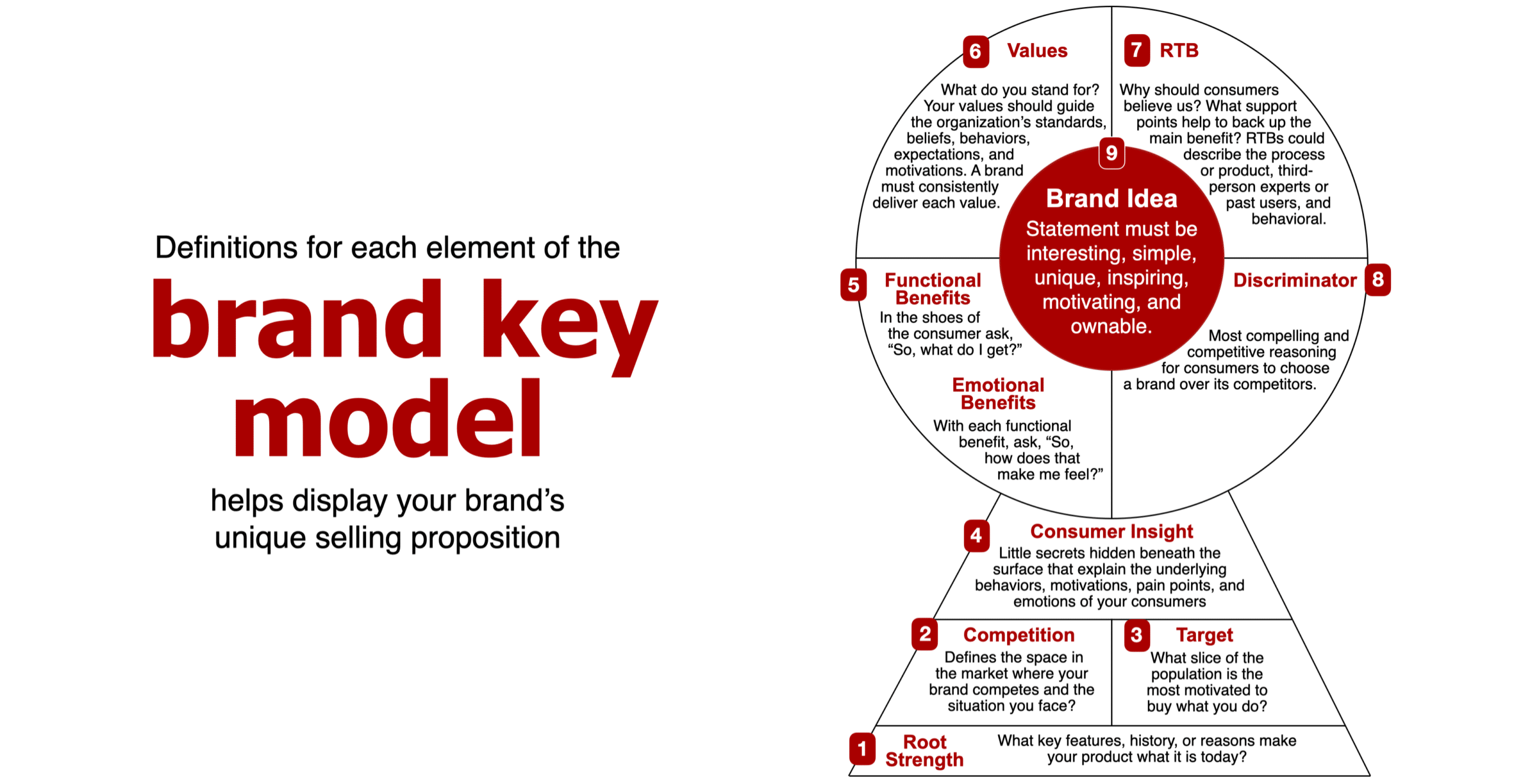
The details of the Brand Key Model explained.

Brand Key Examples
Brand Key example for a Consumer Packaged Goods Brand (CPG)
Below is the Brand Key example for Gray’s Cookies. They are shifting from a product-led to an idea led brand, trying to own “The best tasting yet guilt free pleasure so you can stay in control of your weight.”
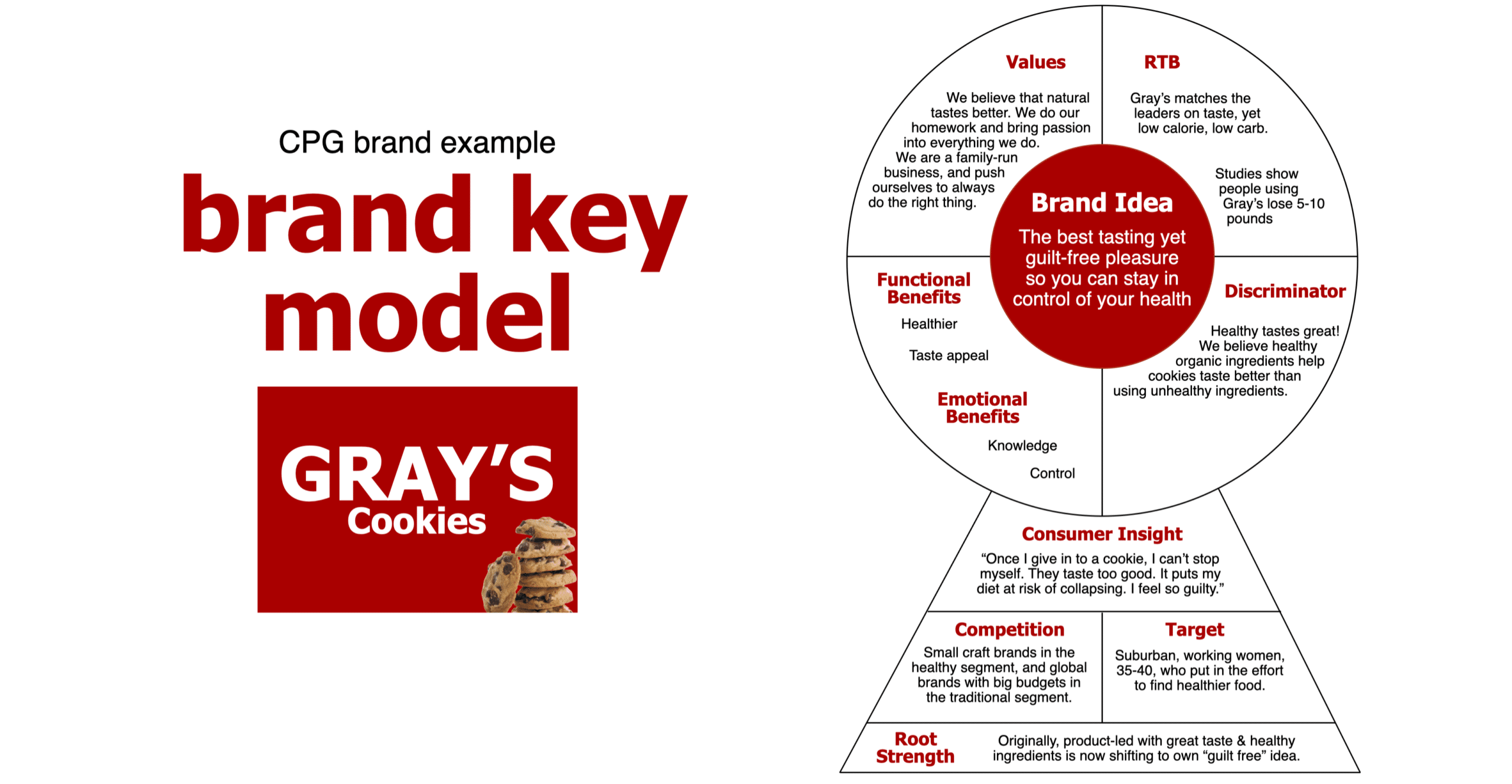
To illustrate, click on the Brand Key Example for a consumer packaged goods brand.
Brand Key Example for a Healthcare brand or pharmaceutical brand.
Below is the Brand Key example for Gray’s QuitFix to help smokers quit smoking. Gray’s is a recent launch of idea led brand, trying to own the psychological USP of the quitting attempt. The brand idea is “We help you stay in control during the rough days, so you can successfully quit smoking.”
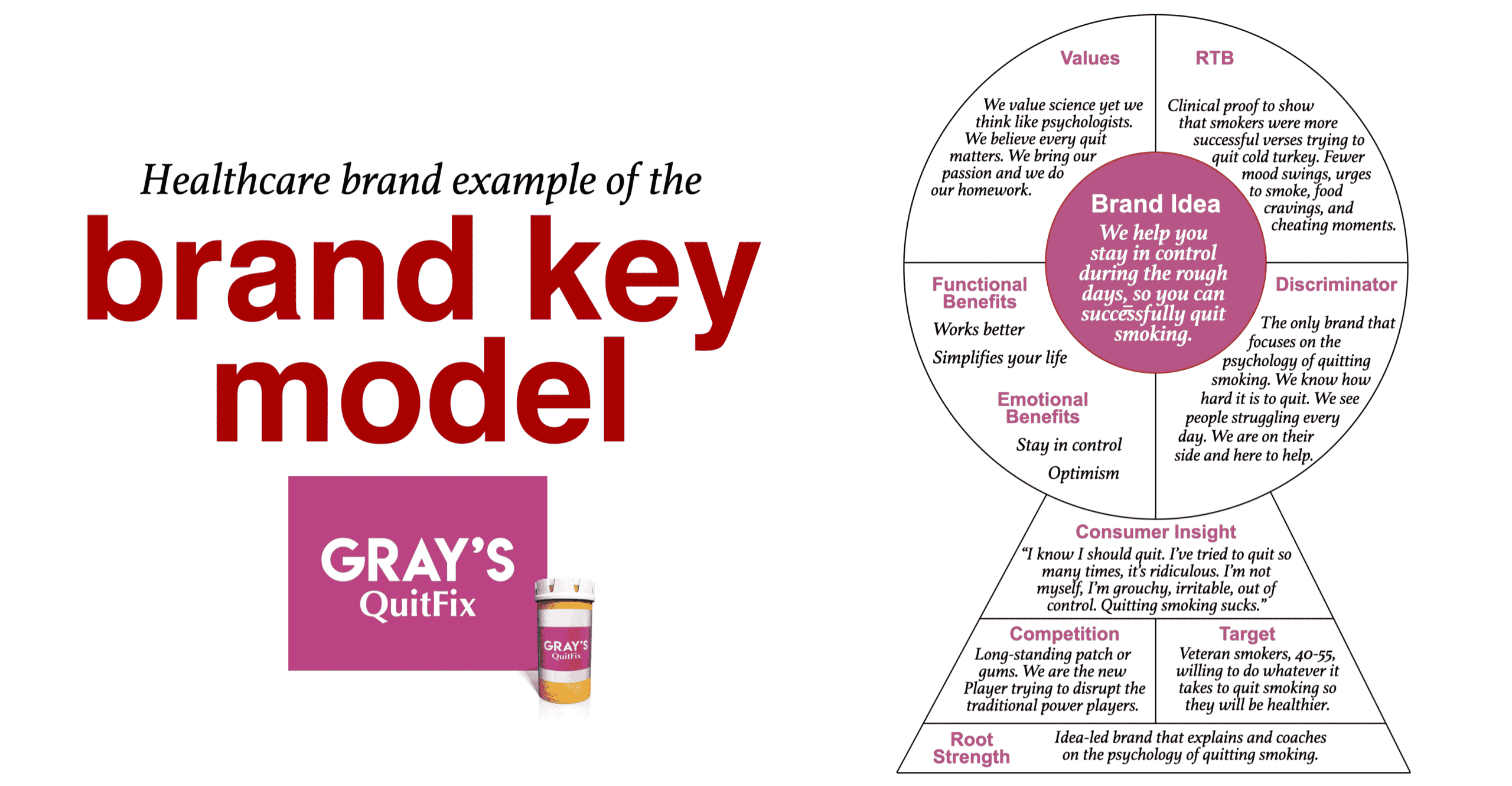
To illustrate, click on the Brand Key Example for a healthcare brand or pharma brand.
Brand Key Example for a B2B industrial brand.
Below is the Brand Key example for Gray’s Industrial Products, which is a successful experience led brand who sells tools into the construction industry. The brand idea is “Same day deliver backed by the smartest advice in the tool business.” The delivery is relatively a table stakes benefit that must be said, but the real discriminator is the hiring of retired tradespeople who can provide advice as part of their service. As Gray’s now battles Amazon, which is mainly price/speed, they’ll have to catch up to Amazon on speed to neutralize that main benefit. But, they can continue to win by playing up their unique selling proposition of peer-to-peer advice.
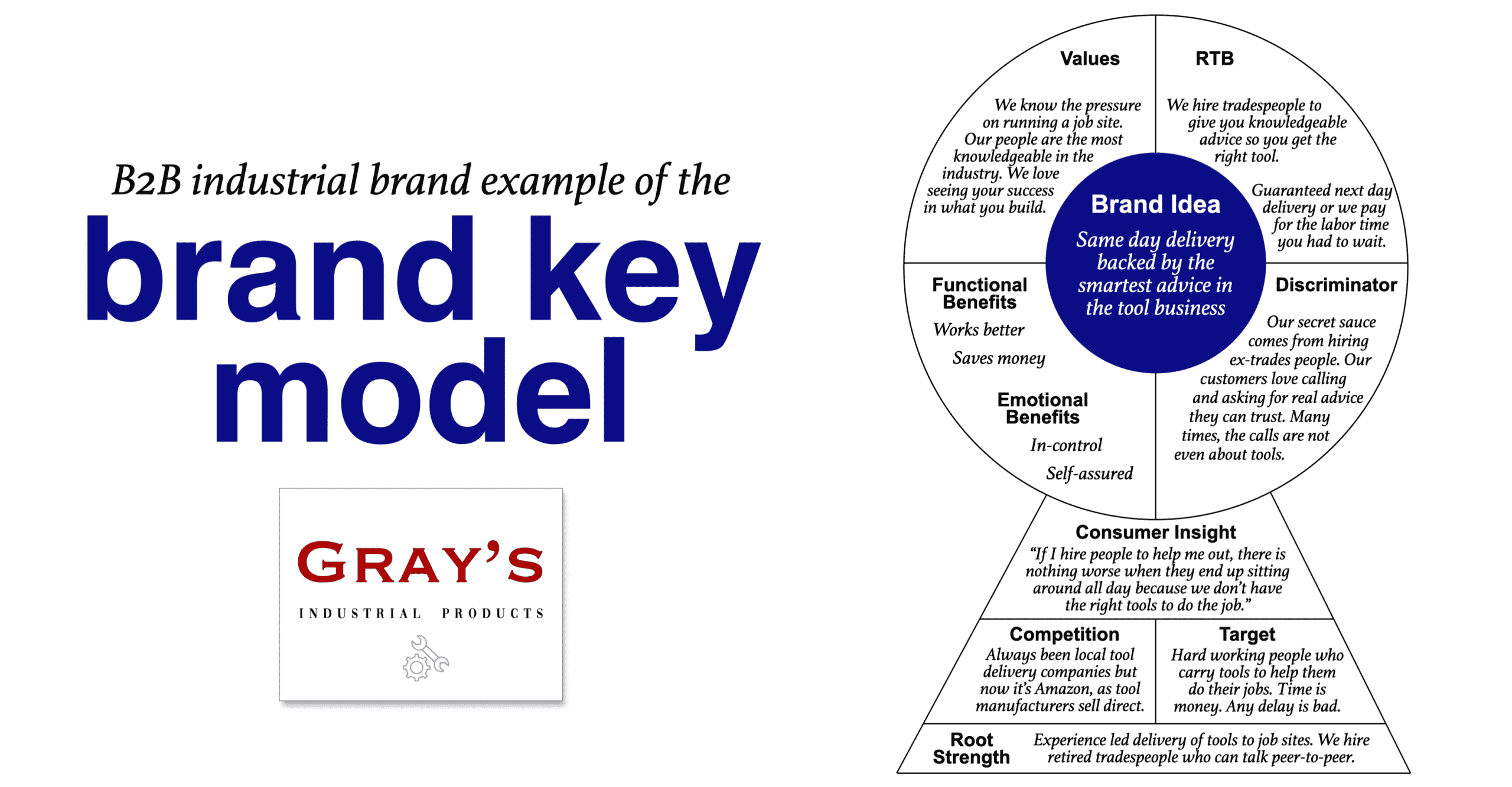
To illustrate, click on the Brand Key Example for a B2B industrial brand.
Brand Key Example for a B2B medical equipment brand.
Below is the Brand Key example for Gray’s Dental Instruments brand, a long-standing power player brand who occupies the high-end premium/prestige segment of the market. As they are losing the younger dentists, they are moving from a product-led to an experience led brand that can help dentists by adding a the unique selling proposition of “an experience that your clients will notice.”
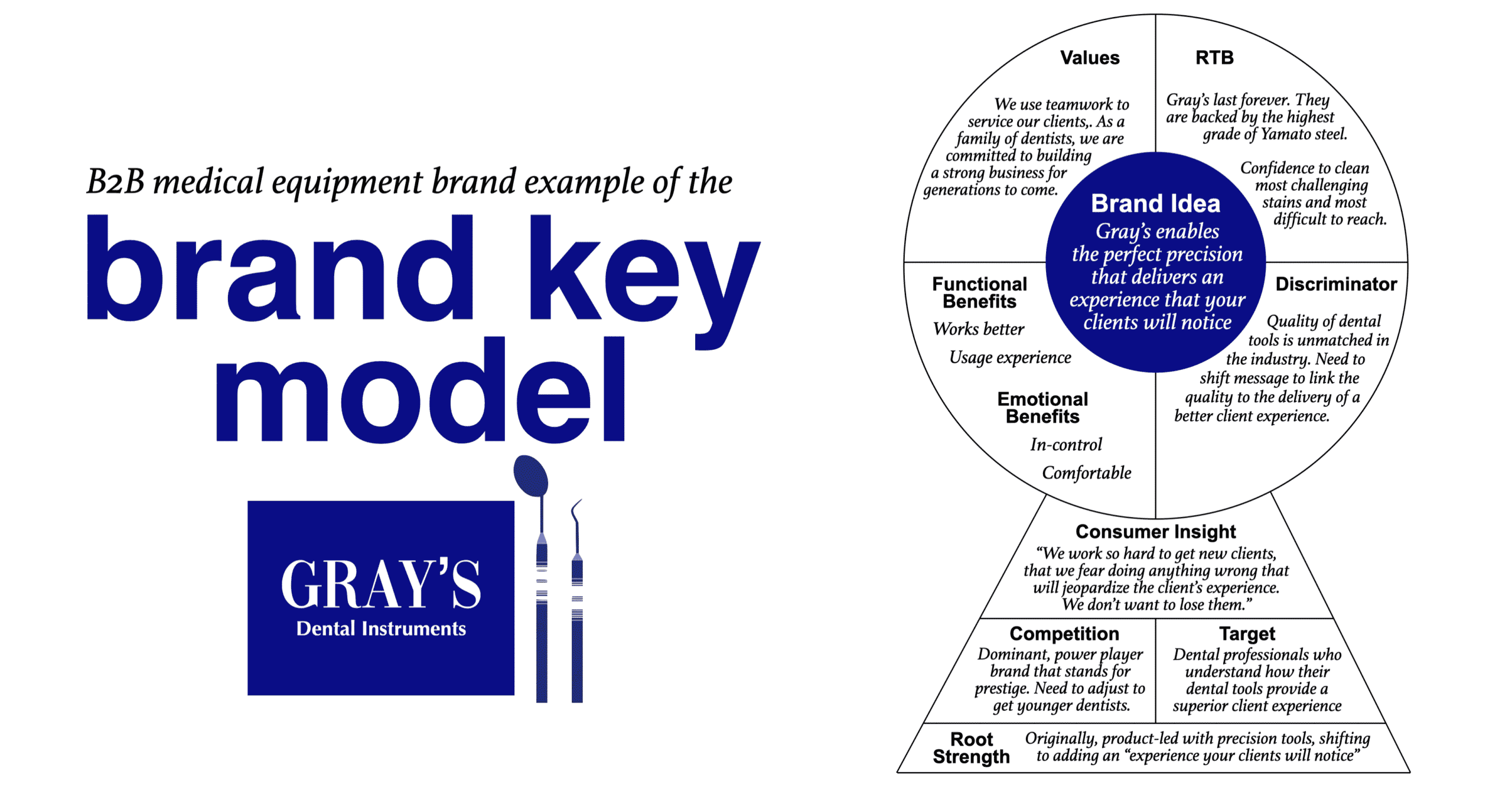
To illustrate, click on the Brand Key Example for a B2B medical equipment brand.
Brand Key Example for the Apple brand.
Below is the Brand Key example for the Apple brand. It really brings to life Apple’s unique selling proposition of simplicity. To read more on our Apple case study, click on this link: How Steve Jobs built Apple around simplicity.
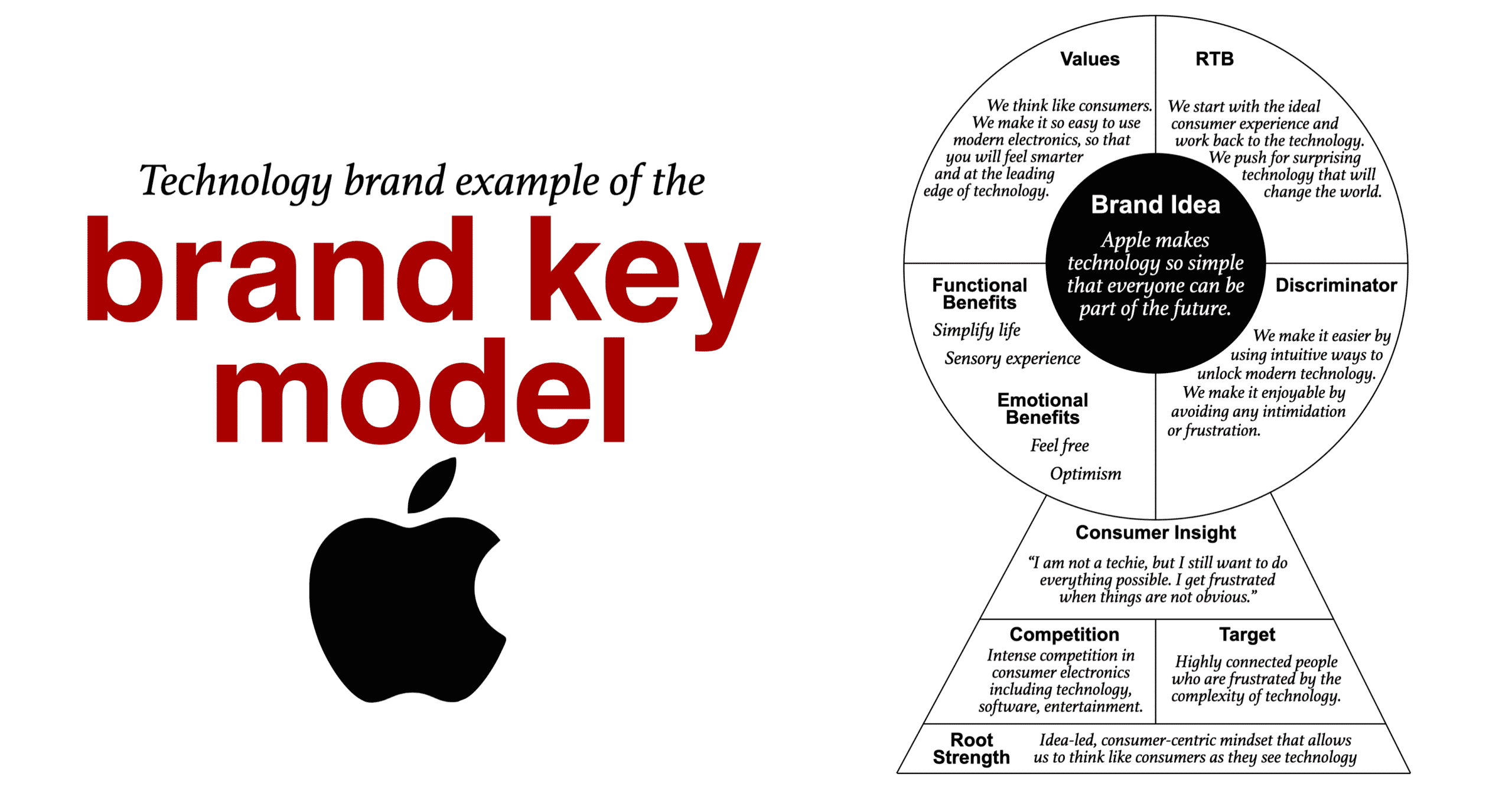
To illustrate, click on the Brand Key Example of Apple unique selling proposition of ‘simplicity.’
Brand Key Example for the Tesla brand.
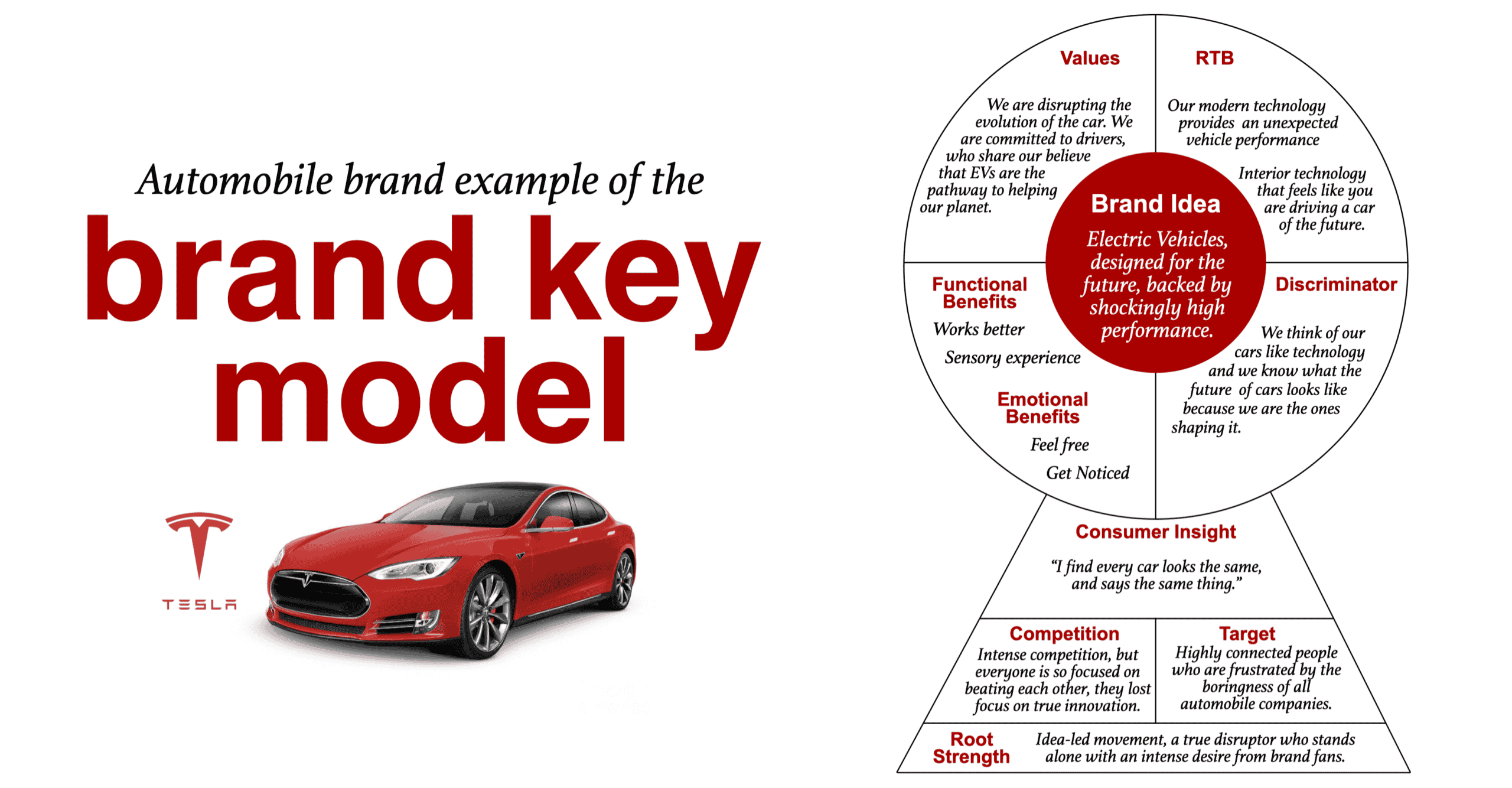
Below is the Brand Key example for the Tesla brand. It speaks to their unique selling proposition of “building EV cars for the future.” To read more on our Tesla case study, click on this link: How Elon Musk built Tesla based on an intense desire.
Frequently Asked Questions - Brand Key Model
What is the Brand Key Model?
The Brand Key Model is a strategic framework that organizes everything that defines your brand’s unique selling proposition (USP) into nine interlocking elements on one page. It gives brand teams a single, coherent picture of what makes their brand different and why consumers should choose it over competitors.
Who created the Brand Key Model?
The Brand Key Model was originally developed by Unilever as an internal brand strategy tool. It has since been widely adopted across industries as one of the most effective frameworks for defining and communicating a brand’s unique selling proposition.
How many elements are in the Brand Key Model?
The Brand Key Model has nine elements: root strength, competitive environment, consumer target, consumer insights, functional and emotional benefits, values and beliefs, reasons to believe, discriminator, and brand idea. Work through all nine, and you have a complete, defensible USP your whole team can align around.
What is the difference between the Brand Key Model and a brand positioning statement?
The Brand Key Model is a working tool that captures all the thinking behind your brand’s USP across nine elements. A brand positioning statement is the output — a tight one or two sentence summary written for internal alignment. The Brand Key gets you to the positioning statement faster because all the inputs are already organized.
How do I use the Brand Key Model for my brand?
Start with your root strength — the single core advantage your brand can win with. Then work through each of the nine elements in order, answering the key questions at each stage. When all nine are complete, your discriminator and brand idea will emerge naturally from the work you’ve done.
What is a discriminator in the Brand Key Model?
The discriminator is the single most compelling reason for consumers to choose your brand over competitors. It sits at the center of the Brand Key Model, connecting your internal brand values to your external reputation. Everything else in the model supports and builds toward it.