One of the biggest mistakes I see marketers make is picking too broad a consumer target market. A tight consumer target profile helps you decide who is in the target and who is not.
There is a myth that a bigger target makes the brand bigger, so the scared marketer targets “everyone.” There is an irrational fear of leaving someone out. Spreading your brand’s limited resources across an entire population is cost-prohibitive. Targeting everyone “just in case” feels safe at first, then drains your resources before you ever see the impact you want. You get a lower return on investment and a brand that never gains traction. Please focus.
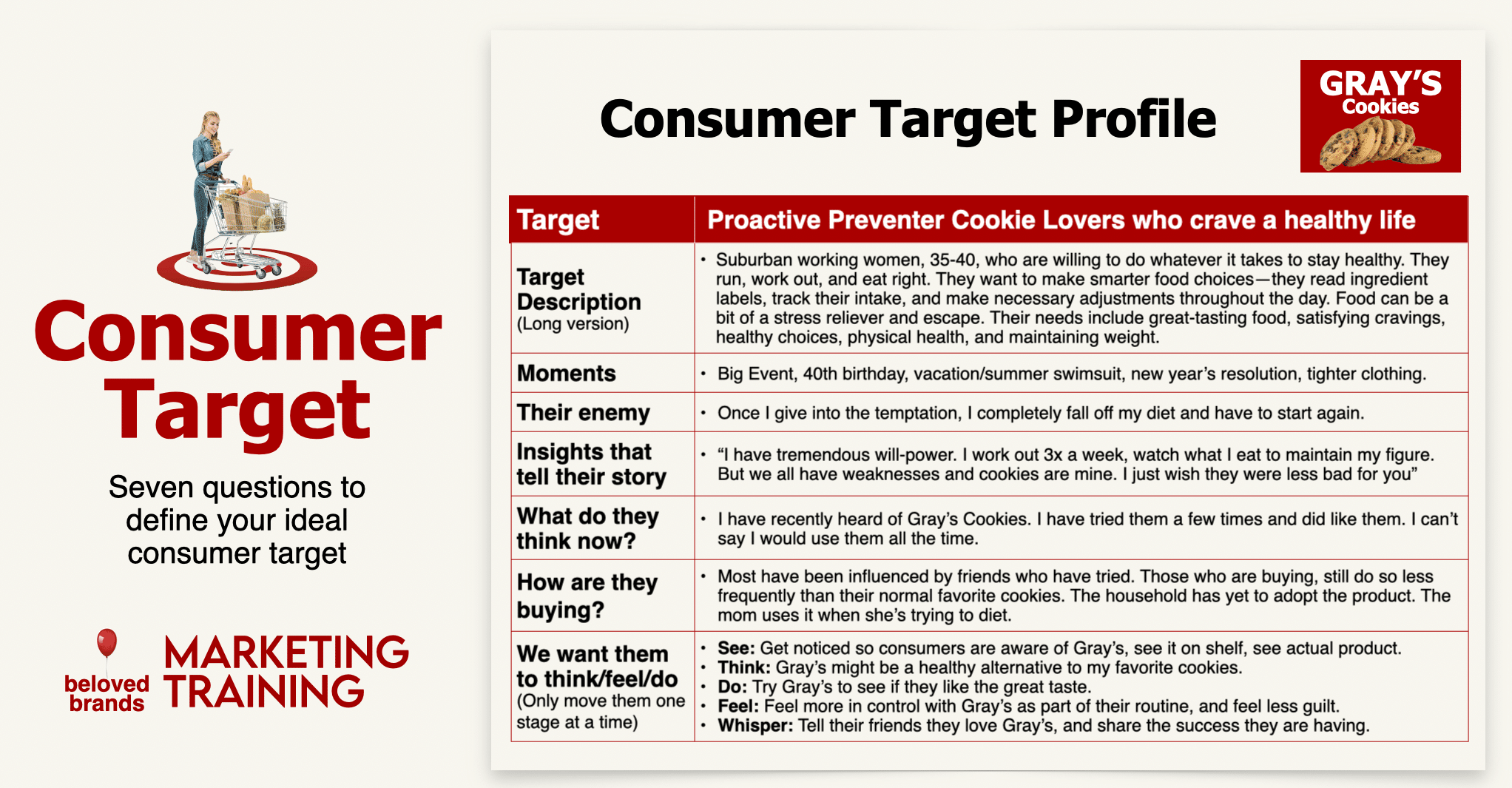
Table of Contents - Consumer Target Profile
Why a focused consumer target beats targeting everyone
The shoeshine target market
Every time I go to the airport, I see the shoeshine person looking down at people’s feet, qualifying potential customers based on whether they are wearing leather shoes. Sure, they could be missing the rare traveler who packed leather shoes in a suitcase. They would rather spend their effort on the consumers most motivated by what they do.
If a shoeshiner can narrow their consumer profile to people wearing leather shoes, why is it so hard for you to narrow your target to the people who care most about what your brand does?
Go after the consumers most motivated by what you offer
Instead of going after who you want, go after those who want you
If you have a golf ball that goes longer than any other golf ball, go after golfers who already hit it long and want to hit it even longer. Or if you have a new recipe for chicken noodle soup, go after people who love chicken noodle soup. If you are selling a mortgage, go after consumers who want to buy a house. That sounds simple. So why do I see golf marketers chase people who hate golf, soup marketers chase people who do not care about soup, and banks try to sell mortgages to everyone?
The three consumer targets: selling, marketing, and program
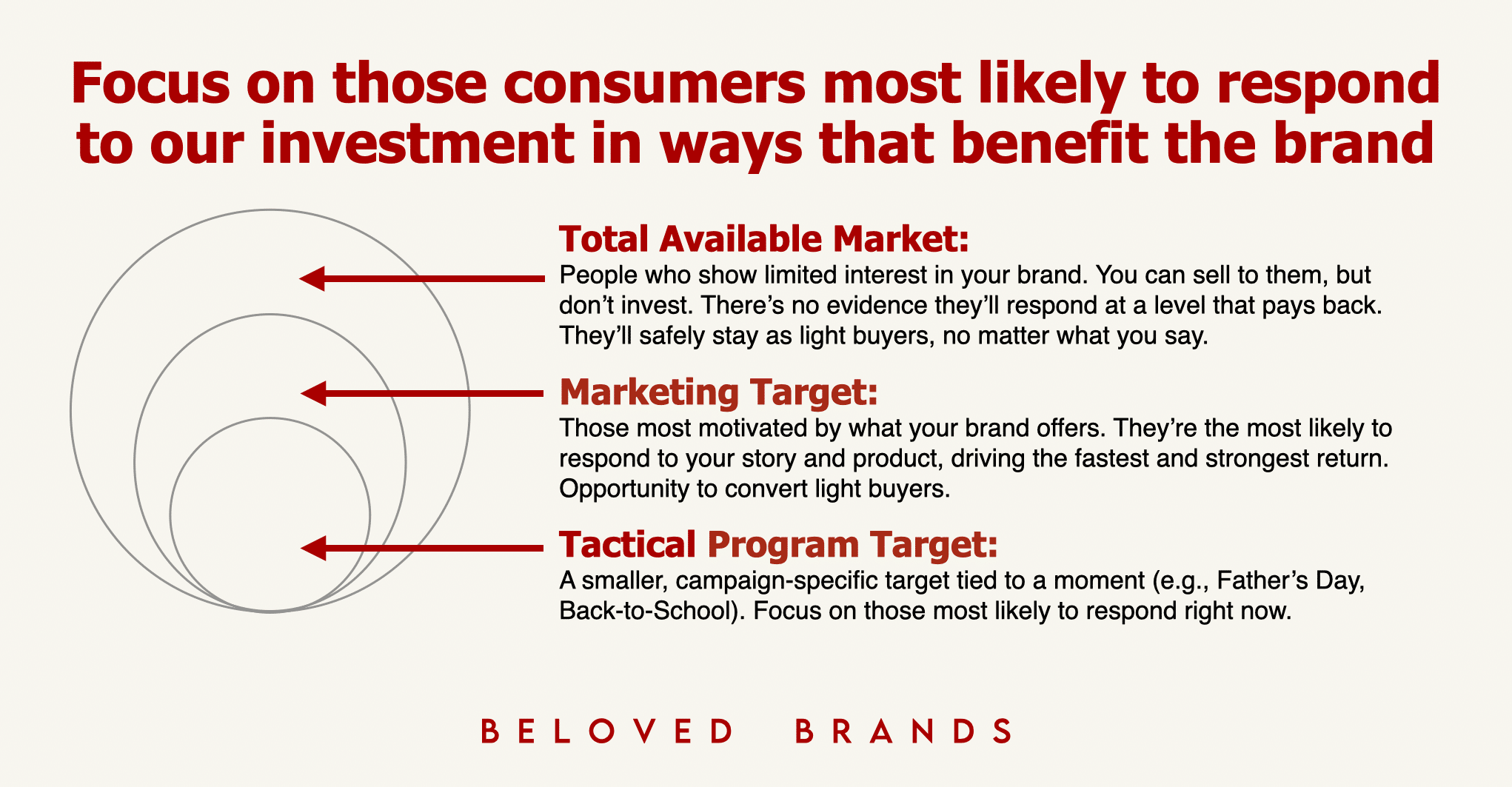
When I define a consumer target, I look at three different layers.
Selling target.
This is pretty much everyone. You sell to anyone who walks in the door and wants to buy, whether or not they fit your ideal target. “Everyone” should never be your marketing target. Spread your resources that thin, and your message misses the consumers most likely to respond.
Marketing target.
Focus your limited resources on consumers most likely to respond to your positioning, advertising, and innovation. A tighter target gives you the fastest and highest return on investment.
Program target.
When you work on a specific campaign, narrow the target even further. Focus on the people you want to move, so you can get them to see, think, feel, or do something that benefits your brand. A specific program target works well when you launch a new product or align with a moment in the year such as back-to-school or the holidays.
The bank that wanted to target everyone
I worked with a bank that told me its target for a first-time mortgage was adults aged 18 to 65, new customers, current customers, and employees. I said, “You forgot tourists and prisoners.” As I pushed them to narrow the profile, they pushed back. They did not want to alienate anyone, just in case. I cringed at “alienate” and at “just in case.”
The odd 64-year-old might be tired of renting for 40 years, and they would not be offended to see a 32-year-old in the ad. People know when they are a natural outlier, and they are fine with it. The age most motivated by a first-time mortgage ad sits in the late twenties to early thirties.
Then I sharpened the target further: “They are looking to buy a house.”
That is the same move as the shoeshine person looking for leather shoes. No one buys their first house on impulse, and no one ever wants a mortgage without a house attached to it. Consumers spend 6 to 12 months looking for a home. Obvious, yet the bank had lost sight of it.
Look at what that focus does to the marketing. Rather than blast everyone on mass media, the brand can reach the consumer where they are already open to the message. Advertise on real estate sites at lunch when they take a break to search listings. Run billboards outside new housing developments. Run the radio on Saturday afternoons while they drive around looking at homes.
How to define your consumer target profile
Defining a target is about who is in and who is out. You bring the target to life by adding their moments of accelerated needs, their consumer enemy, and the insights you hold about them.
Here is the build, using Gray’s Cookies as the example.
Eliminate those who are not your target.
For Gray’s Cookies, that means people who prioritize taste over health and people with no motivation to eat better. Naming who sits outside the target sharpens your focus on the right audience.
Identify the key consumer wants.
Understanding what your consumer wants most lets you shape the message. Gray’s Cookies appeals to people who want to feel healthier and smarter about their choices.
Prioritize the functional needs.
Pick the top functional needs your brand serves. For Gray’s, that is helping consumers eat healthier without giving up the treat.
Address the emotional needs.
Emotional benefits build a deeper connection. For health-conscious consumers, feelings such as optimism, pride, and a sense of control make a cookie feel like something that matters.
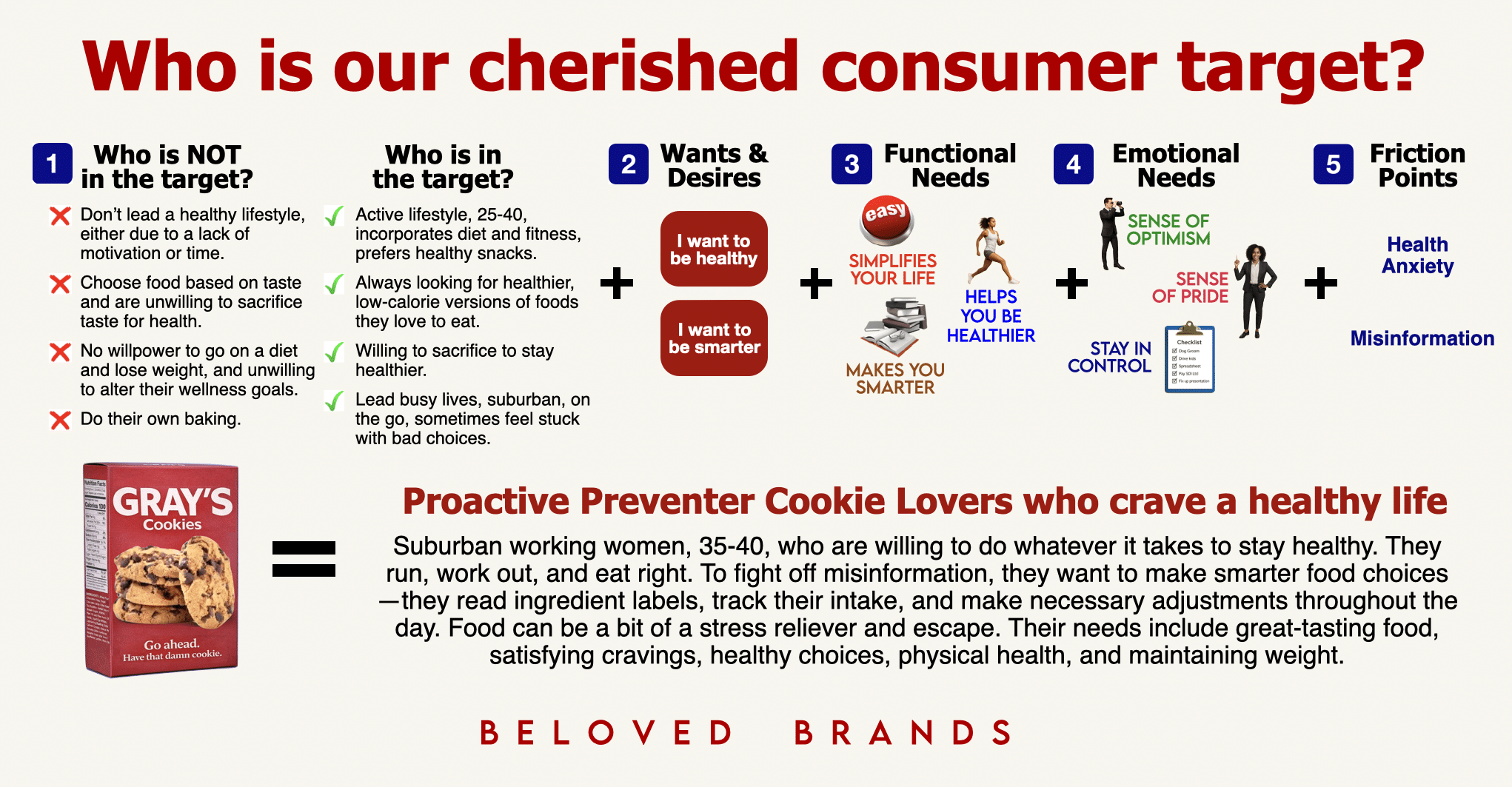
For Gray’s Cookies, the ideal consumer is the proactive, health-conscious person who craves a guilt-free indulgence. A well-defined target goes past demographics into motivations, needs, and aspirations. The better you know that consumer, the more your message lands.
How to segment the market to find your most motivated audience

There are several ways to divide a market and find the most motivated audience. I group them into three.
Consumer profiling.
Demographics are the easiest way in. Some marketers resist them, but at some point you have to put a person in the ad and buy media against an age range. Layer in socioeconomic and geographic factors, and how they shop. Choose current customers or new customers, never both at once. Driving penetration and usage at the same time splits your resources across two different targets that need two different messages, two media plans, and sometimes two product offerings.
Consumer behavior.
Divide the market by need states, purchase occasions, life stages, or life moments. You can also divide by purchase behavior, perceptions, or beliefs.
Consumer psychographics.
Group consumers by shared lifestyle, personality, values, or attitudes.
Segmentation forces you to focus. Do not spend a fortune on a segmentation study and then try to chase every segment with a different message. A brand can hold only one reputation. Pick a combination of three or four segmentation elements to narrow your target, and let the category guide which ones.
Consumer needs: functional and emotional
If you can make consumers buy, you never have to sell. The best brands get consumers to crave the brand and come after it. The work here is matching what your consumers want with what your brand does best.
To get you started, I mapped twelve functional need states that show the spaces your brand can play in, and twelve emotional need states alongside them. Each one means something different by category, so use them as a starting point and add the words that fit your situation.
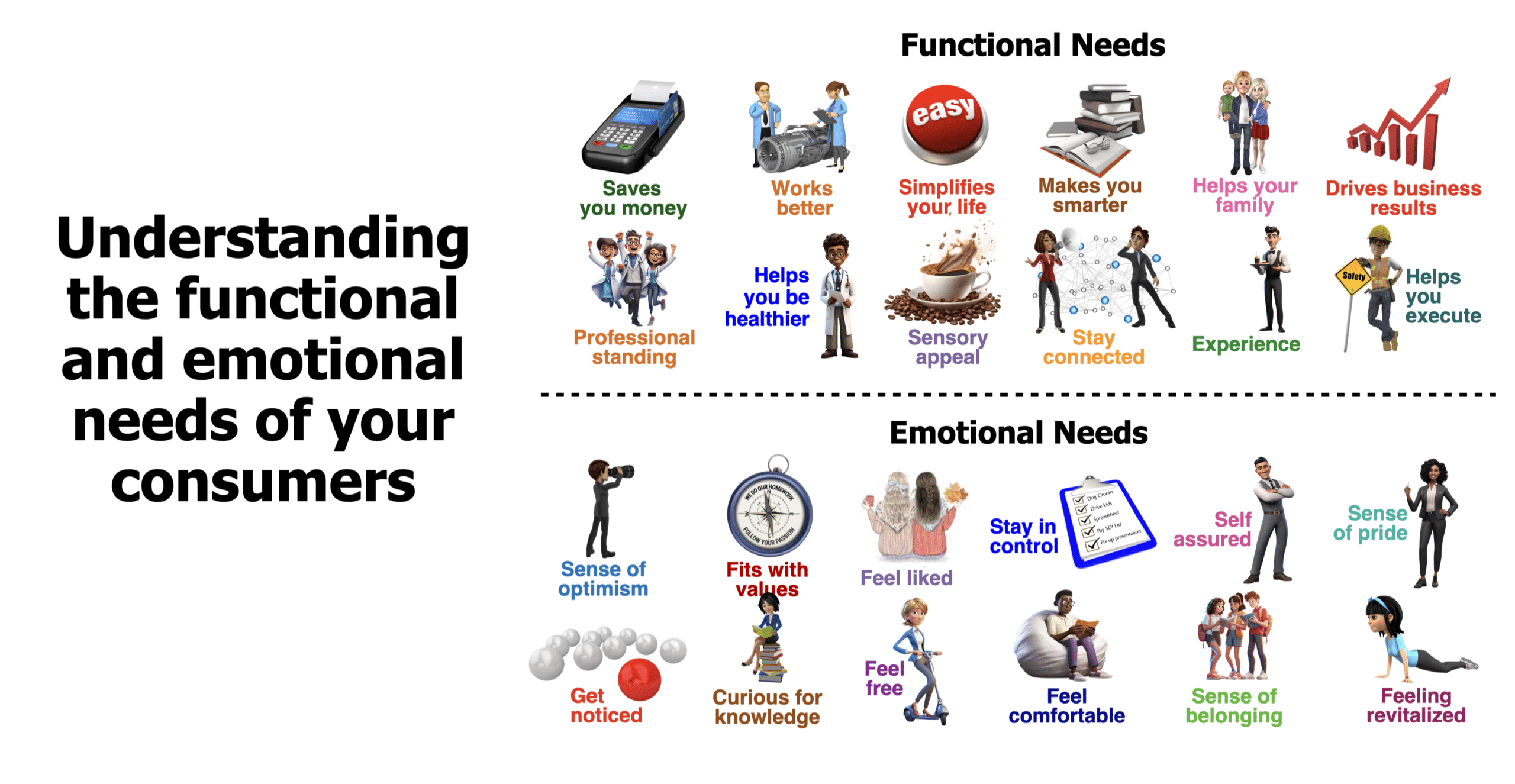
Moment of accelerated needs
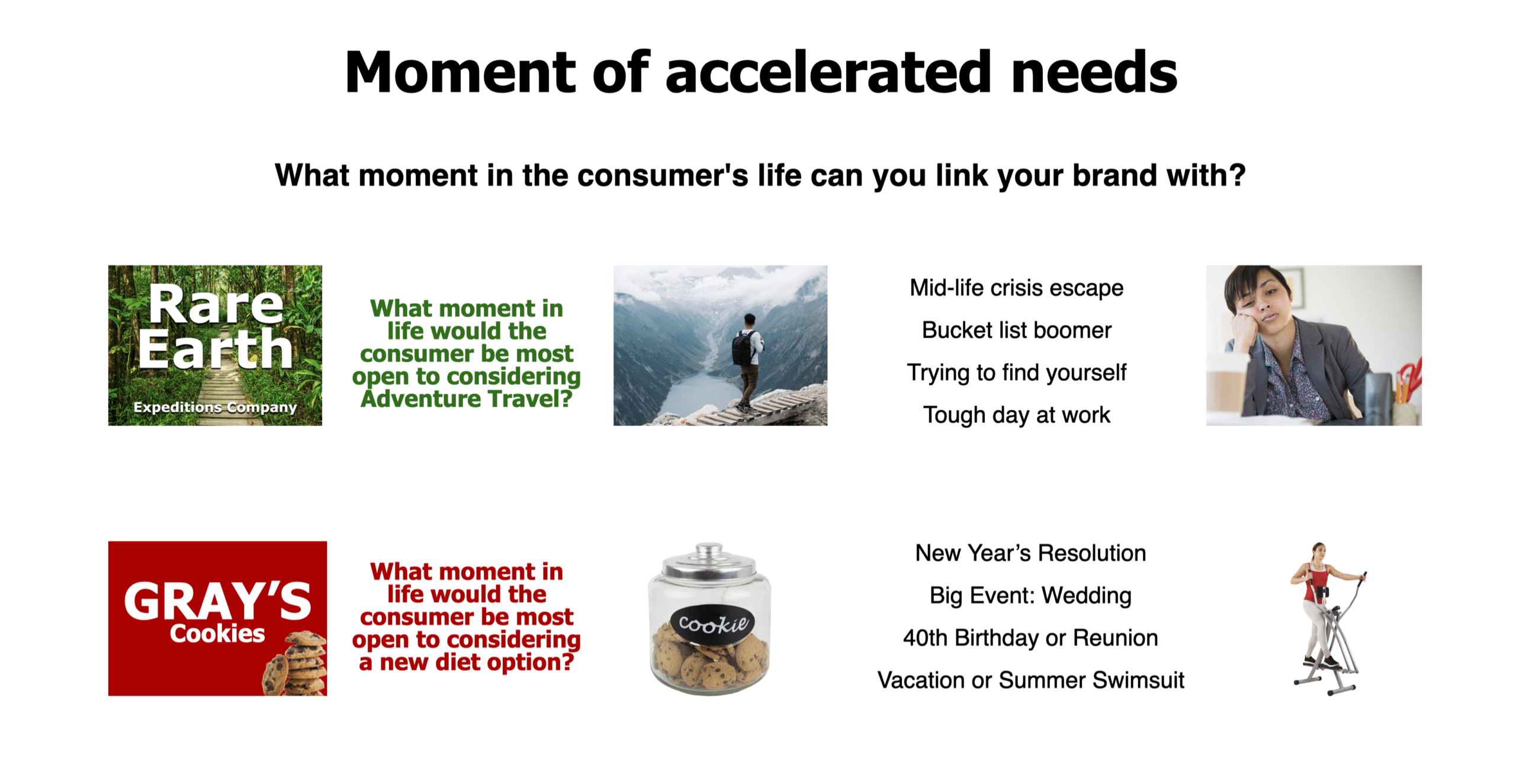
At certain points in a consumer’s life, their physical and emotional needs accelerate and open them up to new products. Brands win by reaching consumers right at those moments, when motivation runs high and knowledge runs low.
People feel a heightened need to quit smoking after a first child, a health scare, or a 40th birthday. Students rethink their food habits when they get to college and see what their peers eat. Newlyweds decide which household brands to bring into the home. Vitamin consumption climbs 8-fold between ages 50 and 55. Something accelerated those needs. Find the moments when your consumer is most open, and meet them there.
The consumer enemy your brand fights for them
Products solve small problems. The best brands beat down the enemy that torments their consumer every day. Put yourself in your consumer’s shoes and find the frustration they feel no one else notices or addresses.
When you can name that enemy and show how your brand fights it on the consumer’s behalf, you move from solving a rational problem to reaching an emotional need. For Tide, grass stains are a problem, yet a mother-in-law’s judgment cuts deeper. Volvo drivers care about safety, and what scares them most is the mindless driver in the next lane.

Consumer insights that connect
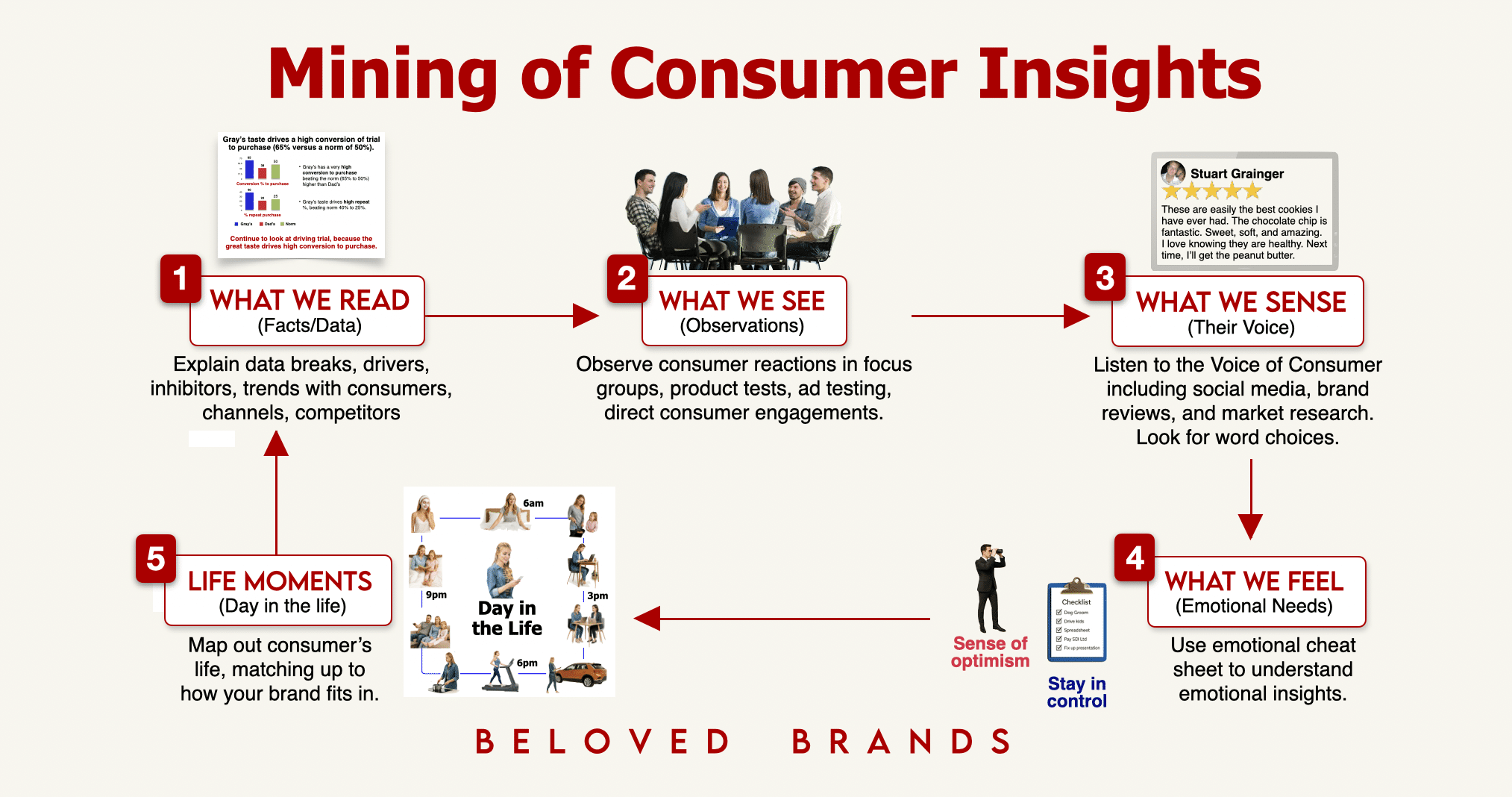
Consumer insights must show up at every consumer touchpoint
Treat consumer insights the way you treat intellectual property. What you know about your consumer is a competitive advantage. The deeper the love you build with your most cherished consumers, the more powerful and profitable the brand becomes, well past what the product alone could deliver. There is only one source of revenue: consumers who buy, not the products you sell.
A consumer insight has to show up at every touchpoint. The best brand communication feels like whispering an inside joke that only you and a close friend understand. When the consumer insight connects, the consumer stops and says, “That is exactly how I feel. I thought I was the only one.” Carried through packaging, advertising, and the purchase moment, that insight makes the consumer feel the brand was built for them.
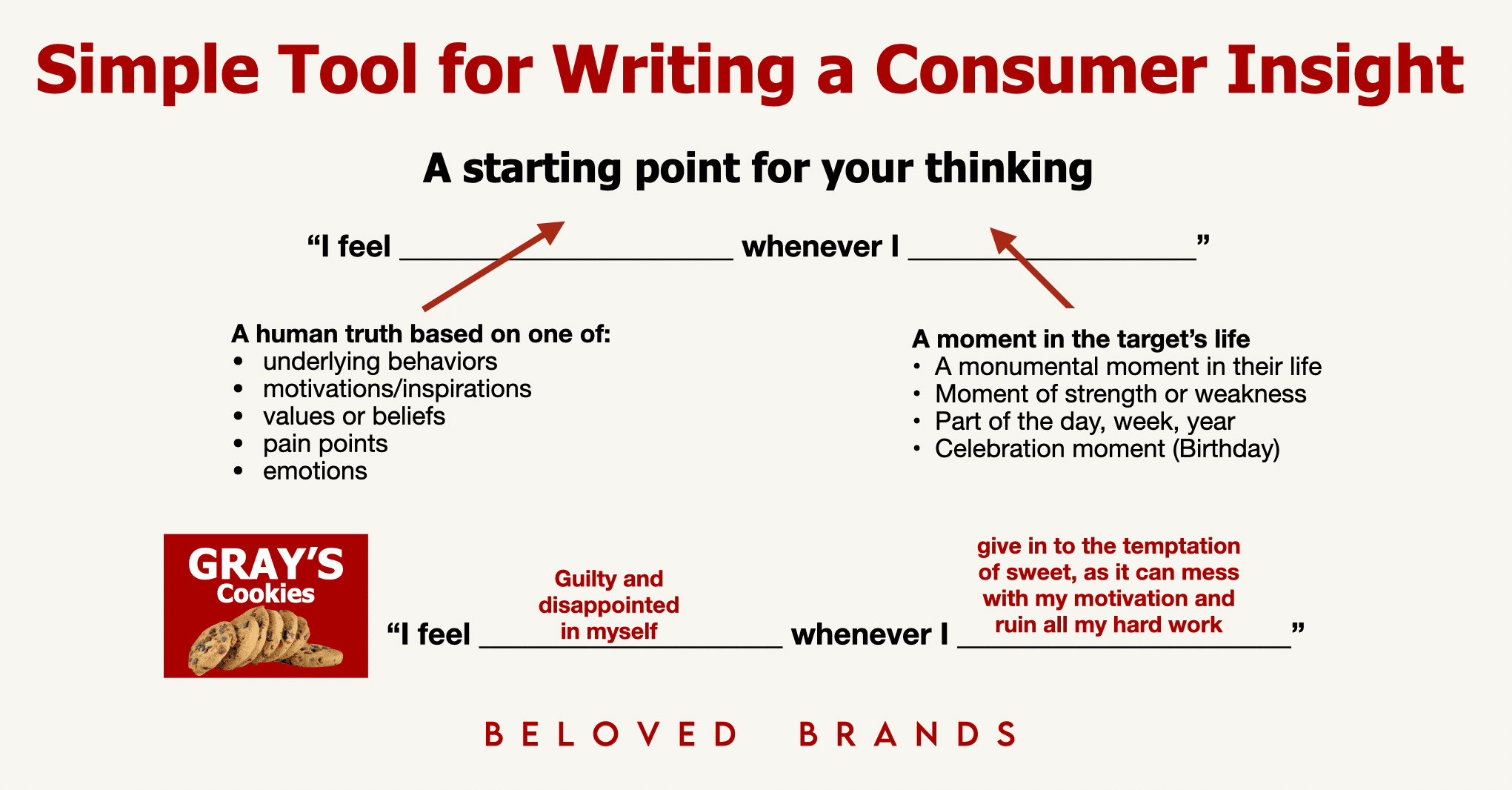
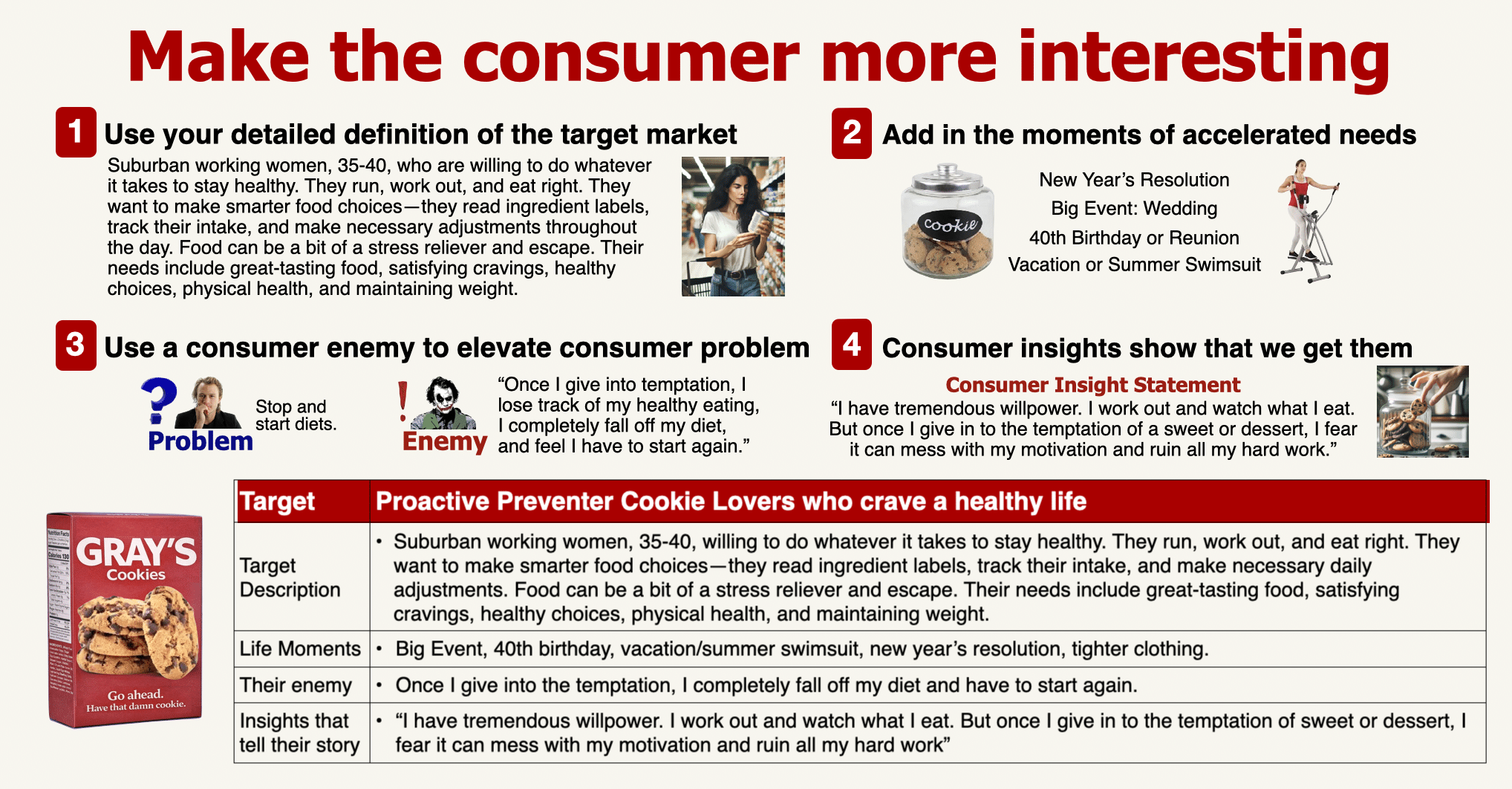
Here is how the insight came together for Gray’s Cookies.
Define the target market. We started with suburban, health-conscious women aged 35 to 40 who want to make healthy food choices inside busy lives. They want great taste and refuse to give up their wellness goals to get it.
Identify the moments of accelerated needs.
Specific moments, such as a big event, a reunion, or a New Year’s resolution, push the desire to stay healthy to a peak. Knowing those moments tells us when to show up.
Elevate the problem into an enemy.
We framed the struggle as a consumer enemy, the temptation to indulge that sets back a healthy lifestyle. That frame positions Gray’s Cookies as the answer to a battle the consumer fights every day.
Capture the insight.
We landed on a statement that proves we understand her: “I have tremendous willpower, but once I give in to the temptation of something sweet, I fear it can ruin all my hard work.” That insight guides every message.
The final target for Gray’s Cookies is the proactive preventer cookie lover who wants a healthy life without giving up taste. Build a profile with that depth, and your messaging carries real weight.
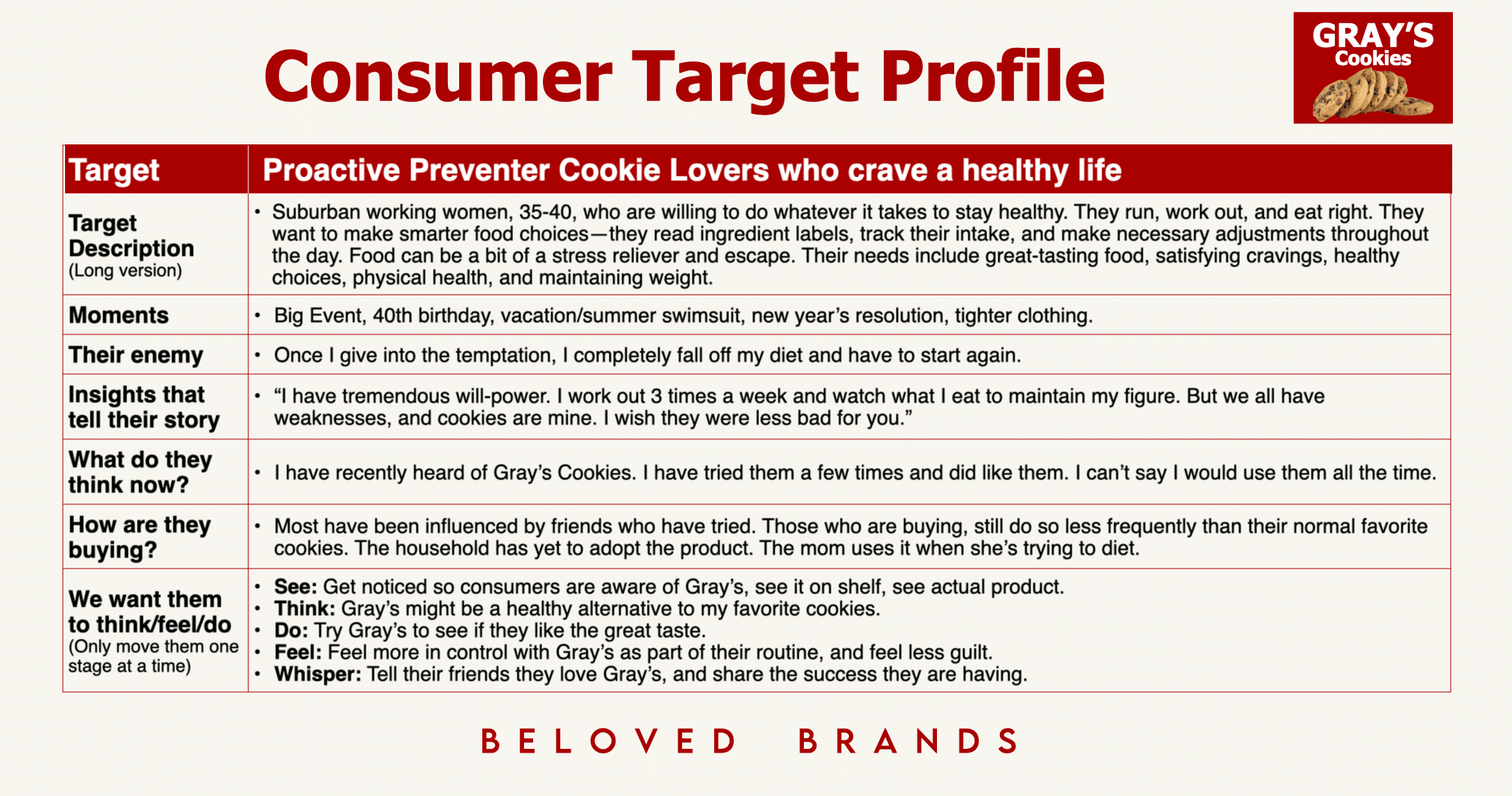
Seven questions to build your consumer profile
I use seven questions to define and build a profile of your ideal consumer.
- What is the description of the consumer target?
- What are the consumer’s main needs?
- Who is the enemy that torments them every day?
- What insights do we hold about the consumer?
- What does the consumer think now?
- How does the consumer buy?
- What do we want consumers to see, think, do, feel, or whisper to a friend?
Most marketers start by naming the consumers they want to attract. Flip it. Go after the consumers already motivated by what your brand offers. Stop asking “Who do we want?” and start asking “Who wants us?”
Frequently asked questions - Defining the consumer target profile
What is a consumer target profile?
A consumer target profile is a defined description of the ideal consumer your brand targets, built from their profile, needs, enemies, insights, buying behavior, and the response you want from them. It names who is in the target and who is not, so you can focus your limited resources on the consumers most likely to respond.
How do you define a consumer target?
Start by eliminating who is not your target. Identify the consumer’s key wants, prioritize the functional needs your brand serves, and address the emotional needs that build connection. Then narrow further using a combination of three or four segmentation elements such as demographics, behavior, and psychographics.
What is the difference between a selling target and a marketing target?
A selling target is everyone who might buy, which is too broad to build a brand around. A marketing target is the focused group with the highest likelihood of responding to your positioning, advertising, and innovation. A program target narrows even further for a specific campaign or launch.
Why should a brand avoid targeting everyone?
Targeting everyone spreads your resources so thin that your message fails to capture the consumers most likely to respond. A focused target delivers a faster and higher return on investment and lets you reach consumers where they are already open to your message.Share
Bring Your Consumers to Life
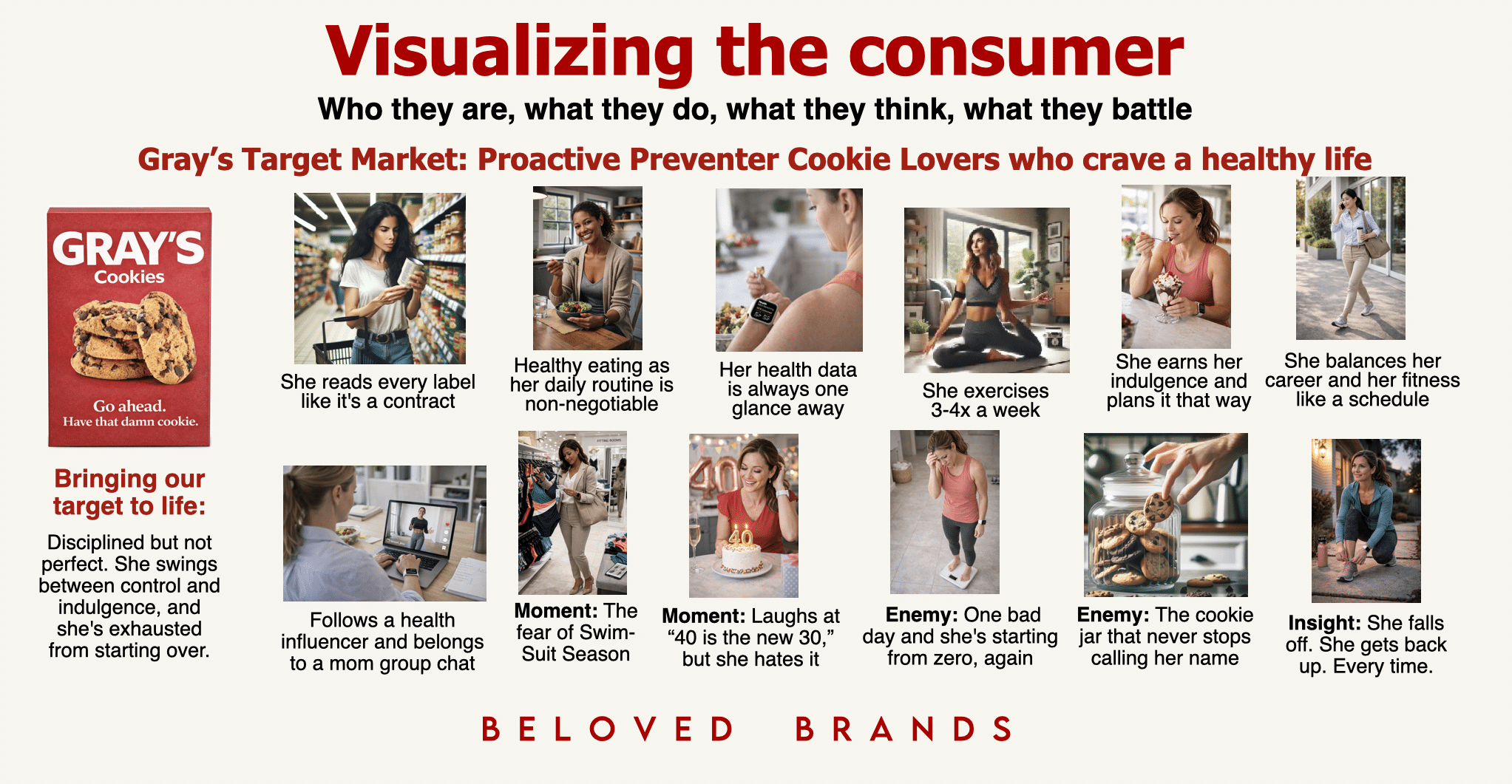
Above is a visual board that helps bring these to life.
𝗠𝗼𝘀𝘁 𝗰𝗼𝗻𝘀𝘂𝗺𝗲𝗿 𝘁𝗮𝗿𝗴𝗲𝘁𝘀 𝗜 𝘀𝗲𝗲 𝗮𝗿𝗲 𝗷𝘂𝘀𝘁 𝗮𝗻 𝗮𝗴𝗲 𝗿𝗮𝗻𝗴𝗲 𝗮𝗻𝗱 𝗮 𝗴𝗲𝗻𝗱𝗲𝗿.
I see too many brand teams define their target as “women 25 to 54” and then wonder why the creative comes back generic. You cannot write a message to a demographic. You can only write a message to a person. Here is what a real target profile looks like when you build it out. This is the health-conscious cookie consumer for Gray’s Cookies, the brand I use across my training programs.
𝗪𝗵𝗼 𝘀𝗵𝗲 𝗶𝘀 𝗮𝗻𝗱 𝘄𝗵𝗮𝘁 𝘀𝗵𝗲 𝗱𝗼𝗲𝘀
- She reads every label like it is a contract. Healthy eating is non-negotiable. Her health data is always one glance away. She exercises three or four times a week. She earns her indulgence and plans it that way.
𝗠𝗼𝗺𝗲𝗻𝘁𝘀 𝘄𝗵𝗲𝗻 𝗵𝗲𝗿 𝗻𝗲𝗲𝗱𝘀 𝗮𝗰𝗰𝗲𝗹𝗲𝗿𝗮𝘁𝗲
- The fear of swimsuit season. Turning 40 and laughing at “40 is the new 30” while hating it. These are the moments when motivation runs high, and she is open to something new.
𝗧𝗵𝗲 𝗲𝗻𝗲𝗺𝘆 𝘀𝗵𝗲 𝗳𝗶𝗴𝗵𝘁𝘀
- One bad day and she is starting from zero again. The cookie jar that never stops calling her name.
𝗧𝗵𝗲 𝗶𝗻𝘀𝗶𝗴𝗵𝘁
- She falls off. She gets back up. Every time.