If you think you play in a challenging category, this is the perfect case study to challenge your thinking. Telecommunications consumers are the angriest, most frustrated and disappointed consumers. It’s likely as bad as the airline industry. As a result, many of the telecom brands are the most hated in the marketplace. Do they care? Not enough. Especially as AT&T and Verizon see themselves with a duopoly that almost dares you to go with the “just as bad” competitor. About five years ago, T-Mobile entered the market and took advantage of all the hatred, using the “un-carrier” brand positioning. What looked like an insurmountable strategy against the giants has become easy pickings each year for their aggressive growth plan.
T-Mobile Brand Strategy
It's all about customers
When T-Mobile’s so-called crazy CEO says, “I’m all about customers and employees” that doesn’t sound so crazy at all. That crazy CEO takes the opposite approach to everything AT&T and Verizon do, backed up by an exceptional customer service idea that lays beneath the surface. If you think marketing is just about logos and advertising, think again. Customer service is the secret sauce for T-Mobile, and the culture they have created allows them to deliver exceptional service.
This is a great case study to show how a brand needs to inspire their culture to deliver. Moreover, this case study shows that happy customers will lead to higher growth and higher profits.
Disruptor strategy using "un-carrier" moves
It all started with the consumer enemy of “frustration” when T-Mobile said they are going to fix a stupid, broken, arrogant industry. Their first move back in 2013 was the “un-carrier” move to no contracts. This is a classic disruptor strategy which makes the main competitors (AT&T and Verizon) look disconnected from what consumers want.
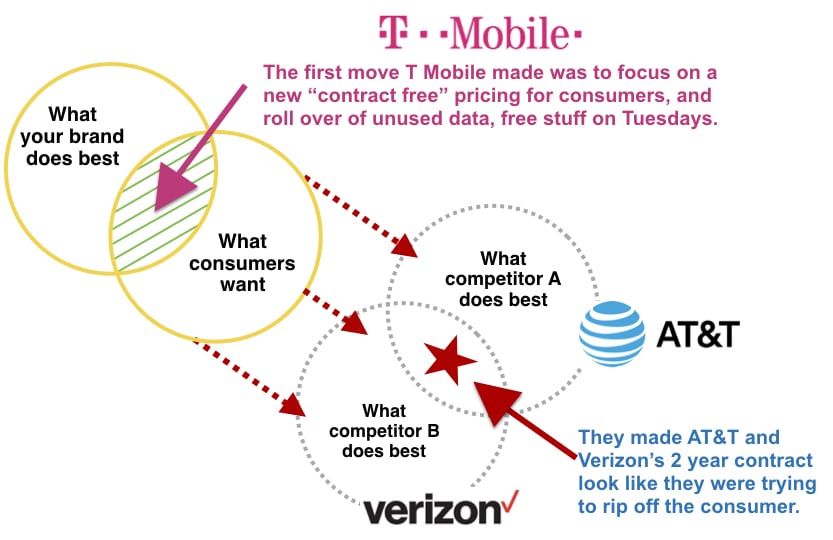
To illustrate, click on the T-Mobile Brand Strategy diagram above to zoom in.
While everyone wants a game-changer, it is a high-risk, high-reward competitive situation. The trick is you have to be “so different” to catch the consumer’s attention and mindshare. Being profoundly different increases the risk you may fail. Also, your success may invite other entrants to follow. At that point, you become the new power player of the new segment. You have to continue attacking the major players while defending against new entrants who attack your brand.

New T-Mobile “un-carrier” move every six months:
- 1.0: Launch of no contracts
- 2.0: “Jump” allowed customers to upgrade their phone up to two times per year, by trading in their phone to purchase a new one at the same price as a new customer.
- 3.0: enabled free international roaming.
- 4.0: launched the get out of jail where they agreed to pay your early termination fees from the competitors.
- 5.0: gave consumers a chance to try out a new phone for a week.
- 6.0: “Music Freedom” with data used on certain streaming music services would no longer count to users’ data limits.
- 7.0: partnered with Gogo inflight internet for free texting on all flights using Gogo.
- 8.0: “Data Stash” lets users carry over unused high-speed data usage for up to one year.
- 9.0: Business program, allows every line unlimited talk and text, 1GB of data
- 10.0: “Binge-on” allows users to watch streaming services without counting towards their data
- 11.0: Tuesday free stuff, including Dominos pizza, Lyft credits, Wendy’s Frostys
- 12.0: Unlimited everything with unlimited talk, text, and data.
- 13.0: Eliminate wireless service and access fees in an effort to make the pricing more transparent.
Competitors can’t keep up
Imagine how hard it is for AT&T and Verizon to make counter moves as T-Mobile picks apart one weakness at a time. It reminds me of the “I’m a Mac” TV ads, which made 66 spots to pick on every weakness by the PCs. To make things worse for AT&T and Verizon is the T-Mobile keeps flaunting his strategy right in the face of his fellow CEOs, who he constantly refers to as dumb-and-dumber.
It’s all about the culture behind the brand
While T-Mobile has great Ads to get consumers in the funnel, they are trying to reinvent how they handle Customer Service. They recognize that easy questions are now done online, so the current calls are questions that are tough to handle.
They are now using a team approach focused on 4 questions in assessing the transformation over time:
- Are our customers happier?
- Are they staying with us longer?
- And, are we deepening our relationship with them?
- Then are we making their service experience low-effort?
These are great questions to ask, showing they are serious about being a loved brand.
Brand idea
Use the brand idea to drive every part of what you do
Brand leaders must manage the consistent delivery of the brand idea over every consumer touchpoint. Whether people are in management, customer service, sales, HR, operations, or an outside agency, everyone should be looking to the brand idea to guide and focus their decisions.
There are five main touchpoints that reach consumers, including the brand promise, brand story, innovation, purchase moment, and consumer experience. Regardless of the order, they reach the consumer; if the brand does not deliver a consistent message, the consumer will be confused and likely shut out that brand. While brands cannot control what order each touchpoint reaches the consumer, they can undoubtedly align each of those touchpoints under the brand idea.
B2B Brands
The B2B playbook for how to create a brand your customers will love

As a B2B marketer, you know that the key to driving growth is a strong brand. But how do you develop and execute a winning B2B brand strategy? Look no further than the B2B Brands playbook.
Prepare to think differently about your B2B brand strategy with B2B Brands. We want to challenge you with thought-provoking questions and take you through our process for defining your brand positioning. Our goal is to expand your mind to new possibilities for your brand by using real-life examples of successful B2B brand positioning strategies.
We’ll start by showing you how to create a brand plan that’s easy for everyone to follow, ensuring that all stakeholders understand how they can contribute to your brand’s success. Moreover, we guide you through the creative execution process, including how to write an inspiring brief and make decisions to achieve smart and innovative communications.
Finally, we’ll teach you new methods to analyze your brand’s performance through a deep-dive business review.
Our B2B Brands playbook offers a wealth of knowledge and insights, including B2B case studies and examples to help you learn new techniques. It’s no wonder that 85% of our Amazon reviewers have given us a 5-star rating. So, join us on this journey to unleash the potential of your B2B brand.