
Marketing job stress is real, and it builds quietly. You are juggling campaigns, analytics, cross-functional teams, and timelines, all while the results clock keeps ticking. I spent over two decades running brands at Johnson & Johnson, Coca-Cola, and General Mills, and I felt every one of these pressures climb as I moved up. The stress never disappears. It changes shape at each level, and if you cannot manage it, it will limit your career.
Six pressures drive most of the stress in a marketing career: ambiguity, the push for results, conflict with peers, time pressure, managing your own path, and protecting your personal life. Here is how each one shows up, and what has actually worked for me in handling it.
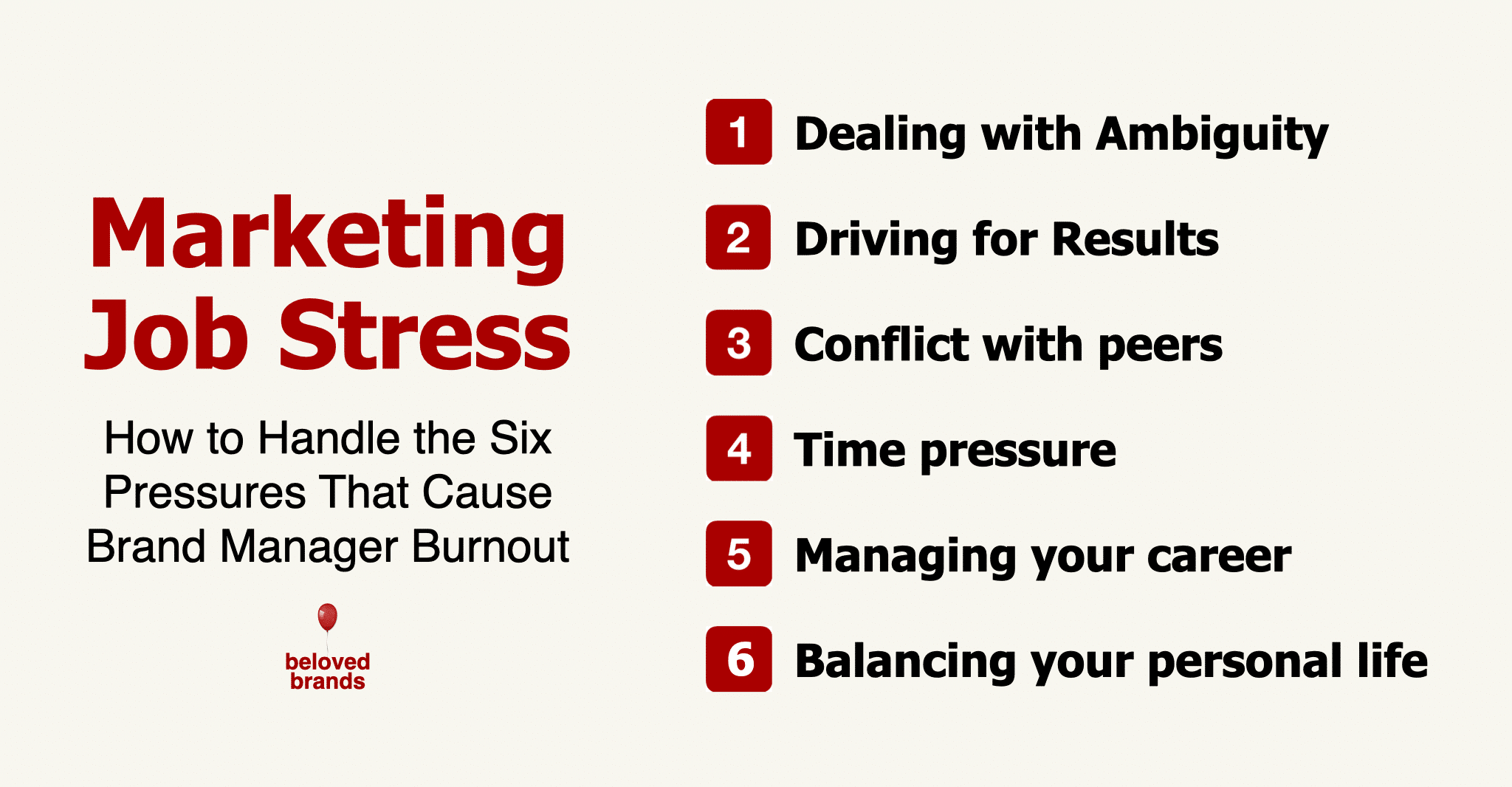
Marketing Job Stress - Six Pressure Points
Dealing with Ambiguity
Ambiguity can chew you up and spit you out. In marketing, there is no right or wrong answer. There is the best answer, and it either works or it does not, and you will not know until your work hits the market. Marketers have to combine fundamentals, thinking, and instinct to make the smartest call they can.
As a leader, persistence, patience, and composure help you sort through it. When you lose your composure, your team gets scared, and you start making quick decisions that bring bad results. So slow your thinking down, map out decision trees, and use your tools to back up your instincts. Then make the decision. Most marketers faced with A or B try to find a way to do both, and that drains limited resources by spreading them thin across two options.
Driving for Results
When the results do not come in, it wears on you. The way to protect yourself is to make reasonable projections in the first place. Keep running regular deep-dive analysis so you always know what is going on and can summarize the key issues fast. When results are struggling, reach for your logic and re-group. Force yourself to course-correct instead of repeating the same moves. I would tell my team that this is exactly when we are needed, and use it to motivate them to dig deep and fix the business in front of us.
If you can put a time frame on the turnaround, you take pressure off the team. Telling everyone that the next three months call for all hands on deck while we turn around the extra-strength business gives people a finish line. That focus cuts the ambiguity.
Conflict with peers
At various points in your career, relationships will cause you more stress than the work. Organizations have natural conflict built in, because priorities pull against each other. For most marketers, sales is the pressure point. They are closing short-term gaps while you are building long-term equity. Make the first move to build the relationship. Figure out what motivates the other person and what annoys them, and reach for common ground, which is usually closer than you think.
I used to have regular lunches with the key account sales directors, mainly to hear them out. I got nothing during lunch and a ton between them. I only figured that out late in my career, after years of butting heads with sales.
Your ad agency is the other one. Agencies value pride in the work more than they value your results. Find the middle ground where they are motivated to do great work that also drives your numbers, and you will get great advertising. Do not treat them like a supplier you pay, because that never works. You have to inspire and energize them, and always tap into their pride.
Time Pressure
Time pressure is almost the opposite of ambiguity. A lot of marketers think being creative gives them a pass on being organized. It does not. You have to be organized and disciplined and work the system so it stays out of your way. Stay calm so you keep making good decisions. You can even turn time to your advantage. When you hold it together in the face of a deadline, you can use the clock to get everyone focused on the simple answers. Time will focus your team as long as you stay cool. The moment you get stressed, everyone around you feels it and freezes.
Managing your Marketing Career
The best marketers are ambitious and want to get ahead, and that ambition is its own form of marketing career pressure. CPG marketing still runs on an up-or-out mentality, which adds weight to keep climbing. Your career changes at every stage, so the pressure keeps changing too. When you are junior, the job is about doing, and making it happen through subject-matter experts. This is also where you manage your boss, so they know what you want. Think about your career across two things, skills and experiences, and make sure you stay well-rounded in both as you move up. Spot the gaps and close them through the choices you make.
Balancing your Personal Life
Across your career, all kinds of things in your personal life will trickle into work. You might be getting married, buying a house, or having kids. Those are the good ones. You could also go through a break-up, make a bad investment, or lose someone you love.
You have to learn to compartmentalize and keep your personal life and your professional life apart. You should not bring your personal life to work, and you cannot carry work home either. That is harder than ever with a smartphone that never shuts off, where every buzz pulls you back in.
Build your own rules for the split, whether that means turning the phone off, protecting your weekends, or setting aside a fixed block of personal time from 6 to 9 pm. Find an activity that helps you shift from the pace of work to the pace of home.
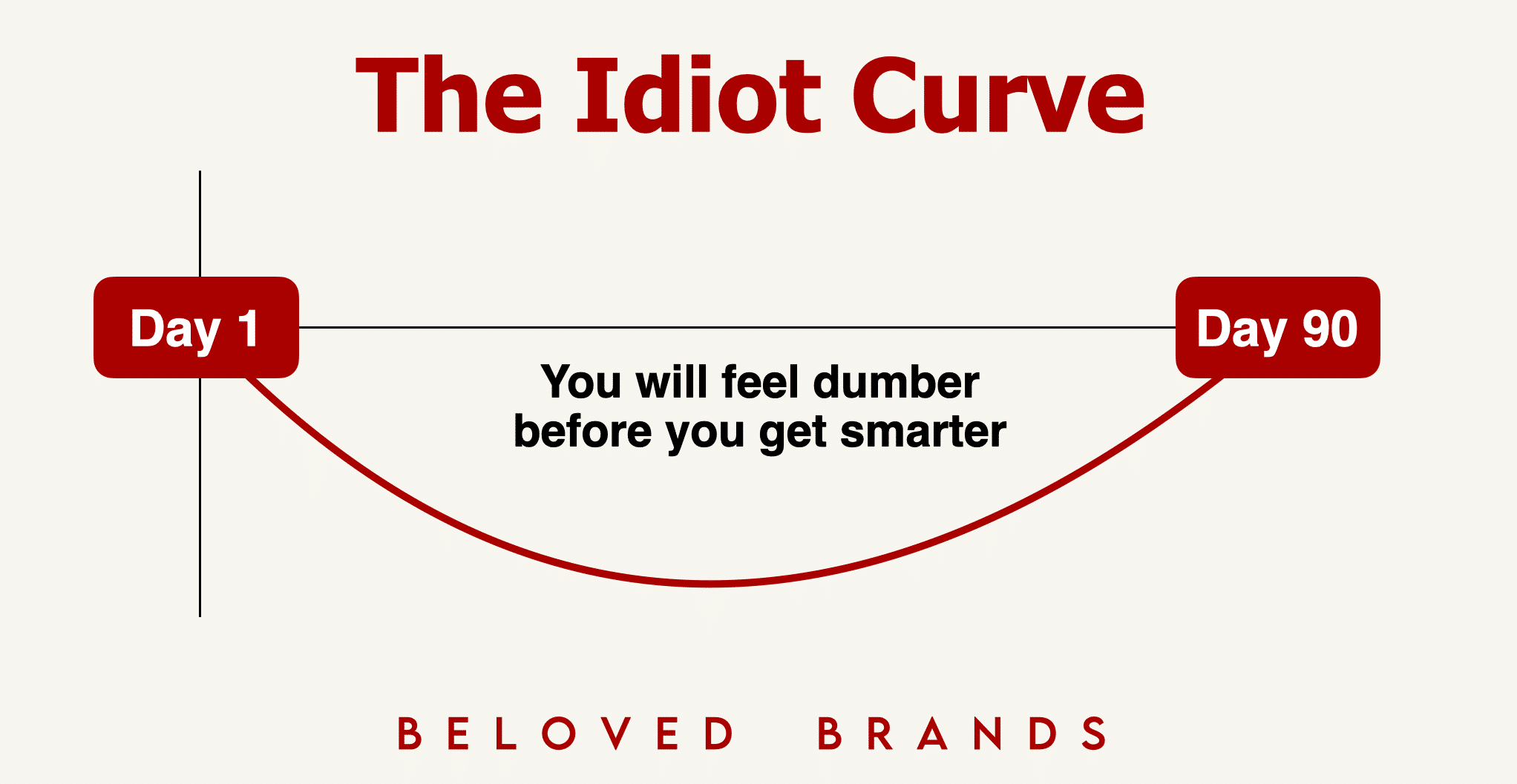
The Idiot Curve
One thing to keep in mind is the Idiot Curve. At every new job, I find it takes three months to get back to being just as smart as I was on my first day. The main rule of the Idiot Curve is that you get dumber before you get smarter. We have promoted some great junior marketers and watched them struggle, and wondered if we made a mistake.
The idiot curve is inevitable.
It shows up differently for each person and at every level you go through. No matter how hard you fight it, you have to ride the curve. So fight through the curve for your own survival.
The biggest gap is that you forget to use your instincts
- You spend so much time trying to absorb everything coming at you that you reach for the basic process instead of your brain.
- You might work on a project for weeks before you think to even look at the budget.
- You work on a promotion for Wal-Mart and then think, oh ya, I should talk to the Wal-Mart sales manager and see what he thinks.
- You say something in a meeting because you think you are supposed to, and it does not even resemble what you actually think, feel, or believe.
- That’s the idiot curve. Also, it will last for three months.
Moreover, you’ll experience it in a new and exciting way you can’t even predict. Feel free to let me know which way so I can add it to the list. (I won’t show names)
I also found at each new level; it got lonely during the first few months. You don’t know your new peers, and it takes them a while to accept you. Your friends, who might have been former peers treat you differently now.
The best way to deal with stress is to make sure you are organized and prepared to handle it
That is the idiot curve, and it will last for three months. You will experience it in a new way you cannot predict. Let me know which way, so I can add it to the list. I will not show names.
I also found that each new level got lonely during the first few months. You do not know your new peers, and it takes them a while to accept you. Friends who used to be peers treat you differently now.
The best way to deal with stress is to get organized and manage what is controllable
- Hit the deadlines. Do not look out of control or sloppy. We have enough to do that things will stockpile on each other.
- Know your business. Do not get caught off-guard. Keep asking the questions and carrying the knowledge forward.
- Open communication. No surprises. Keep everyone aware of what is going on, and present upward with an action plan.
- Listen and decide. Seek to understand, and then give direction or push toward the end path.
- Keep getting better. When you do not know something, speak in an asking way. When you know, speak in a telling way.
- Control your destiny. We run the brands; they do not run us. Stay slightly ahead of the game instead of chasing your work to completion.
- Take feedback as growth. Good or bad, treat every piece of feedback as a lesson, not a personal attack or a setback.
Stress increases with every level in your marketing career, so learn to handle it now
Being unable to handle stress will eat you alive and limit your career, and left unchecked it tips into full brand manager burnout. The stress only grows as you move up. One of the best stress relievers I ever found was the work itself. I pushed myself to love the work, and being satisfied with it brought my stress level down. Every time I settled for OK, it ate at me for months and I regretted settling.
Love What You Do! Live Why You Do It.
Take your brand knowledge to new heights with our Beloved Brands playbook
Beloved Brands is a comprehensive guide that covers the fundamentals of brand management. It goes deep on strategic thinking, brand positioning, brand plan development, advertising decisions, media planning, marketing analytics, and the brand financials. This is an opportunity to build your marketing skills to help your career. And, it will provide you with the roadmap for driving growth on your brand.

Marketers see Beloved Brands playbook as a go-to resource, as they keep it within arm’s reach for any new project. We are thrilled to see that it has received a 5-star rating from nearly 90% of Amazon reviewers. Additionally, we have also created playbooks for B2B Brands and Healthcare Brands, catering to specific industries.

Frequently Asked Questions - Marketing Job Stress
Why is marketing such a stressful job?
Marketing job stress comes from six pressures stacking up at once: constant ambiguity with no clear right answer, the push to deliver results, conflict with sales and agencies, tight deadlines, managing your own career, and protecting your personal life. Each one is manageable on its own. They tend to hit together, which is what makes the job feel relentless.
What causes brand manager burnout?
Brand manager burnout usually builds from carrying ambiguity and results pressure too long without a system to manage them. When you stop course-correcting, stop separating work from home, and let the stress compound across levels, it tips into burnout. Getting organized and putting time frames around your problems takes a lot of that weight off.
How do you handle stress in a marketing career?
The best stress reliever I found over two decades was the work itself. Slow your thinking down, map your decisions, make the call, and stay composed so your team stays calm. Get organized so deadlines do not run you, and build hard rules that keep your work life separate from your personal life.