
The 127-Slide Marketing Plan Nobody Read
I once sat in a planning meeting where a brand manager proudly handed out a 127-slide marketing plan.
It had everything. The market analysis was exhaustive. The competitive section had charts no one could read. The tactics section ran 40 slides deep. There was a slide for every initiative the team had ever considered, plus a few they’d pulled from last year because no one thought to cut them.
Leadership sat quietly for two hours.
At the end, the VP of Marketing looked up and said, “I still don’t know what you want to do.”
The problem wasn’t effort. The brand manager had worked on that plan for three months.
The problem was the sequence. The plan started in the wrong place, built on itself without direction, and arrived nowhere that leadership could follow.
That's the most common and most expensive mistake in marketing planning.
After 20 years as a VP of Marketing at Johnson & Johnson, Coca-Cola, and General Mills — approving plans, rejecting plans, and coaching hundreds of brand managers through the process — I’ve seen this pattern repeat across every company, category, and career level.
The teams that get their plans approved fast aren’t the ones who work harder. They’re the ones who follow the right sequence. They build from vision down to execution. They identify their key issues before writing a single strategy. They show leadership exactly where the brand is, why it’s there, and what it will take to move it forward.
This guide gives you that sequence, step by step.
Table of Contents - How to write a Marketing Plan
Your Plan's Structure Reveals Your Strategic Thinking and Investment
Most marketers treat the marketing plan as a reporting exercise – fill in the sections, hit the word count, hand it in. But the structure of your plan isn’t the container for your thinking. It is your thinking. Leadership doesn’t read a plan and then form a view of the brand manager. They read the structure and they already know.
If your vision is vague, you haven’t decided where you’re going. If your key issues don’t connect to your analysis, you haven’t done the hard diagnostic work. If your strategies don’t answer your key issues, you’ve been making a list, not making choices. And if your investment doesn’t line up behind your strategies, you don’t believe your own plan. The structure exposes every gap in the logic and there’s nowhere to hide.
The teams that get their plans approved aren’t the ones with the most data or the most slides. They’re the ones whose plans follow a sequence so clean that leadership can feel the intention and the investment behind every section. Vision sets the destination. Analysis establishes where you actually stand. Key issues name what’s in the way. Strategies make the choices. Execution proves you know how to land it.
Part 1: Foundation - Where You're Going and Why It Matters
Write a Vision Statement That Actually Commits to Something
A vision statement answers one question: where could this brand be in five to ten years? Not where you hope it ends up. Where it could be if the team makes the right moves and the right bets.
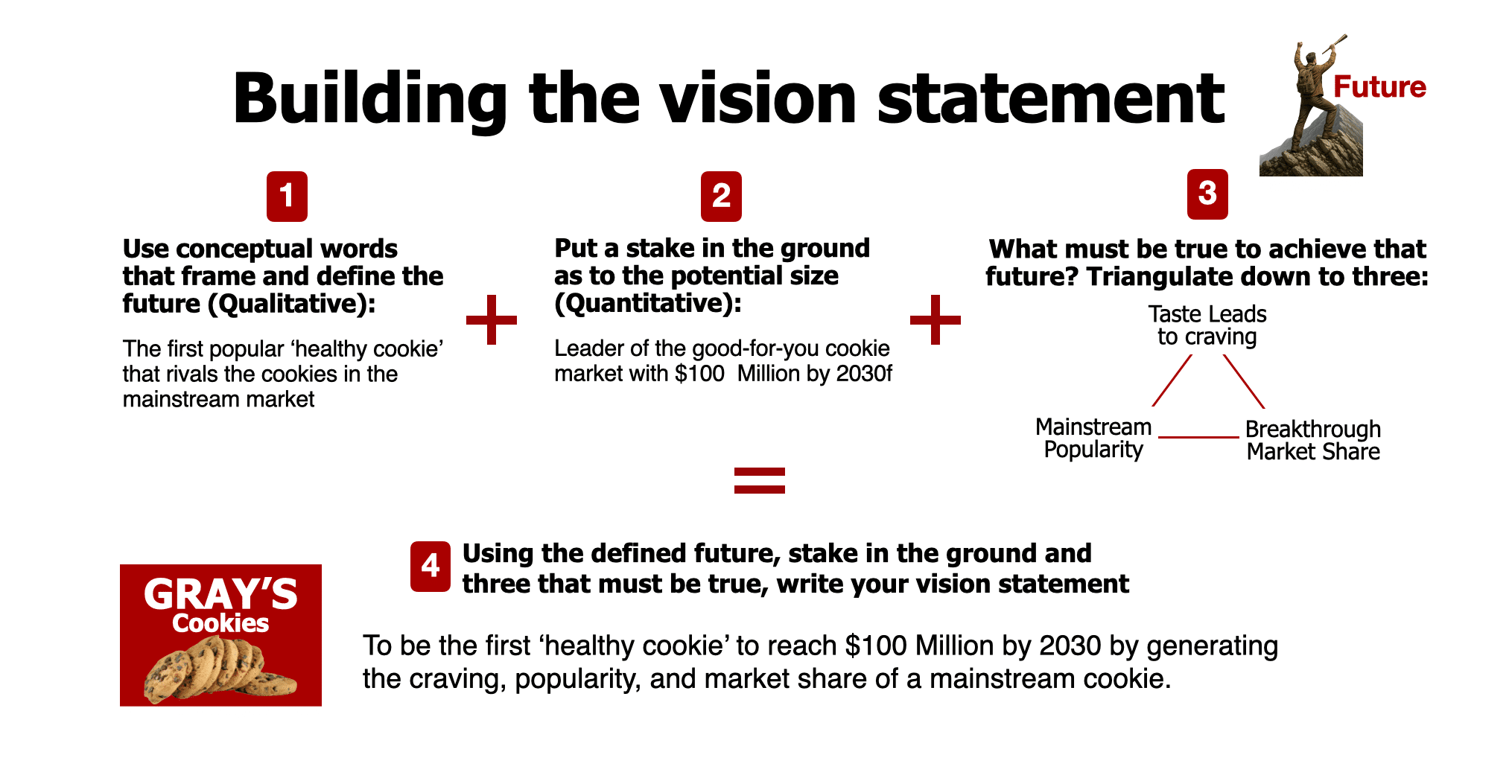
Weak vision statements are vague. “Be the leading brand in our category” tells no one anything. Strong vision statements combine a qualitative picture of the future state with a quantitative stake in the ground, and then back both up with the two or three conditions that must be true for the vision to be achievable.
Vision example: Gray’s Cookies
The qualitative future state: the first healthy cookie that rivals mainstream cookies in taste and popularity. The quantitative stake in the ground: $100 million by 2030. And the three must-be-true conditions that have to hold for that vision to be achievable: taste leads to craving, mainstream popularity, and breakthrough market share.
From those three conditions, every strategy follows. That’s what a real vision does – it doesn’t just describe where you want to go, it tells the team what has to be true to get there.
Vision statement template:
- “[Brand] will reach [quantitative target] by [year] by [qualitative future state], delivered through [must-be-true condition 1], [must-be-true condition 2], and [must-be-true condition 3].”
Make it aspirational enough to pull the team forward. Make it specific enough that leadership knows exactly what you’re committing to.
Set Goals That Tell You Exactly When You've Won
Your goals page is where leadership decides whether you actually understand the business or just understand how to fill in a template.
Most brand managers write goals that are wishes in disguise. “Increase awareness” is a direction. “Grow consideration” is a direction. A goal tells you exactly when you’ve won: what the number is today, what you want it to be, and by when.
Your goals need to cover three things.
- Consumer behavior. What will consumers do differently as a result of your plan? If you’re moving people from awareness to trial, name the shift and the number. “Increase purchase intent from 28% to 40% among our core target by Q3” tells leadership exactly what you’re betting on.
- Financial results. Revenue, share, margin – whatever your leadership tracks. If your strategies don’t connect to these, you don’t have strategies. You have activities.
- Milestones. Only include these when a launch, repositioning, or market entry is actually on the table. Three focused goals with teeth beat seven vague ones every time.
One tool worth building alongside your goals: a brand dashboard. Track both leading indicators – the consumer behaviors you’re driving – and lagging indicators – the business results that follow. If your leading indicators are moving and your lagging indicators aren’t, that’s your early warning. Far better to catch the disconnect in Q1 than explain it in Q4.
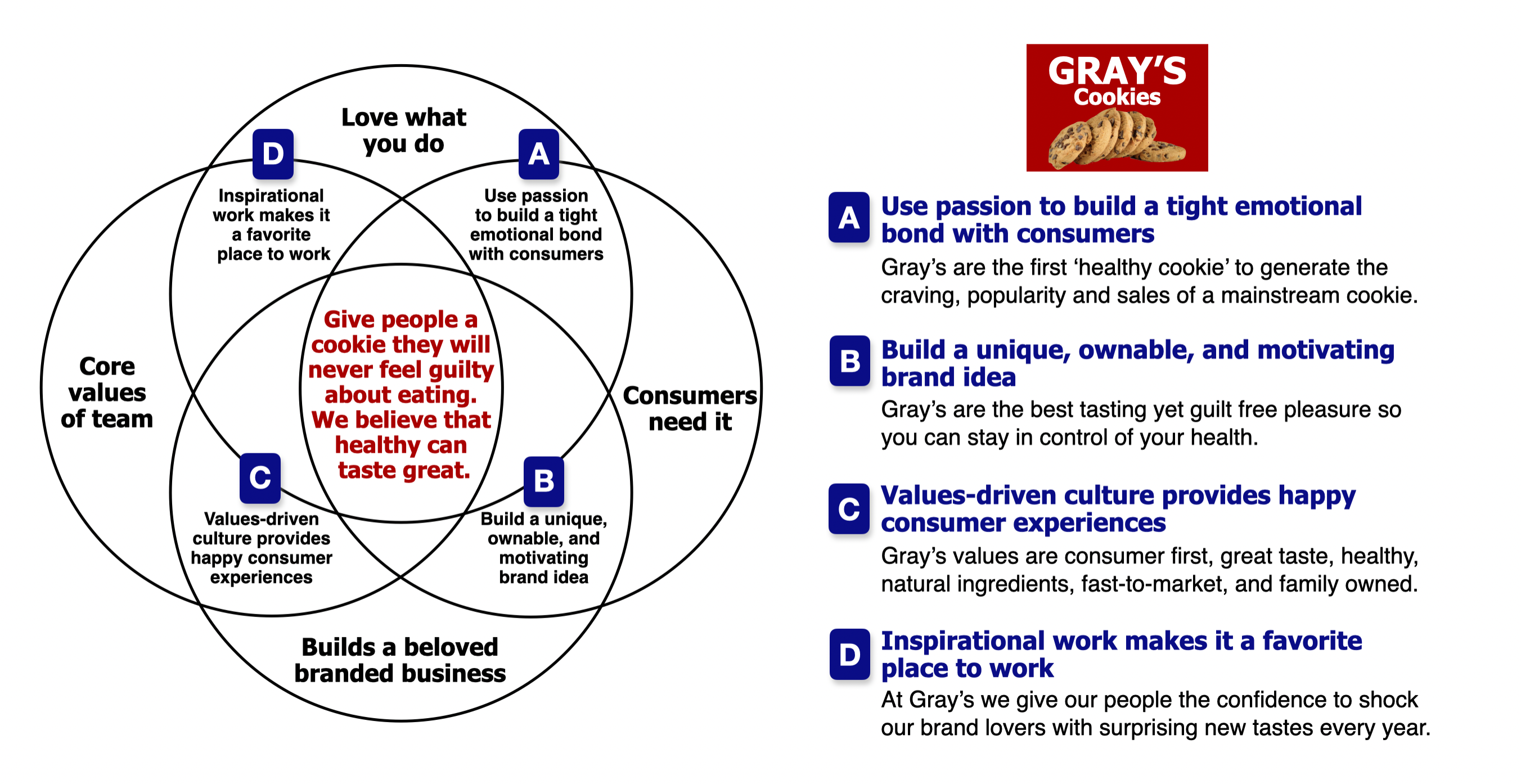
Define Your Purpose and Values
Purpose answers a harder question than vision: why does this brand exist beyond making money? For a branded house, purpose creates the emotional core that connects employees to the mission and gives consumers a reason to care beyond the product itself.
The brands that get this right – Patagonia, Dove, TOMS – don’t use purpose as marketing language. They use it to make decisions. When a choice is difficult, purpose is the filter. Values work the same way. They’re not aspirational adjectives for the website. They’re the behaviors your organization holds itself accountable to, even when they’re inconvenient.
Part 2: Analysis - Where You Stand and What's Blocking You
Conduct Your Situation Analysis
A situation analysis answers one question: where are you right now? Not where you were last year, not where you hope to be – where you actually stand in the market today.
This means an honest look at five areas: market dynamics, consumer behavior, competitive position, brand performance, and internal capability. Most situation analyses are too comfortable. Teams document the strengths in detail and skim the weaknesses. Leadership sees through it immediately.
The most valuable situation analyses are the ones that surface something the team didn’t fully want to say out loud. The category is shifting, and your distribution model isn’t built for it. Your core consumer is aging and there’s no acquisition plan. Your leading competitor just hired the agency that built your last great campaign.
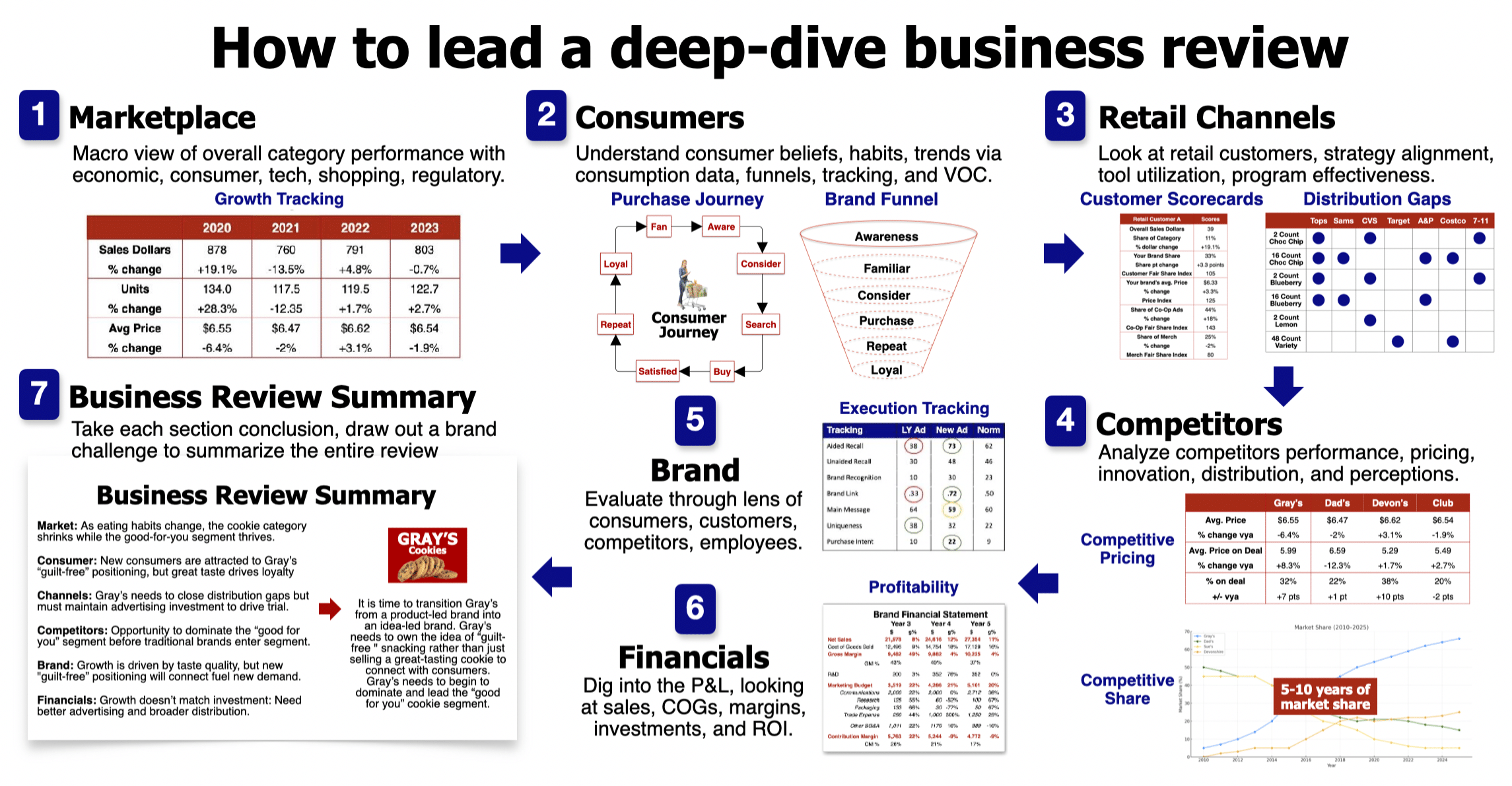
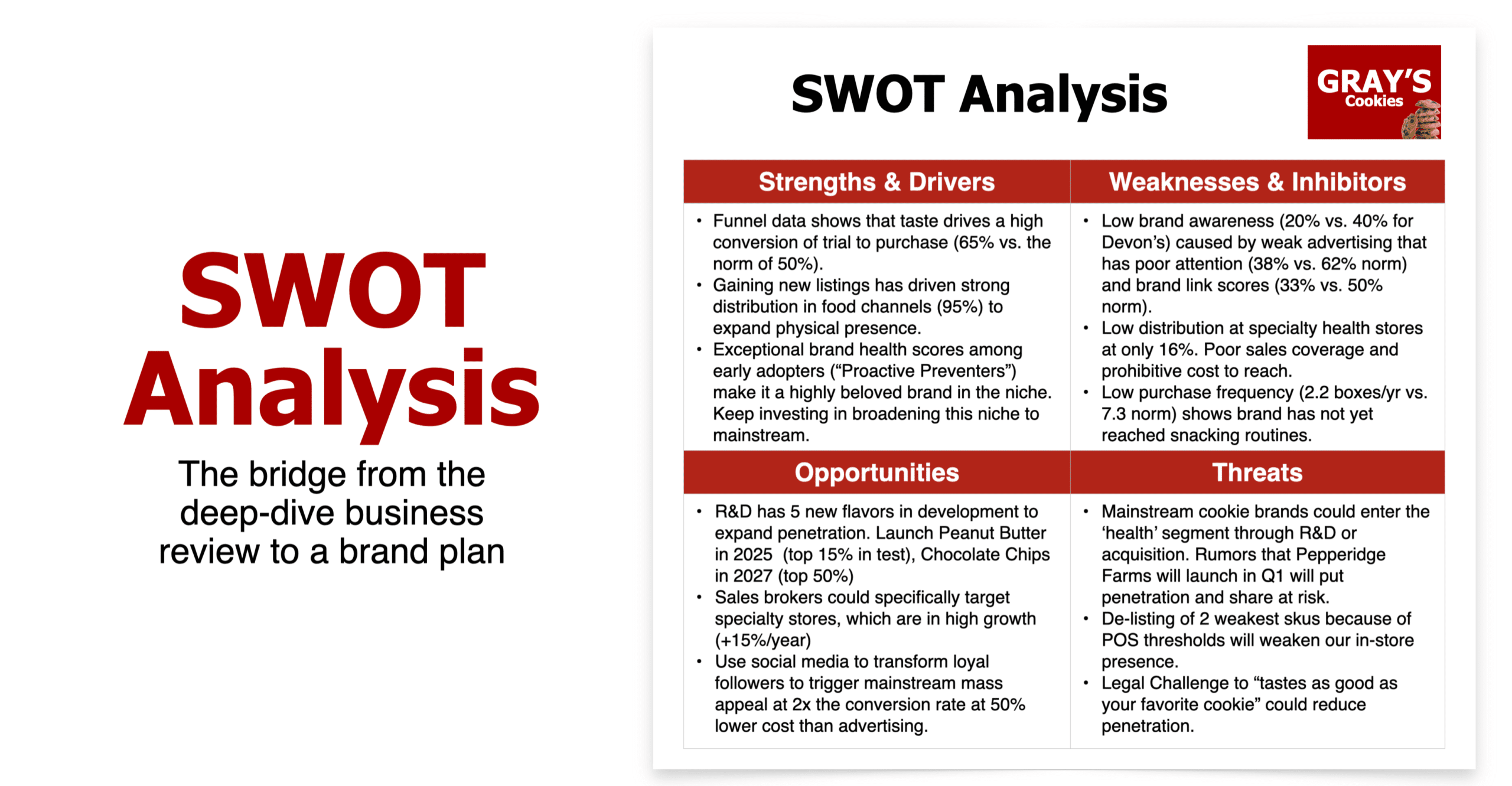
A SWOT is the right tool – but only if you’re honest about all four quadrants.
- Strengths: Where you genuinely have an advantage. What you do better than anyone else. What would be hard for a competitor to replicate?
- Weaknesses: Where you fall short. What competitors do better. Where your resources are thin.
- Opportunities: What trends are moving in your direction? Which consumer needs are unmet? Where competitors are exposed.
- Threats: What trends are working against you? Who’s coming after your position? What could change the rules?
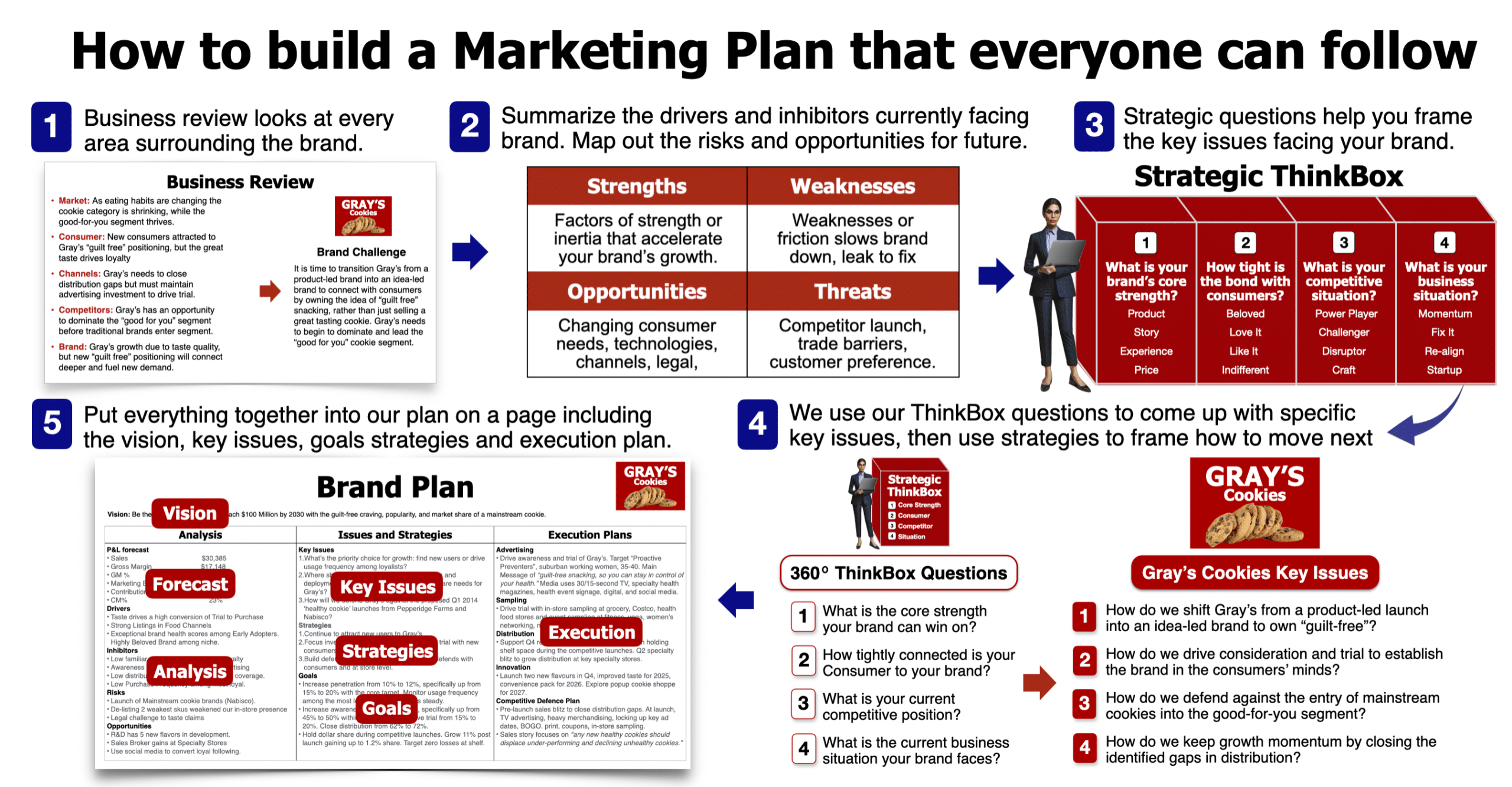
Identify Your Key Issues
Key issues are the strategic questions your plan must answer. They grow directly from your situation analysis, and your strategies must address each one. If you can’t draw a straight line from your analysis to your key issues to your strategies, the plan doesn’t hold together.
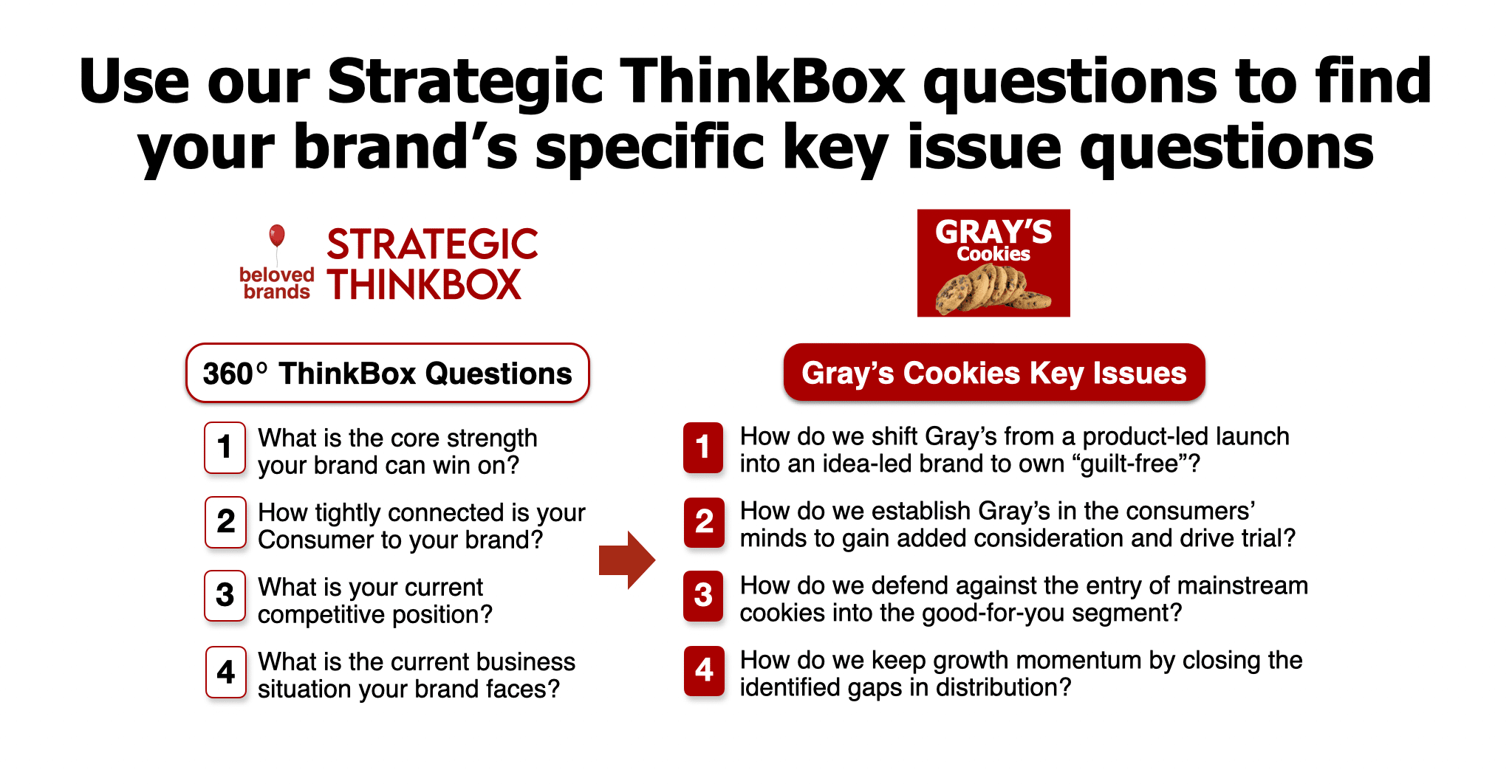
The right tool for surfacing key issues is the Strategic ThinkBox – four forced-choice questions that push you past the obvious.
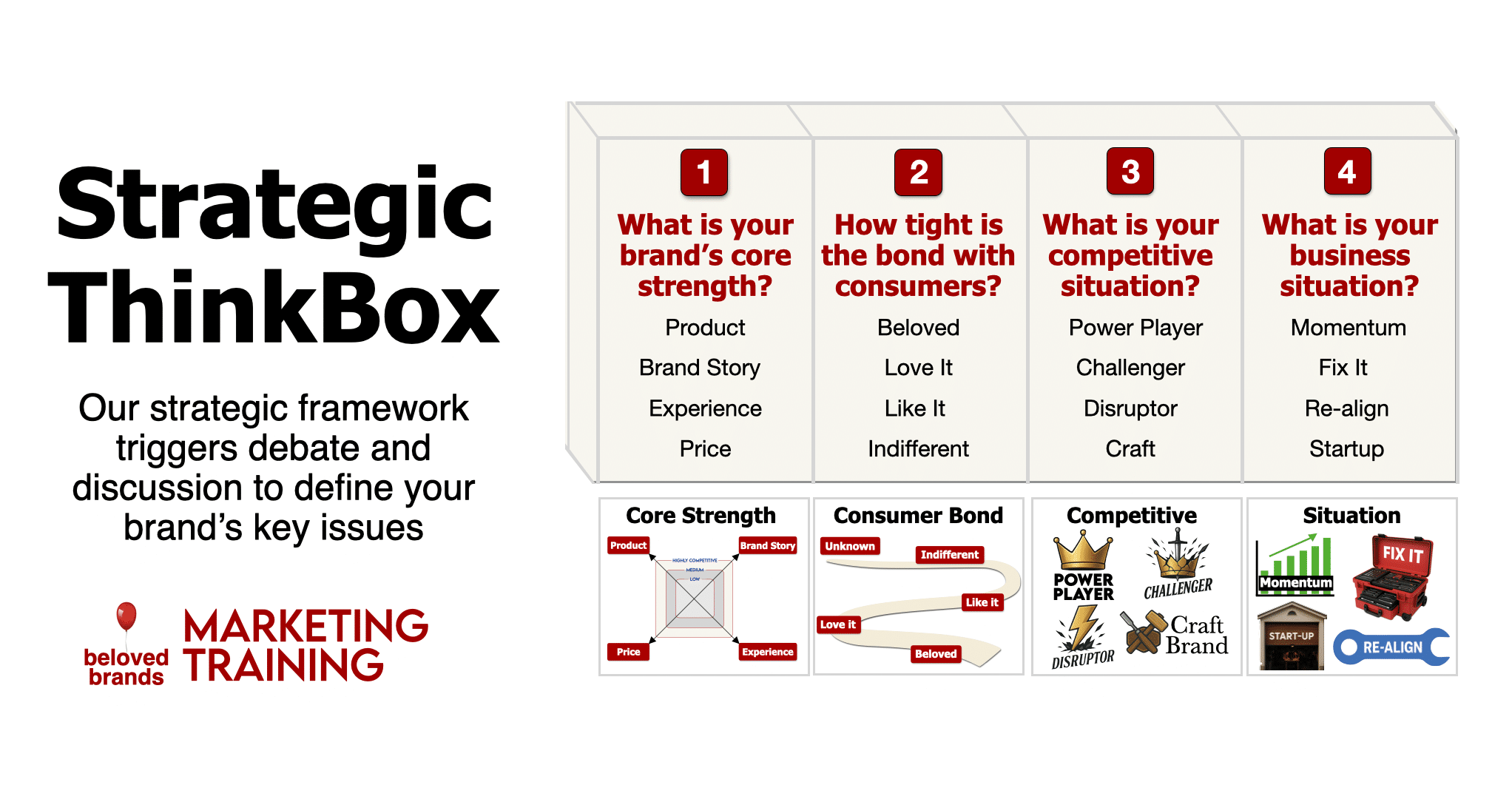
1. What is your brand’s core strength?
Product superiority, brand story, consumer experience, or price. Choose one. The answer determines where you invest most heavily and what you lead with in all communications.
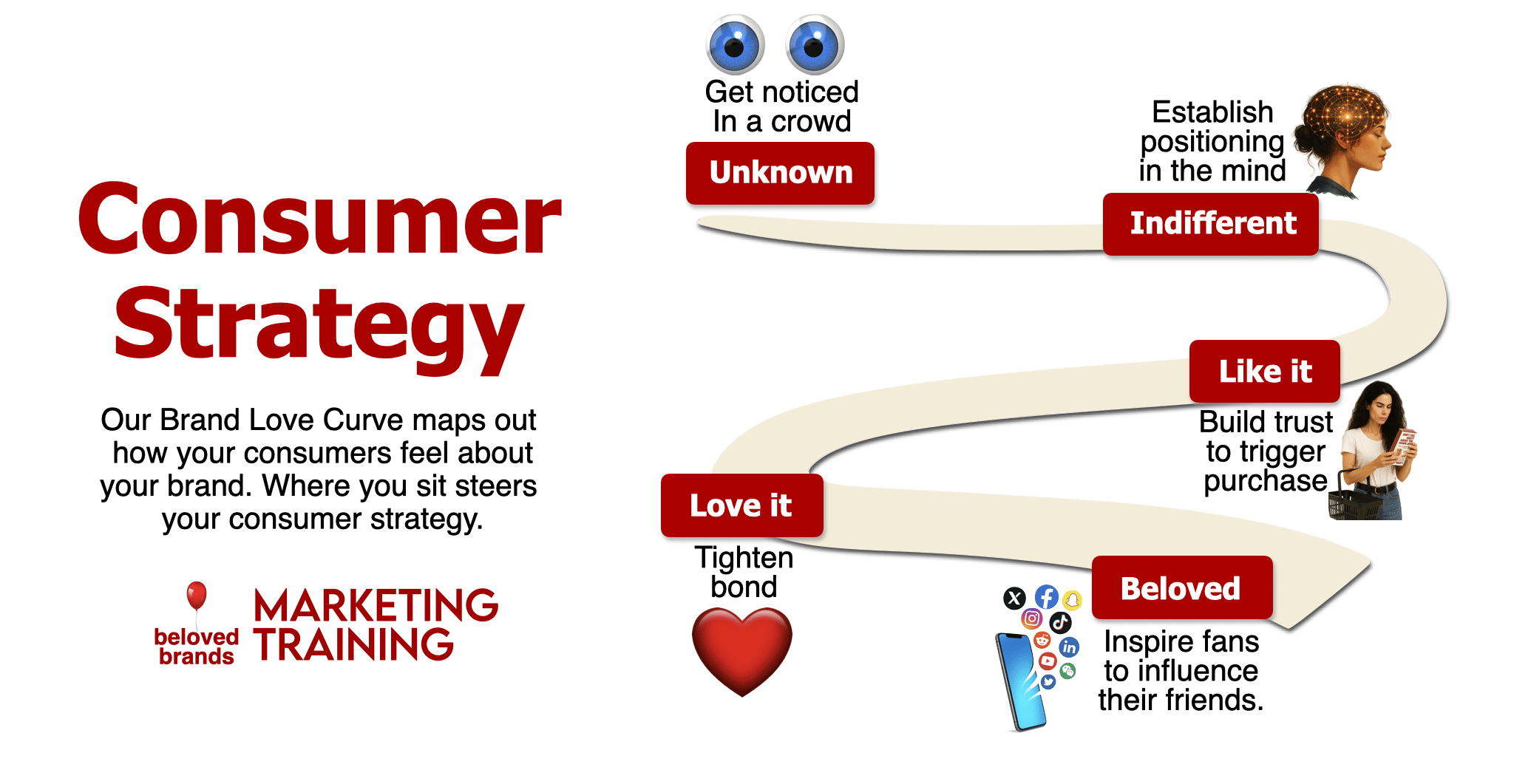
2. Where is your consumer on the brand love curve?
Unaware, Indifferent, Like It, Love It, or Beloved. Your goal is to move consumers up this curve. The stage they’re at right now determines which strategies have any chance of working.
3. What is your competitive position?
Power player defending share, challenger attacking the leader, disruptor pulling consumers away from the mainstream, or craft brand owning a focused niche. Each position demands different choices and different resource allocation.
4. What is your business situation?
Momentum – growing and accelerating. Turnaround – declining and needs a fundamental reset. Realignment – drifting and needs refocusing. Start-up – building from the ground up. Your situation dictates your leadership style and your tolerance for risk.
From those four answers, write three to five key issue questions. They’re framed as questions because your strategies are the answers.
Examples of well-written key issues:
- How do we drive trial among our target consumers before our key competitor closes the gap?
- How do we defend market share against an aggressive new entrant without triggering a price war we can’t afford?
- How do we reposition the brand to attract a younger consumer without losing touch with our core base?
Smart key issues are specific, strategic, and within your control. If your key issue could apply to any brand in any category, rewrite it.
Part 3: Strategy - Making the Choices That Focus the Plan
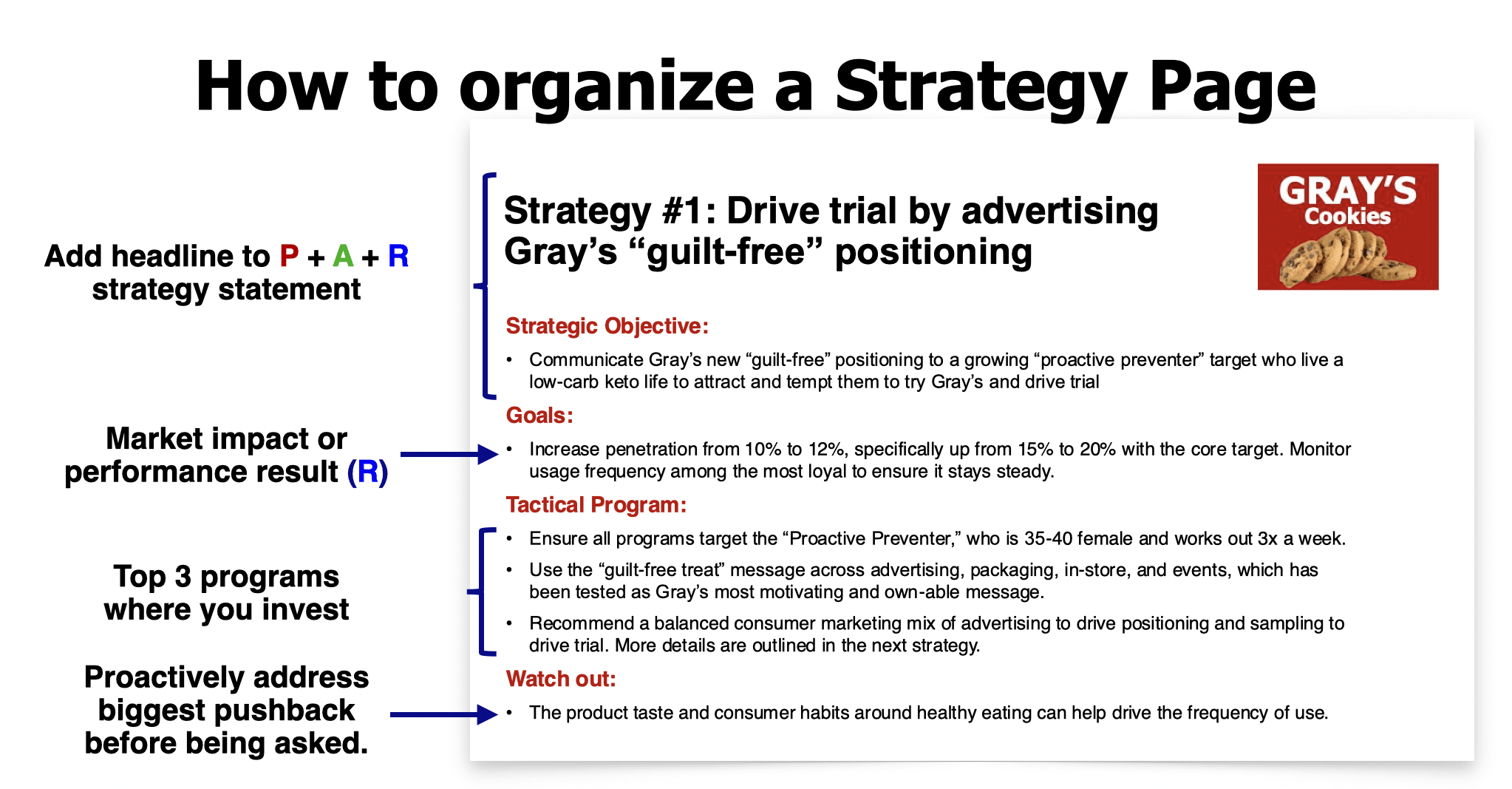
Write Strategy Statements That Make Real Choices
A strategy answers how you’ll overcome a key issue and achieve your goals. Not what you’ll do – that’s tactics. How you’ll win, where you’ll focus, and what result you’re driving.
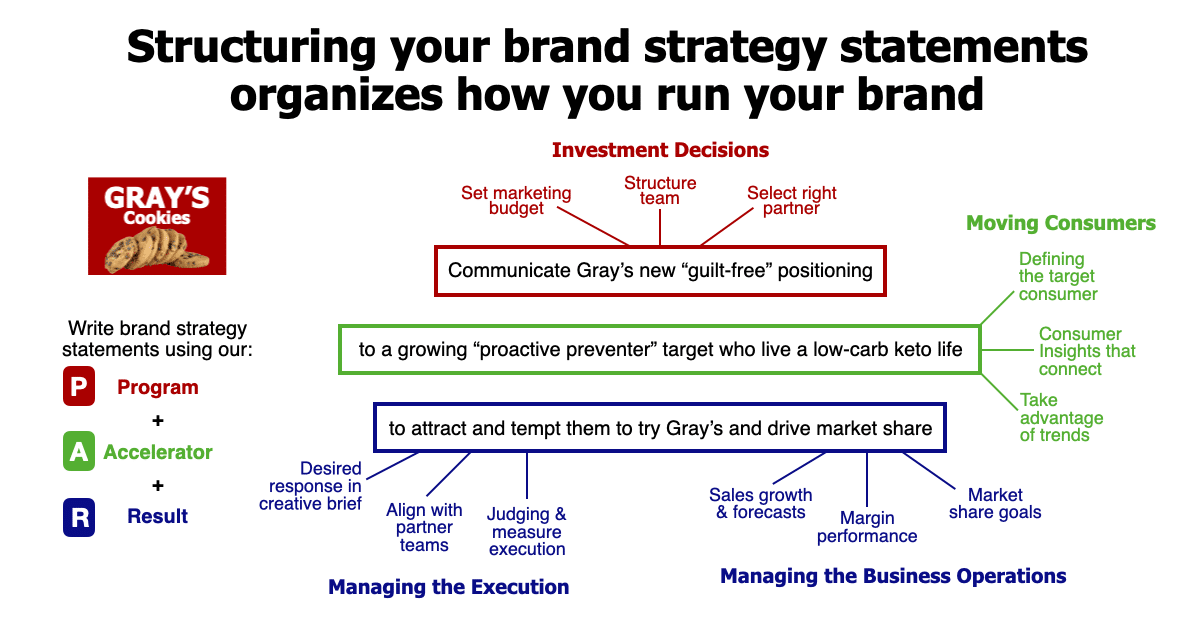
Strategy development comes down to three components: the program you’ll invest in, the accelerator that makes it work, and the result you’re driving toward.
Gray's Cookies strategy example:
- Program: Communicate Gray’s new “Guilt-Free” positioning.
- Accelerator: To a growing proactive preventer target living a low-carb keto lifestyle.
- Result: Attract and tempt them to try Gray’s and drive higher market share.
Full strategy statement:
- “Invest in communicating Gray’s new ‘Guilt-Free’ positioning to the growing proactive preventer target living a low-carb keto lifestyle, to attract and tempt them to try Gray’s and drive higher market share.”
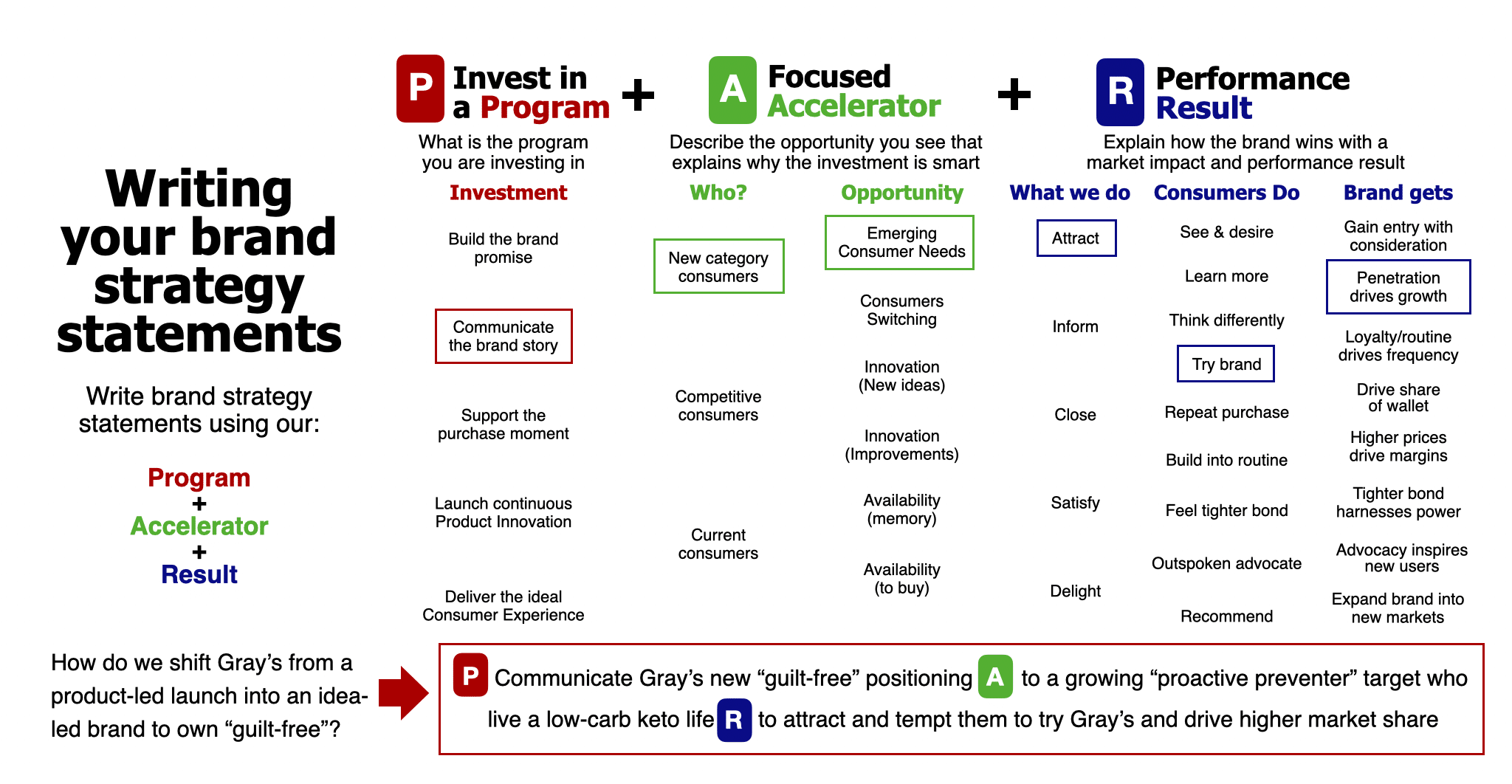
That strategy names an investment, a focused audience, a behavioral insight, and an expected outcome. It gives a creative team something to work with. It gives leadership something to evaluate. And it answers the key issue it was written to address.
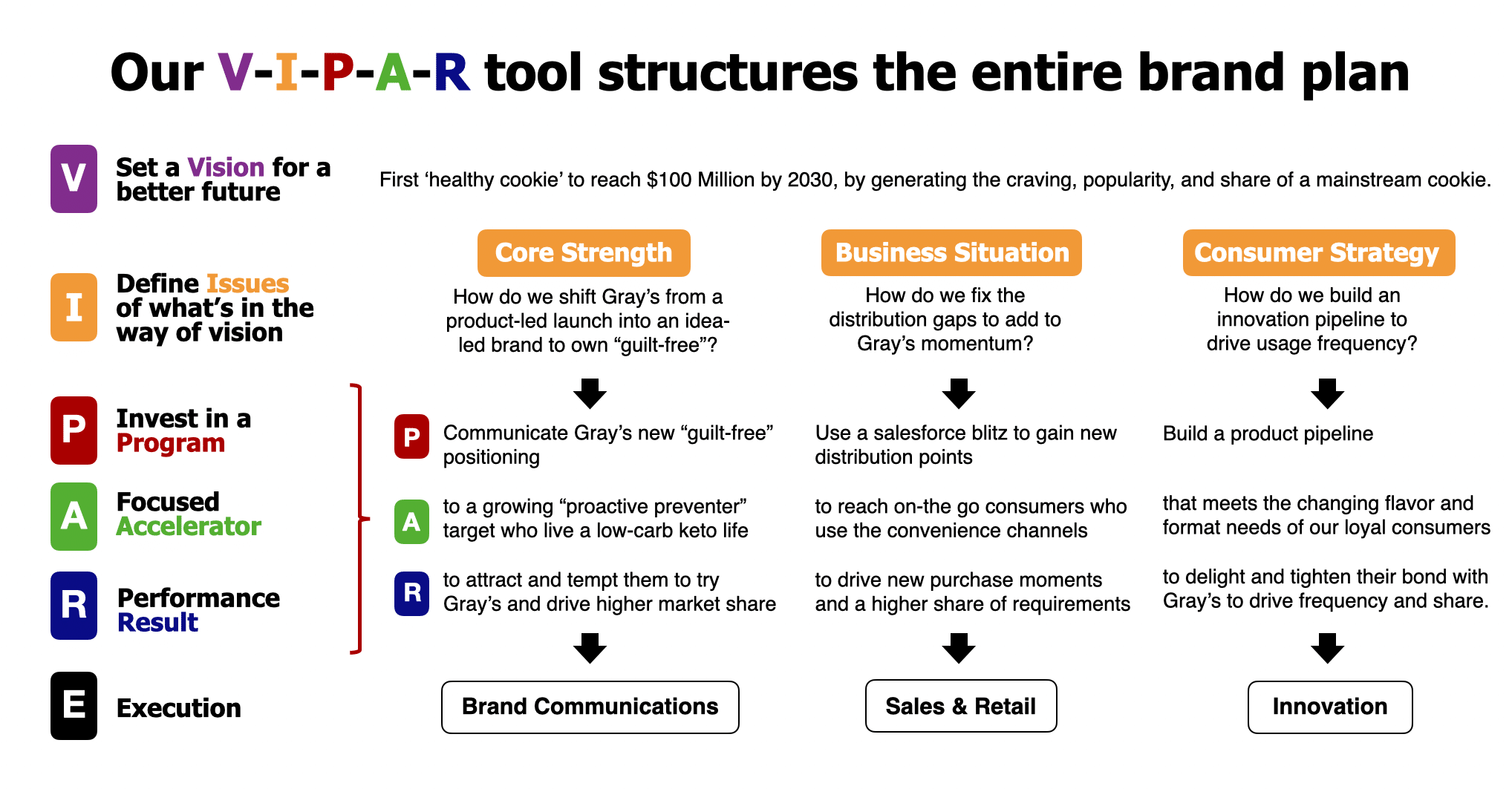
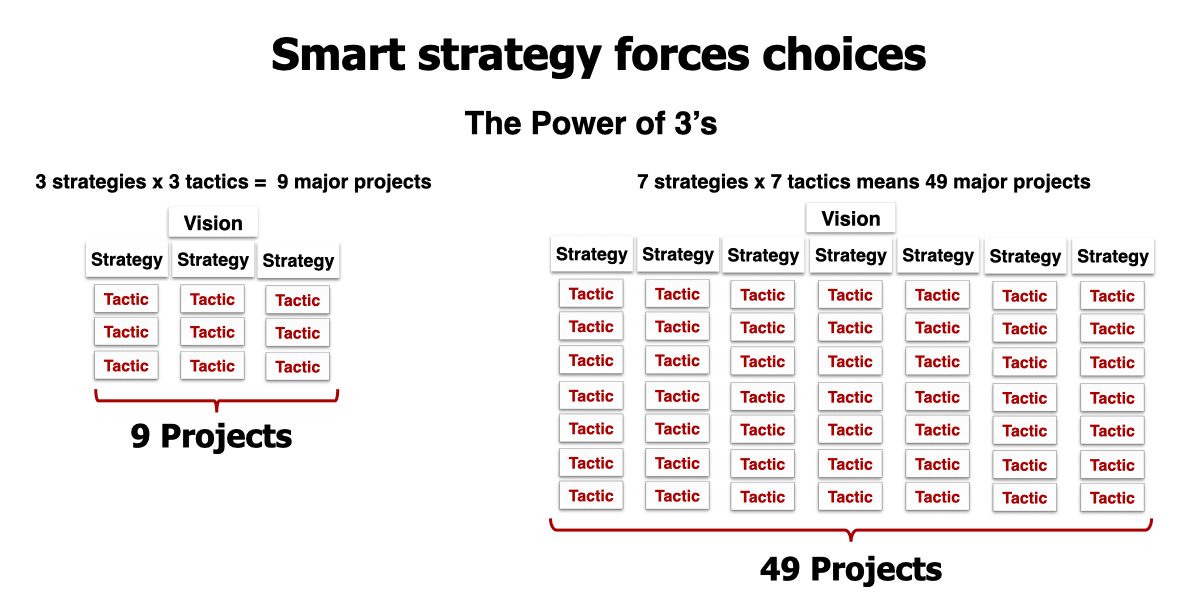
Limit yourself to three major strategies. Spreading a finite budget across six strategies means none of them get enough investment to move anything. The discipline isn’t in generating ideas – every team has plenty of those. It’s in deciding which ones you’ll actually fund.
Build Your Tactical Plans
Tactics are the specific programs that bring each strategy to life. For each strategy, your tactical plan should cover four areas.
- Communication. Campaign themes and messages, media mix, content calendar, budget by channel, and creative timeline. The brief drives the work. If the brief is vague, the work will be too.
- Innovation. New products, product improvements, line extensions, packaging. Every innovation initiative needs a clear consumer insight behind it and a realistic development timeline. The innovation graveyard is full of ideas that launched without either.
- Sales and Retail. Distribution targets, trade promotion calendar, sales enablement tools, in-store activation. If your retail partner doesn’t understand your strategy, your in-store execution will look like everyone else’s.
- Customer Experience. Journey mapping, touchpoint improvements, loyalty program development. Every touchpoint is a brand expression. The ones you ignore send a signal too.
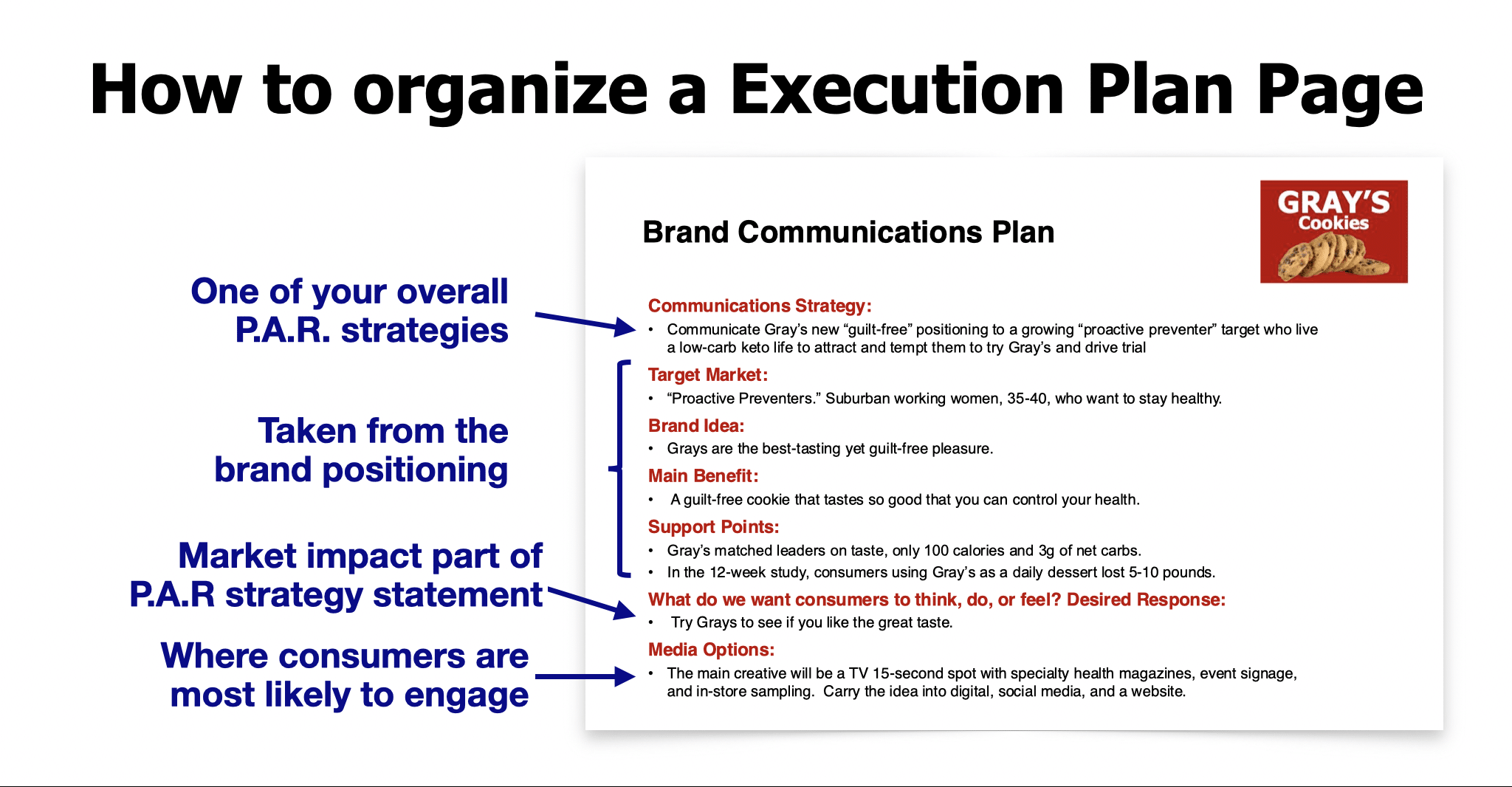
Each tactical area needs objectives, a target audience, key activities with owners, a timeline, a budget, and metrics. If any of those six are missing, the tactic isn’t ready to present.
Part 4: Execution - Turning Plans Into Programs
Execution plans translate your tactics into specific instructions that leave no room for misinterpretation. For each major investment area, you need a plan detailed enough that a new team member could pick it up and know exactly what to do.
- Communication execution. Campaign name and theme, key messages, duration and flight dates, creative brief summary, media plan by channel, reach and frequency targets, budget by medium, and a measurement plan with KPIs and reporting cadence.
- Innovation execution. Product name and description, target consumer and benefit, pricing and positioning, development timeline with stage gates, and launch plan.
- Sales and retail execution. Distribution strategy by channel and geography, promotional calendar, trade deal structure, sales materials, merchandising standards, and planogram requirements.
The execution plan is where most marketing plans fail in practice – not in the room, but in market. A strategy that leadership approves in February gets diluted by June because no one wrote down what it was supposed to look like. Execution plans prevent that.
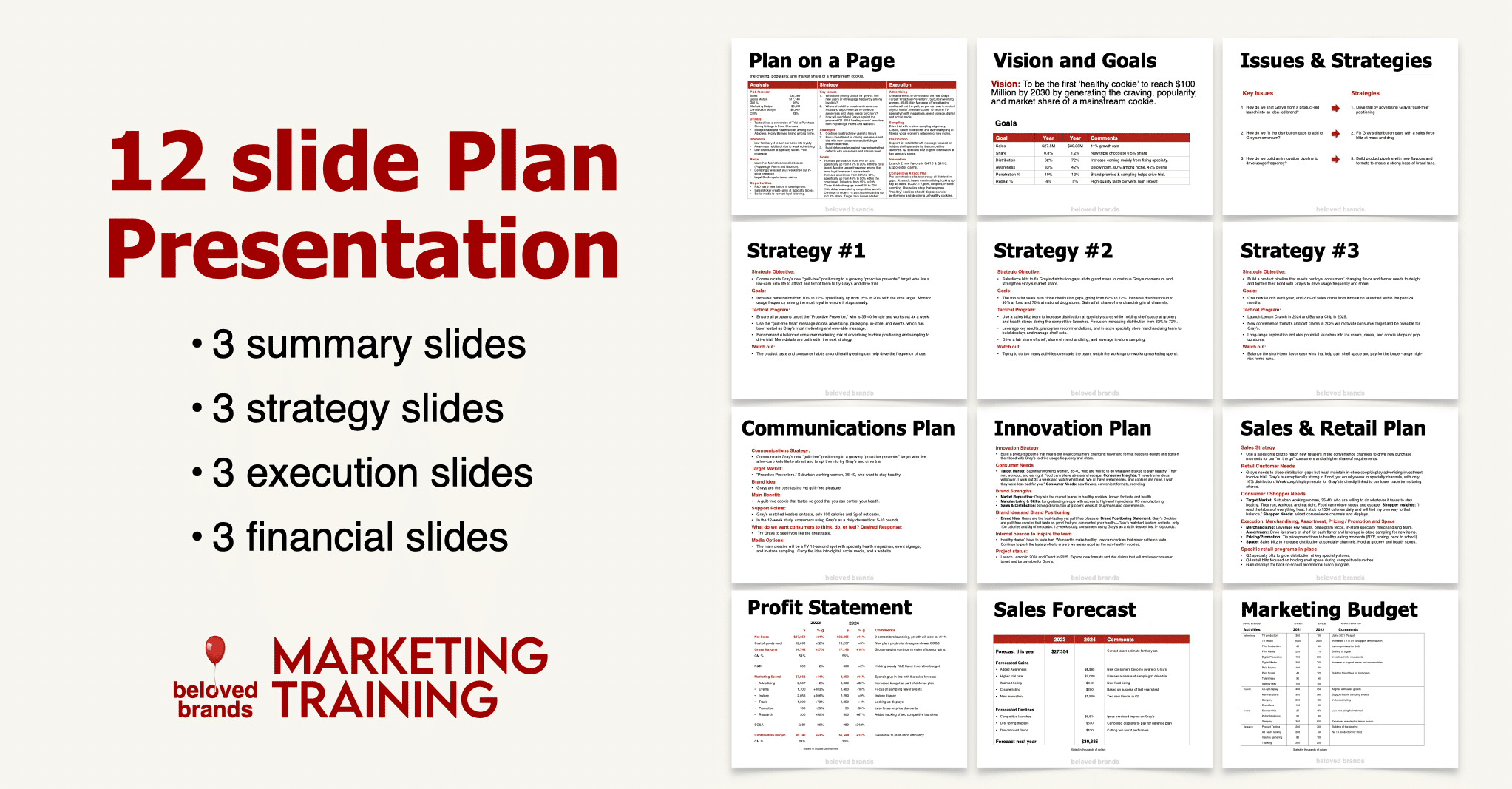
If you want a tighter format for the plan presentation itself, the 12-slide version covers the same logic chain – vision, goals, issues, strategies, execution, and financials – in a format leadership can absorb in one sitting.

The Mistakes That Kill Marketing Plans in the Room
The story doesn’t hold together.
Leadership can forgive a lot, but they can’t follow a plan that jumps from situation to strategy without explaining why. If your key issues don’t grow out of your analysis, and your strategies don’t answer your key issues, you don’t have a plan – you have a collection of slides.
You’re trying to do too much.
Six strategies, with a budget that couldn’t fund two of them properly, means none lands hard enough to move anything. Three strategies, fully funded and tightly executed, will always outperform six.
The goals have no teeth.
“Grow awareness” is not a goal. If you can’t tell me what the number is today, what you want it to be, and by when, you haven’t set a goal. You’ve written a wish. Leadership has seen a thousand versions of this.
You built the plan alone.
If sales, operations, or finance are hearing your plan for the first time in the approval meeting, you’re already in trouble. The purpose of socializing a draft isn’t courtesy – it’s intelligence gathering. Get those inputs before you’re locked in.
You copied last year’s plan.
Changed the dates, adjusted the revenue target, and kept everything else. Leadership has seen it before. A plan that doesn’t reflect a fresh read of the market – new competitive moves, shifting consumer behavior, honest assessment of what worked – isn’t a plan. It’s proof you went through the motions.
Get smarter about marketing
To build your marketing skills, click on any of the stories below
Frequently Asked Questions About Marketing Plans
How long should a marketing plan be?
The version your leadership sees should be 20 to 25 slides. If you can’t make your case in that space, you haven’t figured out what you’re actually saying yet. Put the supporting analysis in the appendix. Leadership will ask for it if they want it. If you need a tighter format, the 12-slide plan template above covers the full logic chain in a single focused presentation.
What’s the difference between a strategy and a tactic?
A strategy names where you’ll focus and why. A tactic names what you’ll do. “Build awareness among health-conscious consumers through digital” is not a strategy – it’s a tactic wearing a strategy’s clothes. A real strategy names the market condition you’re responding to, the consumer behavior you want to shift, and what that means for where you invest. If your strategy could have been written without knowing anything about your specific brand, it isn’t a strategy.
How do you know if your marketing plan is ready to present?
Run it through this test: can you draw a straight line from your situation analysis to your key issues, from your key issues to your strategies, and from your strategies to your tactics? If any link in that chain breaks, the plan isn’t ready. If it holds all the way through, you’re ready for the room.
About the Author
Graham Robertson is the founder of Beloved Brands and a former VP of Marketing at Johnson & Johnson, with experience at Coca-Cola and General Mills. His marketing training programs and consulting work span consumer, B2B, healthcare, and retail brands across 30+ countries.
Contact: graham@beloved-brands.com | 416-885-3911
Related Articles:
Last Updated: May 29, 2026
Reading Time: 18 minutes