The brand manager role is where a marketing career either takes off or stalls. I watched it happen hundreds of times over 20 years at Johnson & Johnson, General Mills, and Coca-Cola. The ones who got promoted to marketing director in three years and the ones who stayed brand managers for six had largely the same starting point. What separated them was how quickly they figured out what the job actually required.
Most new brand managers arrive thinking the role is a bigger version of what they did as an assistant brand manager. More responsibility, more scope, maybe a direct report. The reality is that the brand manager role is fundamentally different. The ABM role was about doing. The brand manager role is about owning. Nobody hands you a project list. Nobody tells you what the strategy should be. The brand is yours and the results are yours.
This post covers the five skills that determine whether a brand manager gets promoted or gets stuck.
Where the brand manager role sits in the career path
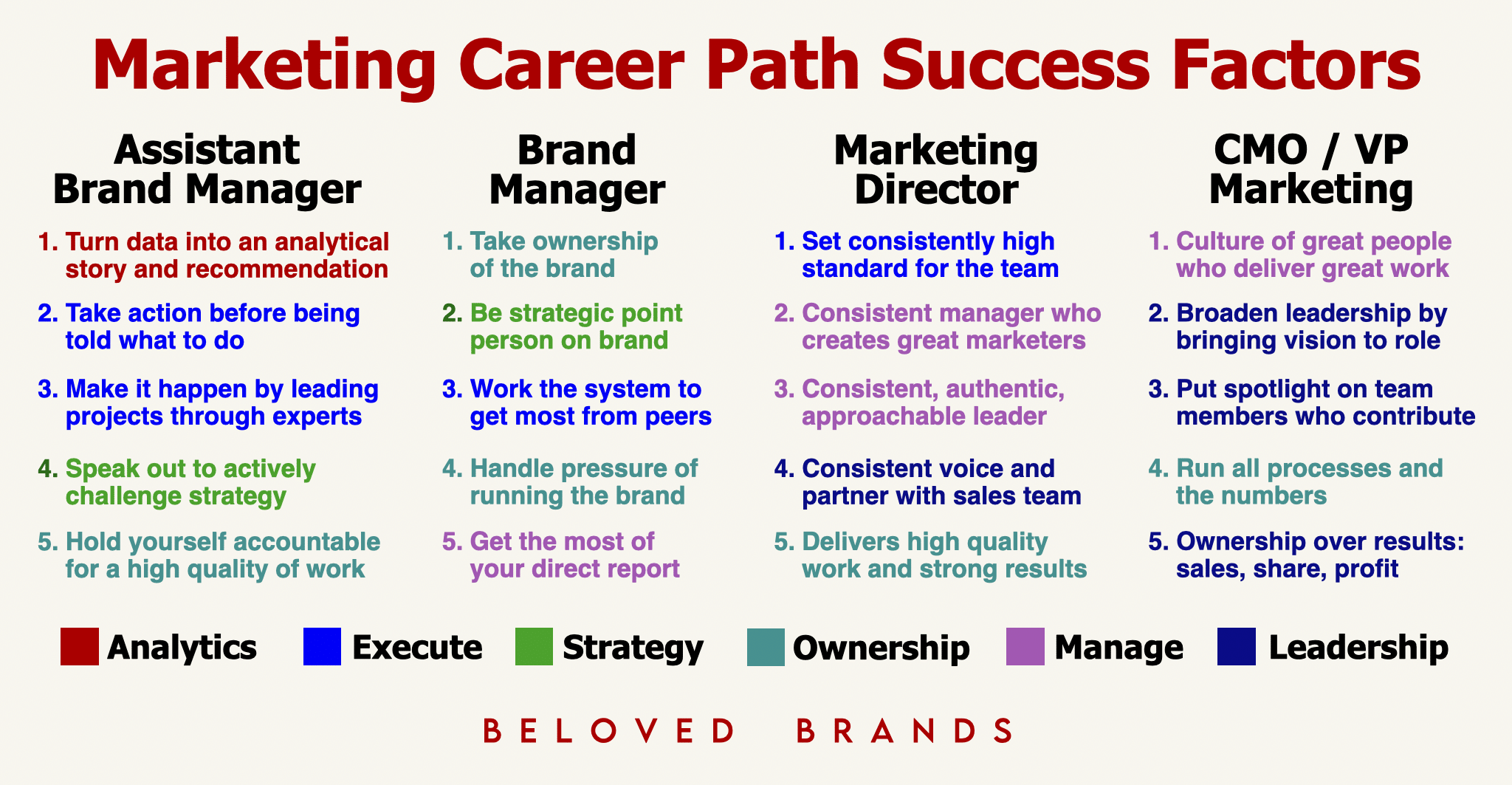
The brand management career path has four levels and each one requires a genuinely different set of skills.
The assistant brand manager role is about executing, analyzing, and signaling that you have the capability for what comes next. You deliver on what’s assigned, you own the data, and you prove you’re reliable.
The brand manager role is the pivot point. It’s where ownership and strategic thinking become the primary job. You write the brand plan, make the key decisions, and manage at least one direct report. Most brand managers are genuinely difficult to work for with their first report and get better around their fourth or fifth. That’s normal and expected.
The marketing director role shifts again. The job becomes about developing people and managing a team rather than doing the work yourself. The marketing directors who keep doing the brand manager’s job themselves tend to hold their teams back rather than elevate them.
At the VP or CMO level, you create organizational vision, invest in people, drive business results, and build the systems that let great marketing happen at scale.
The brand manager who understands where the role sits in that progression, and what comes next, moves through it faster than the one who’s just trying to be good at the current job.

The 5 skills that get a brand manager promoted
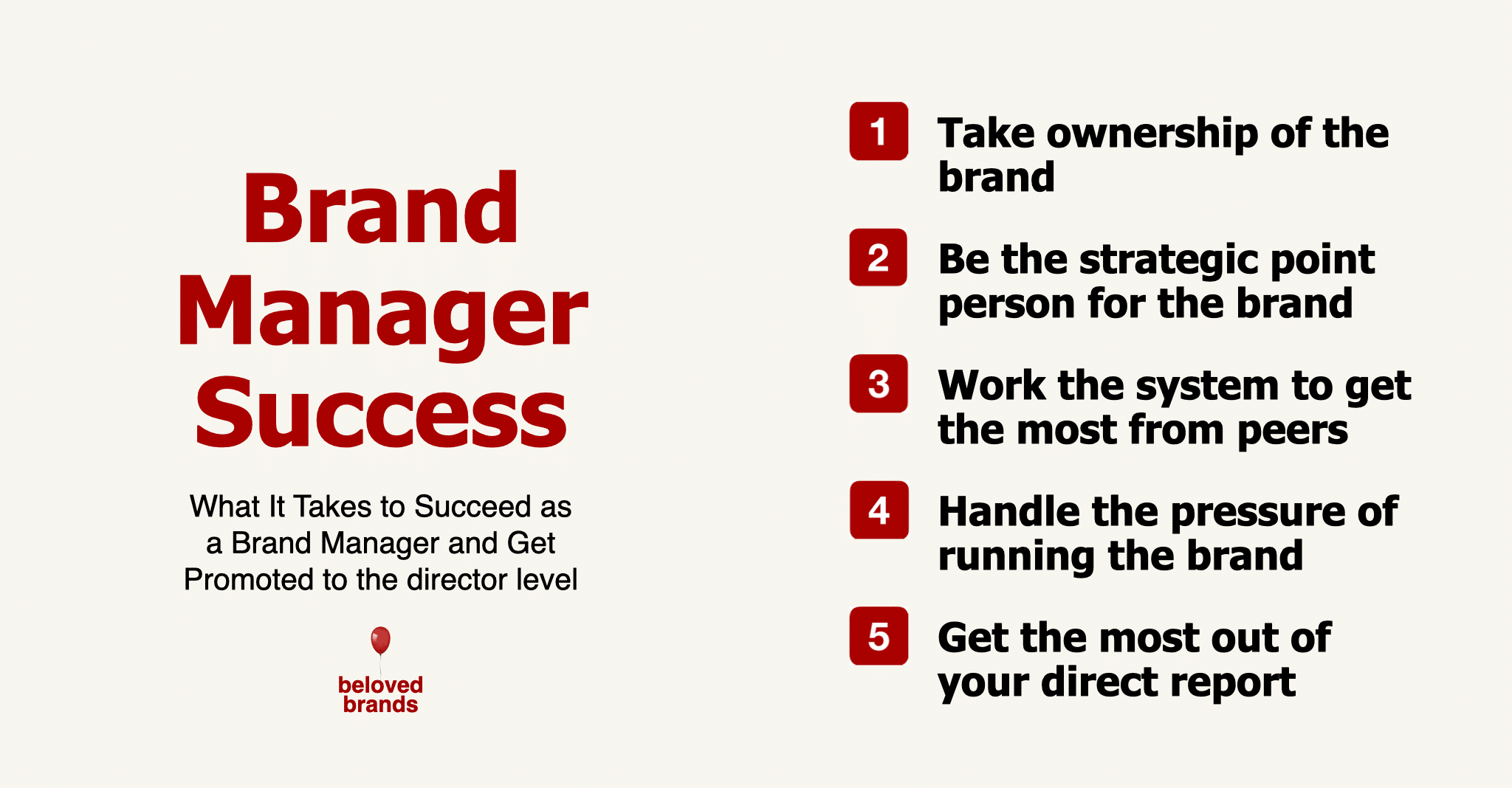
1. Take ownership of the brand
The transition from assistant brand manager to brand manager is fundamentally a transition from helper to owner. It’s the single biggest shift in the career path and the one most new brand managers struggle with.
Ownership means nobody is setting your agenda. You generate the project list, you develop the strategies behind it, and you own the outcome regardless of what happens. When results come in below plan, ownership means you already know why before anyone asks you and you already have a view on what to do about it.
Balance an asking voice with a telling voice in the right situations. Before major decisions, ask your functional experts — the research team, the agency, the sales team — as many questions as you need to understand what they know. Once you’ve formed a direction, they want you to decide. They want to be heard and have their expertise recognized, but they know their role is to recommend while yours is to decide. Own the decision.
When managing upwards, resist the temptation to ask your boss what you should do. A good boss wants you to come in and tell them what you want to do, and then debate it from there. Asking for the answer signals you’re not ready for the next level. Presenting your thinking and defending it signals you are.
2. Be the strategic point person for the brand
The brand manager role is where strategic thinking becomes a daily requirement rather than an occasional exercise. You need a clear vision for where the brand is going, a set of strategies that address what’s standing in the way, and the ability to hold the line on that direction when the organization pulls toward distraction.
The vision is the stake in the ground. It tells everyone who works on or with the brand where you’re taking it. The key issues identify what’s between the brand and that vision. The strategies map the path. And every tactic and execution needs to connect back to one of those strategies. If a program doesn’t connect, it doesn’t run.
At the brand manager level, you become the steward of the strategy across every function and agency that touches the brand. Sales, finance, R&D, operations, and your agency partners all have their own agendas and motivations. Your job is to make sure all of them are pulling in the same direction. That requires a strategy that’s clear enough for everyone to understand and compelling enough for everyone to want to follow.

3. Work the system to get the most from peers
Every organization looks like a collective mess to a new brand manager. Functional groups with competing priorities, layers of approvals, agency partners with their own interests, and internal politics that nobody warned you about. The brand managers who get promoted fast figure out how to work through all of it to get what they need.
Getting to know your experts is the foundation. Understand what each person cares about, what pressures they’re under, and what motivates them to do their best work. Build those relationships before you need them, because when a deadline is tight and you need someone to drop everything for your project, the relationship you built three months ago is what determines whether they do.
One piece of advice that took me years to fully appreciate: if you want someone’s best work, ask for it explicitly. Tell them this project matters, that you’re counting on them, and that you need their best thinking rather than the standard output. Very few people ask. When you do, it connects with something in them that drives a better result.
4. Handle the pressure of running the brand
The brand manager role comes with a specific kind of pressure that the ABM role doesn’t prepare you for. You own the P&L. When results miss, the question lands on your desk. If a key product underperforms, it’s your problem to solve. When a competitor launches and takes share, your response is what gets evaluated.
The ambiguity of not knowing exactly what the right answer is, combined with the time pressure of needing to decide quickly, is the defining challenge of the brand manager role. The ones who thrive learn to hold both simultaneously — enough patience to gather information and think clearly, enough urgency to make a call and move.
When results aren’t coming in, the temptation is to keep pushing the same programs harder. That’s usually the wrong move. Force a proper diagnosis first. Go back to the data, challenge the assumptions, and bring the team together to look at what’s actually happening before committing to a course correction. Repeating a program that isn’t working is expensive and it signals to senior leaders that you’re not reading the situation clearly.
Pressure also shows up in relationships. There are moments when you have to push back on a VP who wants to change the strategy mid-execution, hold an agency to a standard they’re not meeting, or deliver difficult news to a retailer about a program result. How you handle those moments matters. Stay direct, stay respectful, and stay focused on what the brand needs rather than on avoiding the uncomfortable conversation.
Brand Management Mini MBA
Invest in your brand management career. If you are an ambitious marketer, looking to solidify your marketing skills, our Brand Management Mini MBA will teach you about strategic thinking, brand positioning, brand plans, advertising decisions, and marketing analytics.
Have a look at our brochure on our Mini MBA program
Use > to move through the brochure or x to see the full screen.
You get 36 training videos, key chapters from our Beloved Brands Playbook, and a Brand Management Workbook with exercises to try in real-time. Earn a certificate you can use on your resume or LinkedIn profile. It will certainly help you in your brand management career.

5. Get the most out of your direct reports
Most brand managers get their first direct report before they’re ready for it. That’s not a criticism — it’s just the reality of how the career path works. The first one is hard. By the fourth or fifth, most brand managers have figured out what it actually means to develop someone rather than just assign them tasks.
The biggest mistake new brand managers make with their first direct report is doing the work for them. An ABM who brings a draft analysis gets the analysis rewritten by the brand manager rather than coached toward doing it better themselves. The short-term output looks fine. The ABM doesn’t learn. And the brand manager has just added their ABM’s workload to their own.
Managing well means asking better questions rather than giving better answers. It means being clear on the standard you expect and giving feedback when the work doesn’t meet it — specific, direct feedback, not vague encouragement that leaves the ABM guessing what to change. It means understanding what each person on your team is working toward in their career and actively helping them get there.
The brand managers who become great people managers tend to be the ones who had good people managers themselves and who paid attention to what made the relationship work.
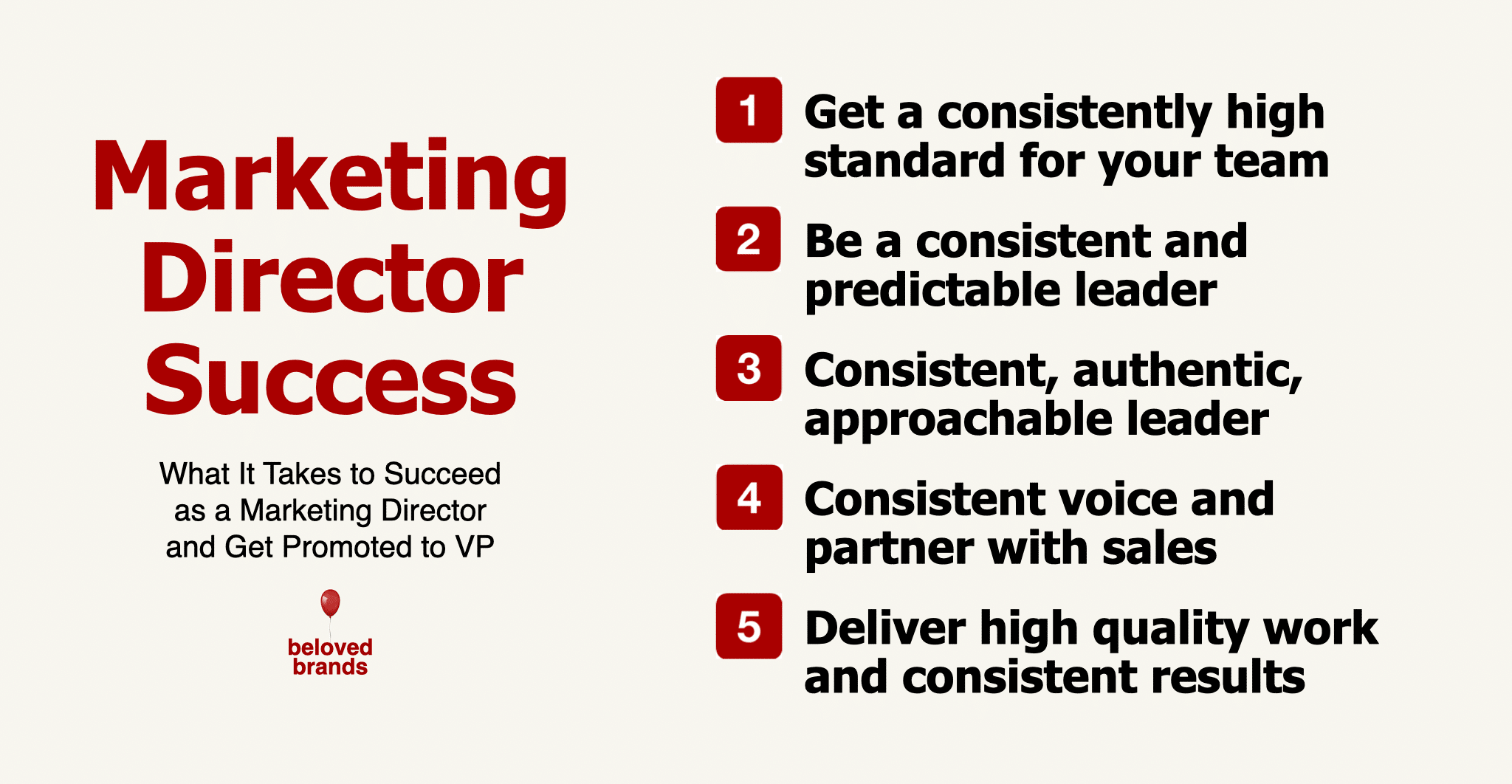
What separates the brand managers who get promoted from the ones who don't
After watching hundreds of brand managers move through the career path, the pattern is consistent. The ones who get promoted to marketing director quickly do five things simultaneously and sustain them over time. The ones who stall are usually strong on two or three of the five and have a visible gap in one or two others.
The most common gap is strategic direction. Strong executional brand managers who can deliver programs, manage relationships, and hit their numbers sometimes never develop a real point of view on where the brand should go. They’re excellent operators of the current strategy but they don’t generate strategic thinking of their own. At the marketing director level, that gap becomes disqualifying.
The second most common gap is managing others. Brand managers who are exceptional individual contributors sometimes struggle deeply when the job becomes about developing other people rather than doing the work themselves. They hire capable people and then can’t let go of the work enough to let those people grow.
The promotion to marketing director requires demonstrating capability in all five areas. Senior leaders promote the brand managers they can see running a larger team with more brands, more budget, and more organizational complexity. That picture has to be visible before the promotion happens, not after.
Frequently Asked Questions About the Brand Manager Role
What does a brand manager do?
A brand manager owns the full strategic and executional direction of a brand. They write the annual brand plan, manage the P&L, direct agency partners, develop the brand strategy, make key decisions across product, pricing, communication, and distribution, and manage at least one direct report. The role requires strategic thinking, analytical capability, cross-functional leadership, and the ability to deliver results under pressure.
What skills does a brand manager need to get promoted?
The five skills that determine whether a brand manager gets promoted to marketing director are ownership, strategic direction, working the organizational system, delivering results under pressure, and managing others effectively. Of these, strategic direction and people management tend to be the biggest differentiators at the marketing director promotion decision.
How long does it take to get promoted from brand manager to marketing director?
Most brand managers move to marketing director in three to five years. The ones who move in three years typically demonstrate strong strategic thinking early, build a track record of delivering results across multiple brands or situations, and develop people effectively. The ones who take longer often have a visible gap in one of the five core skills.
What is the difference between a brand manager and a marketing director?
The brand manager role is about ownership and strategic thinking on a specific brand or set of brands. The marketing director role is about leading a team of brand managers and developing their capability. Brand managers do the strategic work. Marketing directors develop the people who do the strategic work. The transition requires a genuine shift in how you spend your time and where you add value.
How do you manage up effectively as a brand manager?
Managing up well means coming to your boss with your thinking already formed rather than asking for direction. Present your strategic recommendation, explain your reasoning, and invite the debate. Senior leaders promote brand managers who demonstrate they can think independently and hold a point of view under challenge. They don’t promote brand managers who consistently ask what they should do.
What is the hardest part of the brand manager role?
Most brand managers cite managing their first direct report and delivering results when the brand is underperforming as the two hardest challenges. Managing a direct report for the first time requires a mindset shift that most people underestimate — from doing excellent work yourself to developing someone else’s capability. Delivering results when things aren’t going to plan requires a combination of diagnostic thinking, course correction, and organizational leadership that tests every skill at once.
How important is the P&L at the brand manager level?
Owning the P&L is one of the most important aspects of the brand manager role and one of the most underdeveloped skills in many brand managers. Understanding how marketing investment flows through to gross margin and contribution margin, how to build an investment scenario with expected returns, and how to read a monthly P&L and identify what’s driving the numbers are all critical capabilities. Brand managers who can connect their strategic decisions to financial outcomes are significantly more promotable than those who think about marketing investment in isolation from the business results.
What makes a brand manager ready for the marketing director role?
Senior leaders promote brand managers to marketing director when they can see them doing the next job already. That means demonstrating strategic thinking that goes beyond the current brand, developing their direct reports well enough that those people are visibly growing, managing cross-functional relationships with real influence rather than just coordination, and delivering results consistently across different business situations. The promotion conversation usually starts when those things are already visible, not when someone asks for it.