Your brand claims bring your reasons to believe to life, with creativity that backs up your main consumer benefit. Brands have four choices: be better, different, cheaper, or else not around for long.
If you do not define your brand, then you run the risk of the possibility that your competitors will define your brand. And you might not like it.
Four elements make up a brand positioning statement, including who you serve, where you play, where will you win, and why consumers should believe you. These are the consumer target, marketplace definition, the consumer benefit, and support points. Brand claims fit in with the support points.
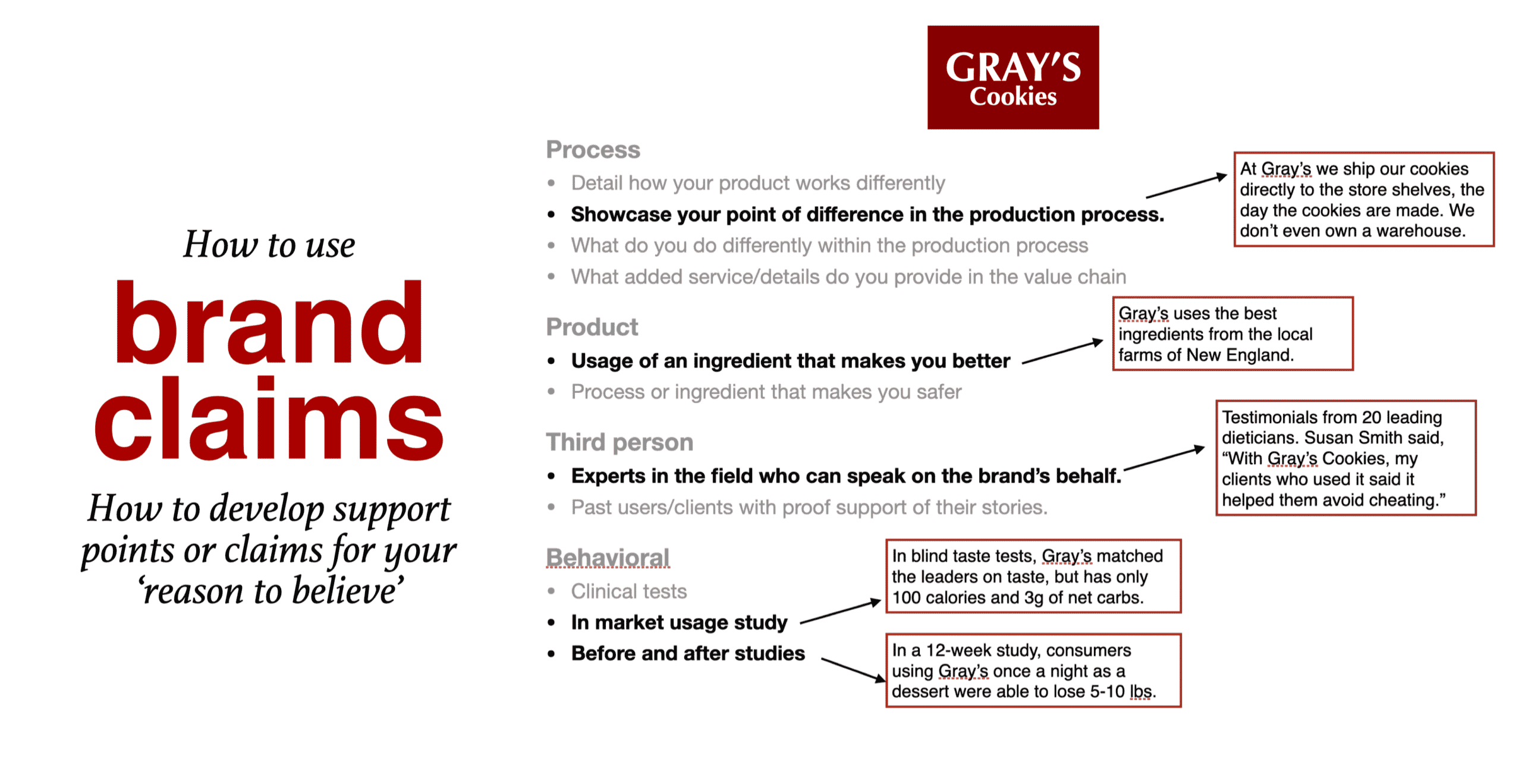
To illustrate, click to zoom in.
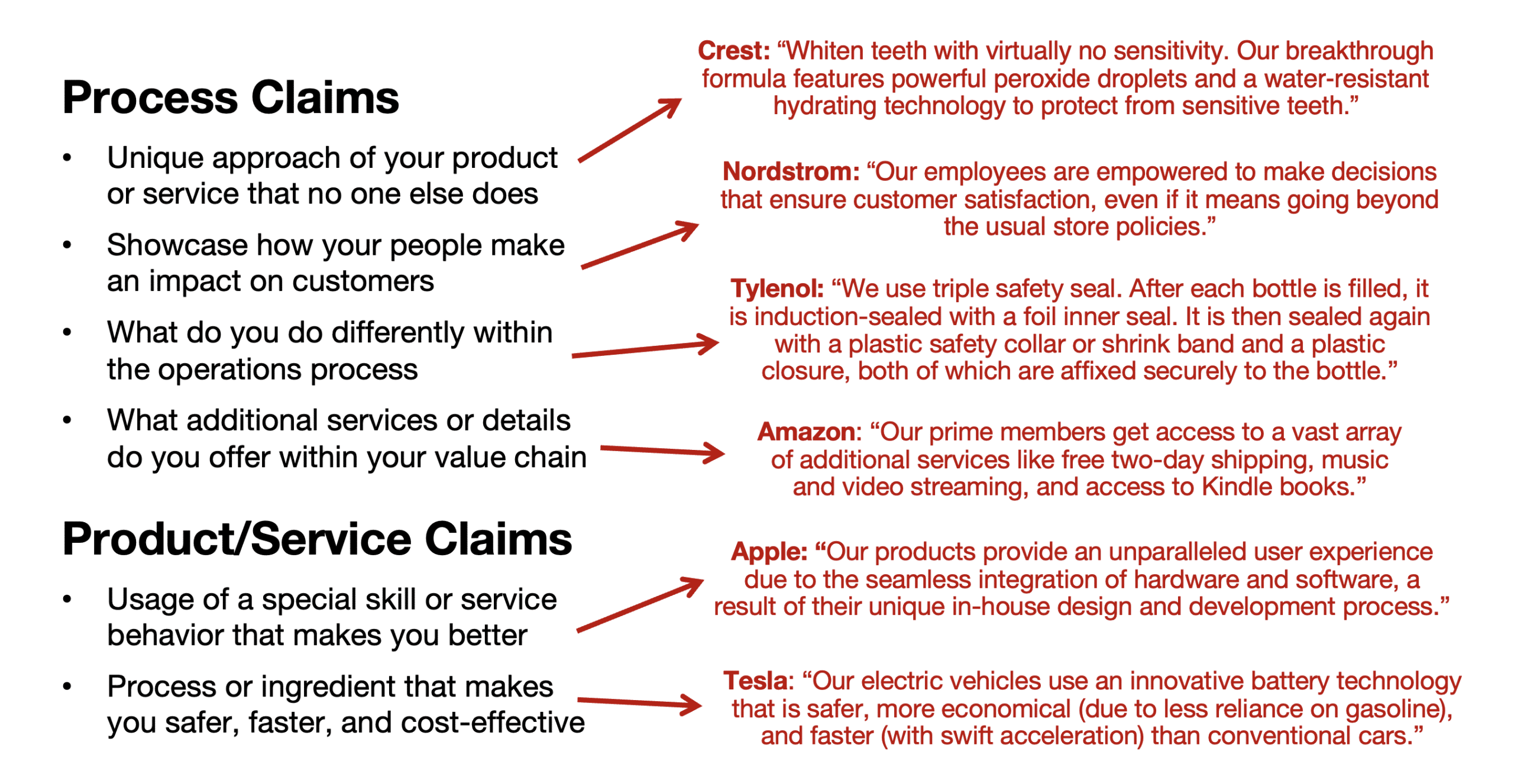
Types of claims
There are four types of brand claims you can use on your brand:
Process support
- How your product works differently
- Showcase what you do differently within the production process
- What added service do you provide in the value chain
Product claims
- Usage of an ingredient that makes your brand better
- Process or ingredient that makes your brand safer
- A process that makes your brand cheaper
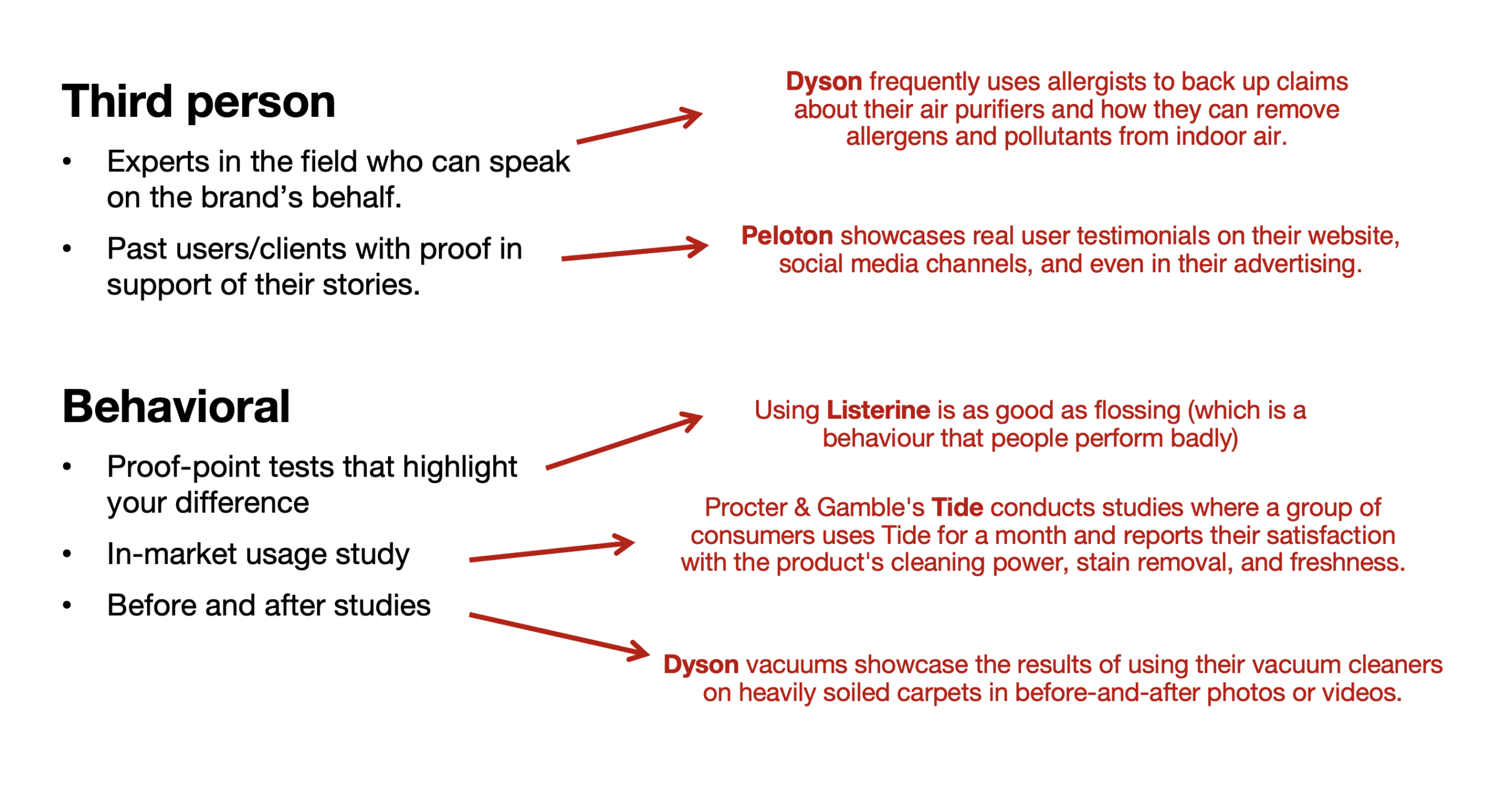
Third-person endorsement
- Experts in the field who can speak on your brand’s behalf.
- Past users/clients with proof support of stories or reviews
- Recognized awards, such J.D. Power
Behavioral results
- Clinical tests
- In market usage study
- Before and after studies
Support points
I took one logic class at university, and the only thing I learned was “premise-premise conclusion.” It was an easy class, but a life-long lesson that has stuck with me. Here is a classic logical argument statement:
- All fish live in water (premise)
- Tuna are fish (premise)
- Therefore, tuna live in the water (conclusion)
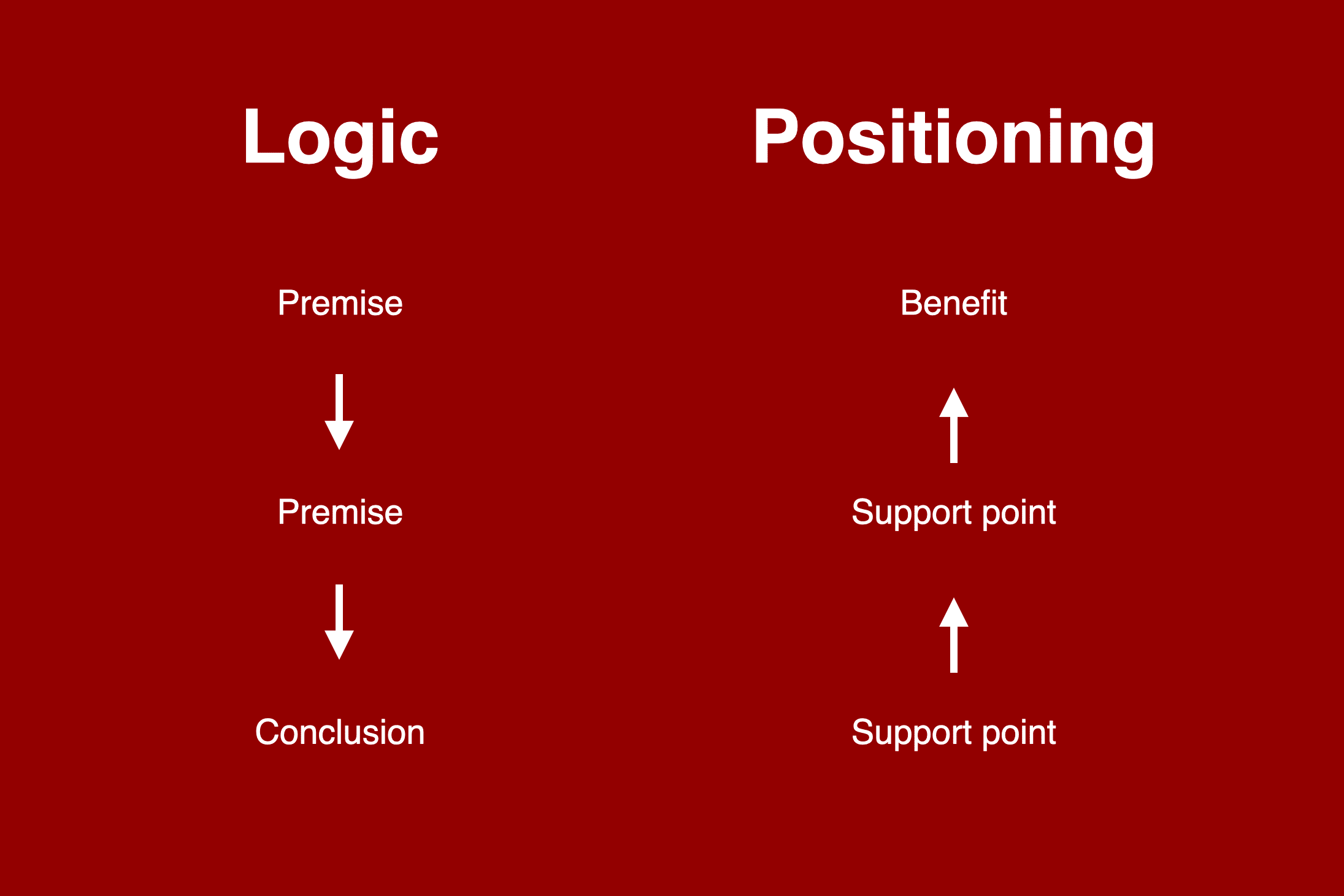
If pure logic teaches us that two premise points are good enough to draw out any conclusion, then you only need two “reasons to believe” (brand claims).
Brands that build concepts with a laundry list of RTBs are not doing their job in making focused decisions on what support points are required.
With consumers seeing 5,000 brand messages per day, having a long list of support points risks making their brand communications a cluttered mess. Brand claims can be a useful tool in helping to support your RTB, yet the RTB should never be the conclusion.
Reason to believe
As you would do with the consumer benefits, you can test these brand claims to see if they are motivating to consumers and whether they help to close off any doubts they may have
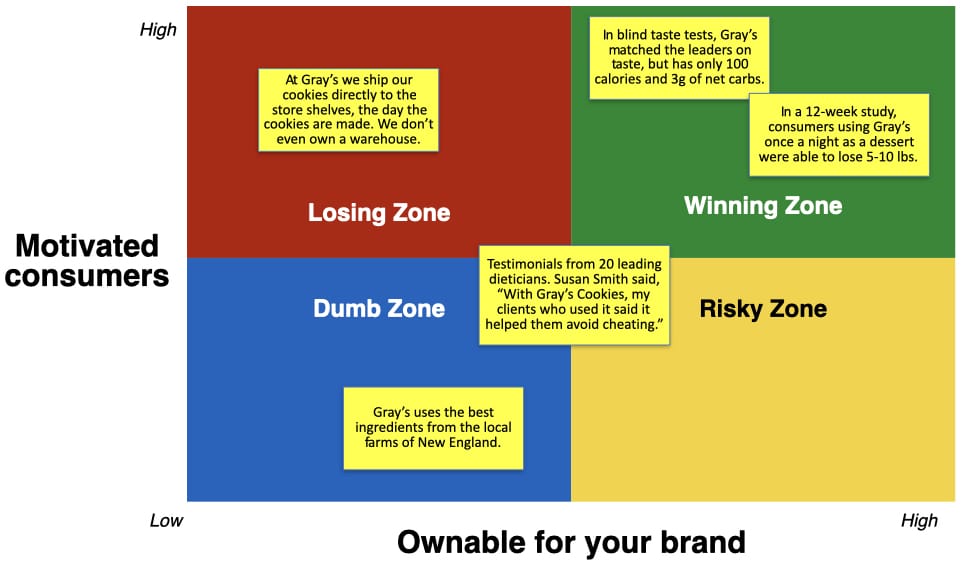
To illustrate, click to zoom in and see claims.
What makes a great product claim
1. Be Specific with Numbers
Consumers believe numbers more than adjectives. Back up the promise with data or measurable proof. Example: “Whitens teeth in 7 days” instead of “Whitens teeth fast.”
2. Create a Competitive Edge
Frame the claim in a way that highlights what your brand does better than others. Example: “The only razor with 5 blades” or “Faster downloads than Brand X.”
3. Solve a Consumer Pain Point
Anchor the claim in a real problem your target feels and make the benefit immediate and tangible. Example: “Stops coughs instantly” or “Stays fresh for 24 hours.”
4. Use Simple, Everyday Language
The claim should be crystal-clear, not marketing jargon. Consumers should “get it” in 3 seconds. Example: “Half the sugar, all the taste” or “Keeps food fresh longer.”
5. Make It Memorable and Sticky
Go beyond functional—use a phrase, metaphor, or contrast that lodges in the consumer’s mind. Example: “Melts in your mouth, not in your hand” or “The breakfast of champions.”
Great examples of Product Claims
Beloved Brands playbook
Our Beloved Brands playbook goes in depth on everything you need to build a brand consumers will love. Learn about strategic thinking, brand positioning, writing brand plans, advertising decisions, media planning, marketing analytics, and financials.

Our readers tell us they keep our Beloved Brands playbook close by for whenever they need to take on a new project. Clearly, we are thrilled that 89% of Amazon reviewers have given Beloved Brands a 5-star rating. Also, we wrote a B2B Brands playbook and a Healthcare Brands playbook.

How to Turn Support Points into Powerful Claims
Every great brand needs more than just a benefit promise—it needs support points (RTBs: Reasons to Believe) that give consumers the confidence to choose you. The challenge for marketers is to take those support points and shape them into compelling claims that separate your brand from the pack.
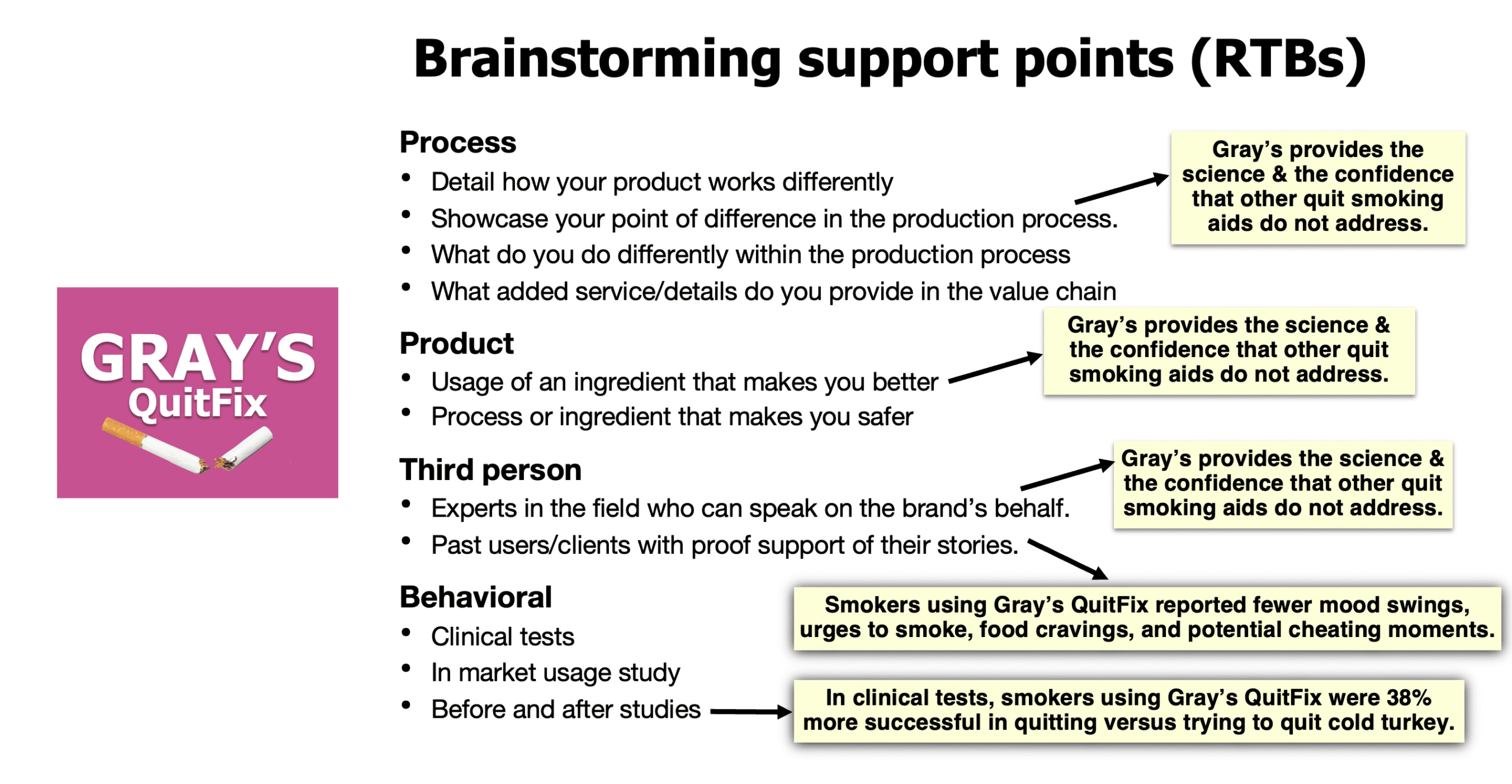
Support points can come from different places:
- Process: What you do differently in how your product works or is made.
- Product: Ingredients or features that make you safer, stronger, or more effective.
- Third person: Experts, users, or credible sources who validate your brand.
- Behavioral: Clinical studies, in-market usage, and before/after results.
On their own, these are just facts. The magic comes when you turn those facts into claims that close deals.
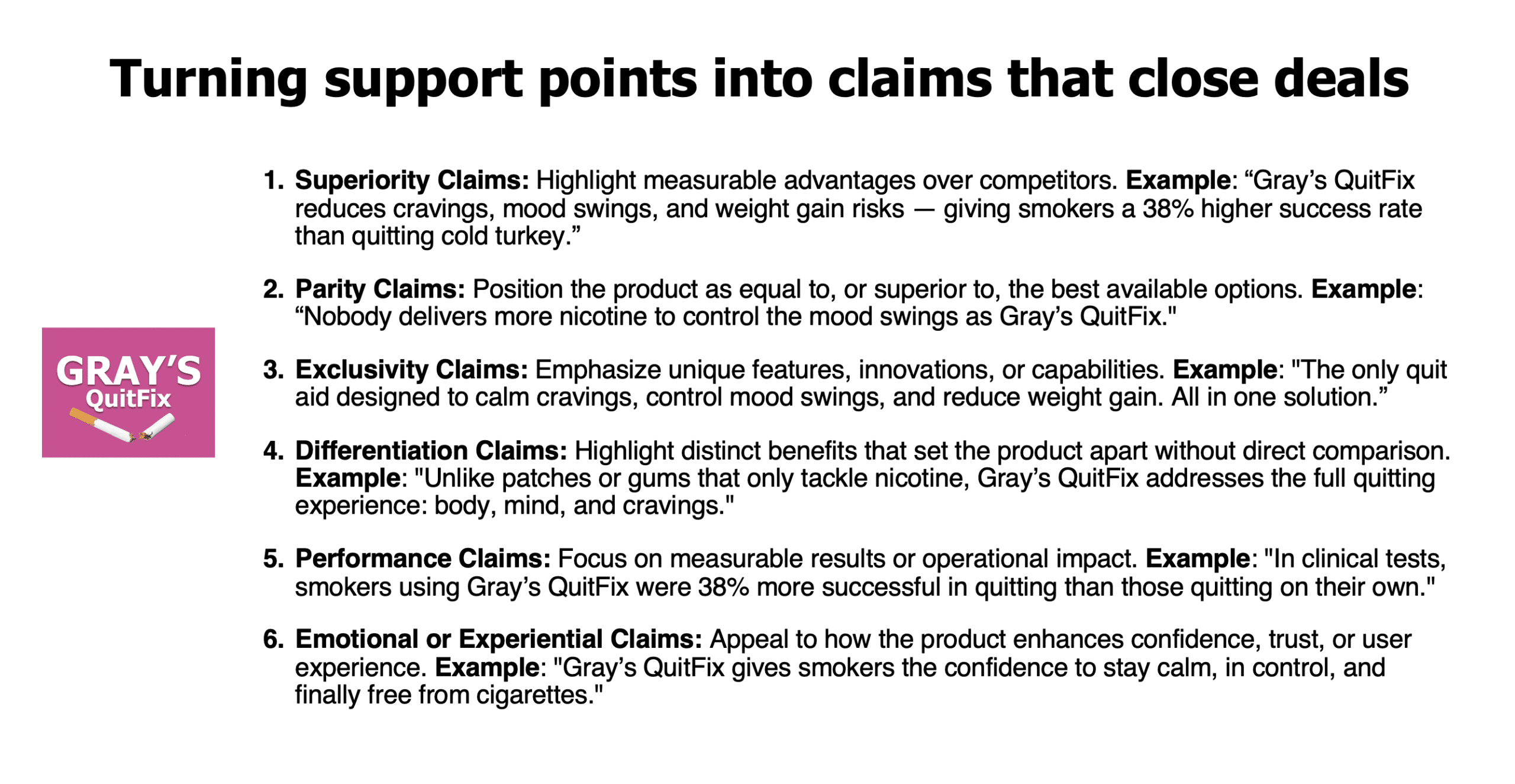
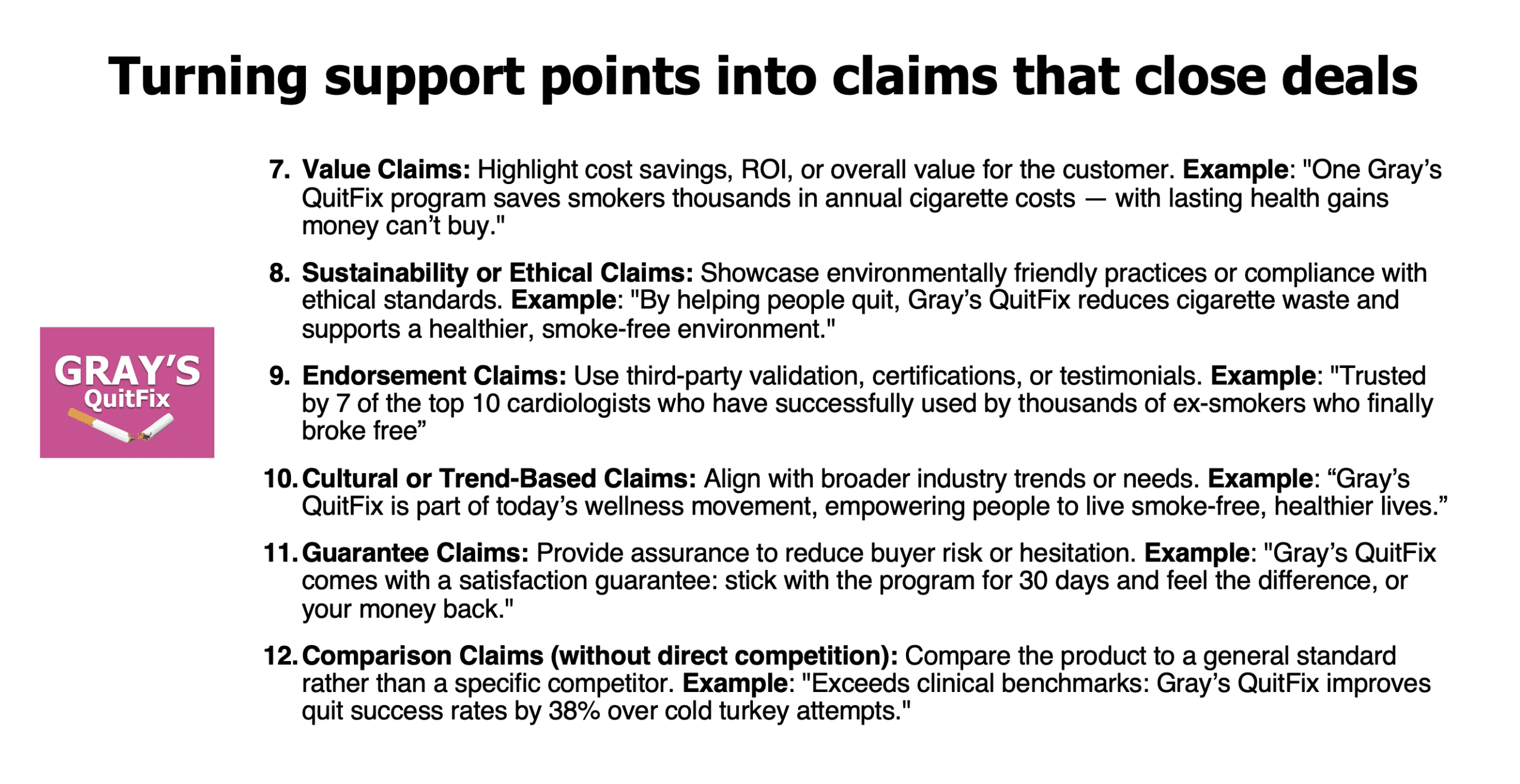
There are many ways to frame your brand’s advantage. Here are twelve types of claims you can use:
- Superiority claims show measurable advantages: “Gray’s QuitFix reduces cravings, mood swings, and weight gain risks — 38% higher success rate than quitting cold turkey.”
- Parity claims reinforce that you’re equal to or better than the best: “Nobody delivers more nicotine to control mood swings than Gray’s QuitFix.”
- Exclusivity claims emphasize something only you deliver.
- Differentiation claims highlight distinct benefits without a direct comparison.
- Performance claims lean on operational or measurable results.
- Emotional/experiential claims connect to feelings of control, calm, or freedom.
- Value claims showcase cost savings or ROI for the customer.
- Sustainability/ethical claims link your brand to broader standards of responsibility.
- Endorsement claims lean on expert or third-party validation.
- Cultural/trend-based claims tie into larger movements and consumer lifestyles.
- Guarantee claims lower the risk of choosing your brand.
- Comparison claims show how you exceed benchmarks, without needing to name competitors.
Why Claims Matter
Consumers are skeptical. They’ve heard it all before. A strong claim not only grabs attention—it closes the gap between interest and action. By backing up your brand’s promise with proof that feels credible, measurable, and meaningful, you help consumers believe you, trust you, and ultimately buy you.
The most successful brands don’t just rely on one type of claim. They layer different approaches—superiority, performance, and emotional claims—to make their story unbreakable.
When building your next campaign, don’t just ask, “What do we want to say?” Instead, ask: “What claims will make our consumers believe us and choose us?”
Brand Strategy
Does your brand have unrealized potential?
Here are five questions you need to be able to answer about your brand:
- First, can you describe your brand in seven seconds in a way that motivates consumers to engage and in a space that is own-able for your brand?
- Second, are you making the right investments that will create a market impact for your brand, and lead to a performance result for your business?
- Next, does everyone on your team know their role and know how they contribute to building a successful brand?
- Does your marketing execution establish your desired brand positioning and move customers to purchase?
- Finally, are you investing in your people to ensure they make smarter decisions and produce exceptional work that drives business growth?
If you cannot answer these five questions, your team will be confused. Clearly, your brand investments will be scattered and won’t pay back. You will see inconsistent execution in the market. The consumer will not know how to define your brand. And, you won’t grow! It is time to make decisions.

We help brands define themselves so they can drive new growth opportunities.
At Beloved Brands, our brand strategy process will help you define your brand and map out a strategic plan for the best possible future for your brand.
We will help you define your brand positioning statement and narrow down to a brand idea that is your seven second pitch. Then, we challenge you to select the right strategic investments for your brand, and build a strategic plan that everyone can follow.
Importantly, you need your marketing execution to build your brand reputation in the market and moves customers along their purchase journey.