

Quick Definition: What is a Marketing Plan?
A marketing plan is a strategic document that outlines your marketing objectives, target audience, competitive positioning, strategies, tactics, budget, and performance metrics—typically for a 12-month period.
Think of it as your marketing roadmap: it defines where you want to go (vision), identifies obstacles in your way (key issues), explains how you’ll get there (strategies), and details what specific actions you’ll take (tactics).
Table of Contents - How to write a Marketing Plan
What You'll Learn in This Guide
- Step-by-step marketing plan process with proven frameworks
- Professional marketing plan template (PowerPoint presentation)
- Real marketing plan examples from Fortune 500 brands
- Strategic tools, including the Strategic ThinkBox
- Common mistakes to avoid when writing your plan
- Marketing plan checklist to keep you on track
Who this guide is for:
Brand managers, marketing directors, CMOs, small business owners, and marketing teams at consumer, B2B, healthcare, and retail companies.
Author credentials:
Written by Graham Robertson, former VP of Marketing at Johnson & Johnson, with extensive experience at Coca-Cola and General Mills. Over 20 years of experience creating and approving marketing plans that drive business growth.
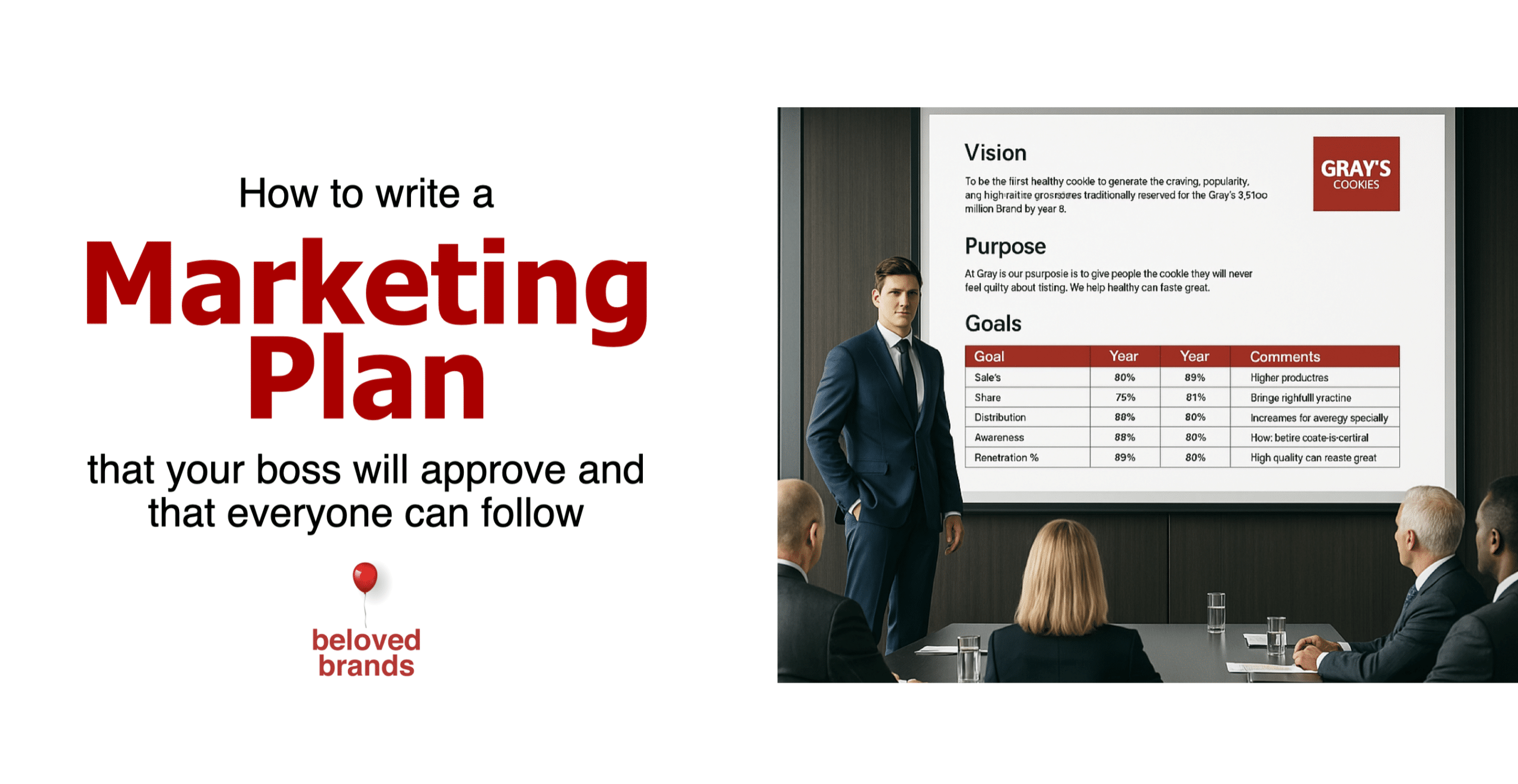
Why Every Business Needs a Marketing Plan
A well-crafted marketing plan serves three critical purposes:
1. Gains approval and secures resources
Your marketing plan is the presentation that convinces senior leadership to invest in your strategies. Without buy-in and budget, even brilliant ideas go nowhere.
2. Provides a clear roadmap
Marketing plans align your entire team around a common vision, eliminating confusion about priorities and ensuring everyone works toward the same objectives.
3. Enables measurement and accountability
With defined goals and metrics, you can track progress, identify what’s working, and make data-driven adjustments throughout the year.
The bottom line:
Companies with documented marketing plans are 313% more likely to report success than those without one (CoSchedule, 2025).
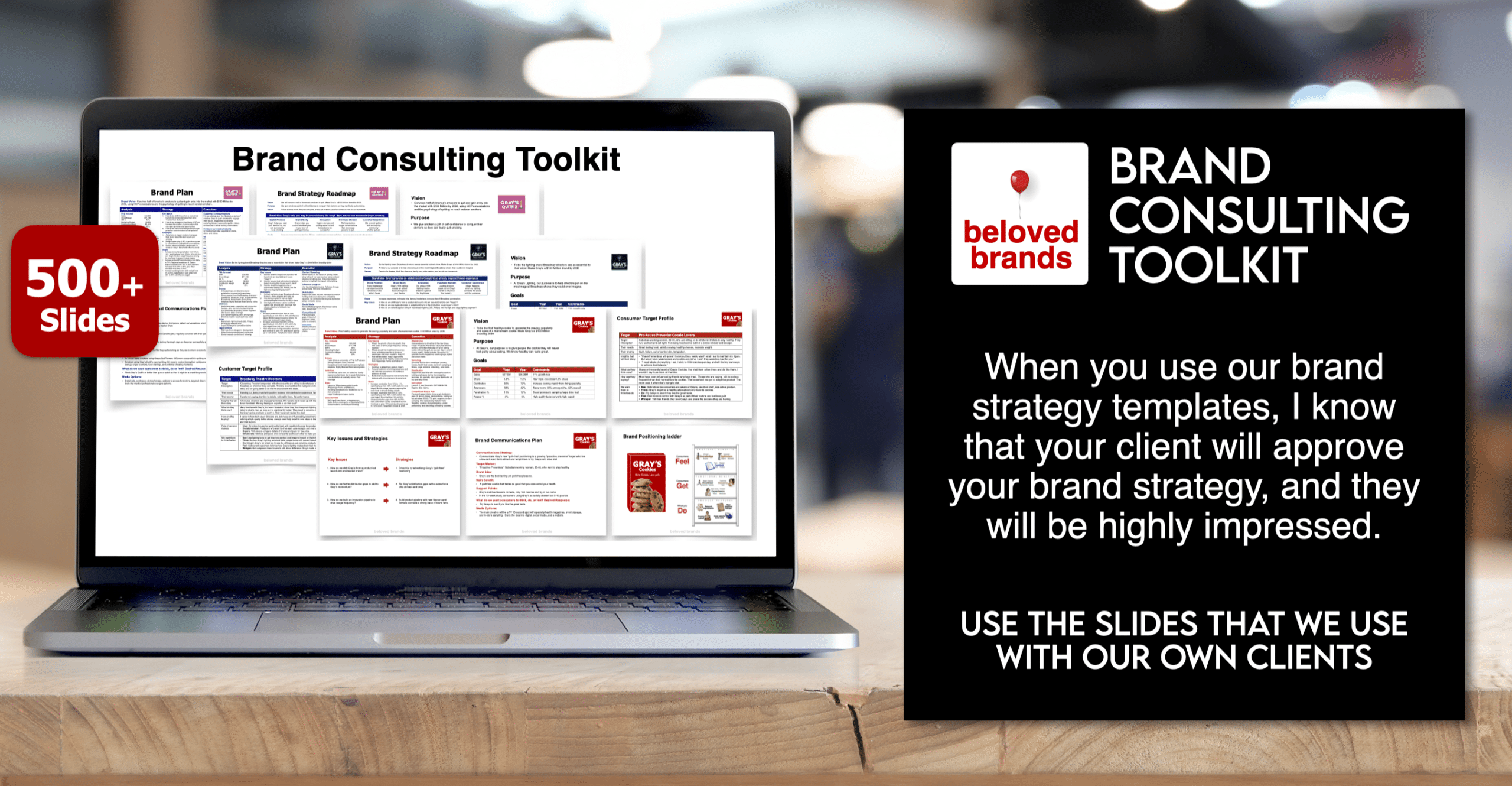
Marketing Plan Template: 5-Step Process
Here’s the proven framework I’ve used to create marketing plans at three Fortune 500 companies:
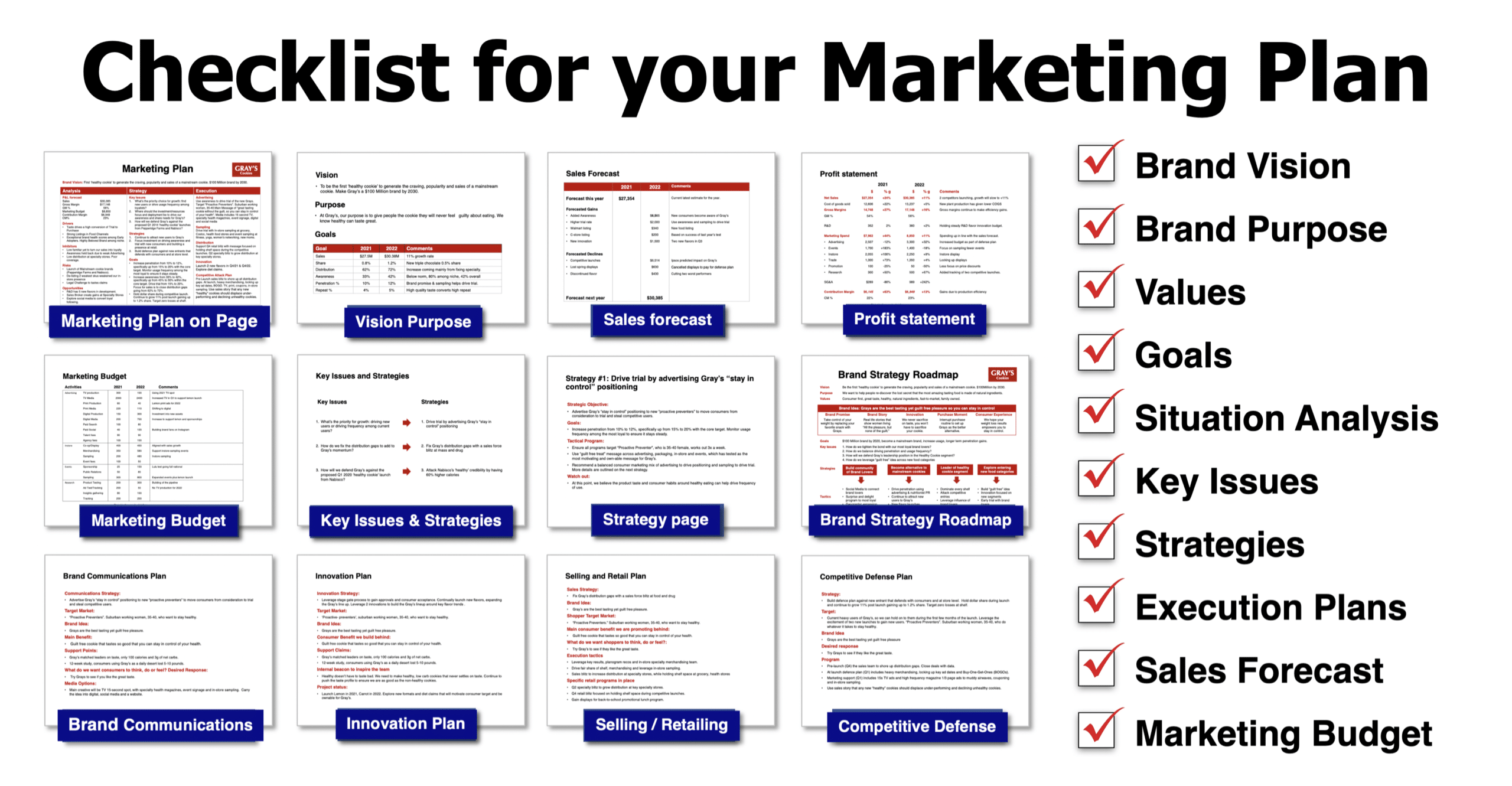
The Complete Marketing Plan Structure:
FOUNDATION (Steps 1-3):
- Vision – Where could we be in 5-10 years?
- Goals – What specific results will we achieve?
- Purpose & Values – Why we exist and what we stand for
ANALYSIS (Steps 4-5):
- Situation Analysis – Where are we now?
- Key Issues – What’s preventing us from achieving our vision?
STRATEGY (Steps 6-7):
- Strategies – How will we overcome our key issues?
- Tactics – What specific actions will we take?
EXECUTION (Step 8):
- Execution Plans – Detailed programs for communication, innovation, and sales
- Let’s dive into each step with examples and templates.
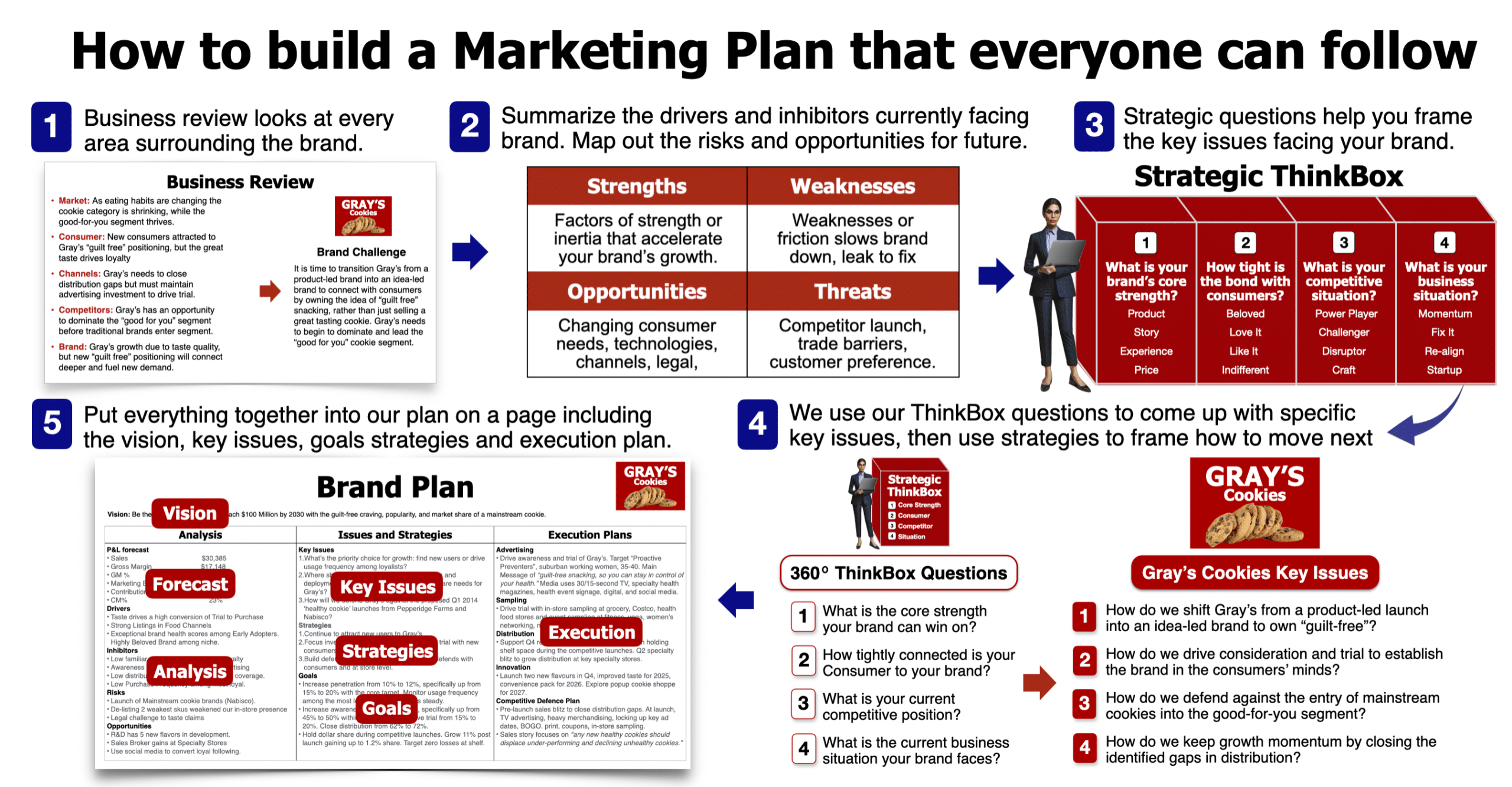
Step 1: Write Your Marketing Plan Vision Statement
What is a Brand Vision?
Your brand vision answers the question: “Where could we be in the future?”
A powerful vision statement combines:
- Qualitative elements – Conceptual words that define your ideal future state
- Quantitative targets – Specific, measurable stakes in the ground
- Three “must-be-true” conditions – Essential elements required to achieve the vision
Marketing Plan Vision Example: iPhone Launch (2007)
Let’s examine how Apple crafted the iPhone vision when entering the mobile phone market:
Qualitative Vision:
Steve Jobs wanted to create the “everything phone”—a device that would become an integral part of consumers’ daily lives by combining a phone, computer, and iPod into one revolutionary product.
Quantitative Target:
Reach $25 billion in sales within 10 years (by 2017)—an extremely ambitious goal considering BlackBerry hadn’t yet reached $1 billion.
Three Must-Be-True Conditions:
1. Simple User Experience
Every interface and interaction must be intuitive and effortless, allowing consumers to navigate without a learning curve.
2. Integrated Solution
Create an ecosystem of services and applications, providing an all-in-one solution for everything in your life—personal and business.
3. Stylish Functionality
Embody cutting-edge design that appeals aesthetically, setting market trends and making ownership a statement of sophistication.
Complete Vision Statement:
“The iPhone will reach $25 billion by 2017 by creating the ‘everything phone’ that enhances everything in our consumers’ daily lives, with integrated solutions, simple user experiences, and stylish functionality.”
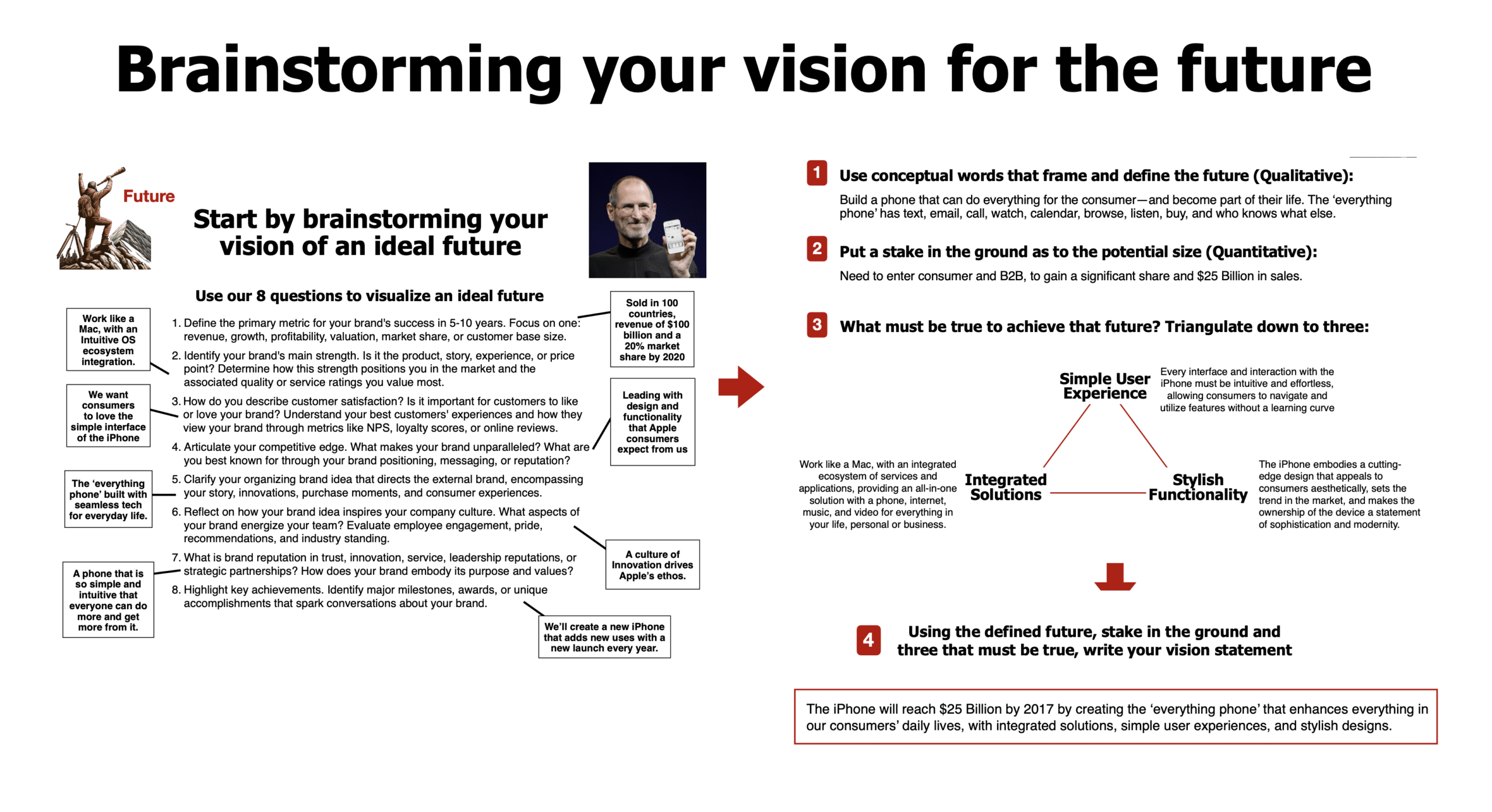
How to Write Your Vision Statement Template:
“[Brand] will reach [quantitative target] by [year] by [qualitative future state], delivered through [must-be-true #1], [must-be-true #2], and [must-be-true #3].”
Best practices:
- Make it aspirational but achievable
- Use language that “scares you a little and excites you a lot.”
- Ensure it lasts 5-10 years to provide consistent direction
- Get buy-in from all stakeholders before finalizing
Step 2: Set Measurable Marketing Goals
What Makes a Good Marketing Goal?
Effective goals in your marketing plan should be:
- Specific – Clearly defined outcomes
- Measurable – Quantifiable metrics
- Achievable – Realistic given resources
- Relevant – Aligned with vision
- Time-bound – Clear deadlines
Types of Marketing Goals to Include:
Consumer Behavioral Goals:
- Increase brand awareness from 45% to 60%
- Improve purchase consideration by 15 percentage points
- Boost customer retention rate to 85%
- Drive 25% increase in customer lifetime value
Performance Metrics:
- Generate 50,000 qualified leads
- Achieve 3.5% conversion rate
- Reach 10 million social media impressions
- Maintain customer satisfaction score above 4.2/5.0
Financial Results:
- Grow revenue by 22% year-over-year
- Achieve $50 million in sales
- Increase market share from 12% to 15%
- Improve marketing ROI to 5:1
Milestone Goals:
- Launch in 3 new markets by Q3
- Complete brand repositioning by June
- Introduce 2 new product lines
- Establish partnerships with 10 strategic retailers
Create a Brand Dashboard
- Transform your goals into a visual scoreboard that tracks:
- Leading indicators (activities that drive results)
- Lagging indicators (actual business outcomes)
- Weekly/monthly progress updates
- Red/yellow/green status for each metric
Step 3: Establish Purpose and Values (for branded house)
Define Your Brand Purpose
Purpose answers: “Why does your brand exist beyond making money?”
Your purpose creates emotional connection with both employees and customers, giving your brand a soul that differentiates it from competitors.
Purpose statement examples:
- Patagonia: “We’re in business to save our home planet.”
- Dove: “To help the next generation of women develop a positive relationship with beauty.”
- TOMS: “To improve lives through business.”
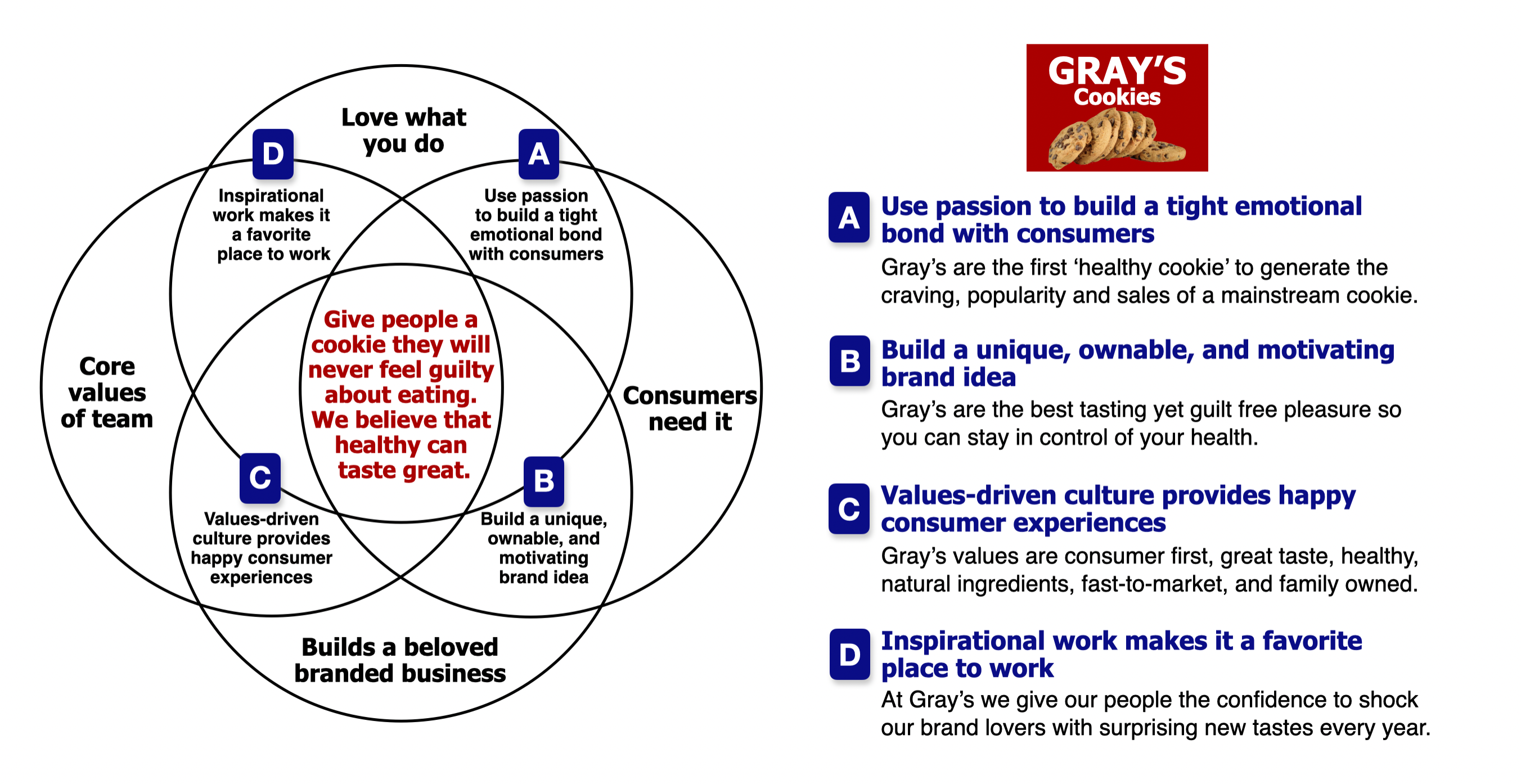
Articulate Your Brand Values
Values answer: “What do we stand for?”
Values guide behavior, shape culture, and set expectations for everyone associated with your brand.
Criteria for strong values:
- Actionable and observable
- Authentic to your organization
- Defensible when tested
- Consistently delivered
Example value set:
- Innovation – We constantly seek better solutions
- Integrity – We do the right thing, even when no one’s watching
- Customer-First – Every decision starts with customer needs
- Collaboration – We achieve more together
- Excellence – Good enough never is
Step 4: Conduct a Marketing Situation Analysis
What is a Situation Analysis?
A situation analysis answers: “Where are we right now?”
This critical step examines:
- Current market position
- Competitive landscape
- Consumer trends and insights
- Internal capabilities and constraints
- External opportunities and threats
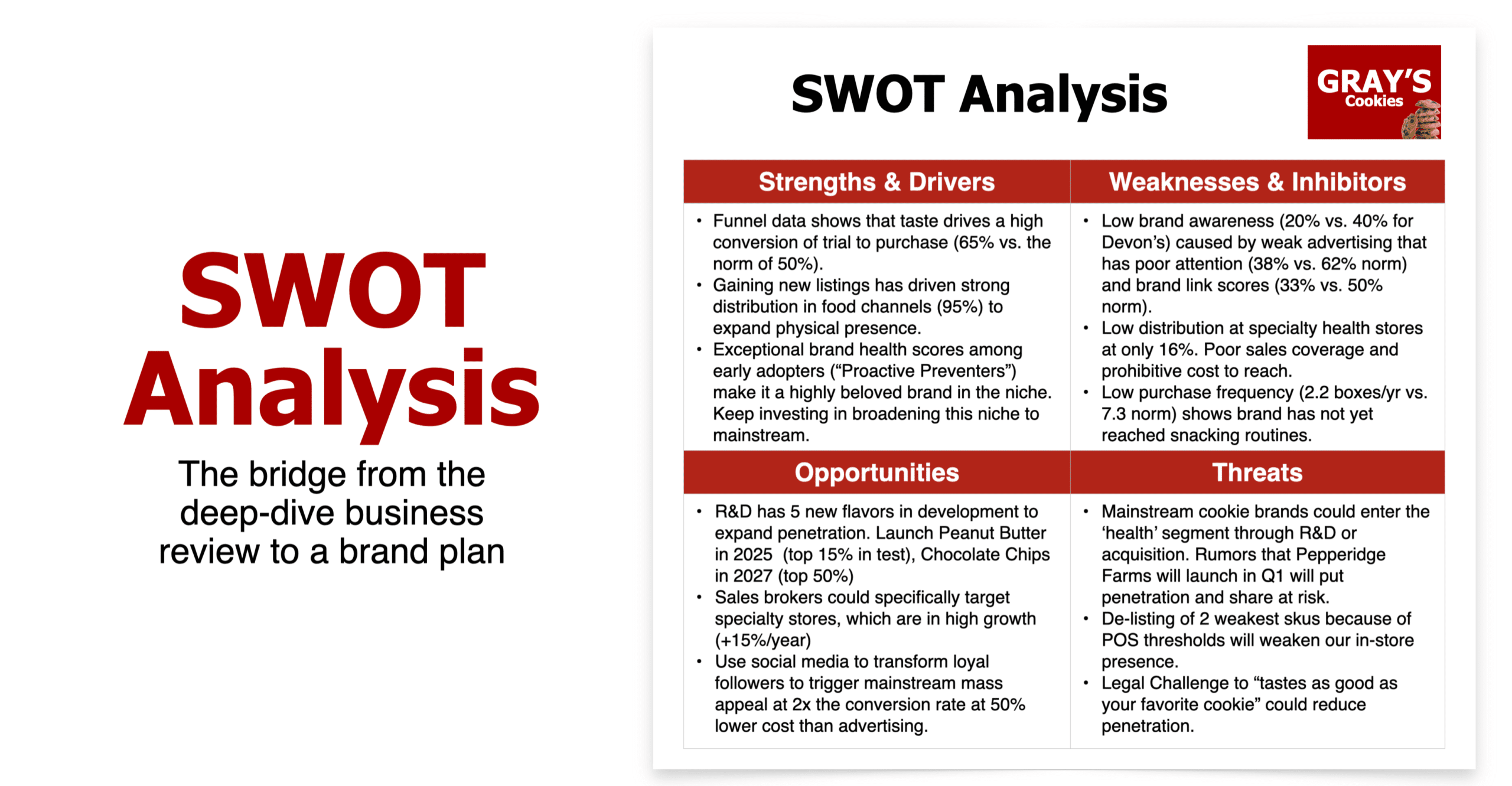
Strengths (Internal):
- What advantages do we have?
- What do we do better than competitors?
- What unique resources do we possess?
Weaknesses (Internal):
- Where do we fall short?
- What do competitors do better?
- What resources are we lacking?
Opportunities (External):
- What market trends favor us?
- Which consumer needs are unmet?
- Where are competitors vulnerable?
Threats (External):
- What trends could hurt us?
- Who are emerging competitors?
- What regulatory changes loom?
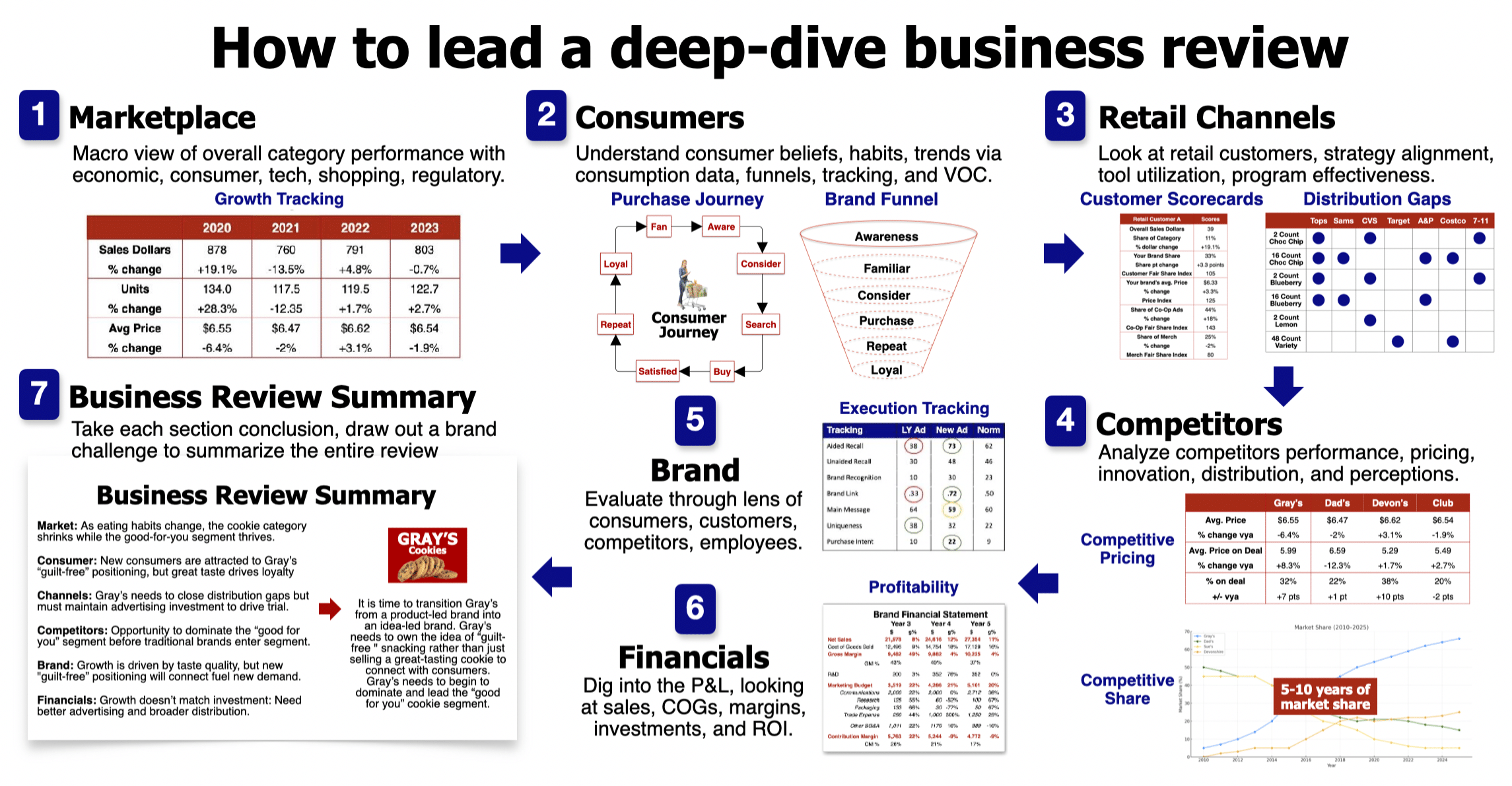
Key Areas to Analyze:
1. Market Dynamics
- Total market size and growth rate
- Category trends (growing/declining segments)
- Price trends and margin pressure
- Distribution channel shifts
2. Consumer Insights
- Target audience demographics and psychographics
- Purchase behavior and decision journey
- Unmet needs and pain points
- Brand perception and awareness levels
3. Competitive Analysis
- Market share rankings
- Competitor positioning and messaging
- Competitive advantages and vulnerabilities
- New entrants and disruptive threats
4. Brand Performance
- Sales trends (volume and value)
- Distribution and availability
- Marketing effectiveness metrics
- Customer satisfaction and loyalty
5. Internal Capabilities
- Team skills and resources
- Budget and constraints
- Technology and tools
- Organizational alignment
Step 5: Identify Key Marketing Issues
What are Key Issues?
Key issues answer: “What’s preventing us from achieving our vision?”
These are the critical obstacles, challenges, or questions that your marketing strategies must address.
The Strategic ThinkBox Framework
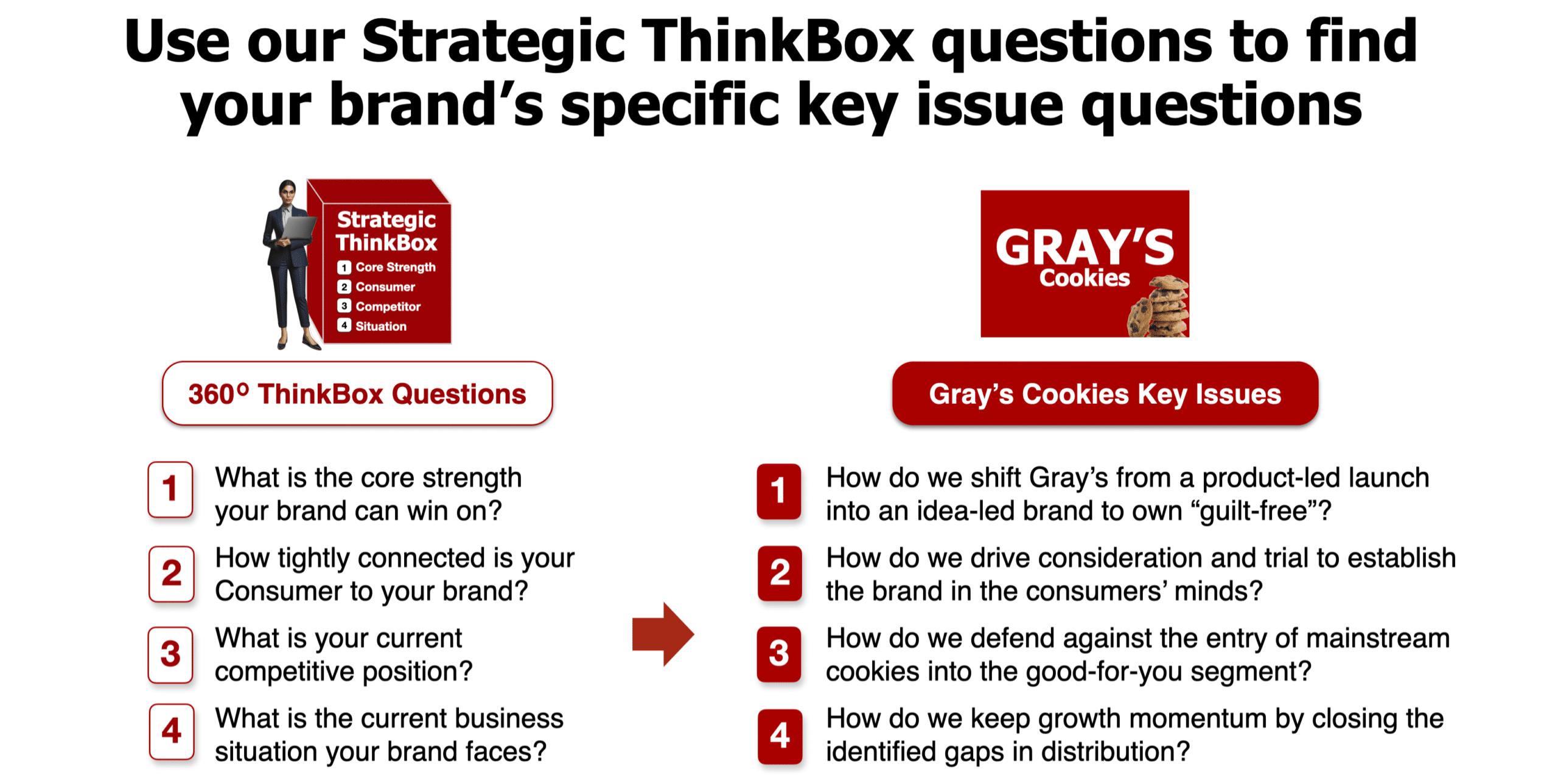
Use this proprietary framework to trigger deeper strategic thinking through four forced-choice questions:
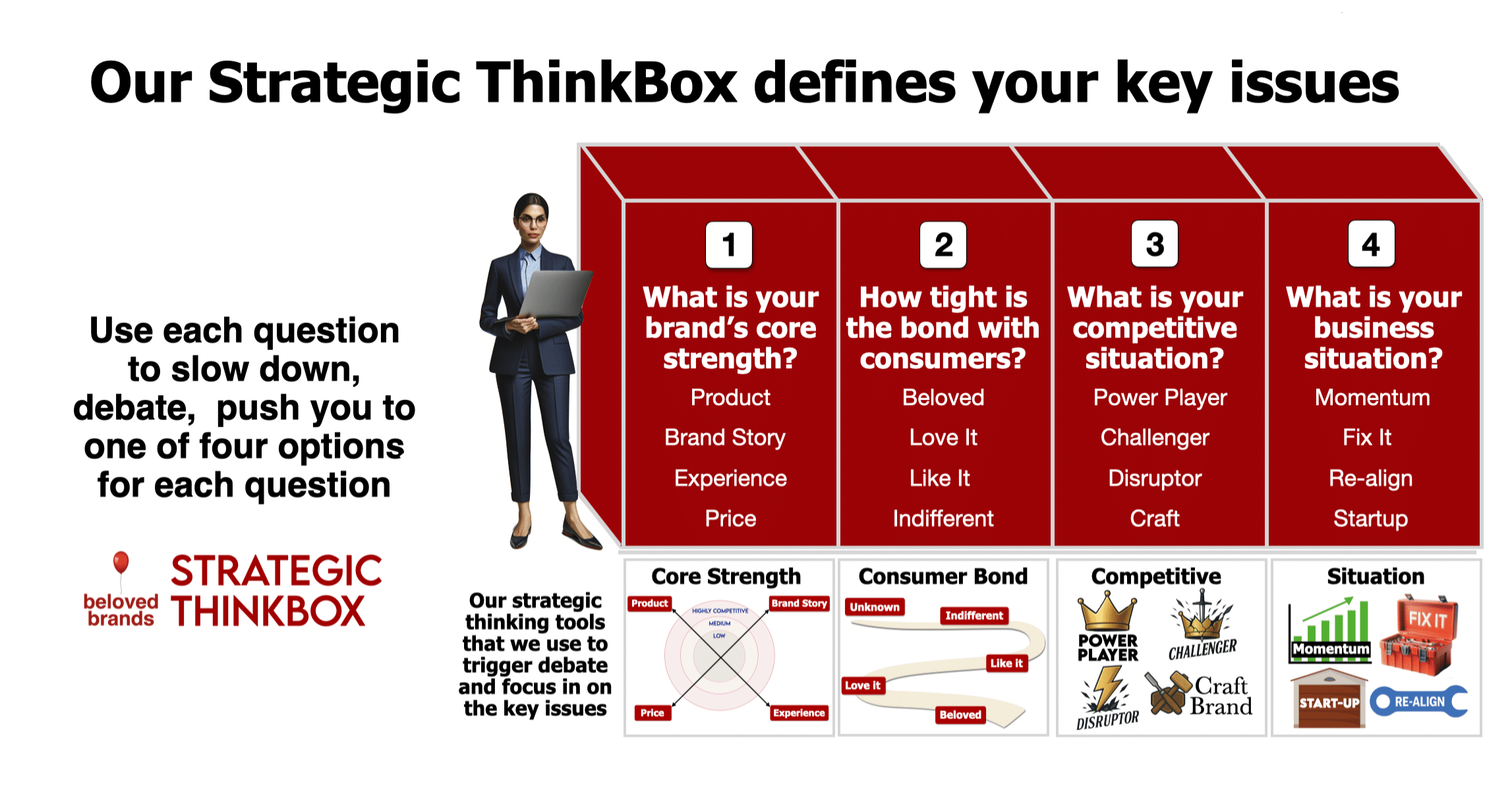
Our Strategic ThinkBox triggers deeper thinking.
Question 1: What is your brand’s core strength?
Choose ONE that will drive your competitive advantage:
- Product – Superior quality, features, or innovation
- Brand Story – Emotional connection and meaning
- Consumer Experience – Service, convenience, or delight
- Price – Value leadership or premium positioning
Your core strength determines where you invest most heavily and what you emphasize in all communications.
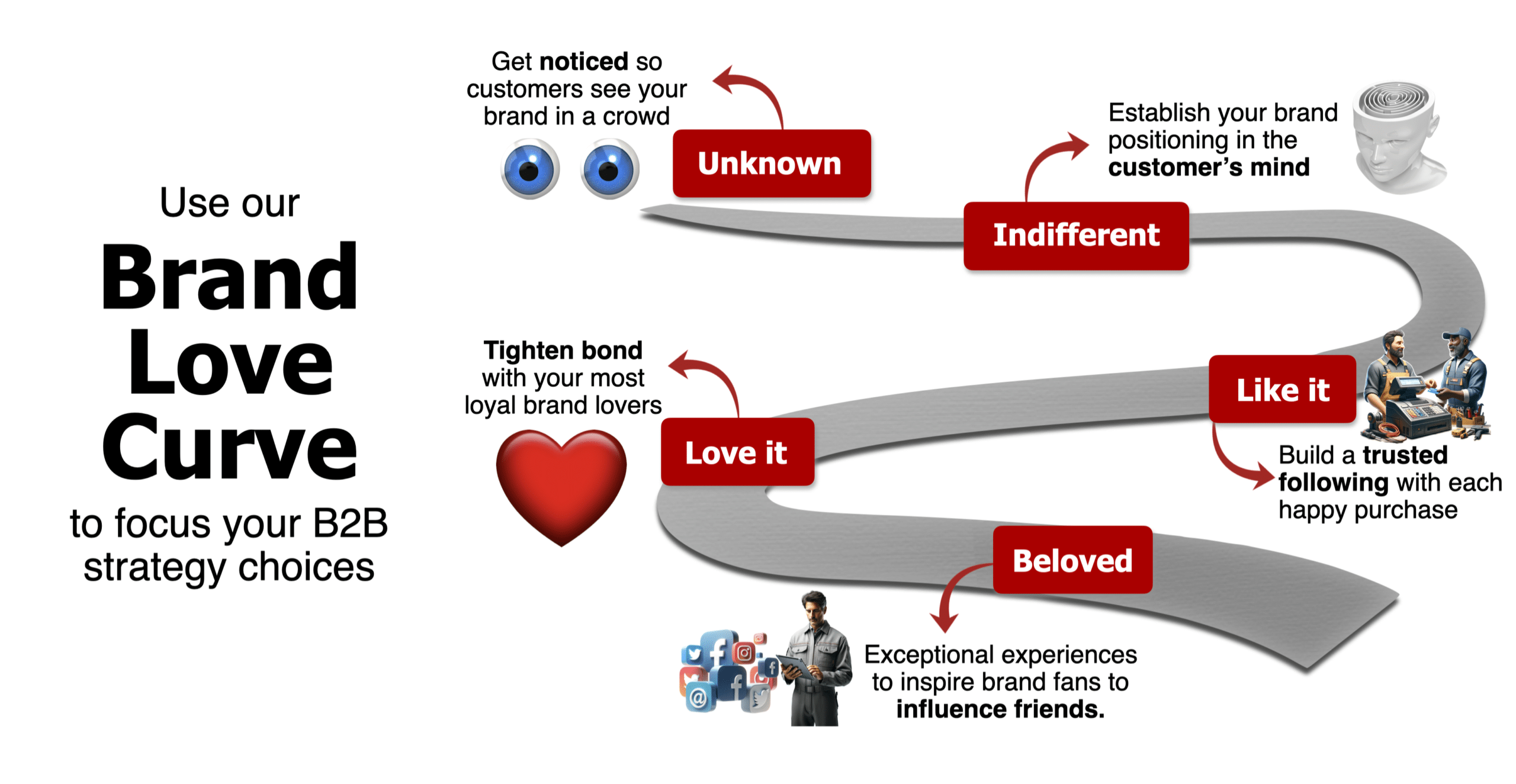
Question 2: Where is your consumer on the brand love curve?
Choose your current stage:
- Unaware – Consumers don’t know you exist
- Indifferent – They know you but don’t care
- Like It – Positive but not loyal
- Love It – Strong preference and repeat purchase
- Beloved – Passionate advocacy and deep loyalty
Your goal is to move consumers up this curve, tightening the bond at each stage.
Question 3: What is your competitive position?
Choose the situation that best describes your market position:
- Power Player – Market leader taking defensive stance
- Challenger – Strong #2 or #3 battling the leader head-on
- Disruptor – Different enough to pull consumers from major players
- Craft Brand – Niche player with specialized target and benefit
Each position demands different strategies and resource allocation.
Question 4: What is your business situation?
Choose the scenario you’re currently in:
- Momentum – Healthy growth, optimize, and accelerate
- Turnaround – Declining performance, needs major changes
- Realignment – Strategy drift, need to refocus
- Start-up – New brand, building from the ground up
Your situation dictates leadership style and strategic priorities.
Translating Analysis into Key Issues
Transform your Strategic ThinkBox answers into 3-5 key issue questions:
Example key issues:
- How do we increase awareness among our target audience from 35% to 60%?
- How do we differentiate our brand in a commoditized category?
- How do we defend market share against aggressive new competitors?
- How do we modernize our brand to appeal to younger consumers without alienating our base?
- How do we improve marketing ROI while maintaining reach?
Characteristics of good key issues:
- Framed as questions that strategies will answer
- Directly linked to achieving your vision
- Actionable and within your control
- Prioritized by impact and urgency
Step 6: Develop Marketing Strategies
What is a Marketing Strategy?
A strategy answers: “How will we achieve our goals and overcome our key issues?”
The Strategy Formula: Programs + Accelerator + Results
I’ve simplified strategy development into three components:
Strategy = What you’ll invest in + Who you’ll focus on + What you’ll get
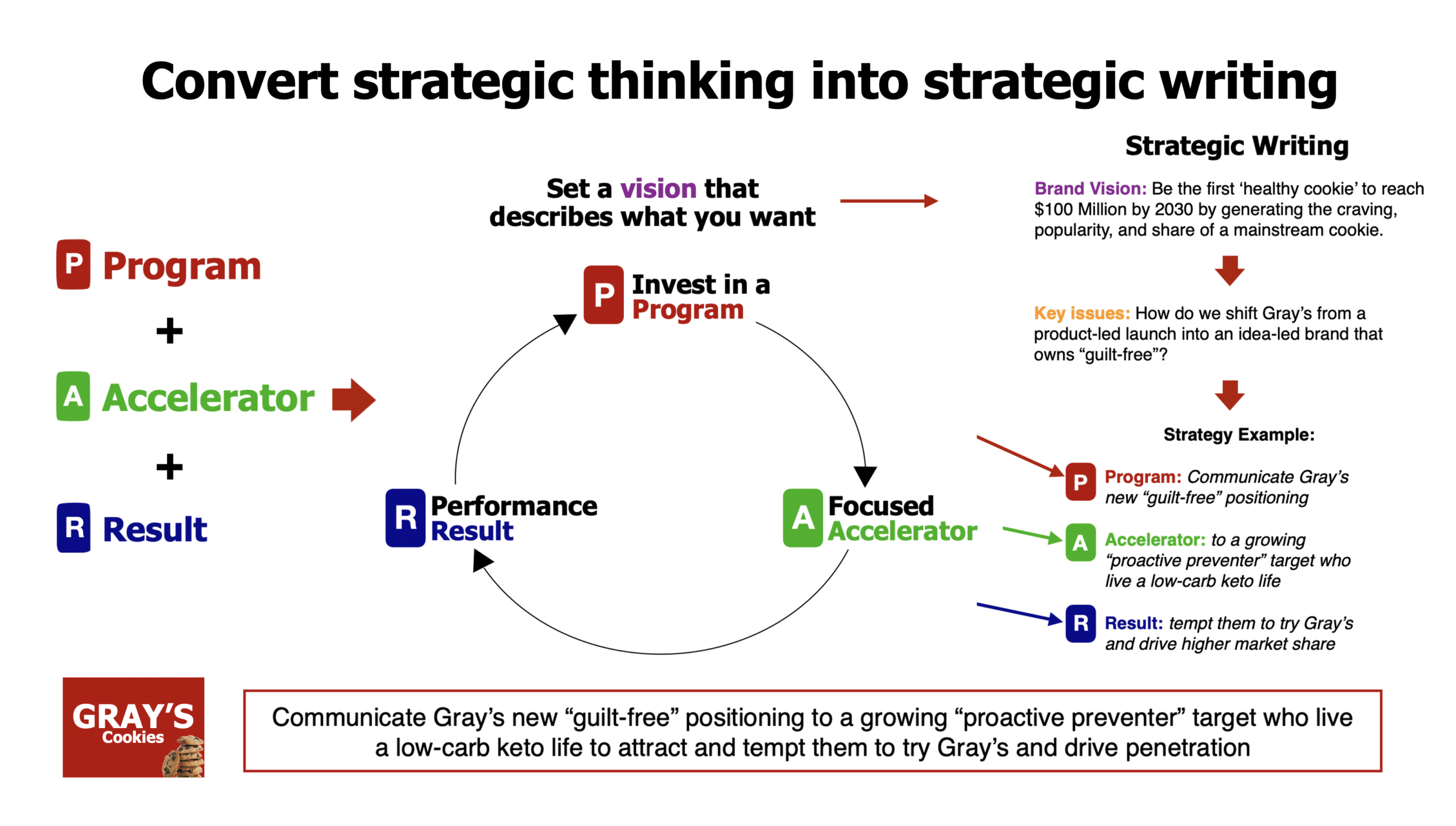
Components breakdown:
1. PROGRAM – Strategic investment area
- What specific program will you invest in?
- Where will resources be allocated?
2. ACCELERATOR – Market opportunity
- Who will you focus on?
- What underlying trend or insight will accelerate success?
3. RESULT – Expected outcome
What consumer behavior will change?
What business performance will improve?
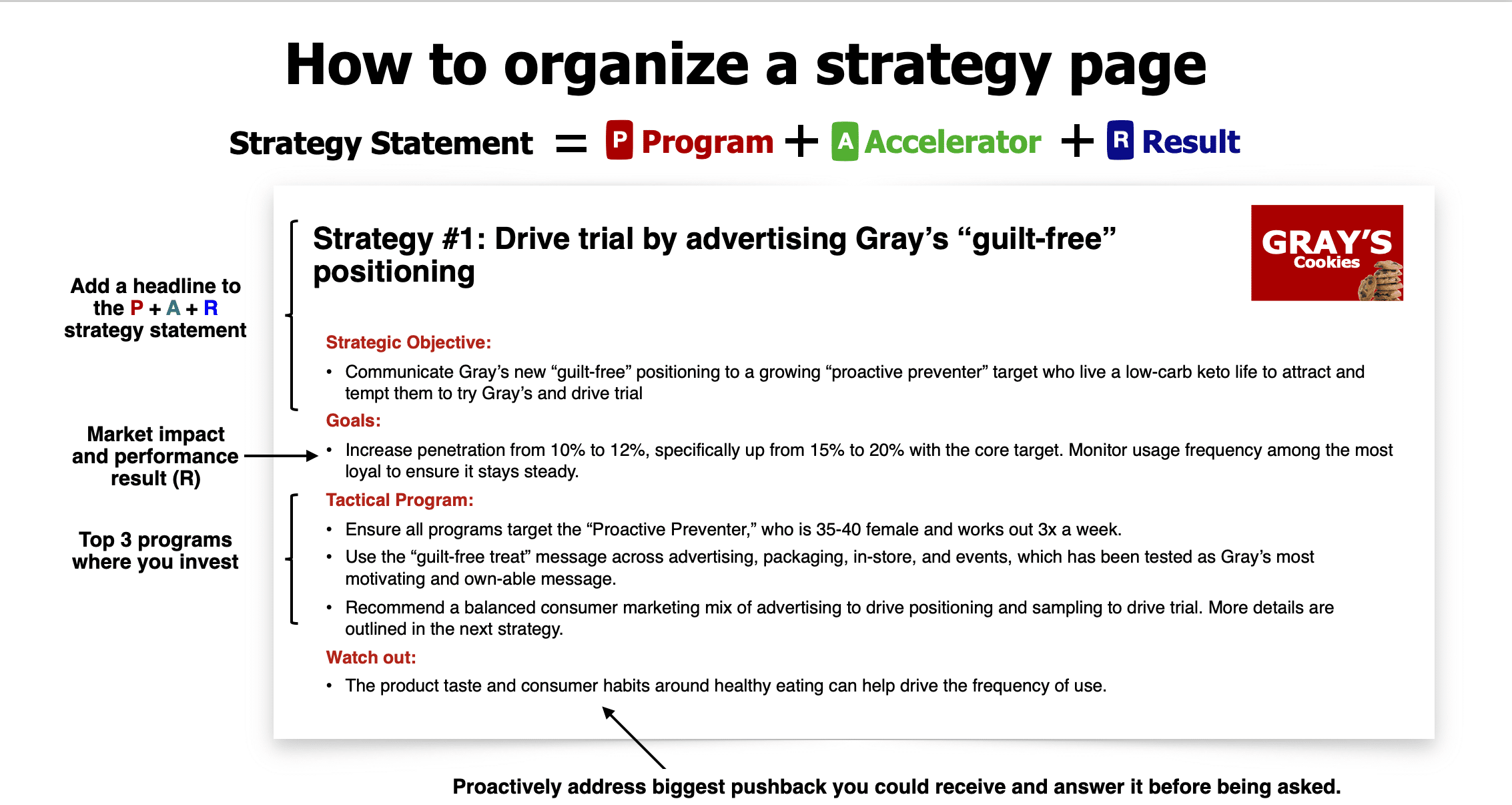
Marketing Strategy Statement Template
- “Invest in [PROGRAM] targeted to [ACCELERATOR] to drive [RESULT].”
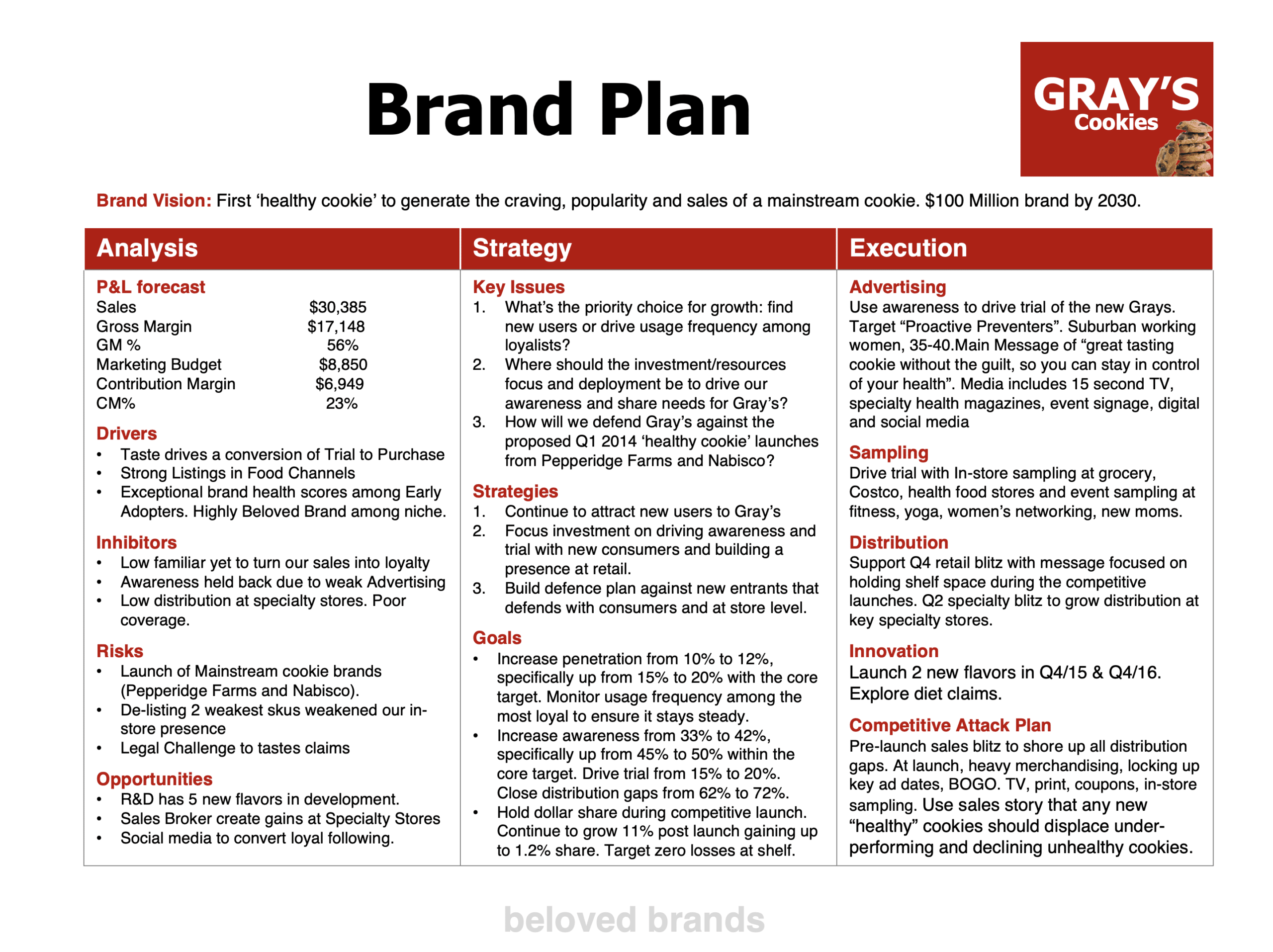
Strategy Statement Example: Gray’s Cookies
Let’s see how this works for a fictional cookie brand:
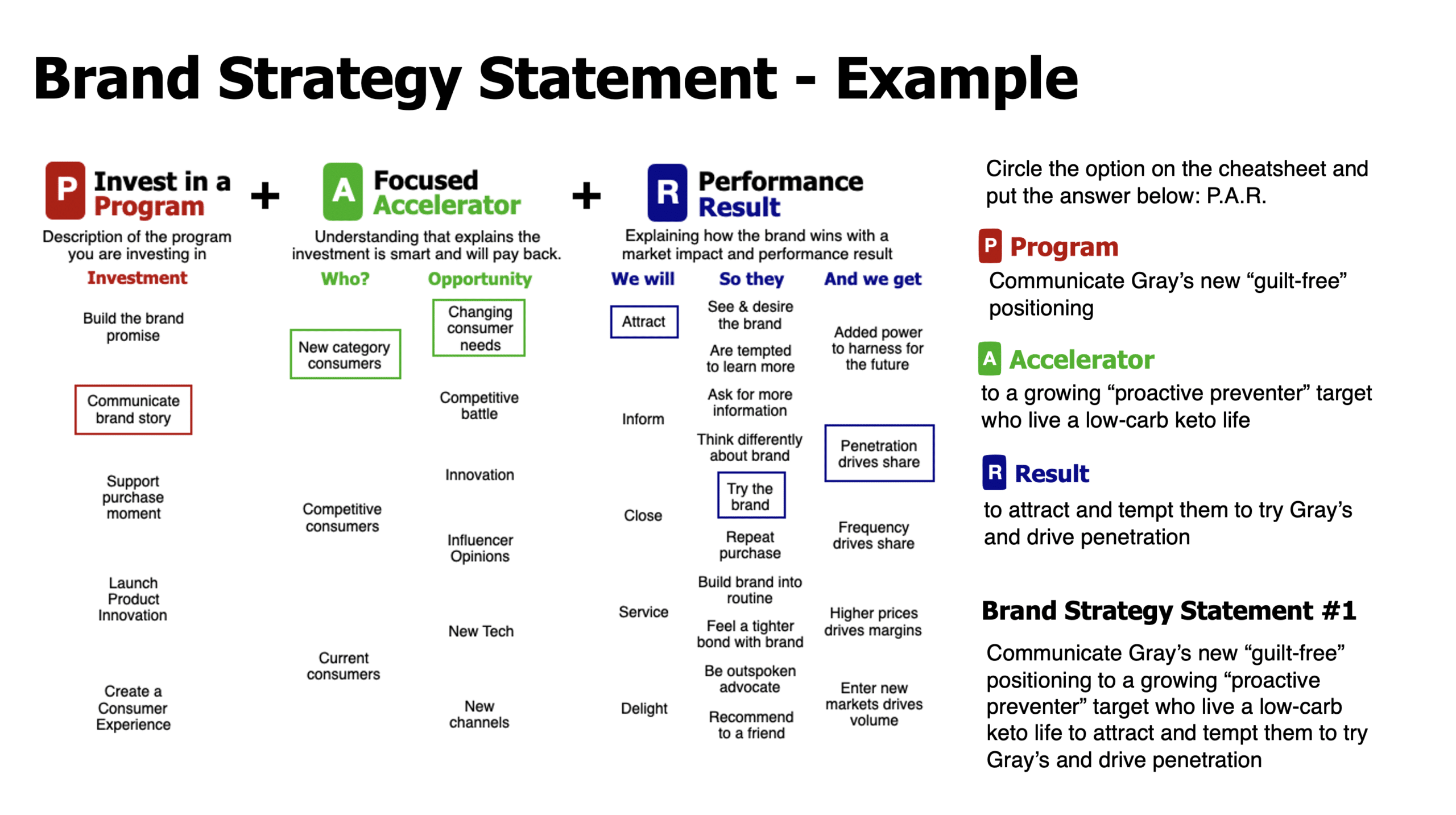
PROGRAM:
- Communicate Gray’s new “Guilt-Free” positioning.
ACCELERATOR:
- To a growing proactive preventer target who lives a low-carb keto lifestyle.
RESULT:
- To attract and tempt them to try Gray’s and drive a higher market share.
Complete Strategy Statement:
- Invest in communicating Gray’s new ‘Guilt-Free’ positioning to the growing proactive preventer target living a low-carb keto lifestyle, to attract and tempt them to try Gray’s and drive higher market share.


Step 7: Create Marketing Tactical Plans
What are Marketing Tactics?
Tactics answer: “What specific actions will we take?”
While strategies provide direction, tactics are the detailed action plans that make strategies real.
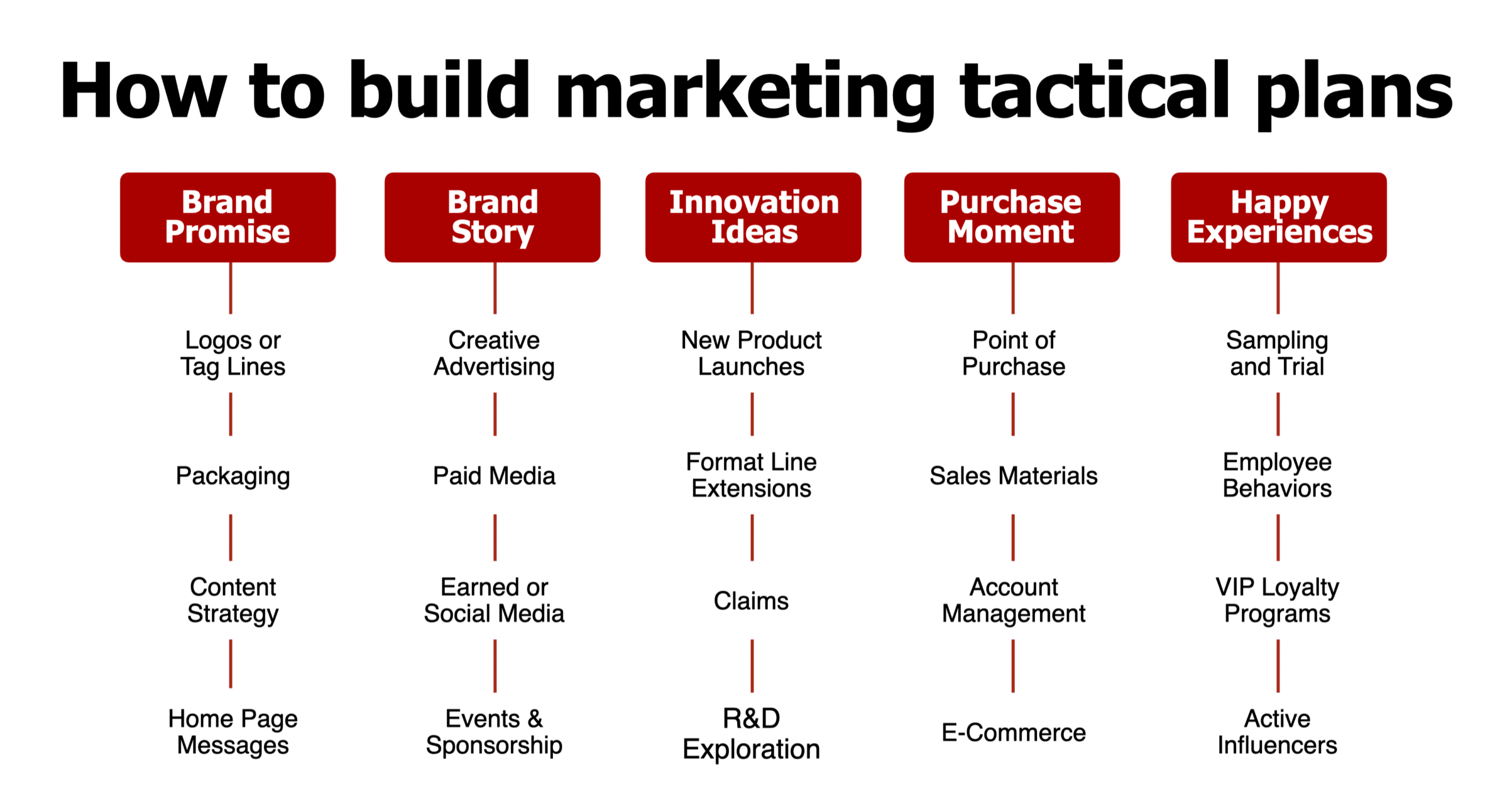
Essential Tactical Plans in Your Marketing Plan
1. Marketing Communication Plan
- Campaign themes and messages
- Media mix and channel strategy
- Content calendar
- Budget allocation by channel
- Creative development timeline
2. Innovation/Product Plan
- New product launches
- Product improvements
- Line extensions
- Packaging updates
- Testing and validation
3. Sales/Retail Plan
- Distribution expansion
- Trade promotion strategy
- Sales enablement tools
- Retail partnerships
- In-store activation
4. Digital Marketing Plan
- Website optimization
- SEO/SEM strategy
- Social media programs
- Email marketing campaigns
- Marketing automation
5. Customer Experience Plan
- Journey mapping improvements
- Touchpoint optimization
- Customer service enhancements
- Loyalty program development
Tactical Plan Components
Each tactical area should include:
- Objectives
- What this tactic will specifically accomplish
- Target Audience
- Who this tactic reaches
- Key Activities
- Detailed action items with owners
- Timeline
- Month-by-month implementation schedule
- Budget
- Resource allocation and expected ROI
- Metrics
- How success will be measured
Step 8: Build Marketing Execution Plans
Why Execution Plans Matter
Execution plans translate high-level tactics into specific instructions that leave no room for misinterpretation. Each major investment area needs its own execution plan.
Brand Communication Execution Plan
- Campaign Overview
- Campaign name and theme
- Key messages and positioning
- Duration and flight dates
Creative Strategy
- Creative brief summary
- Tone and style guidelines
- Tagline and call-to-action
Media Plan
- Channel mix (TV, digital, print, OOH, etc.)
- Reach and frequency targets
- Budget by medium
- Flight schedule
Asset Requirements
- Creative deliverables needed
- Specifications and formats
- Approval process and timeline
Measurement Plan
- KPIs and success metrics
- Tracking methodology
- Reporting cadence
Innovation Execution Plan
- Product Details
- Product name and description
- Target consumer and benefit
- Pricing and positioning
- Development Timeline
Sales/Retail Execution Plan
- Distribution Strategy
- Target channels and accounts
- Geographic priorities
- Placement objectives
- Trade Marketing
Promotional calendar
- Trade deals and discounts
- Co-op advertising
- Sales materials
- Merchandising
- Display requirements
- Shelf placement strategy
- Point-of-sale materials
- Planogram standards
Marketing Plan Examples and Case Studies
Example 1: Consumer Brand Turnaround
Brand: Regional Cookie Company
- Situation: Still relatively new, decide on new users or usage frequency.
- Vision: Become the #1 better-for-you cookie brand in the region within 5 years
Key Strategies:
- Reposition Gray’s as “guilt-free indulgence” targeting health-conscious consumers
- Invest in product innovation with keto and low-sugar lines
- Expand distribution into health food stores and gyms
Results: 28% sales growth in year one, market share increased from 8% to 12%
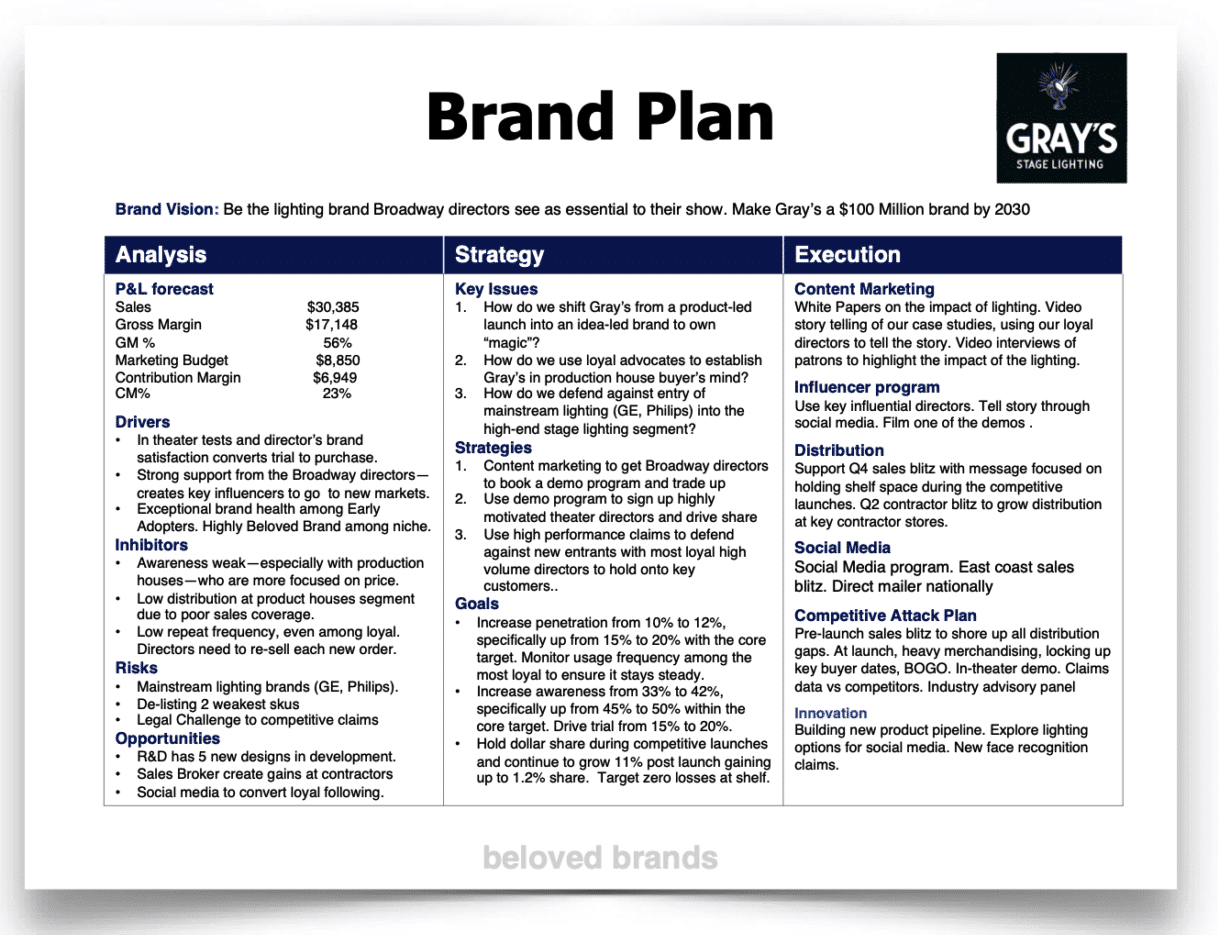
Example 2: B2B Stage Lighting Growth Plan
Brand: Gray’s Stage Lighting
- Situation: Slow growth in a competitive market
- Vision: Triple ARR to $150M in 3 years
Key Strategies:
- Launch new “magic” positioning to tempt Broadway theater directors to book a demo, which will drive conversion.
- Use the sales demo program to sign up motivated theater directors.
- Launch high-performance claims that defend against new entrants.
Results: 156% ARR growth in 18 months, 45% reduction in customer acquisition cost
Common Marketing Plan Mistakes to Avoid
Mistake #1: Messy, Confusing Story
The Problem:
You’re presenting to senior leadership, but the narrative is jumbled, slides are out of order, or the logic doesn’t flow.
The Fix:
- Follow a clear structure (vision → analysis → issues → strategies → tactics)
- Use the marketing plan template provided
- Get feedback from a colleague before presenting
Mistake #2: Trying to Do Too Much
The Problem:
Spreading limited resources across too many initiatives means none get enough investment to make a real impact.
The Fix:
- Limit yourself to 3 major strategies
- Say “no” to good ideas to protect great ones
- Ensure each strategy has sufficient resources
Mistake #3: Lack of Team Alignment
The Problem:
Parts of the organization don’t buy into the plan or weren’t consulted during development.
The Fix:
- Involve sales, operations, and R&D early in planning
- Share drafts and gather input before finalizing
- Create clear ownership and accountability
Mistake #4: Too Many Slides
The Problem:
A 127-slide deck (yes, I’ve seen it) loses the audience and buries key points.
The Fix:
- Maximum 20-25 slides for annual plan presentation
- Use the appendix for supporting details
- One key idea per slide
Mistake #5: No Clear Metrics
The Problem:
Vague goals like “increase awareness” or “improve brand perception” without quantifiable targets.
The Fix:
- Set specific, measurable goals for each strategy
- Define both leading and lagging indicators
- Establish baseline and target
Mistake #6: Ignoring Budget Reality
The Problem:
Ambitious plans that require resources you don’t have and won’t get approved.
The Fix:
- Start with realistic budget parameters
- Prioritize based on ROI potential
- Build a business case for incremental investment
Mistake #7: Copy-Paste from Last Year
The Problem:
Recycling last year’s plan with new dates and minor tweaks.
The Fix:
- Conduct a fresh situation analysis annually
- Identify new opportunities and threats
- Learn from what worked (and didn’t) last year
Frequently Asked Questions About Marketing Plans
What should be included in a marketing plan?
A complete marketing plan includes:
- Executive Summary – High-level overview (1-2 pages)
- Vision and Goals – Where you’re going and what you’ll achieve
- Purpose and Values (for branded house) – Why you exist and what you stand for
- Situation Analysis – Current market position and SWOT
- Key Issues – Critical challenges to address
- Marketing Strategies – How you’ll achieve goals
- Tactical Plans – Specific programs (communication, innovation, sales)
- Budget – Resource allocation across programs
- Timeline – Month-by-month implementation schedule
- Metrics and Dashboard – How success will be measured
How long should a marketing plan be?
- Presentation version: 15-25 slides maximum for senior leadership review
- Document version: 10-20 pages for working document
- One-page summary: Create an executive summary or “plan on a page” for quick reference
The key is being comprehensive without being overwhelming. Use appendices for detailed supporting analysis.
How often should you update your marketing plan?
Annual Plans:
Create a new comprehensive marketing plan each year, typically aligned with fiscal year planning.
Quarterly Reviews:
Review progress, adjust tactics, and reallocate resources based on performance every 90 days.
Monthly Check-ins:
Monitor metrics, troubleshoot issues, and ensure execution stays on track.
As-needed Updates:
Revise when major market shifts occur (new competitors, economic changes, regulatory updates).
What are the 4 P’s of a marketing plan?
The 4 P’s (Marketing Mix) are often included in marketing plans:
- Product – What you’re selling, features, benefits, quality, design
- Price – Pricing strategy, discounts, payment terms
- Place – Distribution channels, availability, logistics
- Promotion – Advertising, sales promotion, PR, communications
How do you write a marketing plan for a small business?
Small business marketing plans can be simpler, but should still include:
Business Goals – Revenue targets, customer acquisition goals
Target Audience – Who you’re trying to reach (be specific!)
Unique Value Proposition – Why customers should choose you
Competitive Analysis – Who you’re up against and how you’re different
Marketing Strategies – 2-3 focus areas (not everything!)
Tactics – Specific activities (social media, email, local ads, partnerships)
Budget – What you can realistically afford
Metrics – How you’ll track success
Pro tip: Start with a one-page plan and expand as you execute and learn.
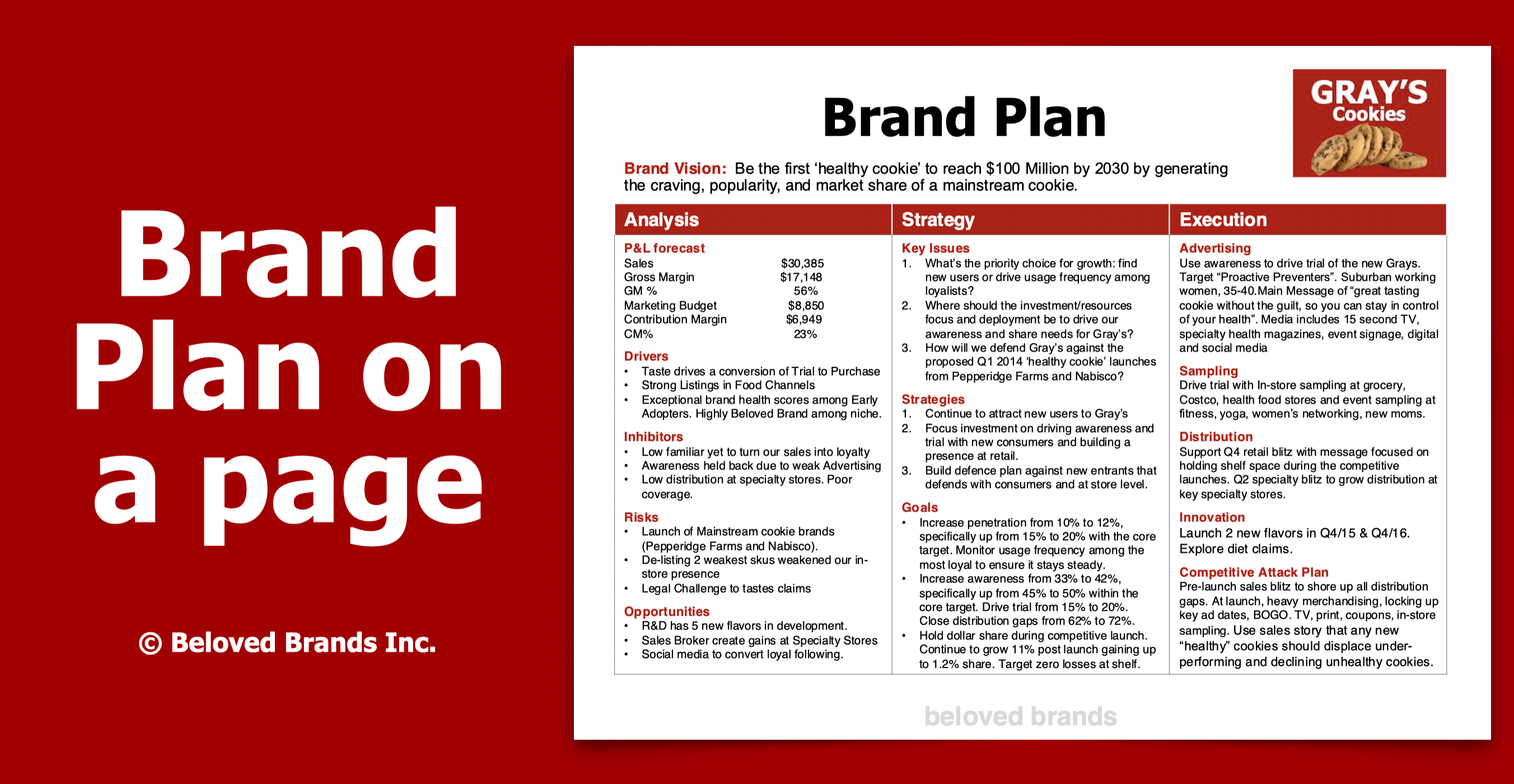
What is a one-page marketing plan?
A one-page marketing plan condenses your entire strategy onto a single sheet, including:
- Vision at the top
- Analytics to the left
- Key issues, strategies and goals in the middle
- Major execution to the right
Benefits:
- Forces clarity and prioritization
- Easy to share and reference
- Keeps team aligned
- Quick to update
How far in advance should you create your marketing plan?
Ideal timeline:
- 2 months to conduct a deep-dive business review
- 1 month to build a plan, including vision, key issues, and strategy
- 1 month to build out the execution plans
- Build in 2-4 weeks for socialization and approval
About the Author
Graham Robertson is the founder of Beloved Brands and a former VP of Marketing at Johnson & Johnson, with extensive experience at Coca-Cola and General Mills. Over his 20+ year career, he has created, reviewed, and approved hundreds of marketing plans for leading consumer brands.
Graham specializes in helping marketers develop strategic thinking skills and create plans that get approved and drive business results. His training programs and consulting services have helped marketing teams at consumer, B2B, healthcare, and retail brands.
Contact:
graham@beloved-brands.com
416-885-3911
Related Articles:
Last Updated: February 13, 2026
Reading Time: 18 minutes


