Most media plans start with a channel list. A stronger media plan starts with the consumer and works its way toward the channels.
The media planning process is the strategic work of deciding how, when, and where to reach your consumer so your message moves them along their journey toward your brand. It sits upstream of media buying. Planning sets the direction. Buying carries it out. When teams skip the planning and jump straight to channels, they spread budget thin, optimize for platform metrics instead of business results, and wonder why a plan that looked good on paper failed to move the needle.
The version below runs on six questions. It opens with your consumer relationship and your brand strategy, then works through the journey, the moments, the creative formats, and the money. The answers come from the strategy work you have already done in your brand plan, your positioning, and your consumer target profile. Each question feeds the next.

The six questions that guide a media plan
Question 1: How tight is the bond with your consumers?
Before you decide where to show up, decide how well your consumers already know you. The Brand Love Curve gives you five stages: Unknown, Indifferent, Like It, Love It, and Beloved. Where you sit changes what your media has to accomplish.
A brand that is still Unknown needs to break through the clutter with distinctive, attention-grabbing communication. An Indifferent brand needs insight-led positioning so consumers finally see why it matters to them. A brand that consumers Like It can lean on product proof and happy experiences to earn repeat and routine. A Loved brand can build emotional connection and reward its fans. A Beloved brand can hand its fans something talk-worthy and let them carry the message outward.
One subtlety worth holding onto: your media target is wider than your creative target. You write creative for a tightly defined consumer, then you place it where a broader pool of like-minded people can find it. The bond question tells you how big that gap is and where the biggest upside to move sits.

Question 2: Where can you impact the consumer journey?
Map the journey your consumer actually travels: Aware, Consider, Search, Buy, Satisfied, Repeat, Loyal, and Fan. Three forces move people around that loop.
Desire builds long-term demand through emotional storytelling that reinforces your positioning and turns memory cues into brand assets. Activation converts the moment, informing and triggering high-intent consumers to buy, repeat, or subscribe. Trusted Influence fuels growth by turning engaged fans into vocal advocates who attract new buyers through trust rather than advertising. The long-running work by Les Binet and Peter Field for the IPA makes the same point in the data: brand building plus activation drives sustained growth, while activation alone delivers only short-term spikes.
Your job is to find the stage with the biggest opportunity gap and aim there. A new brand with a small base of fans usually has its largest upside at the Aware-to-Consider stage, where the priority is to attract people who do not yet know the brand and move them to consider it. A mature brand might find its gap in repeat and loyalty instead. The brand funnel and your consumption data show where consumers drop off, indicating whether growth comes from building penetration or strengthening loyalty.

Question 3: What is your brand's core strength?
Media should line up behind the one thing your brand is built to win on. There are four core strengths, each pointing to a different kind of media.
- Product-led brands win by being better, so they need demonstrations and proof of superiority that show the difference.
- Story-led brands win by being different, so they need broad reach and emotional storytelling to build a fan base.
- Experience-led brands win by being memorable, which depends more on consumer participation and word of mouth than on paid reach.
- Price-led brands win by being cheaper, so they run efficient, always-on conversion media with a clear call to action.
Naming the strength keeps the plan honest. If a brand has stalled as just another “better product” in a crowded category, the answer is often to shift investment toward the brand story so the brand can own a difference that a feature claim never could.

Question 4: When and where is your target most open?
The same consumer is a different person on Monday at 8:15am than on Friday at 10:30pm. Media planning is the search for the moments when your message lands hardest, the windows of mental availability when someone is actually open to hearing from you.
Look at three timescales. The day-in-the-life surfaces moments like the low-attention morning routine, the lunchtime decision window, the mid-afternoon scroll break, and the evening reflection mode, each suited to a different kind of message. The week in the life adds its own rhythm, from Monday reset mode through Friday reward mode and the weekend experience mode. Life moments raise the stakes further, with milestones like a first real job, a first child, or a fortieth birthday reshaping what someone is open to.
The test for this answer is whether it is specific enough to inspire a media expert to bring their own creativity. “Adults 25 to 54” inspires nothing. “Catch her at 6 am post-workout, mid-day scrolling the wellness creators she trusts, and at 3 pm when the craving hits, and she needs an answer that does not derail her day” gives a planner something real to work with.

Question 5: Which media choices best deliver the creative?
Here is the shift that separates modern media planning from the old TV-plus-digital habit. Start with the creative idea, then choose the media. Plan format-first, not channel-first.

Four formats carry almost any idea, and each plays a distinct role:
- Video inspires people to feel something through motion, sound, and emotional storytelling, across TV, streaming, YouTube, paid and organic social, and retail.
- Billboard catches people where they are with a simple, bold idea that connects instantly, across out-of-home, digital display, social statics, shelf signage, and pack design.
- Long Copy tempts the curious to go deeper, across landing pages, blog and SEO articles, product detail pages, email, podcasts, and FAQ content.
- Human draws people in to feel part of the brand through real people they trust, across creators, influencers, reviews, expert spokespeople, sampling, and word of mouth.
Once you know the role, the same idea can flex across every channel within that format, which is how a single creative platform reaches consumers at every stage of the journey. Pressure-test each execution against your ABCS standard of Attention, Brand link, Communication, and Stickiness, and balance your use of paid, earned, shared, and owned media. Your media decisions should come from what you need the consumer to see, think, feel, or do, not from a channel you happen to like.

Question 6: What is the budget size?
You do not set a media budget first. You set a revenue growth target first, then work out the investment level that target requires.
Start with the revenue and profit you are trying to hit, then model the variables that get you there: household penetration, buying rate, frequency, price, and cost of goods. The incremental gross margin those variables produce is the fuel available to invest. A budget set at a healthy percentage of sales should be justified by the incremental margin it is expected to generate, and broken down with a rationale across in-store, consumer insights, production, and working media.

The move to an OmniChannel approach creates a real financial risk worth managing closely. More touchpoints mean more content, which means production costs climb and a smaller share of the budget actually reaches the consumer.
Watch your working-to-non-working ratio and protect the dollars doing the reaching, with a target around 75 percent working.
Three production habits keep the ratio healthy. Reduce production cost by using AI to generate variations, cutdowns, and platform-specific formats. Reuse a master creative platform so one shoot becomes many assets with consistent brand codes. Recycle great work by keeping it in market longer and leaning on wear-in rather than constant refreshes.
The principle underneath all three is simple: build assets, not ads, and spend less on making so you can spend more on showing.


The new efficiency: crowds following crowds
The old TV model bought efficiency through a single big production amortized across a year of airtime. The new model finds a different kind of efficiency. When you get your brand fans to spread the word, you create awareness that paid media cannot buy, because trust now flows peer-to-peer rather than brand-to-consumer. Designing your plan so that crowds can follow crowds and discover your brand is the modern version of working harder for every dollar.

That is why the best media plans do not start with channels. They start with the consumer, the brand strength, the strategy, and the opportunity to invest. Channels come last, after the six questions have done their work.
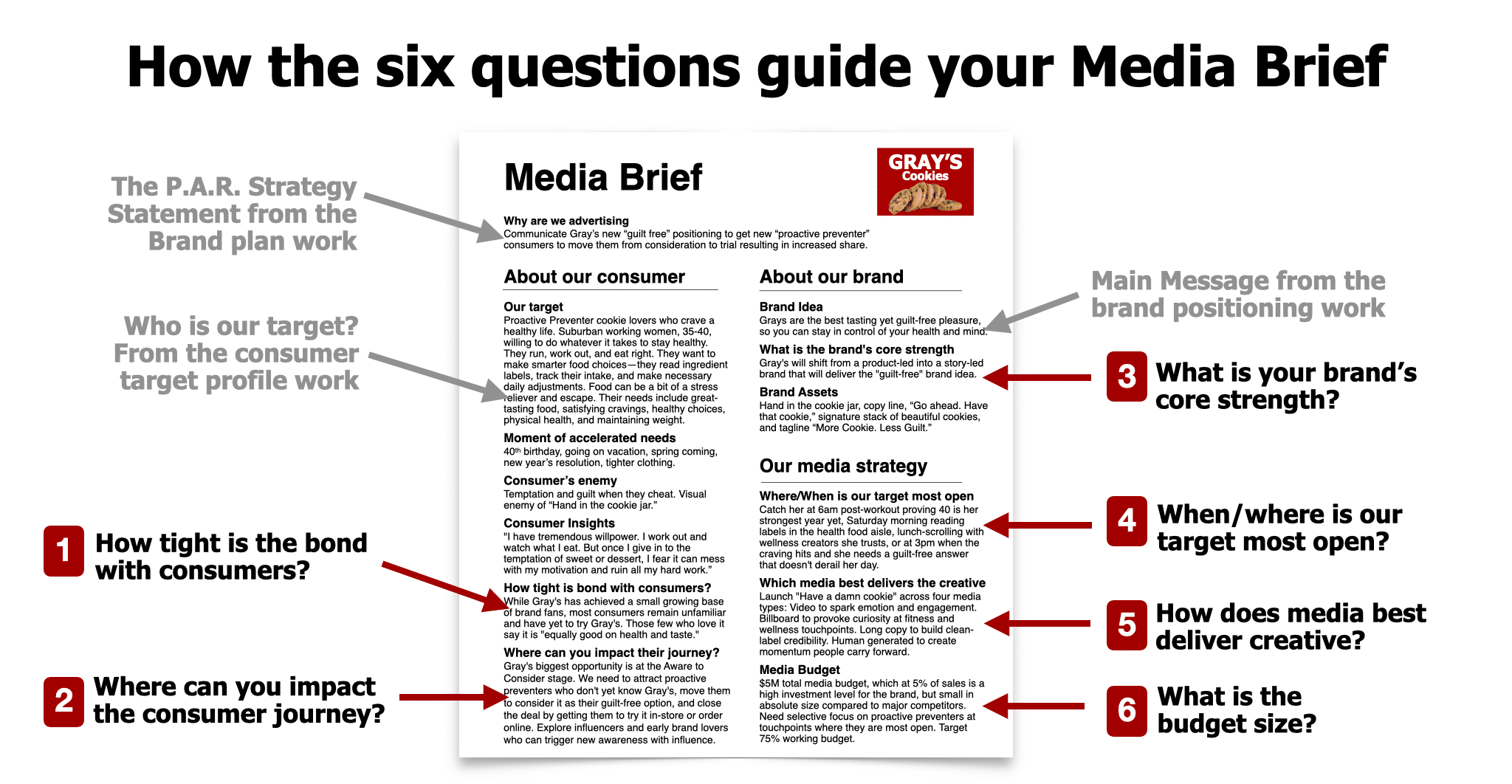
If you want the one-page tool that turns these six answers into a Media Brief document, your creative and media partners can act on, which packages the consumer, the brand, and the media strategy onto a single page.
Frequently Asked Questions - Media Planning
What is the difference between media planning and media buying?
Media planning is the strategic decision about how, when, and where to reach your consumer so the message moves them toward your brand. Media buying is the execution: negotiating and purchasing the time and space. Planners set the direction and buyers carry it out, and skipping the planning step usually means making tactical decisions without a strategic foundation.
What is a media brief?
A media brief is the one-page document that captures the strategy behind a media plan, covering your consumer target, the brand idea and core strength, where to impact the journey, when and where the target is most open, the media approach, and the budget. It translates the six planning questions into a single page that aligns your creative and media partners.
What are the steps in the media planning process?
Answer six questions in order: how tight the bond is with your consumers, where you can impact the consumer journey, what your brand’s core strength is, when and where your target is most open, which media formats best deliver the creative, and what budget size the growth target requires.
How do you set a media budget?
Start with the revenue and profit target, model the penetration, frequency, price, and cost-of-goods variables that reach it, and let the incremental gross margin set the ceiling on what you can invest. Then split the budget across in-store, insights, production, and working media, and protect the working-to-non-working ratio.