Most brand managers learned their craft on the store shelf. You know how to fight for facings, build an end-aisle display, and design a pack that stands out from 10 feet away. Then you look at your numbers and realize a growing share of your business now happens on a 6-inch phone screen, and e-commerce for brand managers needs a different set of skills.
I see this in almost every marketing team I train. The e-commerce team owns the retailer relationships and the dashboards, while the brand team stays a step removed. That gap costs brands sales. The product page is now your package, your shelf talker, and your salesperson all in one, and the brand manager should own what it says.

This is a 101 guide to get brand managers up to speed on the digital shelf. It covers what drives online sales, the decisions you need to make, and the terms you’ll hear in your first meeting with the e-commerce team.

Why e-commerce matters for brand managers
Shoppers have moved online for convenience. Delivery and click-and-collect save the trip to the store, delivery apps like Instacart and Uber Eats put groceries an hour away, and subscriptions lock in repeat purchases without the shopper ever thinking about your brand again. Most of that searching and buying happens on a phone.
How much this matters depends on where you sell. If you run a brand across several countries, your e-commerce plan should change by market.

In high-share markets like China, the UK, and South Korea, online is a core channel. Your digital shelf needs the same investment and attention as your physical shelf. In mid-share markets like the US, Australia, and Japan, online is growing fast, so build the capability now, before it becomes a third of your business. In lower-share markets like Germany, France, Canada, and Brazil, online is still small. Focus on getting the basics right with one or two key retailers.
The first decision for any global brand team is which markets need a full e-commerce plan and which just need the basics.
How e-commerce share varies by category
Country is one lens. Category is another, and for many brand managers it matters more.

Categories that shoppers research, compare, or buy on a regular schedule have moved online fastest. Nearly half of US health and beauty, baby care, and pet care sales now happen online. Shoppers search for the right product once, check reviews, and then reorder from their “Buy Again” list or a subscription.
Food has moved more slowly at about 10%, because shoppers still like to pick their own produce and grab what they need on the way home. It’s still the fastest-growing piece of most grocery businesses, so a food brand manager can’t wait.
If you run a brand in health, beauty, baby, or pet, your product page is already doing half the selling. Treat it with the same care as your pack.
The e-commerce sales formula: Traffic × Conversion × Price
Every online sale comes down to three levers that multiply together.
Traffic is how many shoppers land on your product page, driven by search, retail media, and creators. Conversion is the share of those shoppers who actually buy, driven by your images, content, reviews, and availability. Price is what each shopper pays, including pack size, price per unit, and promotions.

Here’s how the levers trade off. Gray’s Cookies on Amazon gets 100,000 page views a month, converts 5% of them, and sells at $6.00. That’s $30,000 a month.
Now Gray’s takes a 10% price increase to $6.60.
Traffic holds steady, but some shoppers switch to cheaper options and conversion drops to 4.8%. The result is $31,680 a month, a 5.6% gain, because the higher price more than covers the lost orders.
If conversion falls to 4.5% instead, Gray’s drops to $29,700 and loses money on the same price increase. Shopper loyalty decides whether a price move pays off. A brand with strong love can raise prices online. A brand that shoppers see as interchangeable will watch them click to the next option on the same screen.
Use the e-commerce sales formula to find the lever holding your brand back, and fix that one first.

How to drive traffic on the digital shelf
Know the four places shoppers search
Search used to mean Google. Today, your shopper searches in four places, and each one plays a different role.

Retail search on Amazon, Walmart, and Instacart is where the shopper is ready to buy, and ranking depends on keywords, sales velocity, and reviews. Google search is where shoppers research, compare, and look for recipes or ideas. Social search on TikTok and Instagram is where they discover products through creators, especially younger buyers. And AI answers from ChatGPT, Gemini, and Google now hand shoppers a short list of recommendations. Getting onto that list depends on your reviews, consistent product information, and mentions across credible sources.
Start by figuring out where your shoppers search before they buy.
Win the search before the shopper scrolls
Most online shoppers never look past the first page of results. Your ranking depends on how well your page matches what the shopper typed and how fast your product sells. Retailers reward products that already sell, so velocity builds on itself.
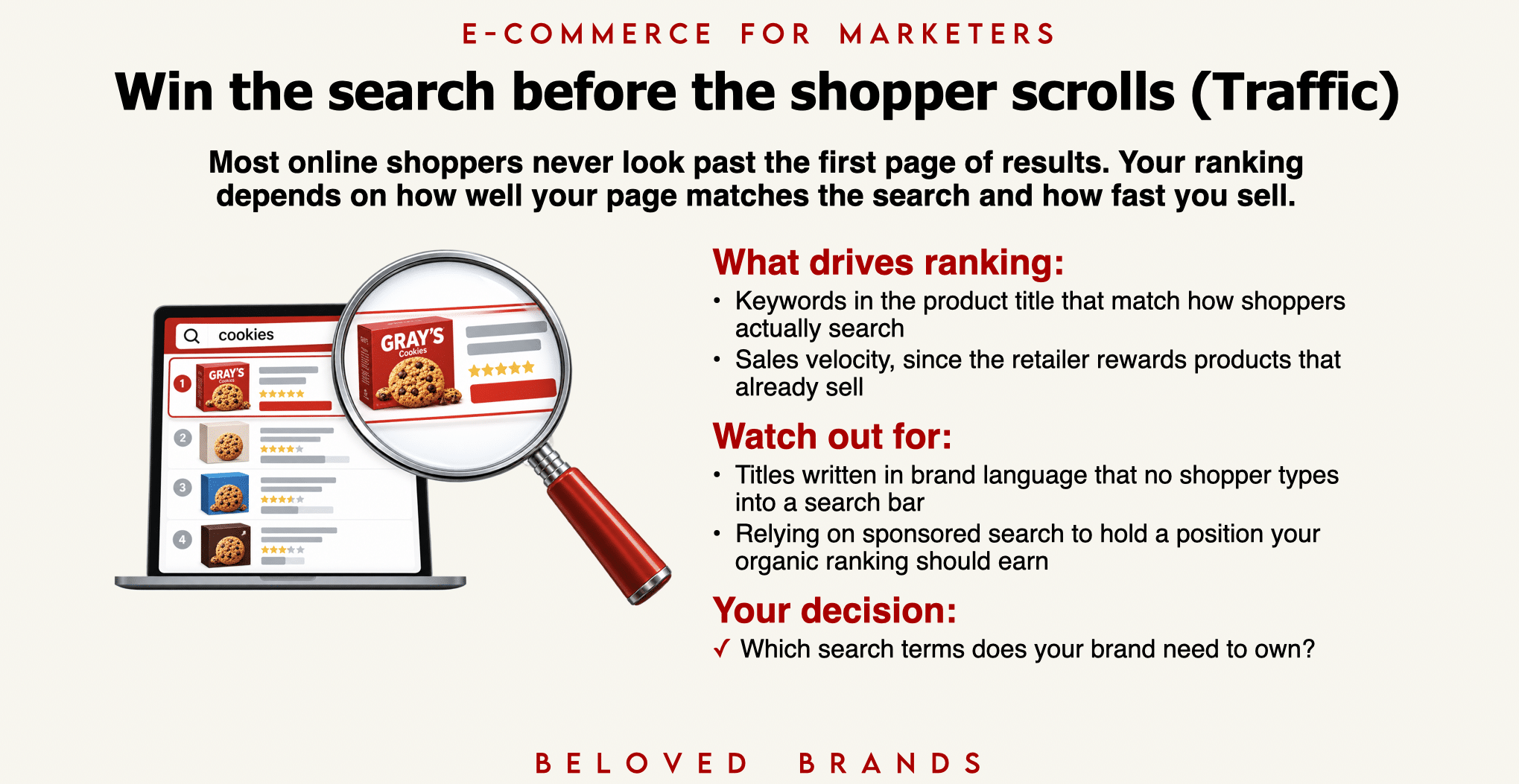
The most common mistake I see is using brand language in product titles. Your team might love the name “Golden Morning Delight,” but no shopper types that into a search bar. They type “butter cookies.” Put the words shoppers actually use into your title, and decide which search terms your brand needs to own.
Use retail media to buy your way onto the first page
Retail media is advertising that retailers sell on their own sites, with sponsored products sitting at the top of search results. It’s the fastest way to get seen on the digital shelf, and it has quickly become a major line in most brand budgets.

Use retail media when launching a new item that has no sales history or ranking yet, when defending your brand name from competitors bidding on it, or when going after a competitor’s shoppers on their branded searches.
Be careful about judging success on ROAS alone, since some of those sales would have happened anyway. And never pay for traffic to a page that won’t convert. The real decision is how much retail media should carry and what your organic ranking should earn on its own.
Use creators to spark discovery
Creators send shoppers straight to your product page through links, affiliate codes, and shoppable posts on TikTok Shop, Instagram, and Amazon storefronts. They work best when your target already discovers products through creators they trust, or when a new launch needs buzz and early reviews. Pick creators whose followers match your target, since it’s easy to pay for the wrong reach.
How to win on the product detail page
How to win on the product detail page
The product detail page, or PDP, is where the purchase decision happens. Shoppers decide in seconds, mostly on a phone. Your hero image needs to read clearly at thumbnail size, showing your brand, product, and size. Your title and bullets should lead with the consumer benefit, and enhanced content further down the page can tell the brand story.
The two biggest mistakes are copying the back of the pack onto the page and using images built for a store shelf that turn into a blur on a phone. Ask yourself whether your page sells the brand idea or just lists the features.
Use ABC’S to build a product page that sells
The same ABC’S test you use to judge advertising works on your product detail page.
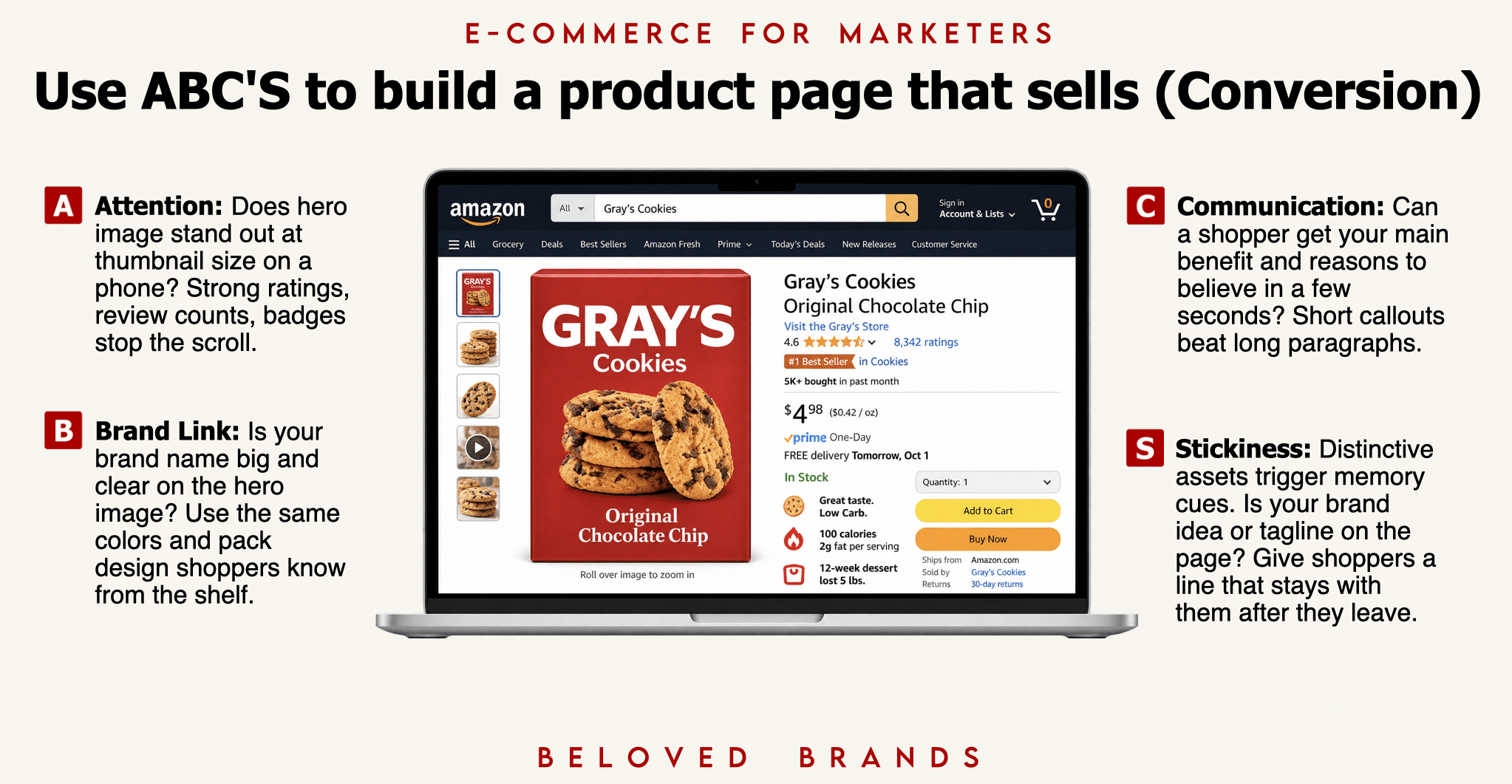
- Attention: Does your hero image stand out at thumbnail size on a phone? Strong ratings, review counts, and badges help stop the scroll.
- Brand Link: Is your brand name big and clear on the hero image? Use the same colors and pack design shoppers know from the shelf.
- Communication: Can a shopper get your main benefit and reasons to believe in a few seconds? Short callouts beat long paragraphs.
- Stickiness: Distinctive assets trigger memory cues. Put your brand idea or tagline on the page, and give shoppers a line that stays with them after they leave.
Reviews are the new word of mouth
Star ratings and review counts are often the first thing a shopper checks, and they show up right beside your competitor’s. You need enough reviews to build trust, especially on a new item, and a rating that holds above four stars.

Launching a new item with zero reviews is a slow start you can avoid with a plan. Pay close attention to negative reviews too, because they often point to a real product problem your team needs to hear about. Every launch plan should answer how you’ll build reviews fast.
Stay in stock and priced right on the digital shelf
In a store, the shopper sees your competitor two feet away on the shelf. Online, the retailer shows them one the moment you run out or look expensive.

An out-of-stock drops you in search rankings, and delivery apps substitute a competitor straight into the shopper’s basket. You can also lose your spot on shoppers’ “Buy Again” lists, which is hard to win back. On price, shoppers sort by price and see price per unit beside every competitor on the same screen. Your store packs can look like poor value online, or arrive damaged. Look at your lineup and decide which SKUs are built to win on a screen.
Where to play and where to win online
Each online channel plays a different role for your brand.

Retailer sites like Walmart, Kroger, and Target extend your in-store business online and are often tied to the same joint business plan. Amazon operates like its own search engine, where ranking, reviews, and content decide who wins. Quick commerce players like Instacart and Uber Eats deliver fast, impulse-driven baskets with smaller assortments, so getting listed is half the battle. Direct to consumer is useful for data, testing, and bundles, but it’s rarely profitable on its own for low-priced products.
Go where your target expects to find your brand, and where your strengths give you a chance to win.
How to make e-commerce work for your brand
Bring it together with three sets of questions.

Start with what you need to know. Where does your target shop and search online? Where do you rank on your top search terms? How do your conversion rate, star rating, and online in-stock rate compare with competitors?
Then think it through. Is your page selling the brand or just listing features? Are you paying for traffic your page can’t convert? Does your pack and price work on a screen?
Then decide which search terms and retailers get priority, which channels match where your target is looking, and what needs fixing before you spend another dollar on traffic.
E-commerce definitions every brand manager should know
You’ll hear these terms in your first meeting with the e-commerce team. Save this list for later.

FAQ: E-commerce for brand managers
What is the digital shelf?
The digital shelf is the online equivalent of the store shelf. It covers everywhere a shopper can find and buy your brand, including search results, category pages, and product listings.
What is the e-commerce sales formula?
Sales = Traffic × Conversion × Price. Traffic is how many shoppers reach your product page, conversion is the share who buy, and price is what each one pays. Because the levers multiply, a weak one drags down everything you invest in the other two.
What should a brand manager own in e-commerce?
The brand manager should own what the product detail page says and how it looks, including the hero image, title, content, and brand story. The e-commerce team usually owns the retailer relationships, operations, and day-to-day retail media management.
Is retail media worth the money?
Retail media works best for launches, defending your brand name, and going after competitor shoppers. Fix your product detail page first, because paying for traffic to a page that won’t convert wastes your budget.
What is a good conversion rate on Amazon?
It varies widely by category and price point. Compare your conversion rate with your closest competitors rather than chasing an industry average.