Strategy is the discipline of choosing. You have a brand with limited resources of dollars, time, people, and partnerships, and you face an almost unlimited list of things you could do with them. A marketing strategy is how you decide which few moves will move your brand, and which good ideas you will walk away from so the important ones get fully funded.
When I was in business school, I had a marketing professor who said the same thing fifteen times a class: “It is all about choices.” He was right. A strong strategy does not try to do everything. It picks the smartest places to invest, names the change in the market it will ride, and commits to a result worth chasing.
A strategy statement is where that choice gets written down. It answers a key issue standing between your brand and its vision, in one sentence tight enough that your whole team knows what to do. This page is about how to write that sentence.
It’s all about choices!
When I was in business school, I had a marketing professor who would say 15 times per class, “It is all about choices. It is all about choices.” Accordingly, your brand strategy statement helps make those choices. Your brand plan is a great tool to make tough decisions. You have to apply your brand’s limited resources of dollars, time, people, and partnerships against unlimited choices. The strategy begins to limit those choices by picking the smartest options to invest in.
Marketing Strategy Statements - Table of Contents
The strategy statement captures three of your five strategic choices
Strong strategic thinking pulls together five elements: a vision of the future you want, the key issues blocking it, the program you will invest in, the accelerator you will ride, and the result you expect. The first two come before the statement. You set the vision and define the key issues first, then the statement answers them.
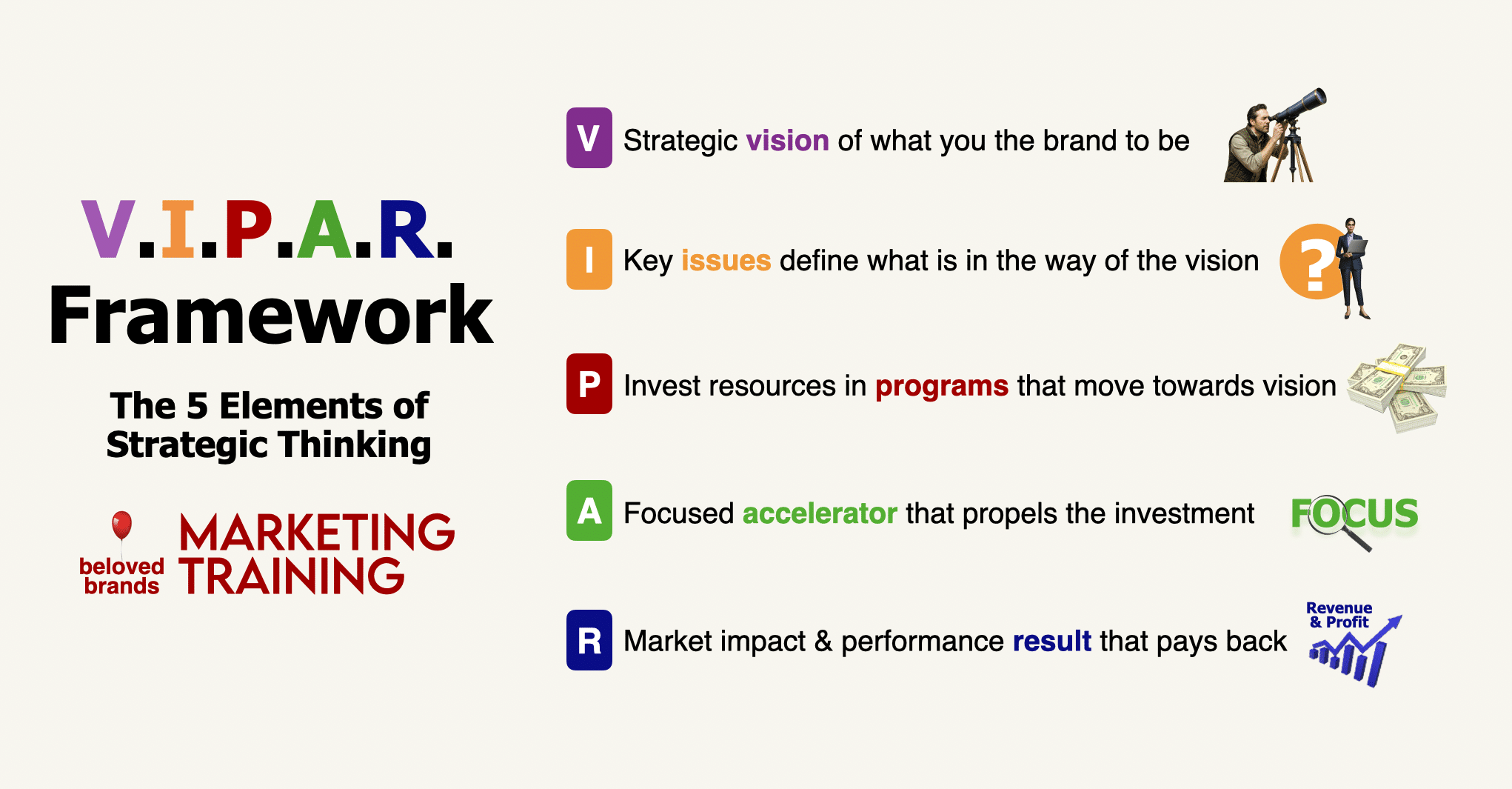
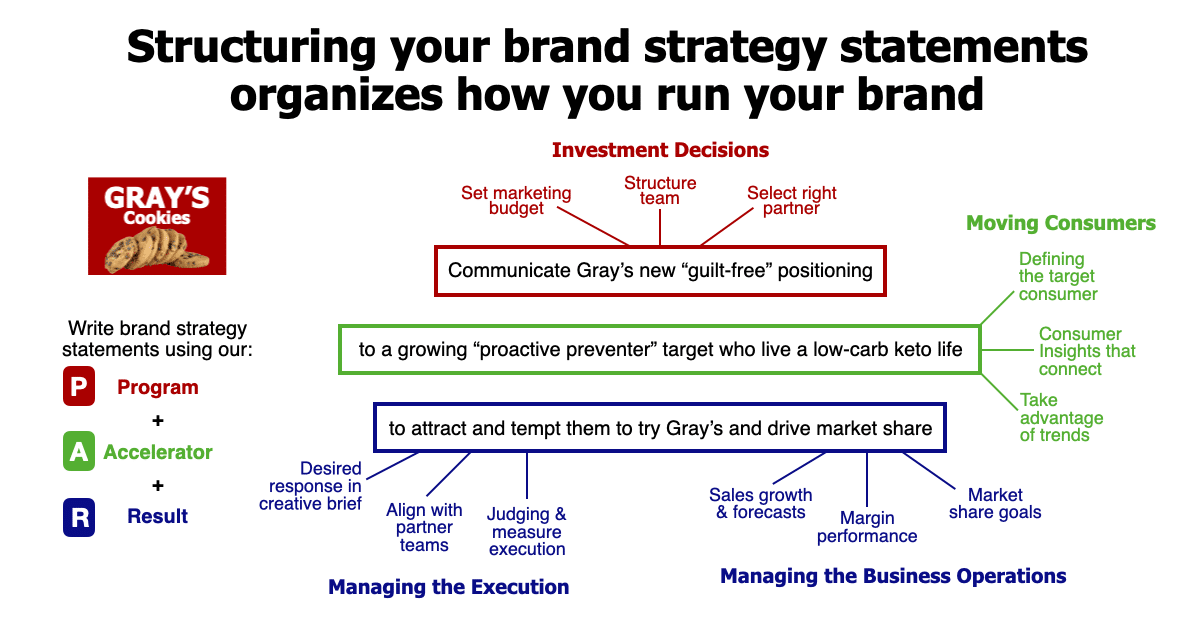
The strategy statement itself carries the other three. Program, Accelerator, Result. Get those three right in a single sentence, and you have a strategy a team can act on.
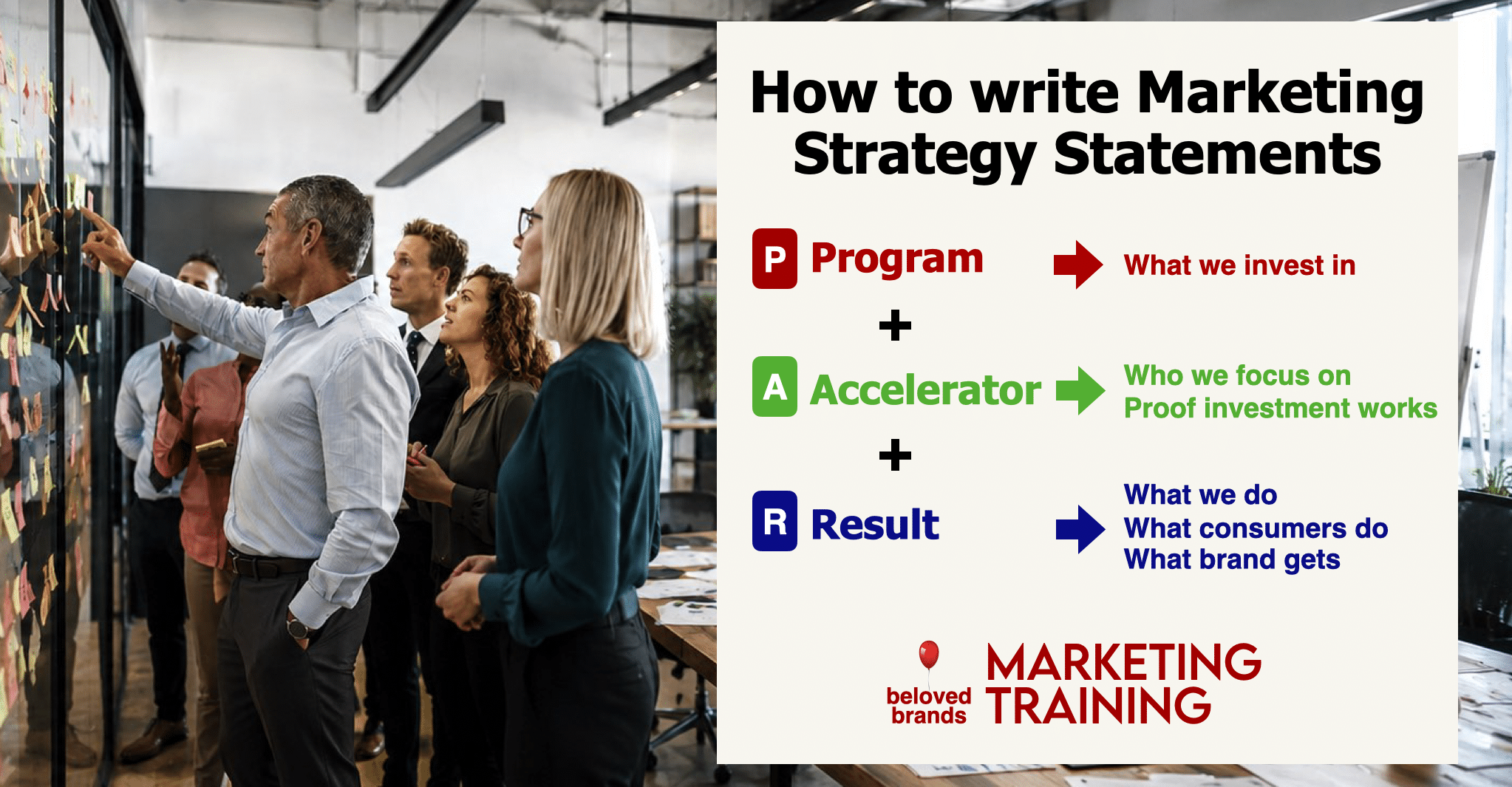
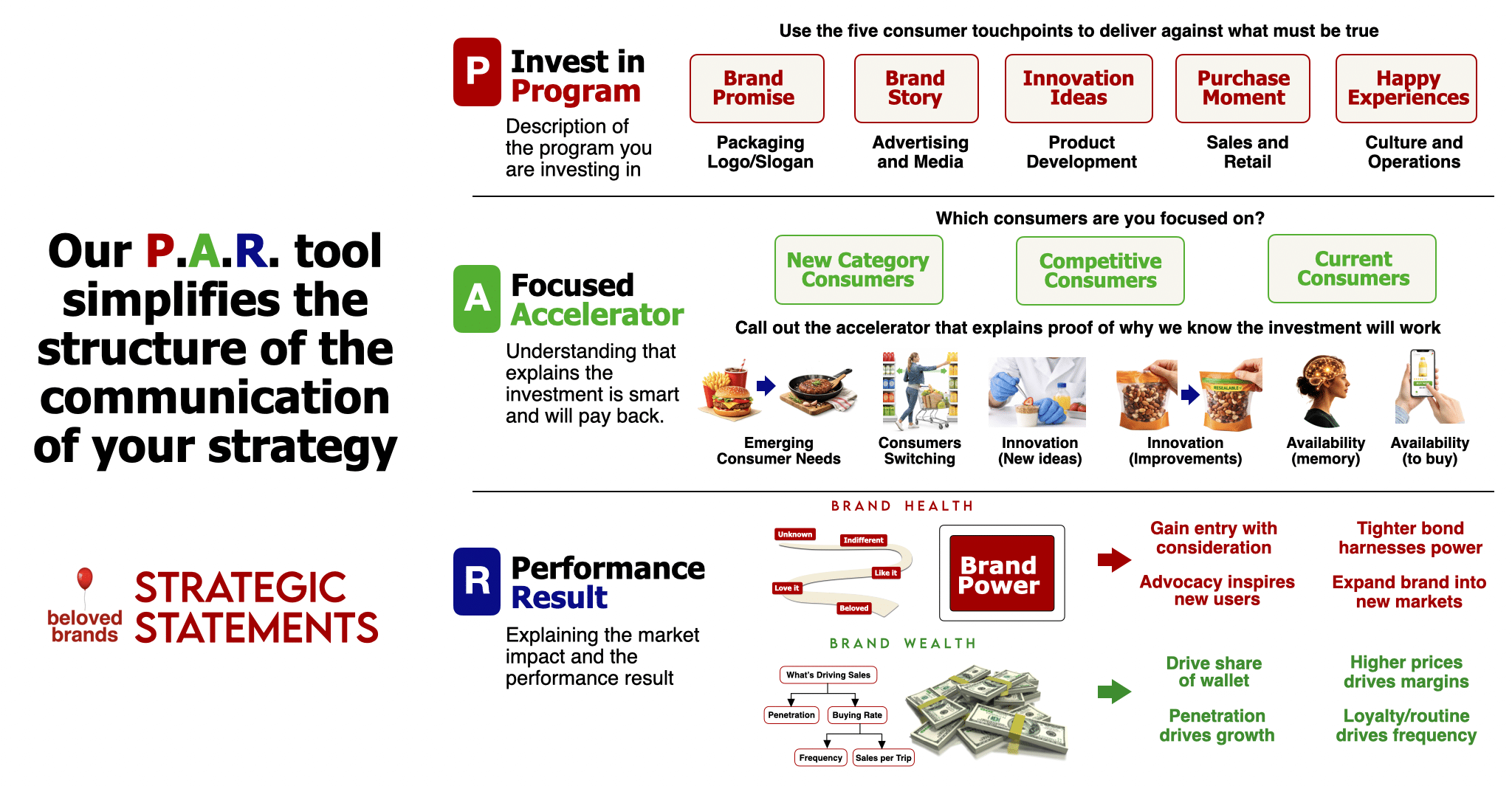
The P. A. R. Strategic Engine: Program + Accelerator + Result
Every marketing strategy I write follows one structure. You invest in a program that gets the consumer target to do something, leading to a result you can explain and defend.
Programs plus Accelerator plus Result. P + A + R.
P: Invest in programs that close the gap to your vision
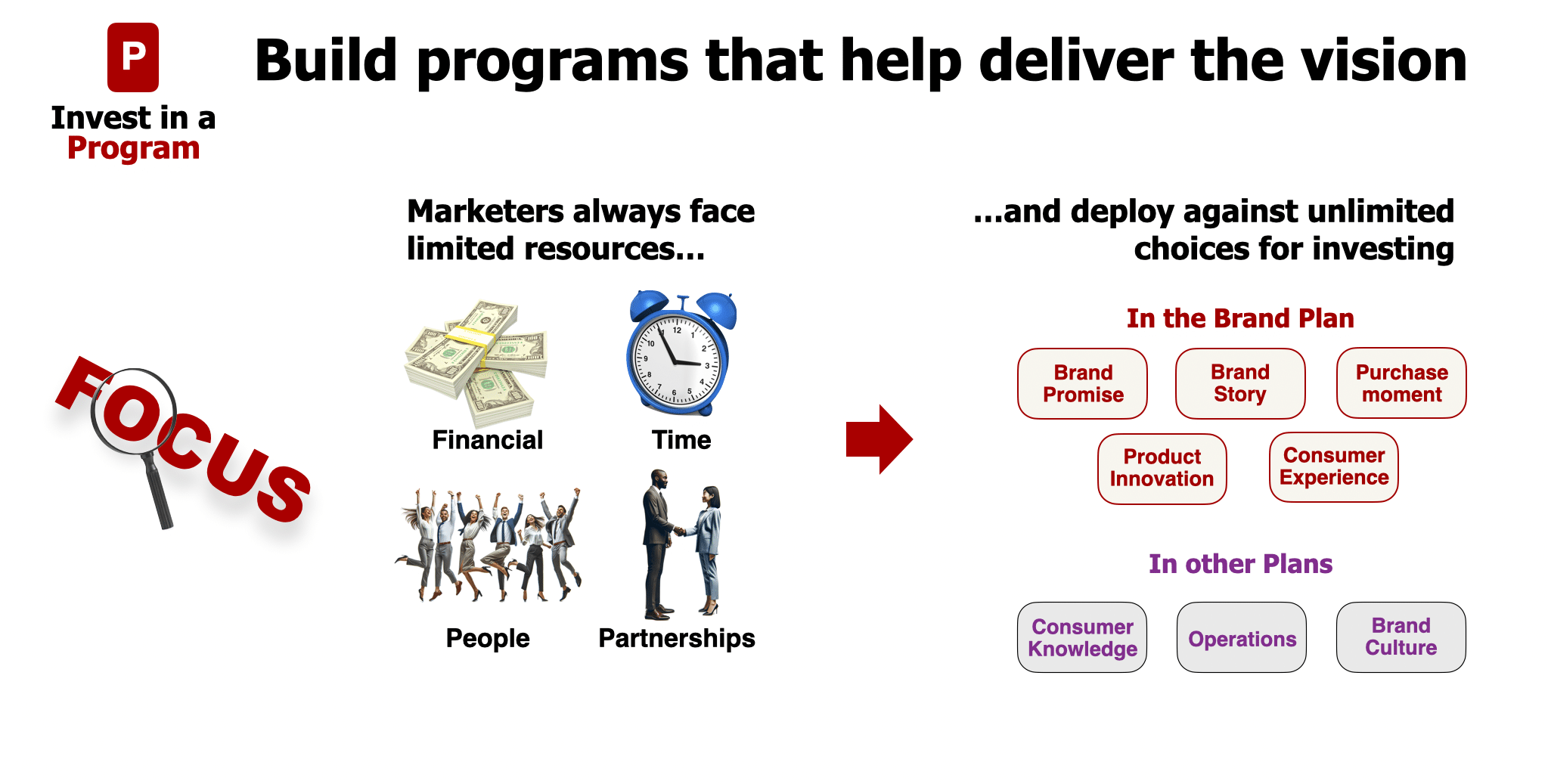
Put your limited resources behind a strategic program that positions the brand for greater power and profitability. You have a clear set of places to invest:
- Brand Promise. Build positioning on your core strength and shape a brand idea that is ownable and motivating, then use it to organize everything you do.
- Brand Story. Use creative media to capture attention, link to the brand, convey the message, and stick with consumers when they are open to moving along their journey.
- Purchase Moment. Invest at retail through merchandising, assortment, promotion, and shelf presence, or in the content and experience that win on e-commerce.
- Product Innovation. Keep a pipeline running so the brand stays fresh, from improvements and extensions to game-changing technology.
- Consumer Experience. Align what the brand story promises with what your people actually deliver, so operations, sales, and innovation each know their role in bringing the idea to life.
You will not invest in all of these at once. The smartest strategy is to choose the three major investments that matter most this year.
A: Ride an accelerator already moving in the market
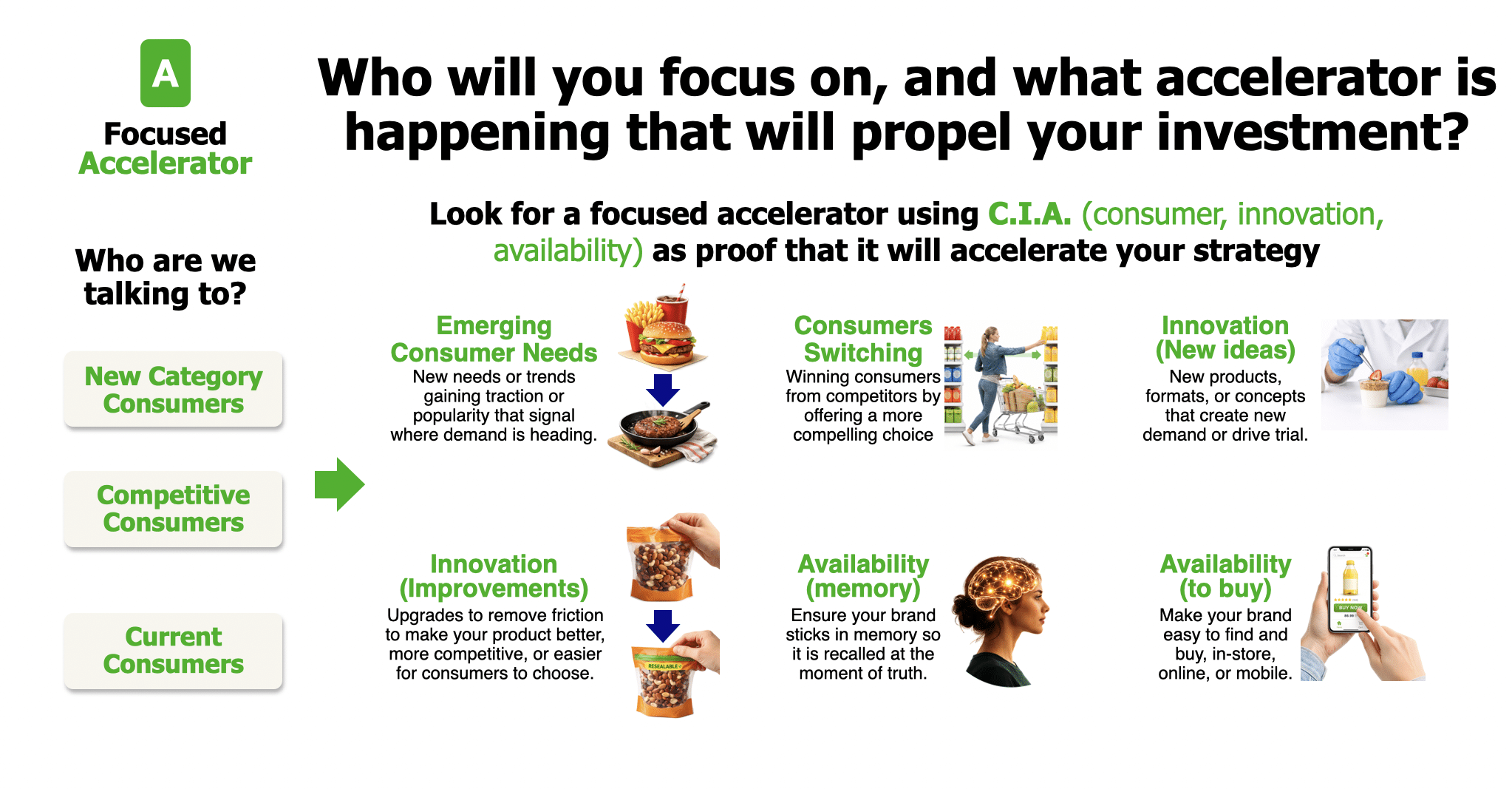
The accelerator is the part most marketers skip, and it is what separates a real strategy from a wish. Look for a change already happening in the market that makes your investment work harder. It could be a consumer trend, a competitive opening, a technological shift, or a new channel. The accelerator is your evidence that the money is well spent.
Take the shift to working from home. That single trend accelerated demand for video meeting software, ergonomic chairs, desks built for small spaces, and grocery delivery, and even changed how real estate agents pitch a house. A brand positioned against that trend did not have to create demand. It rode a wave that was already building.
When you focus your strategy this tightly, the brand gets a stronger return on investment, makes better use of your team’s effort, owns a clearer reputation with a core audience, defends its space more easily as it grows, and earns more funding from a CFO who sees profit coming back.
R: Commit to a market impact that pays back
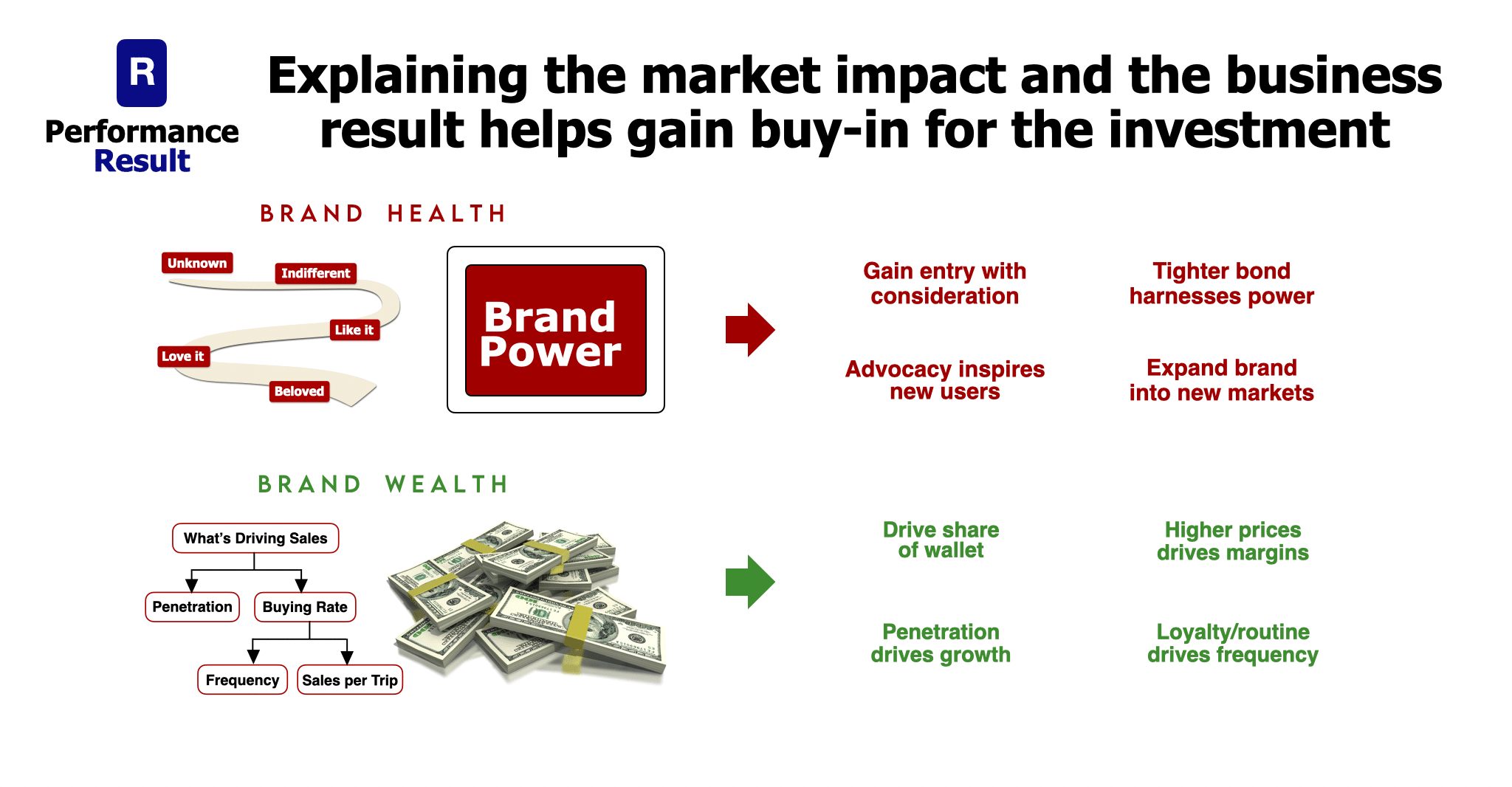
The result has two layers. First, the market impact: what consumers actually do, moving from awareness to consideration to purchase, then on to repeat, loyalty, and becoming fans who influence others. Second, the performance result: the shift in market power and profit that the impact creates.
Great marketing strategy produces a shift in positional power that moves your brand toward its vision. Brand power is stored energy you can spend on future profit. You build it against the consumers you serve, the competitors you battle, the channels you sell through, and the influencers in your market. The end goal is profit, won through premium pricing, trading consumers up, lowering cost of goods, stealing competitive users, or getting loyal users to use more. When you return more profit than you invested, the CFO knocks on your door and says, “Do it again.”
Beloved Brands playbook
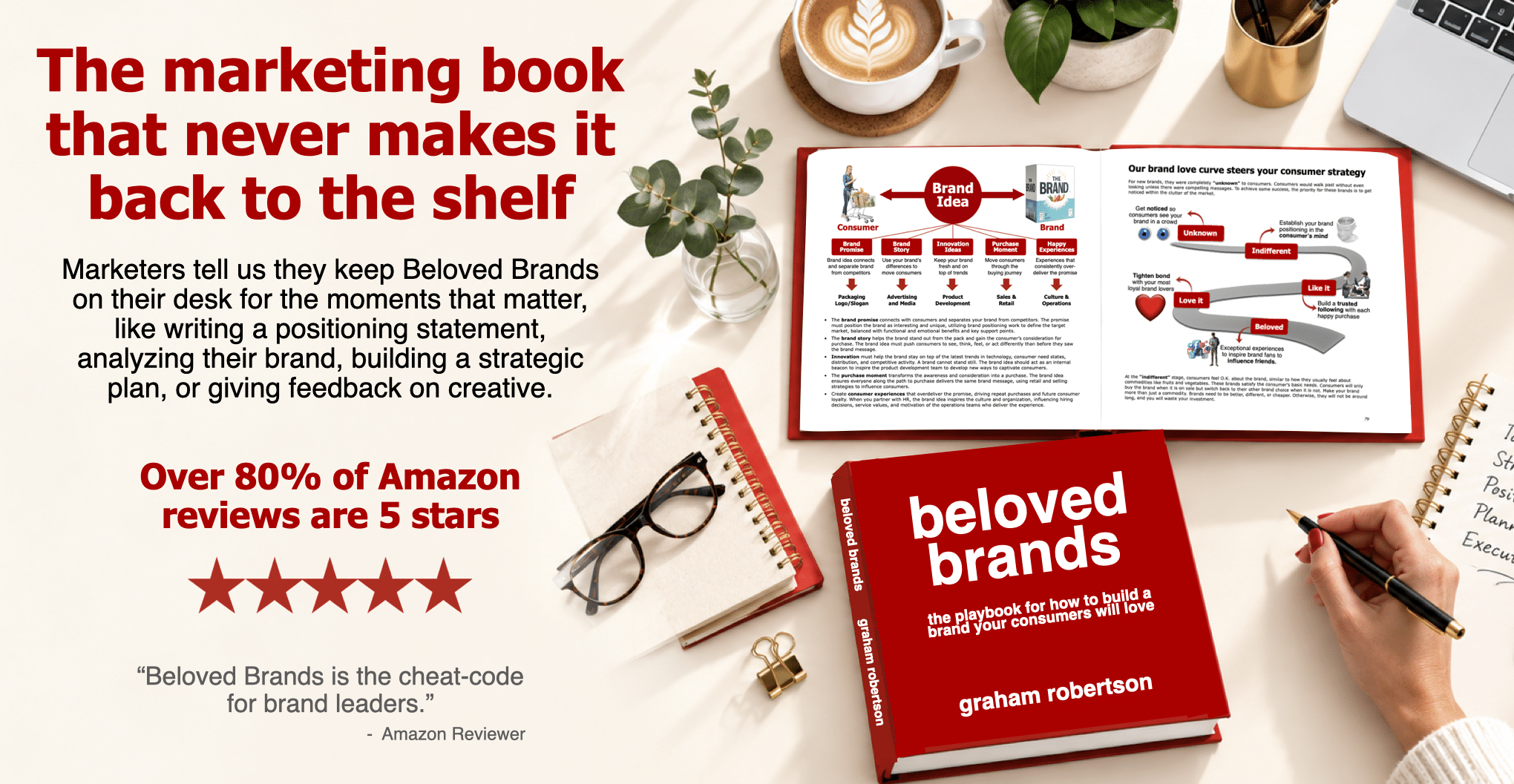
Our Beloved Brands playbook goes in depth on everything you need to build a brand consumers will love. Learn to about strategic thinking, brand positioning, writing brand plans, advertising decisions, media planning, marketing analytics, and financials.
Our readers tell us they keep our Beloved Brands playbook close by for whenever they need to take on a new project. Clearly, we are thrilled that 80% of Amazon reviewers have given Beloved Brands a 5-star rating. Also, we wrote a B2B Brands playbook and a Healthcare Brands playbook.

A worked example: Gray's Cookies
Here is how a statement comes together on a real brand. Gray’s Cookies has a key issue to solve: it launched as a product-led brand, hit a ceiling, and now needs to become an idea-led brand that owns “guilt-free.”
Frame that key issue as a question, then answer it with a P + A + R strategy statement. Here are three examples related to the investment in communication, innovation, and retail.
Marketing Strategy Statement - Communication
Key Issue:
How do we shift Gray’s into an idea-led brand that owns “guilt-free”?
Strategy Statement:
Communicate Gray’s new “guilt-free” positioning (P) to a growing proactive-preventer target who lives a low-carb, keto life (A), to attract them to try Gray’s and drive higher market share (R).
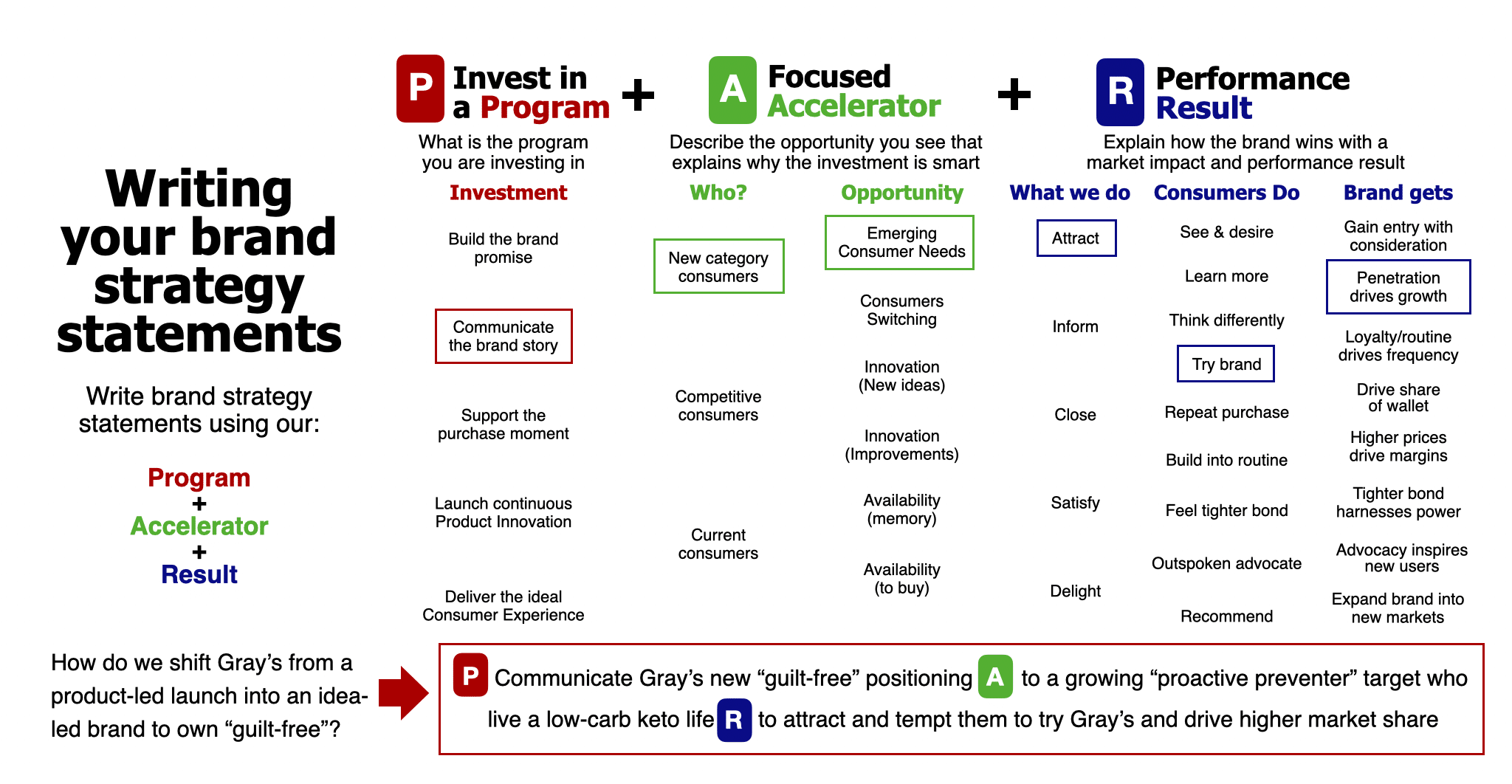
That single sentence makes a choice. It names what the brand will fund, who it will move, the trend it will ride, and the result it expects. Anyone reading it knows what to build and what to leave alone.
Marketing Strategy Statement - Innovation
Here is a second marketing strategy statement, answering a key issue related to product innovation:
Key Issue:
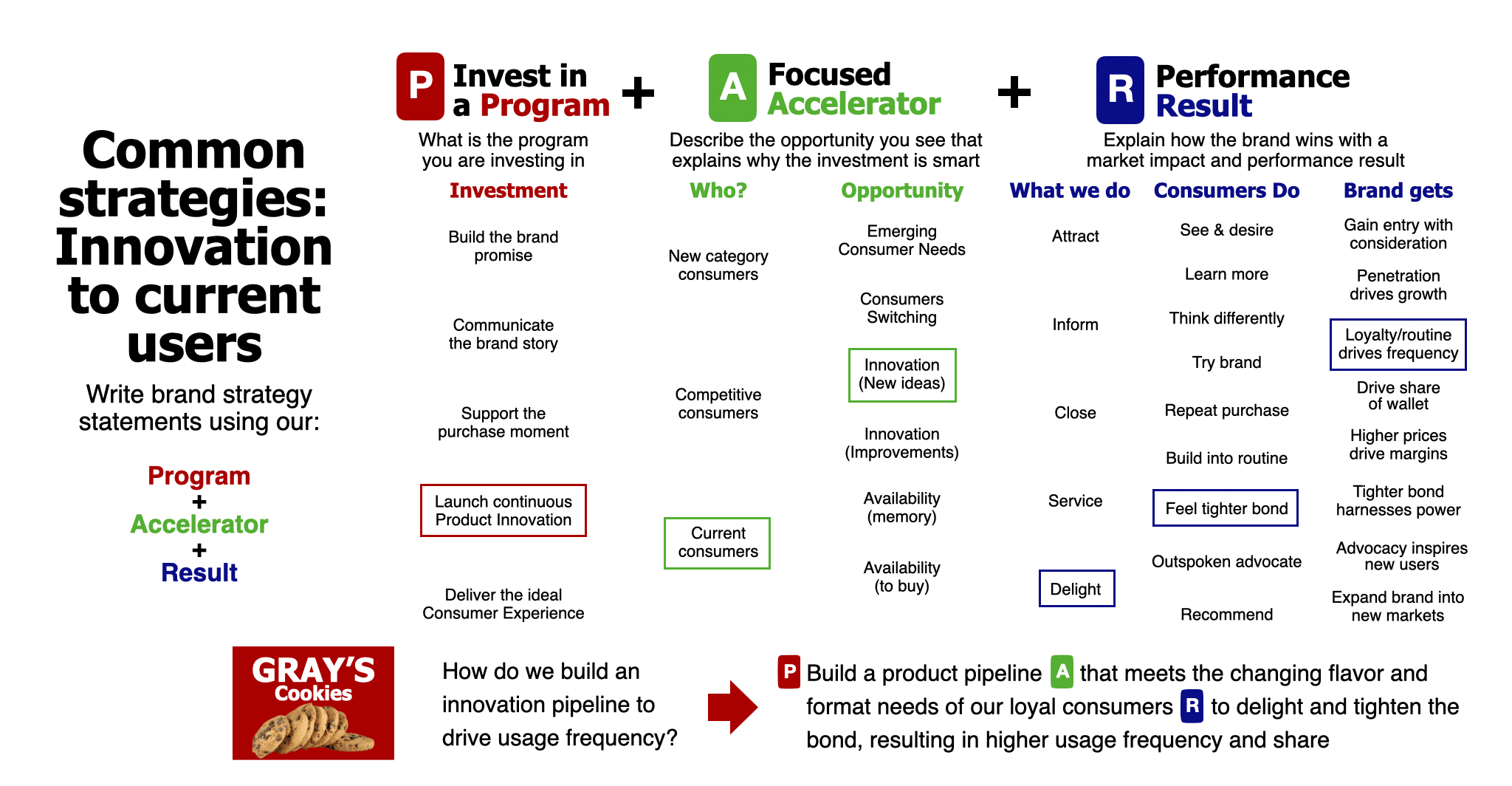
How do we build an innovation pipeline to drive usage frequency?
Strategy Statement:
Build a new product pipeline (P) that meets the changing flavor and format needs of our loyal consumers (A), to delight and tighten the bond, resulting in higher usage frequency and share (R).
Marketing Strategy Statement - Retail
Key Issue:
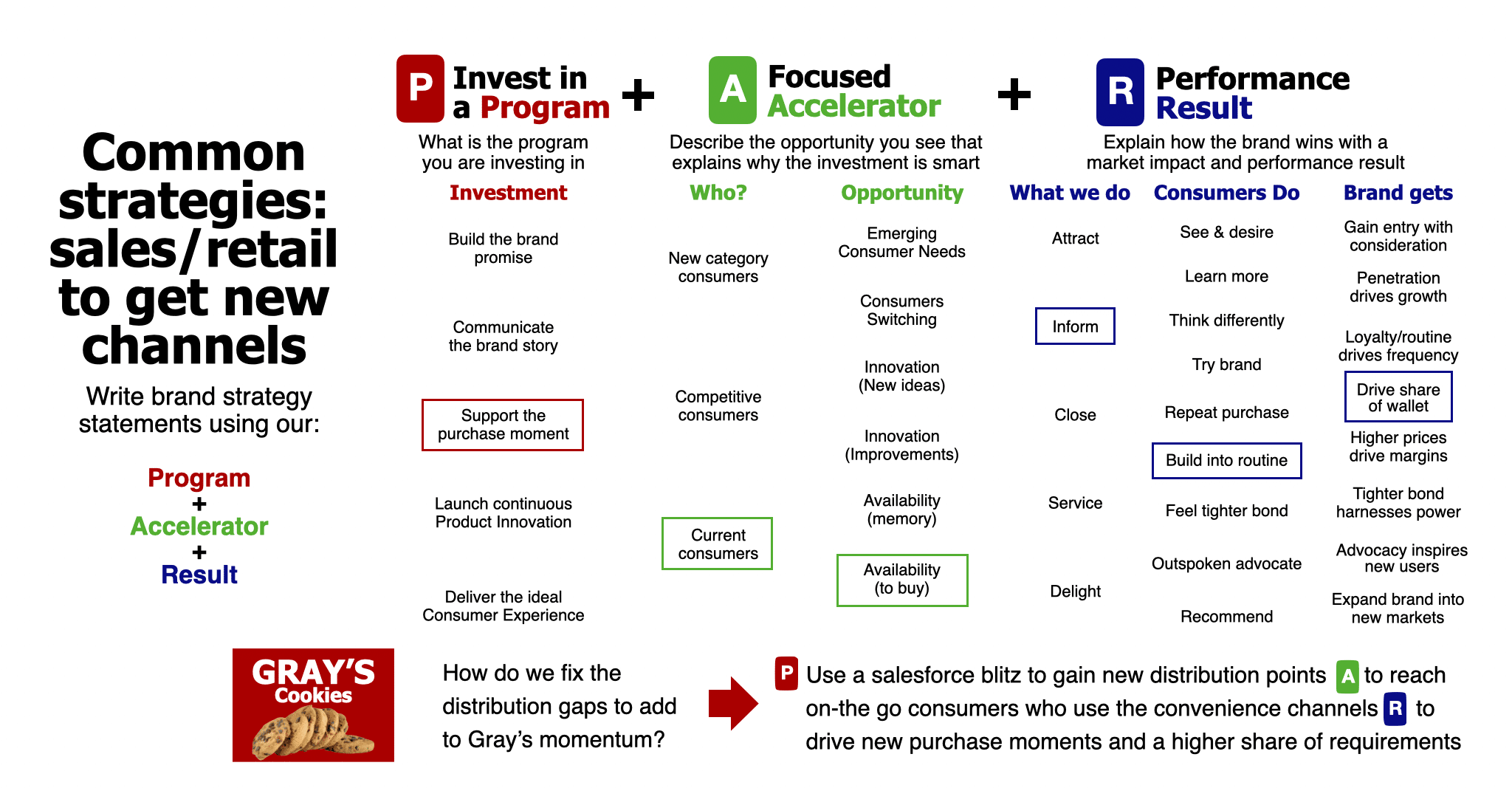
How do we fix the distribution gaps to fuel Gray’s momentum?
Strategy Statement:
Use a Salesforce blitz to gain new distribution points (P) to reach on-the-go consumers who use the convenience channels (A), to drive new purchase moments and a higher share of requirements (R).
Why a tight strategy statement matters
The biggest failure in strategy is not bad thinking. It is strategy that never reaches the people who do the work. The leadership team claps at the town hall, then walks back to their desks, unsure what the slides mean for their jobs. A strategy that cannot be communicated cannot be executed.
A clear P + A + R statement fixes that.
It gives every level of the organization marching orders that frame the level below it. The statement sets the desired response in a creative brief, aligns the sales team, sets the sales forecast, and serves as the test you hold execution against. Write it well, and it does heavy lifting for the rest of the year.
That statement is also the spine of your written plan. It sits at the top of each strategy page in your marketing plan and at the top of every creative brief. The plan is where you turn the strategy into tactics and budgets. The statement comes first.
Sharpen the way your brand writes strategy
Writing strategy is a skill, and like any skill, it gets sharper with the right tools and the right coaching. Our Beloved Brands training builds marketers who think through data rather than guess, use analytics to trigger strategic thinking, build positioning that actually sells, create plans that link to financial results, and execute in ways that move consumers.
The Beloved Brands playbook goes deep on strategic thinking, brand positioning, brand plans, and the decisions that drive execution. If you want to lift how your team makes choices, that is where to start.


Frequently asked questions about marketing strategy statements
What is a marketing strategy statement?
A marketing strategy statement is a single sentence that captures one strategic choice. It names the program you will invest in, the accelerator in the market you will ride, and the result you expect. It answers a specific key issue standing between your brand and its vision, in language clear enough for a whole team to act on.
What is the P + A + R model?
P + A + R stands for Programs, Accelerator, Result. You invest in a program that gets the consumer to do something, which turns into a result you can explain and defend. It is the structure I use to write every strategy statement, because it forces a real choice rather than a vague intention.
What is a focused accelerator?
A focused accelerator is a change already happening in the market that makes your investment work harder. It could be a consumer trend, a competitive opening, a new technology, or a new sales channel. The accelerator is your proof that the money behind the program is well spent, since you are riding momentum rather than trying to create it.
How is a marketing strategy different from a marketing plan?
A marketing strategy is the choice of where to invest and why. A marketing plan is the document that turns those choices into tactics, budgets, and timing. The strategy comes first, then the plan organizes the work to deliver it, with each strategy statement sitting at the top of its own page in the plan.
How many strategy statements should a brand have?
Most brands run best with three strategy statements in a given year, each one answering a separate key issue. More than that, resources get spread too thin to make an impact. The point of strategy is to choose, so a short list of statements is a sign of discipline rather than a gap.
What makes a strategy statement strong?
A strong statement makes a clear choice and leaves no room for confusion about what to build. It names one program, one target, and accelerator, and one measurable result. If a teammate can read it and immediately know what to do and what to ignore, you have written it well.