The best innovation teams are not the ones with the most ideas. They are the ones who know which ideas to push hard and which ones to set aside early. That judgment comes from running every idea through the same rigorous framework — one that looks at consumer demand, brand fit, operational capability, and financial payback before anyone falls too far in love with a concept.
Getting that balance right matters more than most teams realize. The lower-risk, lower-reward ideas are not just filler. They generate the near-term revenue and margin that funds the bigger bets. A brand that only chases high-risk ideas runs out of resources before the big one lands. A brand that only plays it safe runs out of momentum. The innovation checklist helps you build a portfolio that does both with smaller ideas that keep the brand fresh and the business healthy, and larger ideas that can genuinely change the brand’s competitive position.
Innovation Checklist - Table of Contents
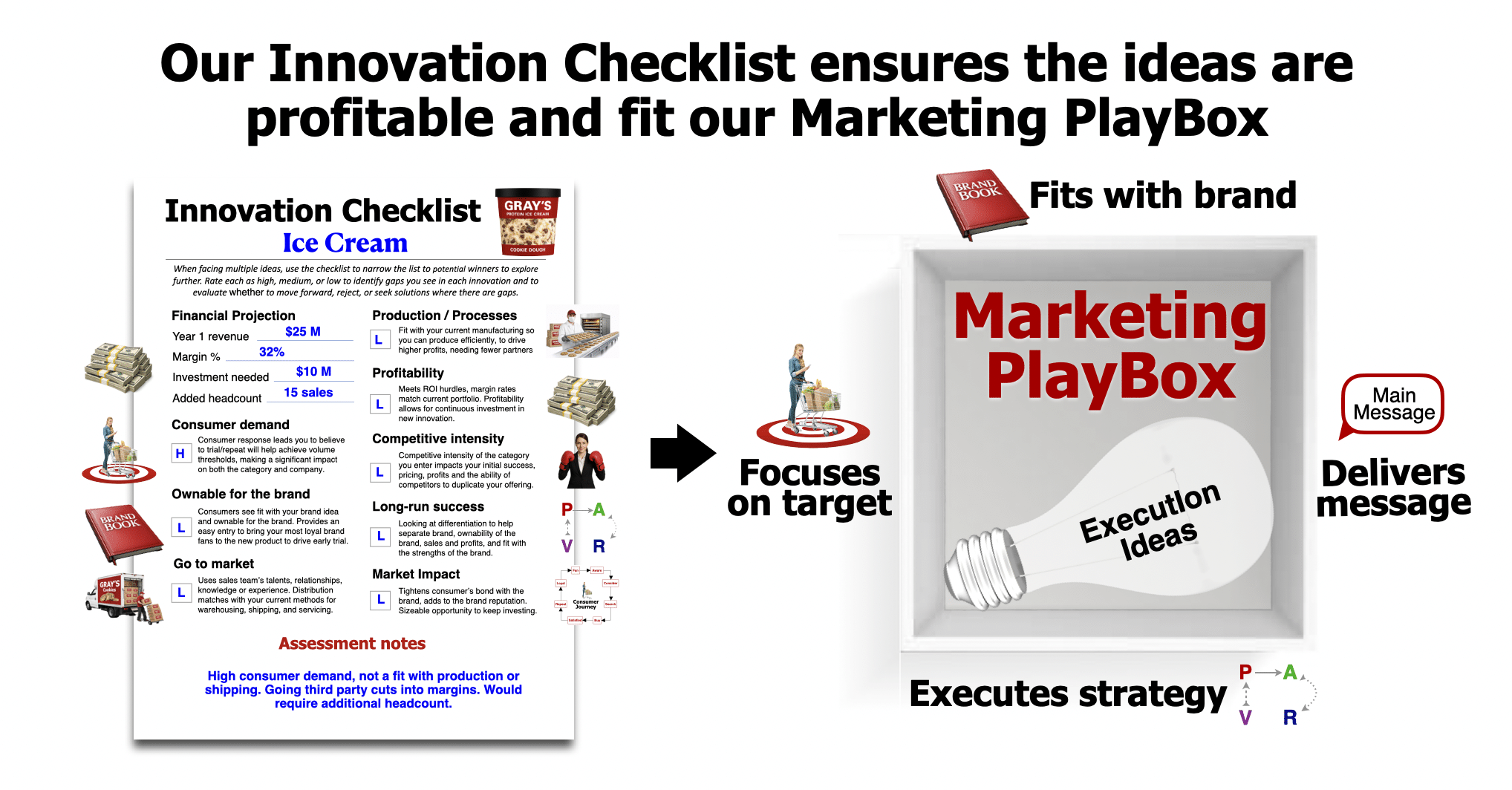
The innovation checklist matches up with the Marketing PlayBox
Every innovation idea gets evaluated against the Marketing PlayBox — the same framework that governs every brand decision. For an innovation to move forward, it needs to fit with the brand, focus on the right consumer target, deliver the consistent brand message, and execute the strategy effectively. The financial projection sits across all four as the viability test.
Financial Projection
Before scoring anything else, establish the financial parameters. Estimate Year 1 revenue, margin percentage, investment required, and headcount needed. These numbers frame every other decision on the checklist. An idea with strong scores across the board but weak financial projections is still a problem. One with modest scores but strong financials deserves a closer look. The financial projection is not just a gate — it is the lens through which every other factor gets interpreted.
Fits with brand
Consumers need to see a natural fit between the new product and the brand idea. An ownable idea brings your most loyal brand users along as early adopters and provides an easy entry into the new product. The further the idea stretches from the core brand idea, the harder and more expensive the launch becomes. Score this High if the fit is obvious and the brand gives the idea a clear competitive advantage going in.
Communicates the brand message
A strong innovation idea should reinforce the brand’s positioning, not dilute it. Every new product that goes to market communicates something about what the brand stands for. If the idea strengthens the brand’s main message and tightens the consumer’s bond with the brand, it earns a High score here.
Consider Volvo. If their R&D team developed the world’s fastest engine, the instinct might be to launch it. The technology is real, the consumer demand for performance exists, and the financials might pencil out. But a high-performance speed engine contradicts everything Volvo stands for. Their brand positioning is built entirely around safety. Launching it would confuse consumers, weaken the positioning, and undermine decades of brand equity. The smarter move would be to sell the technology to Ferrari, where it fits the brand idea perfectly.
That is the test. An innovative idea that cannot reinforce what the brand stands for should not go to market under that brand, regardless of how strong the other checklist scores look.
Focuses on target
Consumer demand
Consumer response needs to give you confidence that the idea will drive trial and repeat at a scale that achieves your volume thresholds and makes a meaningful impact on the category and the company. Concept testing scores and market sizing data are the inputs here. Enthusiasm in a brainstorm room is not enough — the consumer demand score needs to be grounded in evidence from real consumer feedback.
Long-run success
Look at the idea’s ability to sustain success beyond the launch window. Can the brand differentiate enough to hold the position? Is the consumer need durable? Does the idea fit with the long-term strengths of the brand? An innovation that wins at launch but cannot be defended is a short-term gain that creates long-term portfolio complexity and pulls resources away from ideas with real staying power.
Executes strategy
Go to market
The idea needs to work within your existing sales team’s capabilities, relationships, and knowledge. Distribution must match your current methods for warehousing, shipping, and servicing. Ideas that require building an entirely new go-to-market model add significant execution risk on top of market risk. Score this High when the launch fits cleanly into how your team already operates and can be executed without needing to build new commercial infrastructure.
Production and processes
The idea should fit with your current manufacturing so you can produce efficiently, drive higher profits, and minimize the need for third-party partners. Every additional partner in the production and supply chain adds cost, complexity, and risk. Ideas that leverage existing production capabilities score High here and move through the innovation process faster and with fewer surprises.
Profitability
The idea must meet your ROI hurdles, with margin rates that match the current portfolio. Profitability at the product level is what allows continuous reinvestment in innovation over time. An idea that generates revenue but compresses margins across the portfolio undermines the financial health of the brand. Score this carefully using the Year 1 financial projection as the anchor and be honest about the assumptions underneath it.
Competitive intensity
The competitive intensity of the category you are entering directly impacts your initial success, your pricing power, and your competitors’ ability to duplicate your offering quickly. High competitive intensity means more investment required to win shelf space, more pricing pressure, and a shorter window of advantage before a competitor responds. Know what you are walking into before committing resources to the launch.
The range of new product innovation ideas

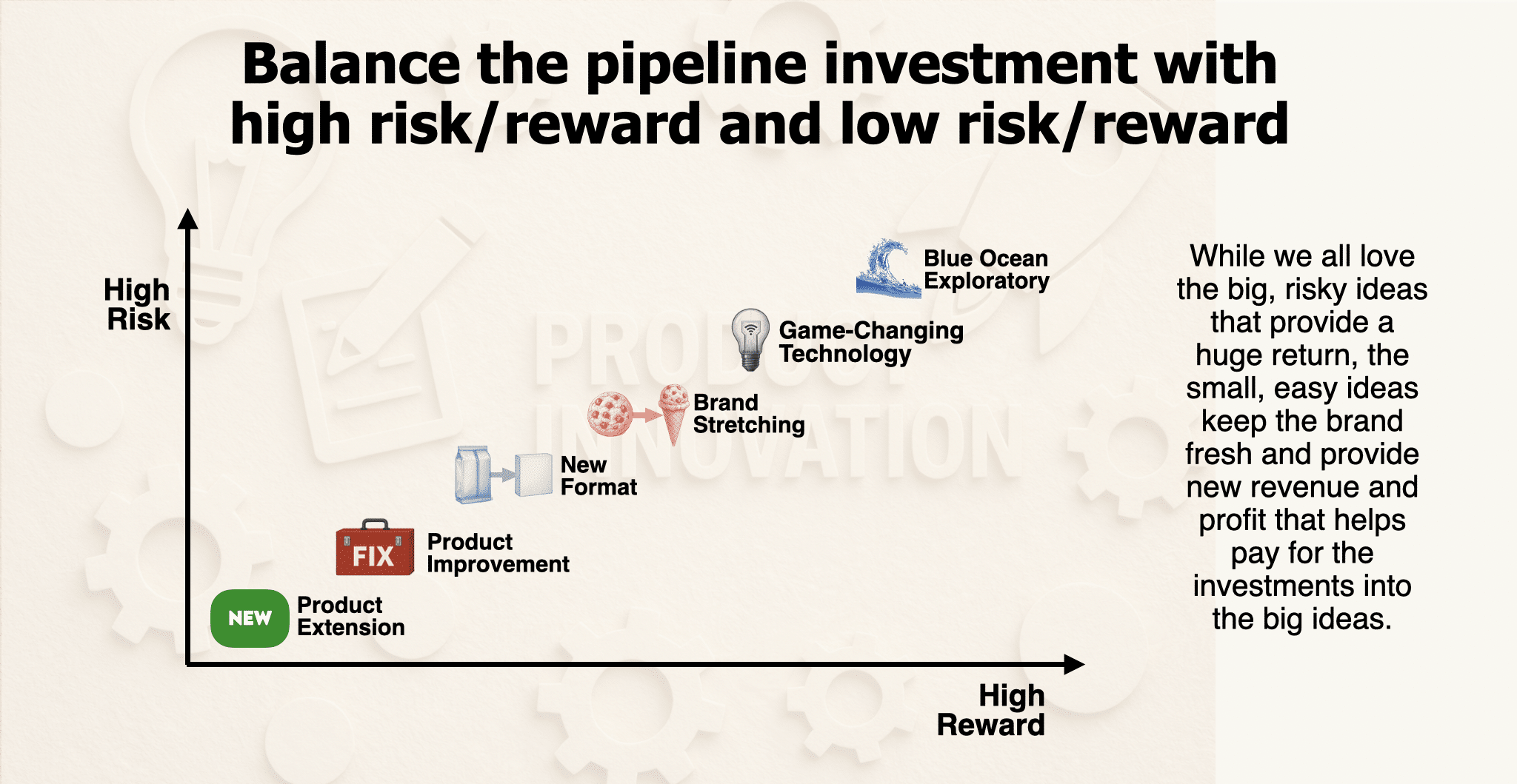
Product strategy covers a wide range of innovation types, from low-risk extensions to high-risk exploratory. A healthy innovation process maintains a balanced pipeline across the full range. Smaller ideas keep the brand fresh and generate near-term revenue. Bigger bets can redefine the brand’s position in the market. The key is not choosing between them; it is managing the portfolio so that both move forward at the same time.
Product extensions
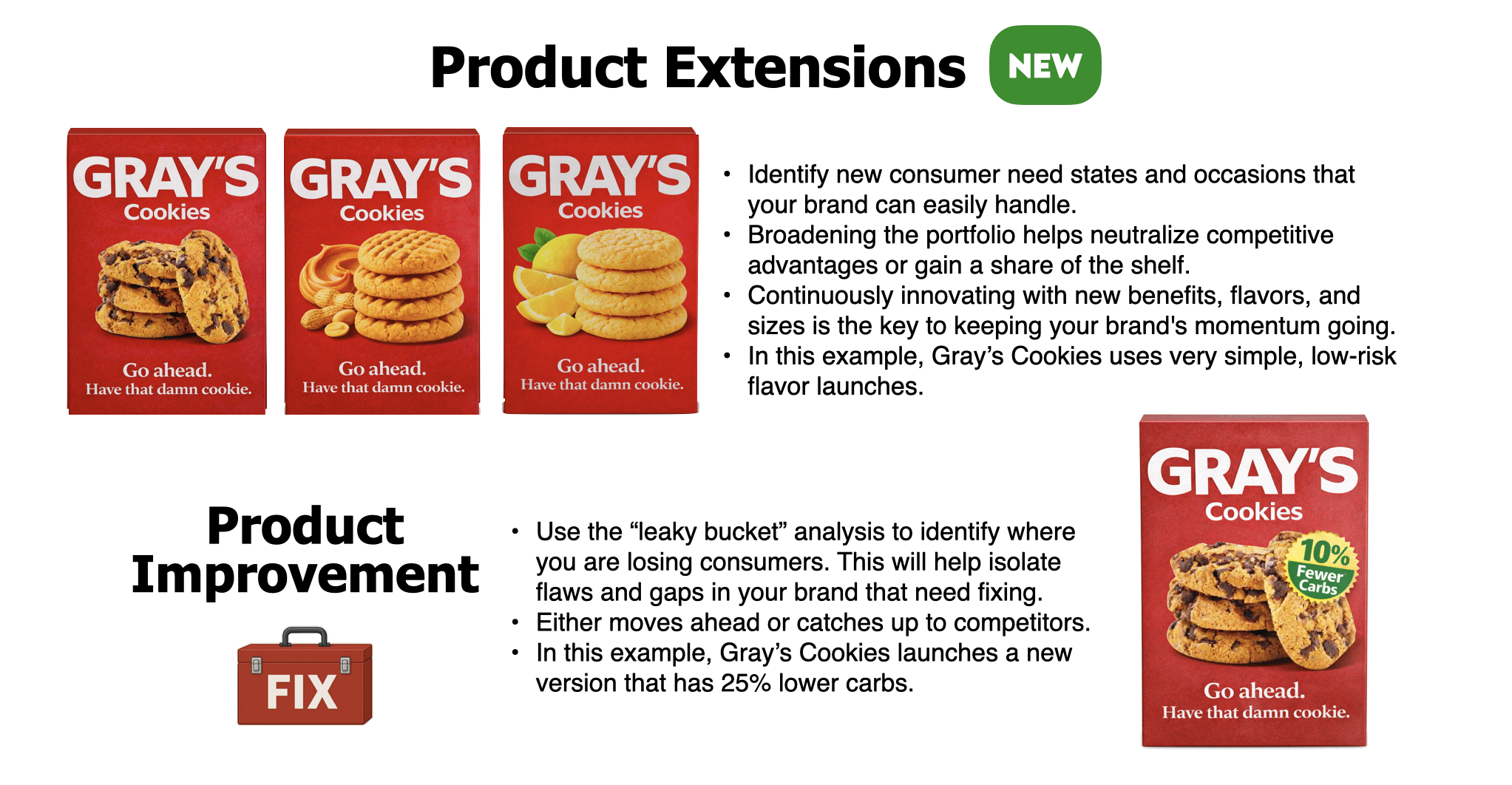
Product extensions identify new consumer needs the existing brand can serve — new flavors, formats, sizes, or benefits. They carry the lowest risk and the lowest reward, but they keep the portfolio competitive and give the sales team something new to sell in. Extensions work best when they are grounded in a real consumer need rather than simply filling a gap in the competitive set.
Product improvements
A product improvement fixes something that is holding the brand back. Use your brand funnel and tracking data to identify where you are losing consumers and why. Fixing a real flaw in the product can recover lost users and close the gap on a competitor who has pulled ahead on a key performance attribute.
New formats
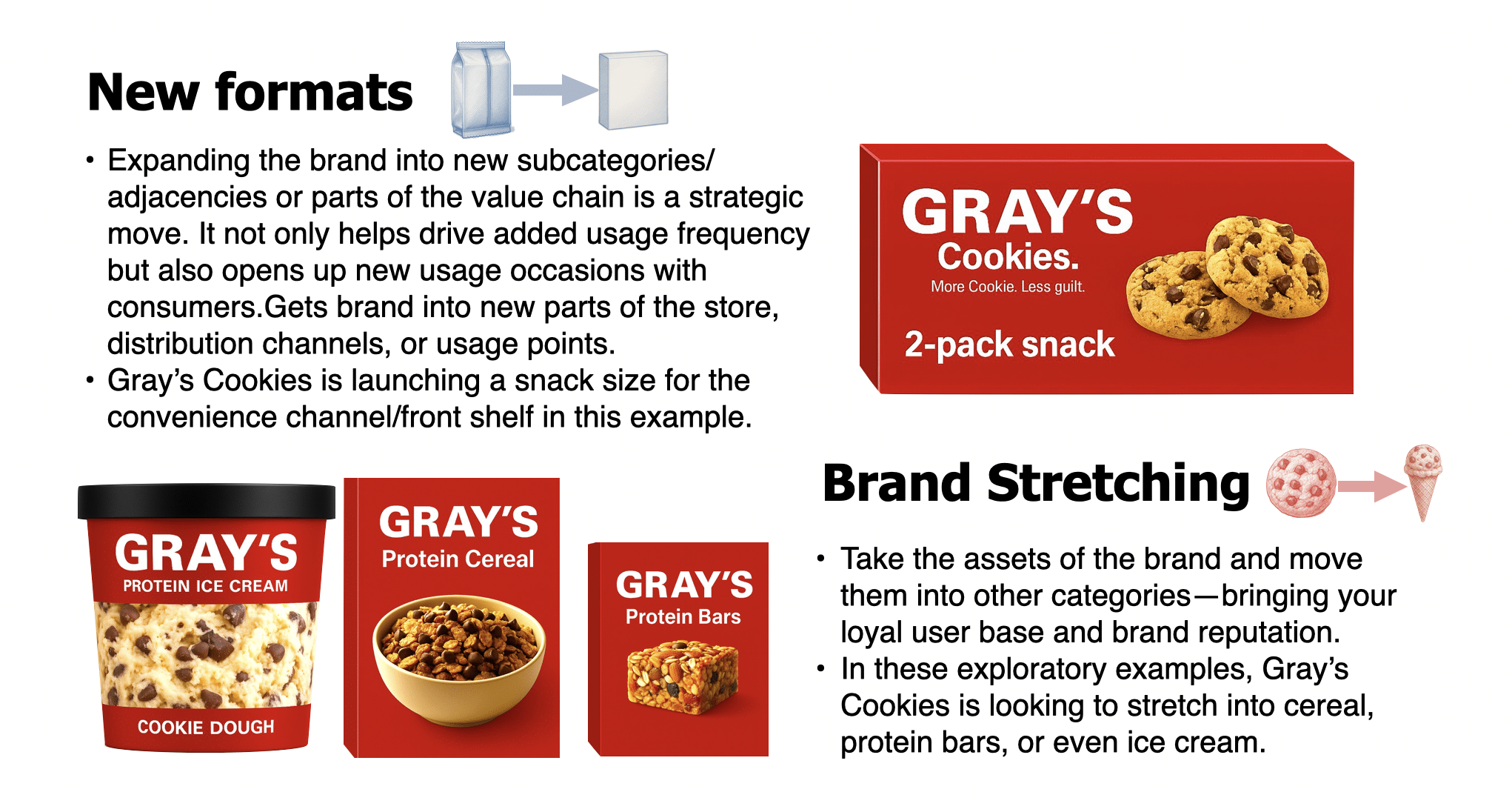
Stretching the brand into a new format opens up distribution channels and retail locations that the core product cannot access. A new subcategory, a new part of the value chain, or a new usage occasion all qualify. The risk is moderate and the potential is real, particularly when the new format connects clearly to the core brand idea and the existing go-to-market model can support it.
Brand stretching
Brand stretching takes the brand’s core assets and equity into an adjacent business opportunity. Loyal users follow the brand into new territory because the brand idea travels with them. The risk is brand dilution if the stretch goes too far from what the brand stands for, which is exactly why the ownable for the brand and market impact scores on the checklist matter so much for this type of idea.
Game-changing technology
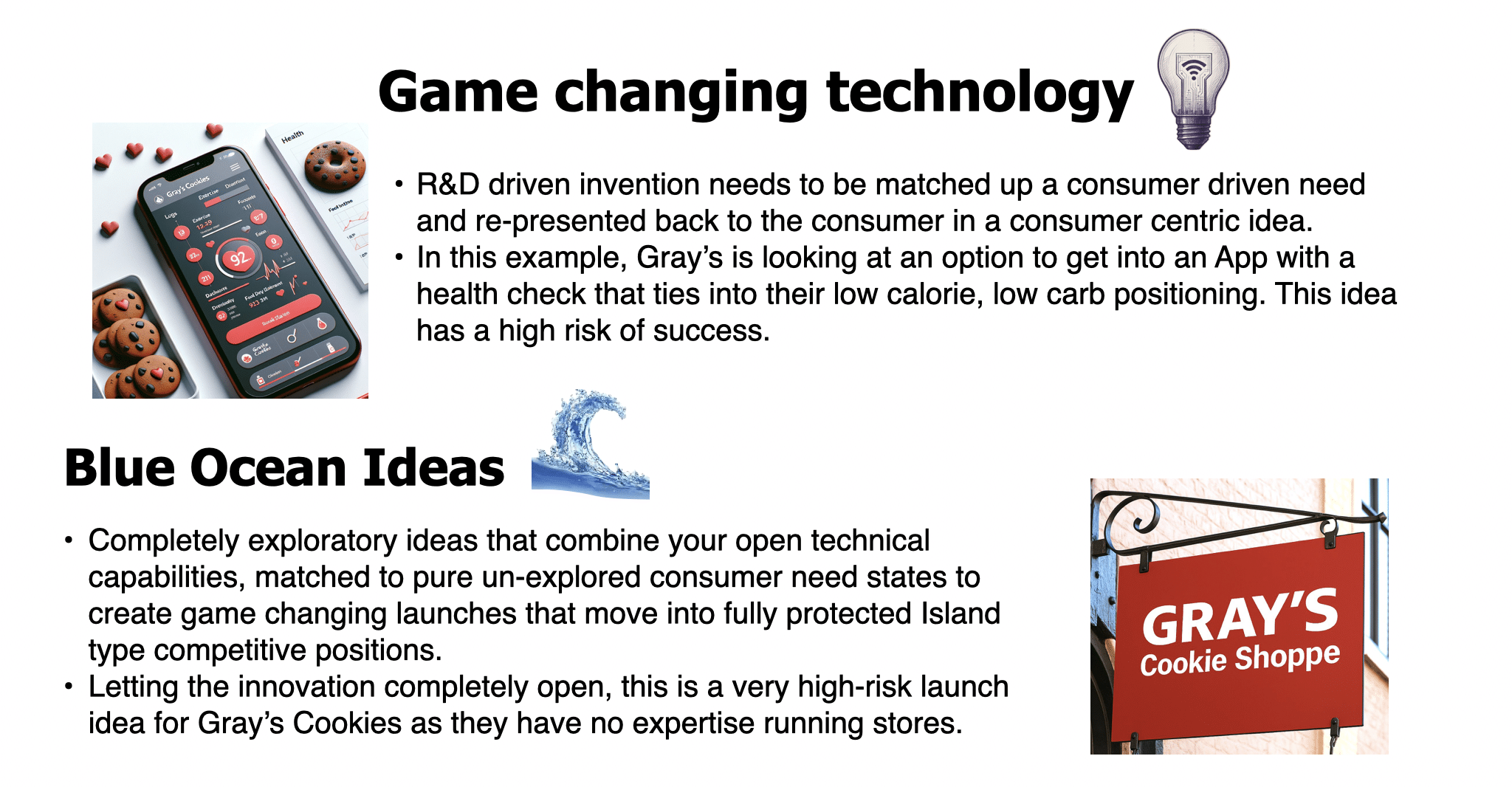
Technology-driven innovation is typically R&D-led and aligned with shifting consumer needs. These ideas take longer to develop and require more capital, but they can establish a meaningful competitive advantage that is hard to replicate. The production and processes score on the checklist is especially important here — technology that exists but cannot be manufactured efficiently is not ready to launch.
Blue ocean exploratory
Blue ocean ideas combine your technical capabilities with unexplored consumer need states to create a genuinely new market. The risk is highest here, and so is the potential reward. A successful blue ocean launch moves you into protected territory where competitors cannot easily follow. These ideas need the most rigorous innovation process work before they are ready to move forward, and they typically score Low on several checklist factors at the start, which identifies the work that needs to happen before the idea is viable.
Higher risk, higher reward
A well-managed product strategy balances the portfolio across risk levels. High-risk, high-reward ideas require significant investment and take time to develop.
Lower-risk ideas keep the brand fresh and generate near-term revenue. The lower-risk ideas are not the consolation prize. They are what fund the bigger bets.
Brands that only pursue safe extensions eventually run out of momentum. Brands that only chase big ideas run out of money before the big one lands.
The innovation checklist helps you manage that balance deliberately rather than letting it happen by default.
Three stages of the innovation process
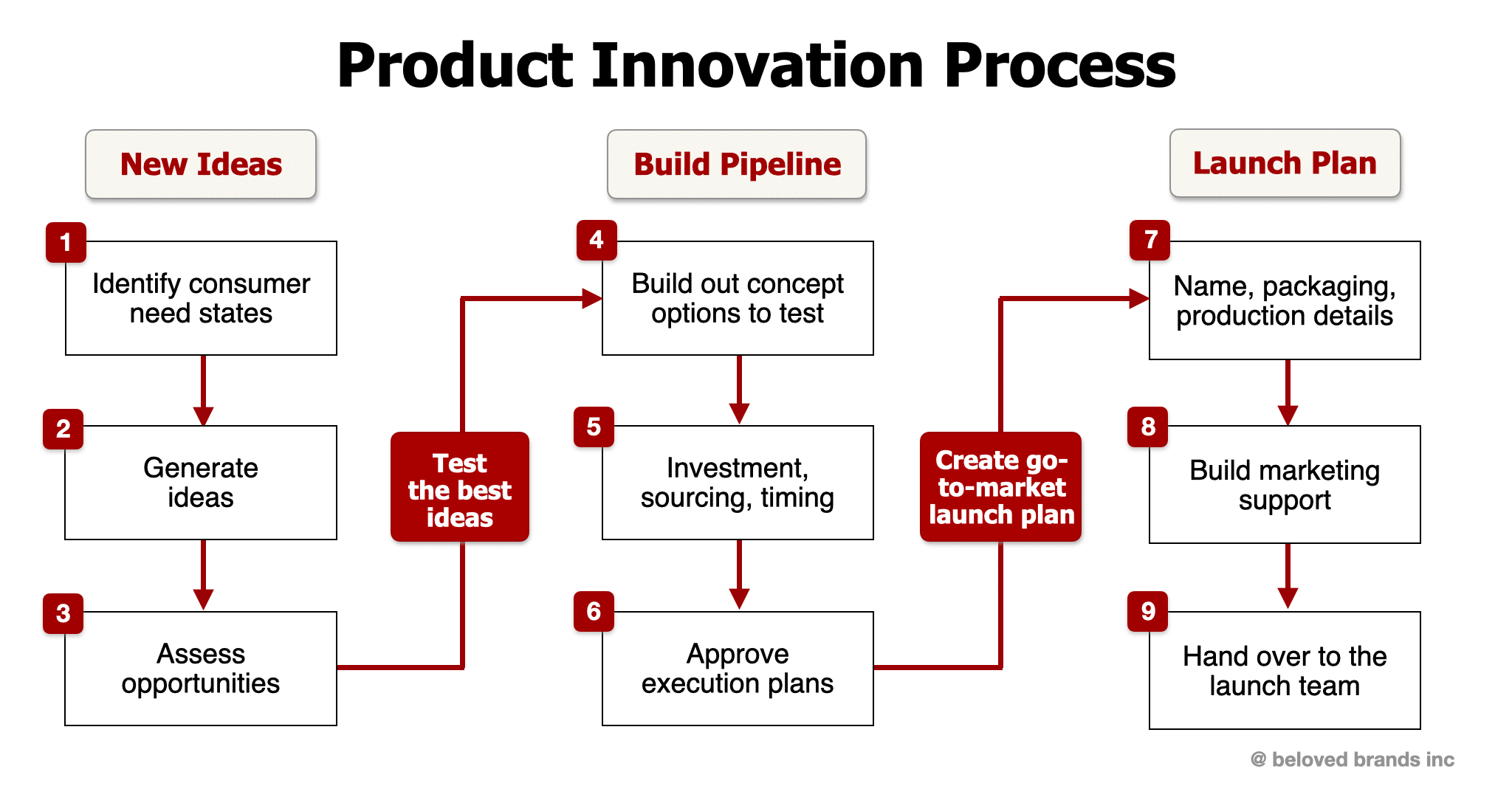
1. New Opportunities
Generating strong innovation ideas starts with a disciplined process of observing unmet consumer needs, tracking market trends, and identifying pain points a new product could solve. Regular brainstorming sessions build the pipeline. From the strongest ideas, develop concepts to test with consumers — measuring each one on uniqueness, motivation to purchase, ownability, potential size, and strategic fit with the brand. Consumer feedback at this stage is not just validation. It is input that shapes the idea into something stronger before real development costs are committed.
2. Innovation Pipeline
The best ideas from concept testing move into the pipeline for further development — concept refinement, market testing, and a formal decision process with management. Each idea needs an execution plan with milestones from production through to launch before it gets approved. A well-managed pipeline maintains a mix of lower-risk launches and higher-risk exploratory ideas moving through simultaneously. The innovation checklist is the tool that makes the comparison across ideas consistent and keeps the decision-making defensible when management asks why one idea moved forward, and another did not.
3. Go-to-market launch plan
Once an idea clears the pipeline process, the go-to-market launch plan takes over. Naming, packaging, production, channel planning, advertising support, and retail presentations all need to come together on a coordinated timeline. A clear project management framework keeps the launch on schedule and ensures the handoff from brand team to launch team happens without losing momentum or letting details fall through the gaps.
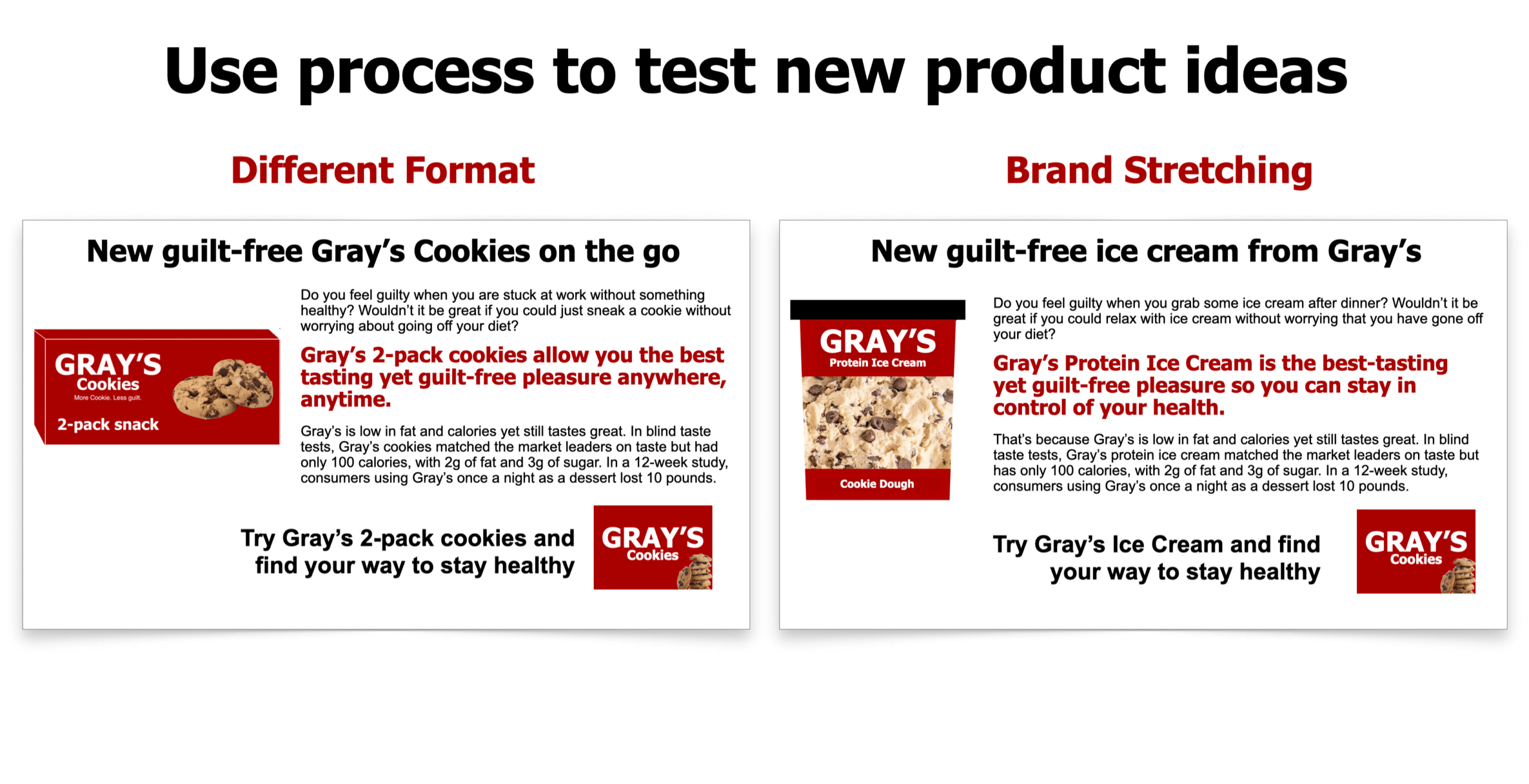
How to use concept testing in the new product development process
At the early stages of the innovation process, turning the strongest ideas into written concepts gives you a structured way to get consumer feedback before committing to development costs. A well-built concept has five components.
Headline
The headline is the first thing a consumer reads. Keep it simple and direct — one clear statement of what the product is or does. A complicated headline loses the consumer before they get to the benefit, and a lost consumer at the headline stage will not recover.
Consumer insight
Open the concept with a consumer insight that connects to a felt experience or a real frustration. The goal is to make the consumer stop and think “that is exactly how I feel.” A strong insight creates an emotional hook that pulls the consumer into the rest of the concept and makes them genuinely interested in the solution.
Promise
The promise statement brings the main consumer benefit to life. Balance functional and emotional dimensions — what the product does and how it makes the consumer feel. The promise needs to be motivating enough to generate real purchase intent, not just passing interest. Weak promises that hedge or try to cover too many benefits at once tend to score poorly in concept testing.
Support points
Support points address the gaps a consumer might have after reading the main benefit. An emotional promise often needs functional support to close off doubt. Keep support points tight and specific — vague support points read as filler and undermine the credibility of the promise rather than reinforcing it.
Call to action
Close the concept with a motivating call to action that drives purchase intent. Include a product visual or mockup where possible. Purchase intent is one of the most important measures in concept testing, and a strong visual paired with a clear call to action significantly affects the score.
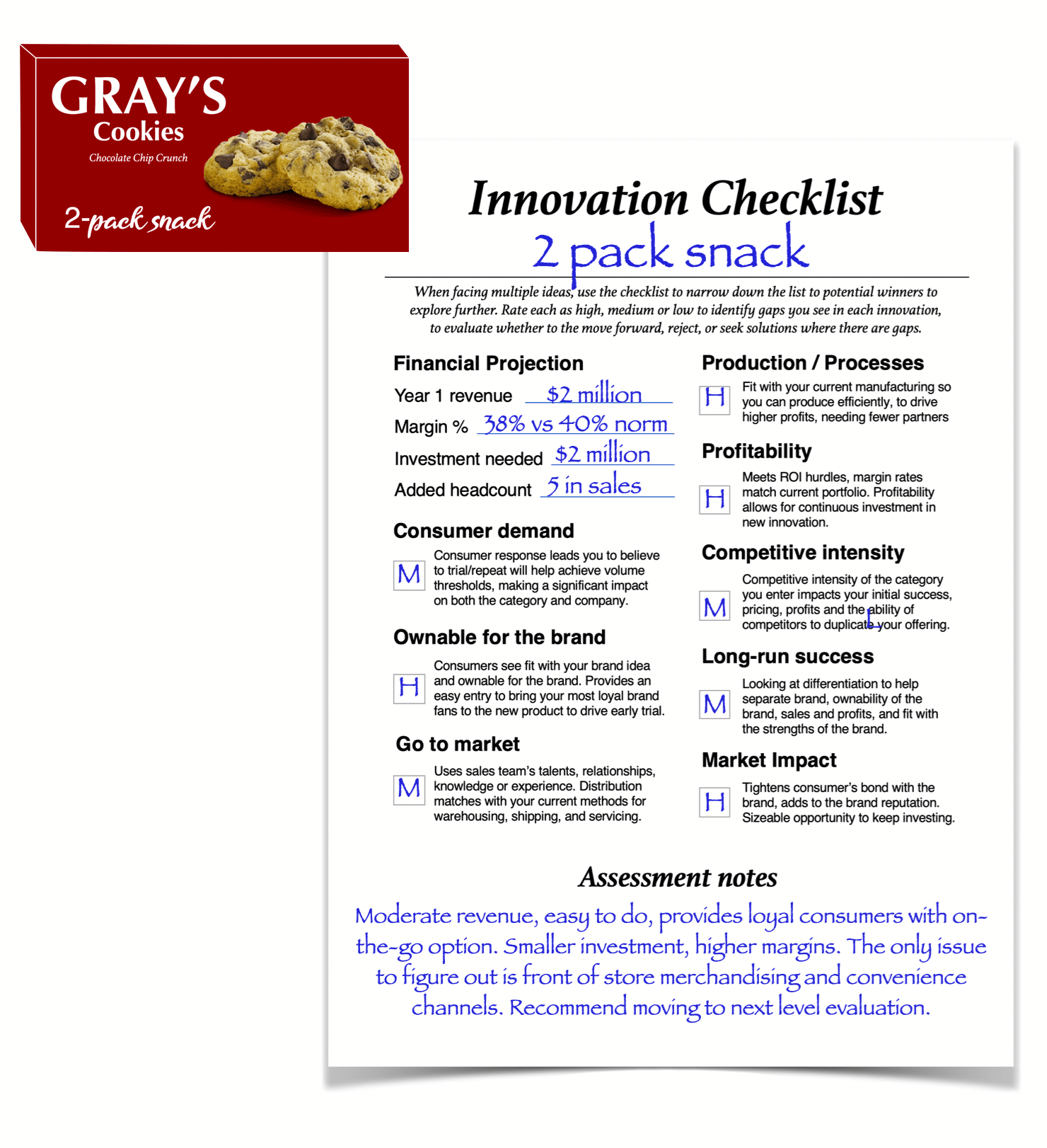
Using the innovation checklist in practice
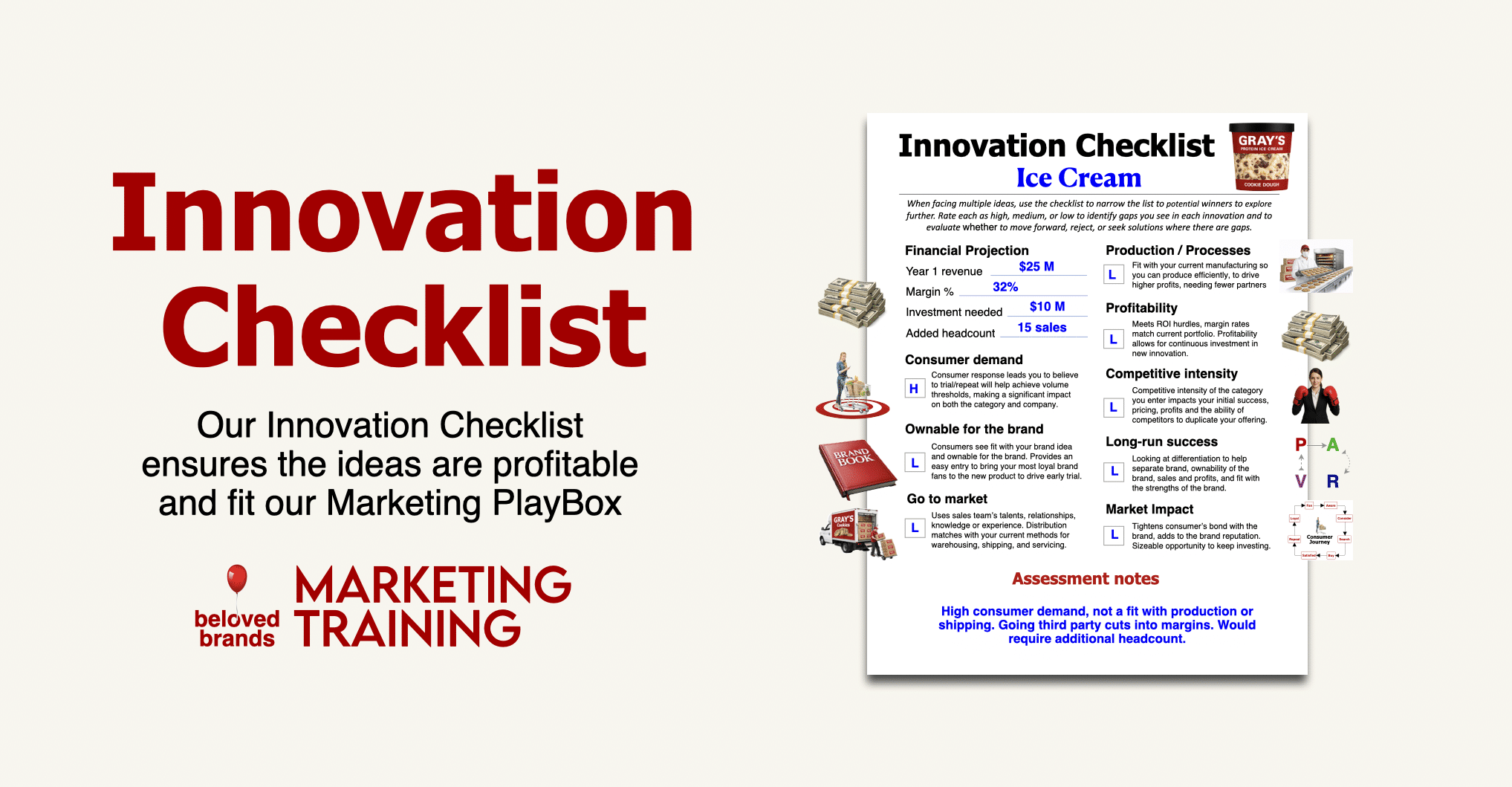
Run every idea through the same nine-factor checklist using Year 1 financial estimates and the best available data on consumer response, competitive intensity, and operational fit. Score each factor High, Medium, or Low. The pattern of scores tells you more than any single factor. A few Low scores do not automatically kill an idea — they identify the gaps that need to be addressed before the idea is ready to move forward.
Gray’s Snack Pack
The snack pack is a lower-risk, lower-reward idea. The investment required is modest and consumer demand is solid among the existing Gray’s user base. The main challenge is competitive intensity — the front-of-store and convenience channel is crowded and getting distribution will take real sales effort. The idea fits the brand well and does not require new manufacturing capability. On balance, the checklist supports moving this idea forward with a realistic expectation of the returns and a clear plan for winning distribution.
Gray’s Protein Ice Cream
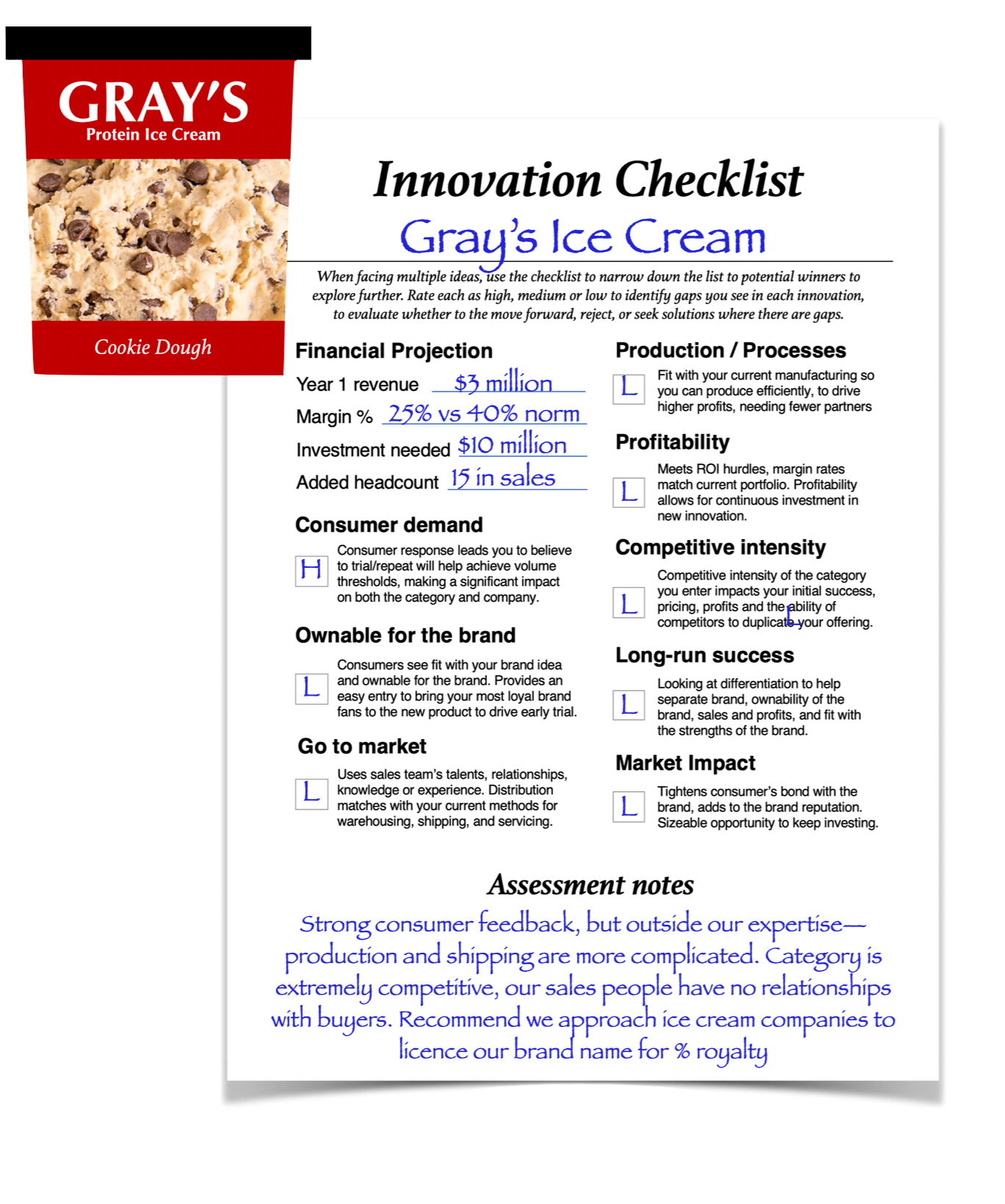
The protein ice cream is a higher-risk, higher-reward idea. Consumer response looks strong, but the checklist surfaces several Low scores across production, distribution, and sales fit. Gray’s does not currently have cold chain capability, and the sales process for frozen is significantly different from their existing go-to-market model. The profitability score is also under pressure given the investment required to close those gaps. The checklist recommendation is to address the production and distribution issues through a partner before committing to a launch — and to model the financials with that partnership cost factored in before moving forward.
Elements of the Innovation Plan
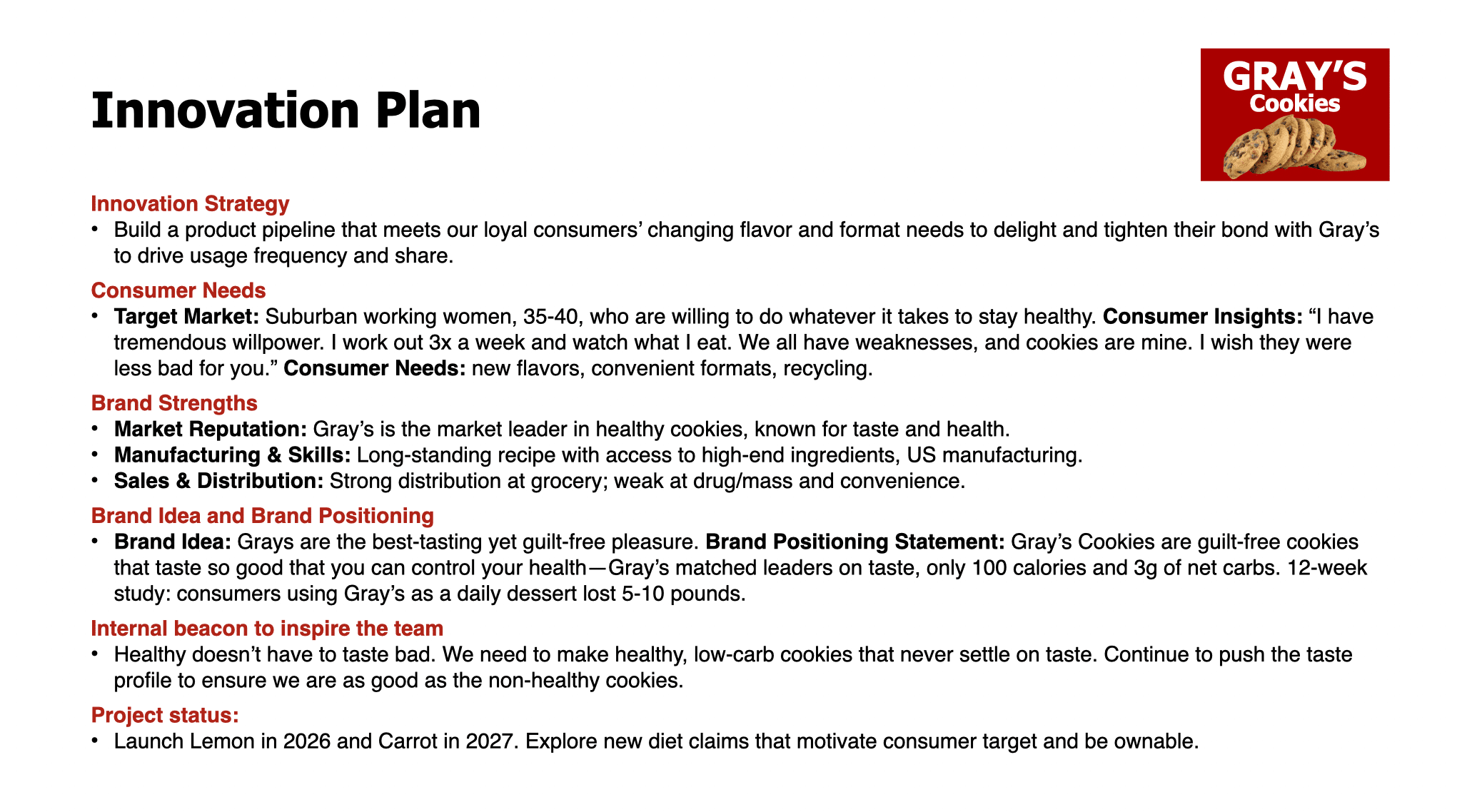
The innovation plan is the output of the full innovation process. It plots your ideas across the next three to five years, organized by innovation type, with investment levels and launch timing mapped out. A well-structured innovation plan gives management a clear view of where the brand is headed, what resources are required, and how the near-term and longer-term bets balance against each other. It also makes the portfolio logic visible — showing that the lower-risk launches are funding the higher-risk exploratory work rather than competing with it.
Frequently asked questions about product innovation and new product development
What is an innovation checklist?
An innovation checklist is a scoring tool that evaluates new product ideas across a consistent set of factors — consumer demand, brand fit, manufacturing capability, sales and distribution fit, financial payback, competitive intensity, and long-term viability. Running every idea through the same checklist makes it possible to compare options objectively and identify which ideas are ready to move forward and which ones need more work before the investment goes in.
What is product strategy in marketing?
Product strategy is the plan for how a brand will grow through innovation — which new product ideas to pursue, in what order, and with what level of investment. A strong product strategy balances near-term extensions that generate revenue with longer-term bets that can redefine the brand’s competitive position. The innovation checklist is the decision tool that keeps that balance honest.
What are the stages of the new product development process?
The new product development process moves through three stages: identifying new opportunities through consumer research and idea generation, building and refining an innovation pipeline through concept testing and management approvals, and executing a go-to-market launch plan. The innovation checklist sits at the pipeline stage, helping teams decide which ideas deserve development resources and which gaps need to be closed before an idea is viable.
What is concept testing in new product development?
Concept testing is the process of presenting written or visual descriptions of new product ideas to consumers and measuring their response. Key measures include uniqueness, motivation to purchase, ownability, and strategic fit. Concept testing happens early in the innovation process, before significant development costs are committed, so that consumer feedback can shape the idea rather than simply validate a decision that has already been made.
How do you build an innovation pipeline?
An innovation pipeline is built by running a large volume of ideas through a disciplined funnel — from initial idea generation through concept development, consumer testing, and management approval. A healthy pipeline maintains a mix of lower-risk and higher-risk ideas moving through at different stages simultaneously. The innovation checklist is the tool that keeps the decision-making consistent as ideas move through the process and ensures the portfolio balance is deliberate rather than accidental.
How does the innovation checklist connect to the marketing plan?
The innovation plan that emerges from the checklist process feeds directly into the brand plan. It maps out what is launching when, what investment is required, and how each launch supports the brand’s overall strategic direction and positioning. Innovation objectives and strategies are typically one of the key sections of a brand’s annual marketing plan, and the checklist is what gives those objectives an evidence base rather than just a wishlist.